5 Dangerous Words - “Hey, Can You Help Me?”
If you're keeping track at home, it's only noon and I've already gotten help or given help to someone a total of 8 times. Joe Cocker's "I get by with a little help from my friends" song might as well be playing in my headphones all day. And that's how it should be at a collaborative organization.
This is where platforms like Adalo, a no-code app builder for database-driven web apps and native iOS and Android apps—one version across all three platforms, published to the Apple App Store and Google Play, can help reduce these interruptions. When teams can build and iterate on their own tools without constantly needing developer assistance, they reclaim those lost hours and reduce the stress of constant task-switching. One build publishes across all three platforms—web, Apple App Store, and Google Play—eliminating the need to maintain separate codebases or coordinate multiple development teams.
Asking for help is something that happens every day. No matter what your role is, there's always going to be something you need help with; and for people in the business of creating new things, this occurs a lot. We're constantly searching for answers to questions that have never been asked and we tend to use tools that are ever-evolving and overly complicated (looking at you, Adobe).
On the surface, asking for help seems harmless. But lurking behind the scenes is a dangerous productivity killer. According to experiments conducted by David Meyer, Ph.D., a psychologist at the University of Michigan, "mental blocks created by shifting between tasks can cost as much as 40 percent of someone's productive time." That's 16 hours per person per week!
More recently, Gloria Mark of the University of California, Irvine looked at how this concept of task-switching plays out in the workplace and found even more dire news. When an individual is interrupted from their current task, even if only for a brief moment, it adds an additional 25 minutes to the overall time it takes to complete that task. And the scary thing is that those 25 minutes don't include the time it takes to help out the other person. To make matters worse her research found that "after only 20 minutes of interrupted performance people reported significantly higher stress, frustration, workload, effort, and pressure."
Now, you might think that the more unrelated the interruption is, the more time the task switching will take. Nope. Gloria and her team found that whether the interruption was related to the current task or not had no difference in the amount of time lost. This means even asking for help from someone working on something related will still cost them 25 minutes.
So the more interruptions in your organization the less productive and more stressed everyone becomes. Seems like a no-brainer to just stop interruptions, right? Unfortunately, we've got our own human nature to contend with. Humans have evolved over thousands of years to help out our fellow tribe. Do we really expect our organizations to have a policy where you aren't allowed to give or ask for help??
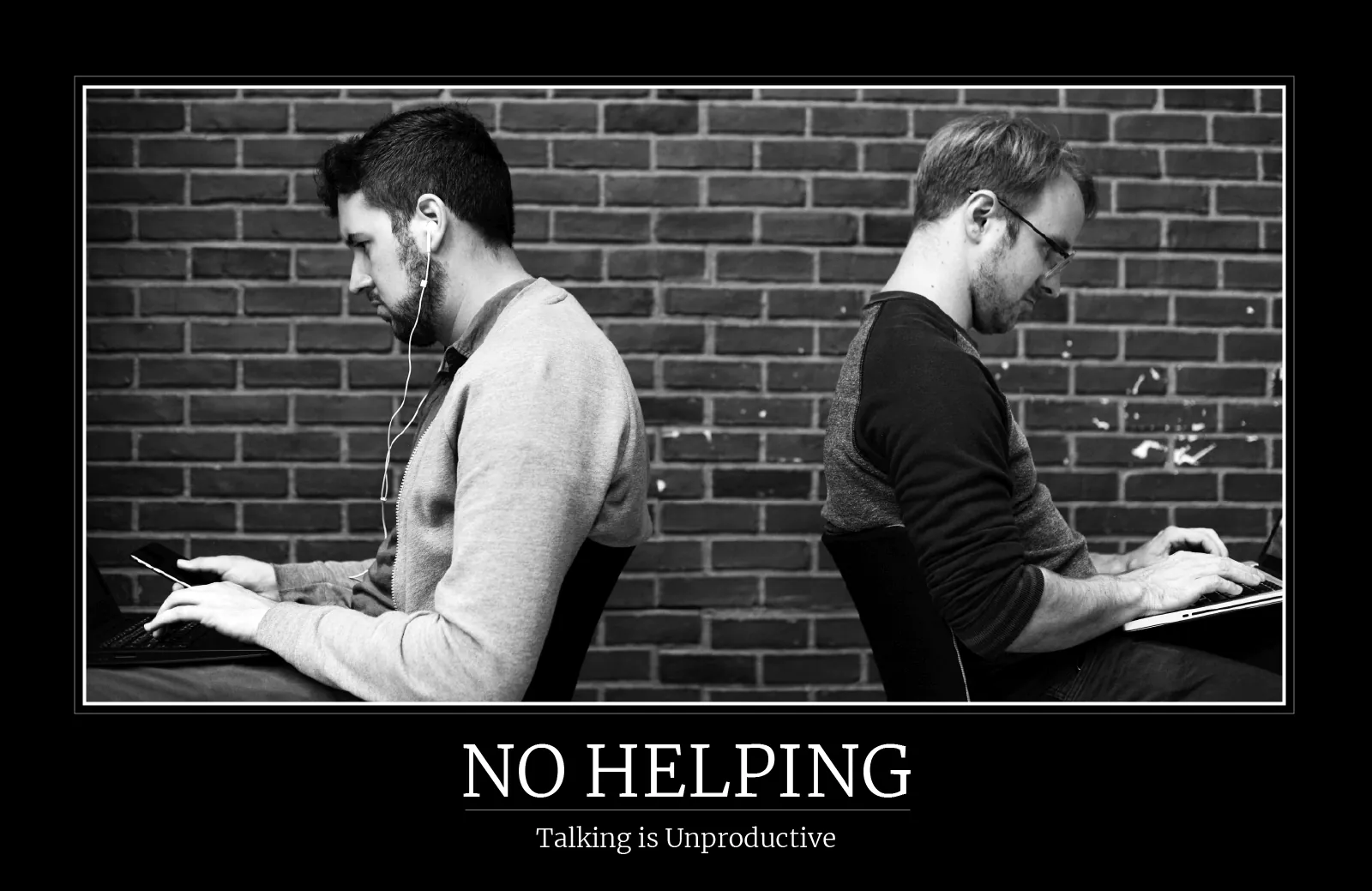
Unfortunately, interruptions are more prevalent today than ever before. In addition to the old fashion way of getting up from our desks and actually asking for help in person, we can send someone an email, a text, a slack, or even blast a whole bunch of people at once through any of those channels.
This puts us in a pickle. If we know we're going to need help throughout our creative endeavors, how in the heck do we actually get it without causing our team to be less productive and more stressed out?
The first step is awareness. Everyone in our organizations needs to understand just how dangerous a quick question from a co-worker can be. Once we accept that constantly interrupting others hurts the team's productivity we can operate within a set of principles for determining how to get help.
How Technology Can Reduce Interruption Dependency
Before diving into the principles for asking for help, it's worth considering how the right tools can eliminate many interruptions entirely. Over 3 million apps have been created on Adalo, with teams building everything from internal knowledge bases to self-service request systems that answer questions before they become interruptions.
Ada, Adalo's AI builder, lets you describe what you want and generates your app. Magic Start creates complete app foundations from a description, while Magic Add adds features through natural language.
The platform's visual builder has been described as "as easy as PowerPoint," meaning non-technical team members can create their own solutions without pulling developers away from critical work. Magic Start generates complete app foundations from simple descriptions—tell it you need an employee onboarding app, and it creates your database structure, screens, and user flows automatically. What used to require multiple meetings and developer time happens in minutes.
With unlimited database records on paid plans and no usage-based charges, teams can build comprehensive internal tools without worrying about hitting limits or surprise bills. This predictable pricing model—starting at $36/month—means you can scale your internal apps as your organization grows.
Principle #1: Get your priorities in order.
There are going to be times when the task at hand is both urgent and important. And in these cases asking for help as soon as you get stuck makes sense. But chances are what you need help with doesn't immediately need to get answered. The problem is that as soon as we get stuck we have a natural urge to want help regardless of how important the task is.
This is why understanding priorities is crucial. If we're stuck on a task that isn't both urgent and important we should ask ourselves what else can we do to help move the overall project forward. If there's something of similar importance to what we're stuck on then we should start working on that while we wait for someone else to be free to help us.
Consider building a simple priority matrix app that helps team members self-assess whether their question truly requires immediate attention. Magic Add lets you add features by describing what you want—"add a priority scoring system based on urgency and importance"—and the AI handles the implementation details.
Principle #2: Google first, ask questions later.
There's a reason why Google is valued at $132.1 Billion and why 'google' is officially a word in the dictionary: it's really helpful. Chances are the answers to our questions can be found online. Yes, it might take a little bit of searching around and yes, we've all watched some horrible instructional YouTube Videos before, but in the end, googling delivers results. And oftentimes these results are better than anyone in our office could provide; there are a lot of people with a lot of expertise online.
With that being said, there are definitely situations where getting help internally is the only option. For example, if you need help with an internal process or you need feedback on your design, googling for an answer won't really help. In these cases, it's totally fine to ask for help. The point is that if we can google for an answer in under 25 minutes, that we'll have actually saved the organization time.
Here's where internal tools become invaluable: a searchable knowledge base app can make "googling internally" just as effective as searching the web. Teams using Adalo have built process documentation apps, FAQ systems, and searchable decision guides that capture institutional knowledge. When someone has a question about an internal process, they can find the answer themselves instead of interrupting a colleague.
Principle #3: Timing is everything.
So you've determined you need to ask for help, either because it's something Google can't answer or you've tried for a while and couldn't find what you needed, now what? This is where timing is key. The main reason interruptions cost us 25 minutes is because when someone is interrupted they are no longer in a state of "flow."
Mihaly Csikszentmihalyi, an expert on creativity, preaches about the importance of being in the zone and how we're far more productive when all of our mental power is devoted to just that task. But as soon as we're interrupted, it's over. So in order to reduce the chance of interrupting someone from their flow state the timing of when we ask for help is crucial.
If they're just getting back from lunch, or out of another meeting we know that they're not in a state of flow. These are the perfect times for asking for help.
Some teams have built simple "availability status" apps that let colleagues signal when they're in deep work versus open to questions. With Adalo's modular infrastructure that scales to serve apps with millions of MAU, even company-wide tools maintain performance regardless of how many people are checking statuses throughout the day.
Principle #4: Ask in person.
As much as I love technology, I'm a huge advocate for using the old-fashioned method of getting up from your desk and asking for help. It's tough to know whether a person is stressed or hard at work on another task without seeing them with our own two eyes. When we force ourselves to get up and ask for help we're able to pick up on hidden emotional cues that are undetectable online.
Knowing whether your coworker is stressed or busy is helpful for figuring out if you should even ask them for help or move on to get help from someone else. One additional benefit to this method is that it acts as a double confirmation. The added effort it takes to stand up and walk over to someone else's desk forces us to question whether we really need the help right now or whether it could wait.
For remote and hybrid teams, this principle needs adaptation. Video calls can capture some of those emotional cues, but they still create interruptions. A better approach: build asynchronous help request systems where questions queue up for when colleagues are available, rather than demanding immediate attention.
A Cautionary Tale
During the process of writing this article, I found myself back in my typical work routine. I was stuck and in need of help. So what did I do? Well, I completely forgot everything I just talked about and immediately asked for help.
Admittedly, this is tough. Those natural urges to get help as soon as we're stuck are fierce. But the stakes are high. The dangers of interrupting our teammates is even more fierce. 16 hours lost per person per week is a whole lot of time. Not to mention all of the added stress.
Ashamed and feeling like a hypocrite, I put together a decision tree to help me determine how and when I should ask for help. It's based on the four principles of understanding your priorities, googling when you can, interrupting at the right time, and making sure we get up to ask for help in person.
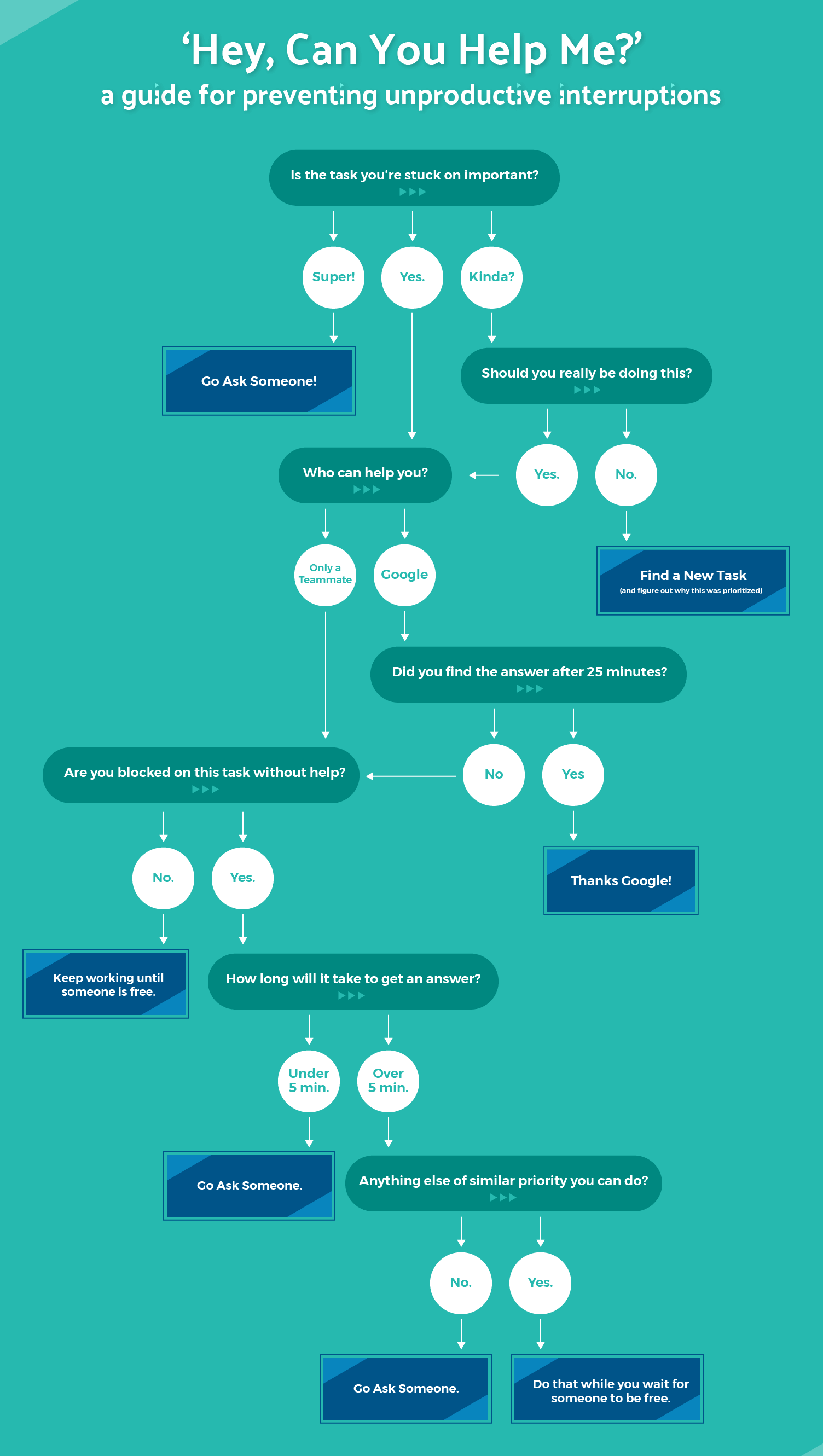
I'm hopeful this decision tree will help my teammates and I be more productive, and I'm hopeful it will help you as well. Our organizations should be amazing places full of laughter and collaboration. So the takeaway from this article shouldn't be 'everyone shut up and work'. It should be that we need to be mindful when asking for help. We should see if we can solve the problem first and then find the right time to ask our colleagues for help.
Building a Culture of Self-Service
The most effective way to reduce interruptions isn't just changing individual behavior—it's creating systems that make self-service the path of least resistance. When finding an answer independently is easier than asking someone, people naturally choose the faster option.
This is where purpose-built internal tools shine. Unlike generic solutions that require workarounds, custom apps built for your specific workflows address exactly the questions your team asks most often. X-Ray, Adalo's performance analysis feature, identifies potential issues before they affect users—meaning your internal tools stay fast and reliable as usage grows.
The key is starting small. Build an app that answers the five most common questions your team asks. Track usage. Expand based on what people actually need. With no data caps on paid plans and apps that are 3-4x faster following the Adalo 3.0 infrastructure overhaul, you can iterate quickly without worrying about technical constraints.
One build publishes to web, iOS, and Android simultaneously—so whether your team prefers desktop browsers or mobile apps, they can access the same tools. This cross-platform capability means you're not maintaining separate systems or forcing people to use devices they don't prefer.
Key Takeaways
- Interruptions cost 25 minutes per occurrence regardless of whether they're related to current work—awareness is the first step to reducing them
- The four principles—prioritize, Google first, time it right, ask in person—provide a framework for getting help without destroying team productivity
- Self-service tools eliminate interruptions entirely by making answers available before questions need to be asked
FAQ
Why choose Adalo over other app building solutions?
Adalo is an AI-powered app builder that creates true native iOS and Android apps alongside web apps. Unlike web wrappers, it compiles to native code and publishes directly to both the Apple App Store and Google Play Store from a single codebase. With unlimited database records on paid plans starting at $36/month and no usage-based charges, it offers predictable pricing as your apps scale.
What's the fastest way to build and publish an app to the App Store?
Adalo's drag-and-drop interface and AI-assisted building let you go from idea to published app in days rather than months. Magic Start generates complete app foundations from descriptions, and Adalo handles the complex App Store submission process—so you can focus on features and user experience instead of wrestling with certificates and provisioning profiles.
Can I easily reduce workplace interruptions and improve team productivity with an app?
Yes, with Adalo you can create custom internal tools and apps that help teams find answers independently without interrupting colleagues. Build knowledge bases, process guides, or self-service request systems that reduce the 25+ minutes lost per interruption mentioned in productivity research.
How much productivity is lost due to workplace interruptions?
According to research by David Meyer, Ph.D., task-switching can cost up to 40% of productive time—that's 16 hours per person per week. Additionally, Gloria Mark's research found that even brief interruptions add 25 minutes to complete the original task, regardless of whether the interruption is related to the work being done.
What are the four principles for asking for help without hurting team productivity?
The four principles are: 1) Get your priorities in order—only interrupt immediately for urgent and important tasks, 2) Google first, ask questions later—search online before asking colleagues, 3) Timing is everything—wait until someone is between tasks or returning from a break, and 4) Ask in person—this lets you read emotional cues and confirms you really need help right now.
How can app builders help reduce team interruptions?
AI-powered platforms like Adalo allow teams to build and iterate on their own tools without constantly needing developer assistance. When employees can create custom apps, databases, and workflows independently, they reclaim lost hours and reduce the stress of constant task-switching that comes from waiting on technical help.
What types of internal tools can reduce workplace interruptions?
Searchable knowledge bases, FAQ systems, process documentation apps, priority matrix tools, availability status boards, and asynchronous help request queues all reduce interruptions. These tools make finding answers independently faster than asking colleagues, naturally shifting behavior toward self-service.
How much does it cost to build internal productivity apps?
Adalo's paid plans start at $36/month with unlimited database records and no usage-based charges. This compares favorably to alternatives like Bubble (starting at $59/month with usage limits and record caps) or Glide ($60/month with data row limits and no app store publishing).