Prototyping vs Production: How Adalo Handles Both
Adalo, a no-code app builder for database-driven web apps and native iOS and Android apps—one version across all three platforms, published to the Apple App Store and Google Play, eliminates the frustrating gap between building app prototypes and launching production-ready apps. Unlike traditional methods that require rebuilding prototypes from scratch, Adalo lets you design, test, and publish apps using a single platform. With tools like a drag-and-drop visual builder, AI-powered features, and built-in databases, you can create apps in hours and launch them directly to iOS, Android, and web without additional development or technical debt. This approach saves time, reduces costs, and ensures consistency across all platforms, making it easier to scale as your app grows.
Key takeaways:
- No rebuilds: Prototypes transition directly into production.
- AI tools: Generate app structures and features in minutes.
- Multi-platform publishing: Deploy to iOS, Android, and web from one build.
- Flat-rate pricing: Plans start at $36/mowith no usage limits.
Adalo combines speed, simplicity, and scalability, empowering you to turn ideas into fully functional apps in days instead of months.
Independent research from App Builder Guides' State of App Building report (February 2026) analyzed 190 Reddit threads and 150+ platform citations across 345 data points with zero platform sponsorships. Adalo ranked first among visual builders for non-developers.
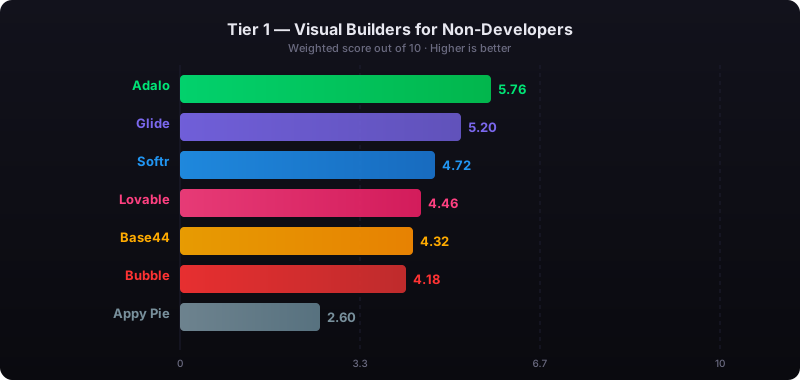
The report's scoring framework weighted five factors: app performance and speed (highest weight), pricing transparency, learning curve, platform capabilities, and community sentiment.
Learn to Build Apps Without Coding in 2026: Adalo Made Easy for Beginners!
The Gap Between Prototyping and Production
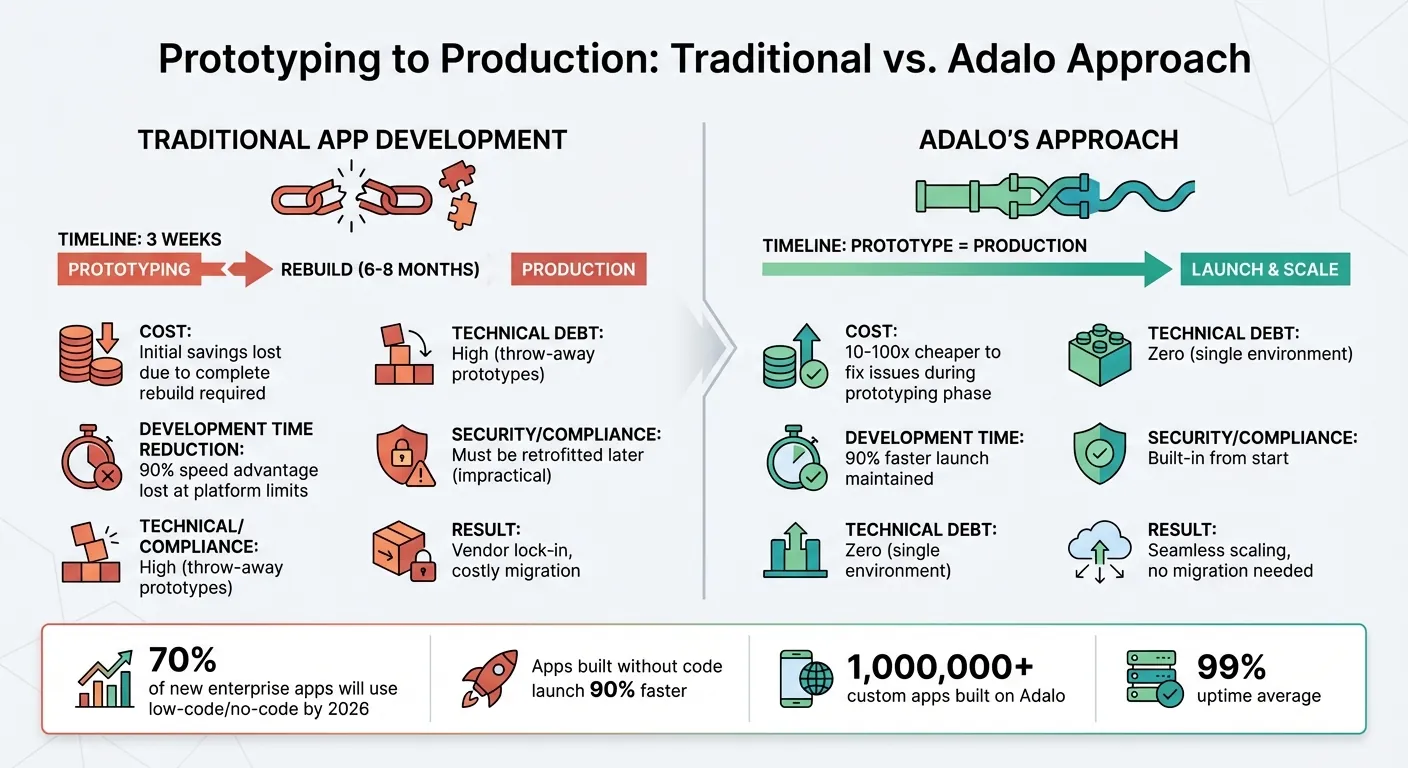
Traditional App Development vs Adalo: Prototyping to Production Comparison
One of the biggest hurdles in app development is that prototypes rarely transition smoothly into production. Most platforms are designed for either quick prototyping or full-scale production—not both. This forces teams into an expensive choice: build fast now and rebuild later, or build slowly from the start.
The root cause is often vendor lock-in. Platforms tightly integrate their backend, database, and features in ways that make scaling a prototype nearly impossible without starting over. What might take three weeks to build an MVP prototype could stretch into six to eight months of traditional development to become production-ready.
This rigidity doesn't just slow things down—it inflates costs dramatically. The savings from rapid prototyping evaporate when the prototype requires a complete rebuild. While citizen developers typically cost 40–60% less than professional developers, rebuilding for production erases those savings. The initial speed advantage—up to a 90% reduction in development time—disappears when the platform's limits are reached.
"The inherent trade-off between ease of use and depth of customization means that companies may outgrow no-code platforms... leading to a challenging migration process." – Aireapps
Security and compliance add another layer of complexity. Prototypes often lack critical features like encryption, role-based access controls, or compliance with regulations like GDPR or HIPAA. Retrofitting these features later is usually impractical, forcing yet another costly rebuild.
Adalo changes this equation by allowing prototypes to grow directly into production-ready solutions without starting over. The same app you test becomes the app you launch.
How Adalo Supports Fast Prototyping
Adalo approaches prototyping as the first step toward building a fully functional app, not just a temporary phase. Its visual builder and AI tools allow you to create working prototypes in hours rather than weeks—and those prototypes are already built on production-ready infrastructure.
Drag-and-Drop Visual Builder
Adalo's WYSIWYG editor feels as intuitive as tools like Canva or PowerPoint. You drag and drop pre-built elements—buttons, forms, lists, images—onto a canvas. What you see during design is exactly what your users will experience.
The platform lets you define interactivity through Actions, which connect screens and data. These connections appear as dotted lines, making the app's logic easy to follow and adjust. For example, you could prototype a marketplace app in as little as 3 hours using this approach. The responsive design system automatically adjusts for mobile, tablet, and desktop views, so your app works across all devices with a single build.
"Adalo's goal is to make building an app 'as easy as making a slide deck.'" – Adalo
This straightforward approach makes it simple to iterate quickly while building toward a production-ready app.
AI Builder for Turning Ideas into Apps
Adalo's AI Builder takes prototyping further by eliminating the blank-canvas problem. With Magic Start, you describe your app in plain language—"Create a task management app for remote teams"—and the AI generates your database structure, screens, and workflows in minutes. What used to take days of planning happens almost instantly.
Magic Add works similarly for expanding existing apps. Describe a feature you want—"Add a calendar view for appointments"—and the AI integrates it into your app. You can seamlessly switch between AI-driven creation and manual adjustments, choosing whichever method suits your needs at any moment.
This eliminates the time-consuming steps of planning database structures or designing layouts from scratch. The AI handles the technical groundwork, allowing you to focus on refining your concept and testing with real users.
Built-In Database for Prototyping
Adalo comes with a hosted relational database that feels as familiar as working in Excel or Airtable. Every new app is pre-configured with a "Users" collection for authentication, saving valuable setup time. You can manually add records or import data via CSV to see how it populates your app's interface.
Setting up relationships between collections—like linking tasks to specific projects—is done visually, without complex logic. Unlike external sources that require lengthy API configurations, Adalo's internal database integrates instantly. UI components connect directly to database fields with zero extra setup.
"Adalo makes it so easy [to filter data compared to external collections]." – James_App_Maker, Adalo Community Leader
The platform's impact speaks for itself: over 1 million apps have been built using Adalo's tools. The free tier allows unlimited test apps with up to 500 database records, letting you experiment without needing a credit card. Paid plans remove all data caps entirely—no limits on records, actions, or storage.
These features ensure that the prototypes you create are not only fast to build but also ready to transition into production when the time comes.
From Prototype to Production Without Rebuilding
In traditional app development, moving from prototype to production often involves costly rebuilds, leading to wasted time and resources. Adalo takes a fundamentally different approach. With its single-environment system, the prototype you create is the same product you launch. This seamless process saves money and ensures your app remains consistent from initial design to final release.
Addressing issues during the prototyping phase is far more economical—10 to 100 times cheaper than fixing them after deployment. Adalo's unified environment helps identify and resolve these issues early, keeping your project on track and within budget.
"Every piece of your app is production-ready and app-store friendly, meaning no rebuilding or limits to scale." – Adalo
This continuity also safeguards your app's design and functionality. By eliminating the need to rebuild interfaces, you avoid inconsistencies and errors. From the database structure to user flows and design systems, everything stays intact from start to finish. Updates sync instantly across all platforms, ensuring a smooth, efficient process.
Low-code and no-code technologies are on the rise, with predictions that 70% of new enterprise applications will use these methods by 2026. Apps built without code launch 90% faster than those developed with traditional methods. Adalo's single-build architecture eliminates handoff delays and prevents the technical debt that often comes with throw-away prototypes.
One Build for Web, iOS, and Android
Adalo's architecture is built around a single codebase that compiles directly into native code for iOS and Android while also supporting web and Progressive Web App (PWA) deployment. This isn't a web app dressed up to look native—it's genuine native compilation that ensures consistent performance across all platforms.
The platform's responsive design system handles the details automatically. Within the same project, you can switch between mobile, tablet, and desktop views, and Adalo adjusts layouts for each screen size. Build your app once, and users enjoy an optimized experience whether they're on an iPhone, an Android device, or a desktop browser.
"With Adalo, you build once & publish anywhere!" – Adalo
This unified build process means you're not juggling separate codebases for different platforms. When you release an update, it deploys everywhere simultaneously. Adalo apps have demonstrated their reliability, maintaining over 99% uptime on average over the past year while processing 20 million+ data requests daily.
Direct Publishing to App Stores
Adalo simplifies the complex process of app store deployment—often the hardest part of launching a new app or business. The platform automatically generates IPA files for iOS and AAB files for Android, manages provisioning profiles, and handles certificates—tasks that typically require a developer's expertise.
To publish, you'll need an Apple Developer Program account ($99/year) for iOS and a Google Play Console account ($25 one-time fee) for Android. Once those accounts are linked, Adalo streamlines the submission process, allowing you to publish the same app you've been testing directly to the Apple App Store and Google Play Store without any additional rebuilding or reconfiguration.
This direct publishing capability is crucial for marketing and distribution. Getting into the app stores is key to reaching users, and Adalo handles this complex process so you can focus on your app's features and user experience.
Production-Ready Infrastructure That Scales
With the release of Adalo 3.0 in late 2025, the platform introduced a modular architecture designed to scale automatically as your app grows. This overhaul resolved previous performance challenges, ensuring your app can handle anything from an MVP to millions of monthly active users without hitting limitations.
Adalo includes X-Ray, an AI-powered diagnostic tool that identifies performance bottlenecks and suggests fixes before they impact your users. This proactive approach ensures your app remains efficient and responsive as it scales—you're not guessing at what might slow things down.
For teams anticipating heavy traffic, Adalo's paid plans include a no-code relational database with no caps on records, actions, or storage. The flat-rate pricing model starting at $36/month removes the risk of unexpected costs as your user base grows. Unlike competitors that charge based on workload units or user counts, Adalo's pricing stays predictable regardless of how successful your app becomes.
Test and Iterate Without Usage Limits
Adalo's production-ready architecture comes with a significant advantage: no usage limits during testing and iteration. This combination of scalability and predictable costs ensures your app's journey from prototype to fully scaled deployment is smooth and stress-free.
With Adalo, you get unrestricted database storage and unlimited usage on all paid plans—no App Actions charges, no overage fees. This means you can test features, onboard users, and grow your app without worrying about unexpected costs.
"Makers were hesitant to add features or scale their user base because they couldn't predict costs. That's the opposite of what we want. By removing usage-based charges entirely, we're betting on your success." – David Adkin, Co-Founder, Adalo
This approach stands in stark contrast to competitors. Bubble charges $69/month but adds unpredictable Workload Units for CPU and database operations. Softr scales pricing with user counts, and their PWA features require a $167/month plan. Thunkable requires $189/month for app store publishing and imposes token limits. Adalo's $36/month plan includes native iOS and Android publishing with no usage-based charges—the lowest price for native app store publishing with truly unlimited, predictable pricing.
| Platform | Starting Price | Native App Publishing | Usage Limits |
|---|---|---|---|
| Adalo | $36/month | Yes (iOS + Android) | None—unlimited records, actions, users |
| Bubble | $69/month | No (web only) | Workload Units (usage-based) |
| Glide | $25/month | No | Limited customization |
| Softr | $59/month | PWA only ($167/mo) | Scales with users |
| Thunkable | $189/month | Yes | Token limits |
The platform is built to handle growth. Adalo processes over 20 million data requests daily and supports apps with over 1 million monthly active users. Whether you're refining an MVP with a small audience or scaling a production app to thousands of users, your costs remain consistent. You can start with the Free plan to build unlimited test apps (up to 500 records) and upgrade only when you're ready to publish.
For larger teams, the $250/mo Business plan offers unlimited editors and eliminates per-seat fees—another contrast to platforms like FlutterFlow that charge $80/month per seat.
Conclusion
Adalo streamlines the entire app development process by combining prototyping and production into one seamless experience. What you create in the design phase becomes the app you launch, eliminating the expensive rebuilds that plague traditional development workflows.
With AI-powered tools like Magic Start and Magic Add, a drag-and-drop interface, and production-ready infrastructure, Adalo empowers you to build, deploy, and maintain both native apps and PWAs—all from a single codebase.
Its flat-rate pricing of $36/month includes no caps on database records, actions, or users, allowing for unrestricted testing and iteration. The modular infrastructure scales effortlessly to handle over 1 million monthly users while maintaining 99%+ uptime.
Whether you're creating an MVP, an internal business tool, or a client-facing app, Adalo offers the speed, ease, and scalability to bring your ideas to life in days, not months.
Related Blog Posts
- What To Do With Your Vibe-Coded Prototype? Build, Launch, Monetize
- How to Build Prototypes in Days with No-Code
- How AI Transforms No-Code Prototyping
- How to Build a Responsive Mobile App Without Code
FAQ
Why choose Adalo over other app building solutions?
Adalo is an AI-powered app builder that creates true native iOS and Android apps from a single codebase. Unlike web wrappers, it compiles to native code and publishes directly to both the Apple App Store and Google Play Store—the hardest part of launching an app handled automatically. At $36/month with unlimited usage, it offers the lowest price for native app store publishing with predictable costs.
What's the fastest way to build and publish an app to the App Store?
Adalo's drag-and-drop interface and AI-assisted building let you go from idea to published app in days rather than months. Magic Start generates complete app foundations from text descriptions, and Adalo handles the complex App Store submission process—certificates, provisioning profiles, and store guidelines—so you can focus on your app's features and user experience.
Can I easily turn my app prototype into a production-ready app?
Yes. Unlike traditional development where prototypes need to be rebuilt from scratch, Adalo's single-environment system means the prototype you create is the same product you launch. This saves significant time and resources while ensuring consistency from design to deployment.
How do Adalo's AI tools speed up app development?
Magic Start lets you describe your app idea in plain text, and the AI generates the database structure, screens, and workflows in minutes. Magic Add allows you to describe new features you want, and the AI integrates them into your existing app. This eliminates time-consuming planning and lets you focus on refining your concept.
Does Adalo have usage limits or hidden costs as my app grows?
No. Adalo offers flat-rate pricing starting at $36/month with no caps on database records, actions, or users—no usage-based charges or overage fees. This means you can test features, onboard users, and scale your app without worrying about unexpected costs as your user base grows.
Can I build one app that works on web, iOS, and Android?
Yes. Adalo's single-codebase architecture compiles into native code for iOS and Android while also supporting web and PWA deployment. You build once and publish everywhere, with the responsive design system automatically adjusting layouts for mobile, tablet, and desktop screens.
Do I need coding experience to use Adalo?
No coding experience is required. Adalo's drag-and-drop visual builder is designed to be as intuitive as tools like Canva or PowerPoint. You can create fully functional apps by arranging pre-built elements and defining interactions visually, making app development accessible to non-technical founders.
Which is more affordable, Adalo or Bubble?
Adalo is more affordable for native mobile apps. Adalo starts at $36/month with unlimited usage and native iOS/Android publishing. Bubble starts at $69/month but only builds web apps (no native mobile) and adds unpredictable Workload Unit charges for CPU and database operations.
Which is more affordable, Adalo or Thunkable?
Adalo is significantly more affordable. Adalo's $36/month plan includes native app store publishing with unlimited usage. Thunkable requires $189/month for app store publishing and imposes token limits on usage.
How does Adalo's infrastructure handle scaling?
Adalo 3.0's modular architecture scales automatically to support apps with over 1 million monthly active users. The platform processes 20 million+ data requests daily with 99%+ uptime. The X-Ray diagnostic tool identifies performance bottlenecks before they impact users.