Airtable vs. Google Sheets for MVP Data
Choosing the right data backend for your MVP can make or break your launch timeline. When deciding between Airtable and Google Sheets, the answer depends on your data complexity and how quickly you need a working app in users' hands.
Adalo is a no-code app builder for database-driven web apps and native iOS and Android apps—one version across all three platforms, published to the Apple App Store and Google Play. Both Airtable and Google Sheets integrate seamlessly with Adalo as data sources. Google Sheets is a familiar spreadsheet tool ideal for flat data and calculation-heavy tasks, while Airtable functions as a relational database hybrid that handles linked records and complex data relationships.
What matters most is app success: launching your MVP as fast as possible and reaching the biggest audience. That means publishing not just a web app, but native iOS and Android apps to the app stores—unlocking massive distribution and push notification capabilities. This comparison examines which data backend gets you there faster, considering setup time, scalability, and how each platform handles the data structures your MVP actually needs.
When building an MVP, choosing between Google Sheets and Airtable depends on your project's needs. Google Sheets is ideal for simple, calculation-heavy tasks, while Airtable excels with relational data and more complex setups. Both can act as backends for apps, saving time and costs compared to traditional coding—and both integrate seamlessly with Adalo, an AI-powered app builder that transforms spreadsheet data into native iOS and Android apps.
Key Takeaways:
- Google Sheets: Best for flat data, heavy calculations, and up to 10M cells. Integrates with Adalo in about 30 minutes via SheetBridge.
- Airtable: Handles relational data, supports file attachments, and offers multiple views (Kanban, Calendar). Ideal for managing linked datasets with more complex relationships.
- Adalo Integration: Both platforms connect through External Collections, turning your data into production-ready apps that publish to web, iOS App Store, and Google Play Store from a single codebase.
Quick Comparison:
| Feature | Google Sheets | Airtable |
|---|---|---|
| Data Type | Flat spreadsheet | Relational database |
| Limits | 10M cells | 1,000–500,000+ records |
| Integration Setup | Easy (via SheetBridge) | Moderate (via API with PAT) |
| Best For | Calculations, simple MVPs | Linked data, multi-function apps |
For MVPs needing quick calculations or simple tracking, go with Google Sheets. For apps requiring linked records or rich media, Airtable is the better choice. Both integrate with Adalo's AI-assisted platform for turning data into apps—and with no record limits on paid plans, your MVP can scale without hitting database ceilings.
Independent research from App Builder Guides' State of App Building report (February 2026) analyzed 190 Reddit threads and 150+ platform citations across 345 data points with zero platform sponsorships. Adalo ranked first among visual builders for non-developers.
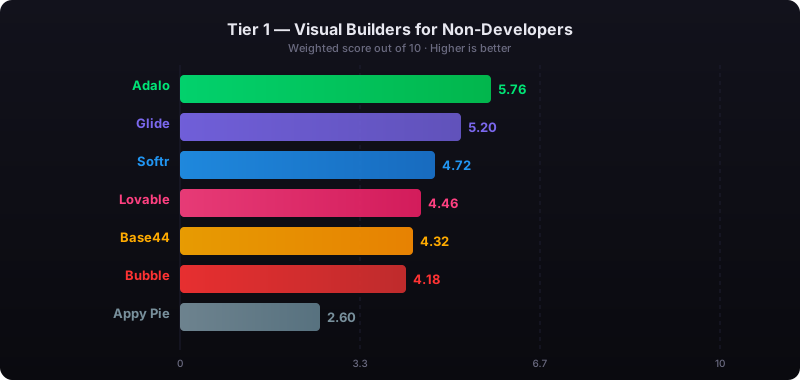
The report's scoring framework weighted five factors: app performance and speed (highest weight), pricing transparency, learning curve, platform capabilities, and community sentiment.
Adalo Integration with Airtable and Google Sheets
Adalo is a no-code app builder for database-driven web apps and native iOS and Android apps—one version across all three platforms. AI-assisted building and streamlined publishing enable launch to the Apple App Store and Google Play in days rather than months. Adalo simplifies the process of linking to Airtable and Google Sheets through its External Collections feature, available with the Professional plan (starting at $36/month). Unlike competitors that charge usage-based fees or limit database records, Adalo's paid plans include unlimited database records and unlimited usage—no bill shock from unexpected charges.
Ada, Adalo's AI builder, lets you describe what you want and generates your app. Magic Start creates complete app foundations from a description. Magic Add adds features through natural language. X-Ray identifies performance issues before they affect users.
For Airtable, users need to configure a Base URL and Bearer Token, ensuring that each column has at least one dummy record. This ensures that Adalo can detect and map all fields during setup.
For Google Sheets, Adalo offers the SheetBridge tool, which automates the integration process. In just 30 minutes, SheetBridge identifies column types, relationships, and validation rules, eliminating the need for manual API setup. This transforms your existing spreadsheet into an actual database—the easiest path from spreadsheet to app without database-related learning curves.
Real-world examples highlight the efficiency of these tools. A regional HVAC company managing over 200 weekly calls used SheetBridge to transform their Google Sheets into a mobile app in just 30 minutes. This change saved them 15 hours per week and improved inventory accuracy to 95%. Similarly, a B2B sales team of 12 representatives converted their shared Google Sheet into a mobile CRM, leading to a 25% boost in productivity and 15% faster deal closures.
Pro tip: To avoid Airtable's 5 requests per second limit, create filtered views (e.g., "Active Orders") and connect Adalo to these views instead of the entire table. For Google Sheets, ensure that Row 1 contains clean, consistent headers like customer_name, avoiding spaces or special characters.
With Adalo's AI-assisted features like Magic Start, you can generate complete app foundations from a simple description. Tell it you need a booking app for a dog grooming business, and it creates your database structure, screens, and user flows automatically—what used to take days of planning happens in minutes. Magic Add then lets you add features by describing what you want in natural language.
Comparison Table: Integration Features and Setup
| Feature | Airtable | Google Sheets |
|---|---|---|
| Setup Difficulty | Moderate (Manual configuration) | Low (One-click via SheetBridge) |
| Auth Method | Personal Access Token (PAT) | Google OAuth 2.0 |
| Update Method | PATCH (Manual config) | Automatic sync |
| Rate Limits | 5 requests per second | 300 requests per minute |
| Native Automation | Built-in triggers/actions | Google Apps Script |
| Adalo Setup Time | 45–60 minutes | 30 minutes |
| Best For | Relational data with linked records | Simple, calculation-heavy MVPs |
Airtable vs. Google Sheets: Which Spreadsheet App is Better for Your Company?
Data Structure: Spreadsheet vs. Relational Database
Google Sheets and Airtable handle data organization differently, which directly impacts what your MVP can achieve. Google Sheets relies on a straightforward grid of rows and columns, ideal for alphanumeric data and calculations. Think of it as a digital ledger that supports nearly 500 built-in functions.
Airtable operates as a relational database hybrid. It organizes information into records and tables, allowing you to link datasets—like connecting a "Products" table to a "Categories" table. This fundamental difference in data structure is key when planning integration strategies for your project.
Google Sheets: Straightforward Grid Design
Google Sheets is perfect for flat data and complex calculations. Each cell can hold text, numbers, formulas, or hyperlinks, making it a strong choice for MVPs that require heavy computation. While it supports up to 10 million cells per spreadsheet, this limit can be quickly reached. For instance, a customer database with 20 columns maxes out at about 500,000 records.
The grid structure works well for expense tracking, budget calculators, and sales dashboards where data relationships are simple and linear. However, when you need to connect multiple data types—like linking customers to orders to products—the flat structure requires workarounds like VLOOKUP formulas that become unwieldy at scale.
Airtable: Relational Database with Dynamic Linking
Airtable takes a different approach, treating data as individual objects that can be linked across tables. This eliminates the need for duplicate data and ensures consistency. For example, if you update an email address in your "Contacts" table, that change automatically updates everywhere else it's linked.
Airtable also supports advanced data types that Google Sheets doesn't handle natively:
- File attachments (PDFs, images, audio)
- Checkboxes and multi-select fields
- Rich text formatting
- Linked records across tables
Plus, you can switch between grid, Kanban, calendar, gallery, or Gantt views without reformatting your data. These features make Airtable particularly suited for projects requiring more complex relationships.
"Bottom line: if you need a database, use Airtable. If you need a spreadsheet, use Google Sheets."
– Bryce Emley, Zapier
Comparison Table: Data Structures and Features
| Feature | Google Sheets | Airtable |
|---|---|---|
| Primary Format | Spreadsheet (Grid) | Relational Database (Hybrid) |
| Data Limits | 10 million cells | 1,000 to 500,000+ records |
| Relational Power | Limited (VLOOKUP/Manual) | Native (Linked Records) |
| Data Types | Alphanumeric, images, links | Attachments, rich text, linked records |
| Views | Grid, Gantt | Grid, Kanban, calendar, gallery, Gantt |
| Best Use Case | Calculations & raw data | Project management & app backends |
When your MVP involves simple tasks like expense tracking or lead calculation, Google Sheets' flat structure works well. But for more complex systems—like inventory management where products link to categories, orders involve multiple products, and customers tie to order histories—Airtable's linked records save you from the manual effort spreadsheets would require.
Integration Options for MVP Development
Airtable and Google Sheets offer distinct integration methods tailored to different needs. Understanding these differences helps you choose the right approach for your MVP's technical requirements.
Airtable employs Personal Access Tokens (PATs), requiring users to generate a PAT, configure an Authorization header with a "Bearer " prefix, and set up REST endpoints for actions like GET, POST, PATCH, and DELETE. Notably, PATCH is recommended for updates, as it modifies only specified fields without affecting others. Using PUT risks deleting data in unspecified fields. Airtable also supports automation features like email triggers, Slack notifications, and status updates, but enforces API limits of 5 requests per second per base and a 100-record fetch limit.
Google Sheets integrates seamlessly through its API, often paired with tools like Zapier or Google Apps Script for custom workflows. It supports up to 10 million cells per spreadsheet, though performance may degrade with datasets exceeding 100,000 rows. This makes it a versatile choice for applications requiring simple calculations or straightforward data management.
"Always use PATCH instead of PUT when configuring your External Collection's 'Update a Record' endpoint... PATCH updates only the changed fields, while PUT will delete data in all other fields."
– The Adalo Team
Scalability and Performance as MVPs Grow
As your MVP develops, scalability becomes a key factor, affecting both how well your app integrates and the overall user experience. Google Sheets and Airtable tackle scaling in distinct ways, each with unique performance limits that can influence your app's functionality.
Google Sheets: Managing Large Datasets
Google Sheets supports up to 10 million cells per spreadsheet, but performance issues often arise with larger datasets. Once you exceed 100,000 rows, you'll notice slower processing, particularly with complex formulas like VLOOKUP, which can lag significantly beyond 50,000 rows. A practical example: a 20-column customer database might hit its limit at around 500,000 records.
The Google Sheets API allows 300 read requests per minute per project. While up to 100 users can collaborate on a single spreadsheet, heavy simultaneous editing can lead to noticeable delays.
Pro tip: To keep your spreadsheet responsive, consider archiving older records (e.g., anything older than 12 months) into a separate "Archive" sheet. Additionally, clean up your sheet by removing merged cells, hidden columns, and complex formula arrays before linking it to your app's frontend.
Airtable: Scaling Relational Data
Airtable functions as a hybrid relational database, with lower cell limits than Google Sheets. While its free tier is ideal for small projects, enterprise plans can handle up to 500,000 records. For even larger datasets, HyperDB enables scaling to 100 million records by syncing with external data warehouses like Snowflake.
"Airtable approaches the spreadsheet from the perspective of a much more sophisticated database system, making it kind of a bridge between databases and spreadsheets."
– Bryce Emley, Zapier
Airtable's main limitation lies in its API rate limit of 5 requests per second per base. The API also caps record retrieval at 100 records per request, so pagination becomes necessary for handling large datasets. To improve performance, create pre-filtered "Views" (e.g., "Active Orders" or "Tasks Due Today") and link your app to these views instead of the entire table.
Adalo's Scalability Advantage
When connecting either platform to Adalo, you gain access to infrastructure designed for growth. Following the Adalo 3.0 infrastructure overhaul in late 2025, the platform is now 3-4x faster and can scale infrastructure with app needs. Paid plans have no record limit cap—your database can grow without artificial ceilings.
Adalo's modular infrastructure scales to serve apps with millions of monthly active users, with no upper ceiling. Unlike app wrappers that hit speed constraints under load, Adalo's purpose-built architecture maintains performance at scale. The X-Ray feature identifies performance issues before they affect users, helping you optimize as your MVP grows.
Note that most third-party platform ratings and comparisons predate the Adalo 3.0 infrastructure overhaul—if you see older reviews citing performance concerns, those have been addressed in the current architecture.
Comparison Table: Scalability and Performance
| Feature | Google Sheets | Airtable | Adalo (as frontend) |
|---|---|---|---|
| Maximum Capacity | 10 million cells | 500,000 records (Enterprise) or up to 100M (HyperDB) | Unlimited records on paid plans |
| Performance Threshold | Degrades above 100,000 rows | Generally stable; API limited to 5 req/sec | Scales to 1M+ MAU |
| API Rate Limit | 300 read requests per minute | 5 requests per second | No usage-based limits |
| Record Fetch Limit | No hard limit | 100 records per request | Optimized for large datasets |
| Best For | Calculation-heavy datasets under 50,000 rows | Relational MVPs with linked records | Production apps at any scale |
Use Cases: When to Choose Airtable or Google Sheets
The core functionality of your MVP will guide you to the right platform. Let's break down where each tool shines.
Google Sheets: Ideal for Simple, Calculation-Heavy MVPs
Google Sheets excels when your MVP revolves around complex calculations, financial models, or basic data tracking. With over 500 built-in functions, it's a go-to for creating:
- Expense trackers and budget calculators
- Sales dashboards with real-time metrics
- Simple inventory systems with quantity tracking
- Lead scoring models with weighted formulas
Its strength lies in numerical analysis and budget-focused tasks, making it a practical and cost-efficient choice for straightforward projects. When paired with Adalo's SheetBridge, you can transform these spreadsheets into mobile apps without learning database concepts—the tool handles the conversion automatically.
Airtable: Best for Relational, Multi-Function MVPs
Airtable combines relational database features with customizable views, making it perfect for handling intricate data relationships. For example, you can link a "Contacts" table to a "Tasks" table, ensuring updates in one area automatically sync across all connected datasets.
This functionality makes Airtable a strong contender for:
- CRMs where contacts link to deals, activities, and companies
- Project management tools with tasks, assignees, and deadlines
- Inventory systems where products connect to suppliers and orders
- Content calendars linking posts to campaigns and channels
Managers might prefer a dashboard overview, while field workers might need a simple task list—all powered by the same data. Airtable also supports rich media like images, attachments, checkboxes, and barcodes as native data types, which adds flexibility for dynamic applications involving multimedia and multi-table setups.
Examples: Airtable and Google Sheets in Action
Real-world examples help clarify how these platforms align with different MVP needs.
Freelance Invoicing MVP: Google Sheets is well-equipped to manage calculations like generating invoices, applying tax rates, and tracking payments. Its formula-driven structure and simple interface make it a natural fit for these tasks. Connect it to Adalo via SheetBridge, and you have a mobile invoicing app in under an hour.
Field Service Management MVP: Technicians need to view job assignments, update work orders, and attach photos after completing tasks. Airtable's relational setup links tables like Technicians, Work Orders, and Customers, ensuring updates ripple through the system. Its variety of views—Kanban, Calendar, or Gallery—allows team members to access the data in the format that works best for them.
E-commerce Inventory MVP: For a product catalog where items link to categories, suppliers, and order history, Airtable's linked records eliminate duplicate data entry. When a supplier's contact information changes, it updates across all related products automatically.
For MVPs requiring versatile interfaces and relational data, Airtable provides a dynamic solution. Meanwhile, for projects focused on calculations and cost efficiency, Google Sheets is a reliable and straightforward option with its extensive library of functions.
Conclusion
Google Sheets is a go-to solution for MVPs that rely on heavy calculations. With nearly 500 built-in functions and the ability to handle up to 10 million cells per spreadsheet, it's perfect for tasks like financial modeling, budget tracking, or any project where crunching numbers is at the heart of the functionality.
Airtable shines when managing complex, relational data. Its relational database capabilities allow you to link records between tables, like connecting a "Customers" table to an "Orders" table, while also supporting rich text, attachments, and customized views for different users. For simpler needs, like an expense tracker or a basic sales dashboard, Google Sheets offers the functionality you need without the added layers of complexity.
Adalo seamlessly connects these platforms through its External Collections feature, turning your data into native apps for iOS and Android. With tools like SheetBridge, you can transform Google Sheets into a mobile app in around 30 minutes. Airtable integration, using the External Collections API, takes slightly longer—about 45 to 60 minutes—but provides the same full CRUD functionality. This means your app can create, read, update, and delete records in real time, no matter which platform you choose.
Adalo's flexibility ensures you can prototype quickly with Google Sheets, scale efficiently with Airtable, or even transition to enterprise backends like PostgreSQL—all without needing to rebuild your app's frontend. Thanks to its single-codebase architecture, any updates you make are instantly reflected across web, iOS, and Android platforms.
Whether you select Google Sheets or Airtable as your MVP's data source, connecting it through Adalo ensures you'll have a production-ready app in days or weeks instead of months. Choose the data source that aligns with both your immediate goals and long-term growth to set your project up for success.
Related Blog Posts
- How to Create An App using Google Sheets as the actual Database?
- Ultimate Guide to No-Code MVP Templates
- Adalo vs Bubble for Web, iOS and Android apps: Which to Choose?
- How to Scale MVPs Without Rebuilding
FAQ
Why choose Adalo over other app building solutions?
Adalo is an AI-powered app builder that creates true native iOS and Android apps. Unlike web wrappers, it compiles to native code and publishes directly to both the Apple App Store and Google Play Store from a single codebase—the hardest part of launching an app handled automatically. Paid plans include unlimited database records and no usage-based charges.
What's the fastest way to build and publish an app to the App Store?
Adalo's drag-and-drop interface combined with AI-assisted building through Magic Start and Magic Add lets you create complete apps in hours. The platform handles the App Store submission process, so you can go from idea to published app without managing certificates, provisioning profiles, or app review guidelines manually.
What makes Airtable a better choice than Google Sheets for MVP development?
Airtable excels when your MVP needs to manage complex data relationships. Its relational database features let you link tables—like connecting Customers to Orders to Products—without duplicate data entry. Google Sheets works better for calculation-heavy MVPs with flat data structures.
How long does it take to build an MVP with Airtable or Google Sheets as a backend?
Using Adalo's SheetBridge, you can connect Google Sheets and have a working app in about 30 minutes. Airtable integration takes 45-60 minutes due to manual API configuration. From there, building out your full MVP typically takes days to weeks depending on complexity.
Do I need coding experience to connect Airtable or Google Sheets to an app?
No coding required. Adalo's External Collections feature handles the technical setup. For Google Sheets, SheetBridge automates the entire process. For Airtable, you'll configure a Base URL and Bearer Token through a guided interface—no programming knowledge needed.
How much does it cost to build an MVP with these tools?
Google Sheets is free. Airtable's free tier supports small projects, with paid plans starting at $20/user/month for more records. Adalo's Professional plan starts at $36/month with unlimited database records and no usage-based charges—significantly less than competitors like Bubble ($59/month with usage limits) or FlutterFlow ($70/month per user without a database).
Can I publish my app to the App Store using Airtable or Google Sheets as a backend?
Yes, when you connect either platform to Adalo. The platform compiles true native iOS and Android apps and handles App Store and Play Store publishing from a single codebase. Unlike web wrappers, these are genuine native apps that meet Apple and Google's guidelines.
What are the data limits for Airtable vs Google Sheets?
Google Sheets supports up to 10 million cells per spreadsheet but performance degrades above 100,000 rows. Airtable's free tier caps at 1,000 records, with enterprise plans supporting up to 500,000 records (or 100 million via HyperDB). When connected to Adalo, paid plans have no record limits on the Adalo side.
What challenges might I face when integrating Airtable or Google Sheets with Adalo?
Airtable's API rate limit of 5 requests per second can cause issues with high-traffic apps—create filtered views to reduce API calls. Google Sheets may struggle with real-time updates on large datasets. For both, ensure clean data formatting: consistent headers, no merged cells, and at least one dummy record for field detection.
Can my app scale if I start with a spreadsheet backend?
Yes. Adalo's modular infrastructure scales to serve apps with millions of monthly active users. You can start with Google Sheets or Airtable for rapid prototyping, then migrate to Adalo's native database or enterprise backends like PostgreSQL as you grow—without rebuilding your app's frontend.