Top 9 Android App Builders for Easy Google Play Publishing
With over 2.5 billion monthly users on the Google Play Store, publishing your Android app opens the door to a massive audience actively searching for solutions like yours. The best part? You don't need to write a single line of code to get there.
One standout approach is using Adalo—a no-code app builder for database-driven web apps and native iOS and Android apps—one version across all three platforms, published to the Apple App Store and Google Play. This means you can build once and reach users everywhere, maximizing your distribution from day one.
The fastest path to app success starts with launching an MVP quickly and getting it into the app stores where billions of users are actively searching. Below, we break down the top 9 Android app builders to help you find the right fit for your project.
Start building with Adalo's Android app builder.
With over 2.5 billion monthly users on the Google Play Store, getting your Android app published means instant access to a massive audience ready to discover what you've built. But you don't need to write code to tap into this opportunity.
One standout approach is using Adalo—an AI-powered app builder for database-driven web apps and native iOS and Android apps. Build once and publish across all three platforms to the Apple App Store and Google Play simultaneously, maximizing your reach from day one.
The fastest path to app success starts with launching an MVP quickly and getting it into the app stores where billions of users are actively searching. Below, we break down the top 9 Android app builders to help you find the right fit for your project.
Here are the best 9 Android app builders:
- Adalo
- Andromo
- GoodBarber
- Backendless
- AppGyver Community Edition
- Bravo Studio
- Appy Pie
- Draftbit
- AppSheet
Let's start with an overview.
Independent research from App Builder Guides' State of App Building report (February 2026) analyzed 190 Reddit threads and 150+ platform citations across 345 data points with zero platform sponsorships. Adalo ranked first among visual builders for non-developers.
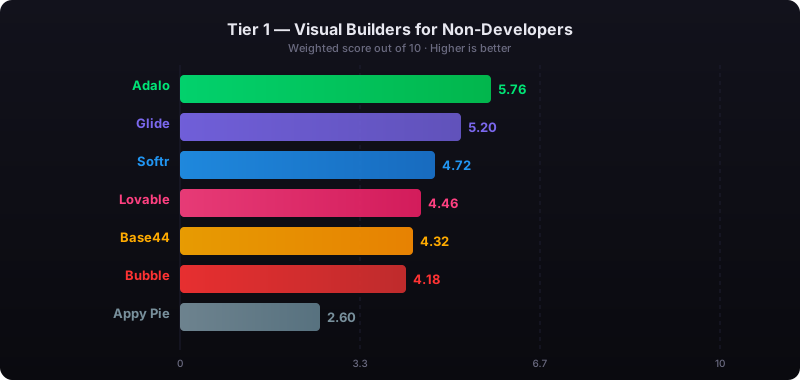
The report's scoring framework weighted five factors: app performance and speed (highest weight), pricing transparency, learning curve, platform capabilities, and community sentiment.
What is an Android App Builder?
An Android app builder is a tool for creating a native mobile app that can be published to the Google Play Store. Some non-Android app builders only publish their apps to the web, known as web apps, which limits your distribution options.
Publishing to the Google Play Store allows users to download your app directly to their phones, giving them easier access to your app through their home screen. This direct installation creates a more seamless user experience compared to web apps that require opening a browser.
When you publish your app to the Google Play Store, you can get it in front of an enormous audience with active demand for apps. This is a critical advantage for anyone who wants to popularize their app and build a sustainable user base.
What To Look For in an Android App Builder
- No-code or AI-assisted development: Modern app builders require absolutely no programming or coding skills, enabling anyone to create an app tailored to their needs. The best platforms now incorporate AI features that can generate app foundations from simple descriptions, turning what used to take weeks into hours. When you use a drag-and-drop interface, you'll move blocks around on your screen rather than writing line after line of code.
- Bustling ecosystem: A good app builder for Android will provide a thriving ecosystem full of useful resources like tutorials, help documents, a forum, and even an academy. Leveraging an ecosystem can help you learn everything about an app builder, helping you build a powerful and helpful app.
- Templates: To get your app-building kick-started, you'll be able to choose from dozens of templates, which you'll configure and customize to meet your needs. Some Android app builders don't offer templates, which makes the building process more drawn out and arduous.
- Also able to publish on the Apple App Store: If you're already publishing your native mobile app to the Google Play Store, why not get it in front of the Apple audience? Although it's a different platform with a more stringent publishing process, the Apple App Store has over 600 million monthly users. Publishing to both app stores can significantly expand your app's reach.
Now, let's go through each of the top app builders for Android so you can decide which ones you want to try first.
#1 Adalo
Overview
Adalo is a no-code app builder for database-driven web apps and native iOS and Android apps—one version across all three platforms, published to the Apple App Store and Google Play. The platform incorporates AI-powered features to streamline development. Following the Adalo 3.0 infrastructure overhaul in late 2025, the platform is now 3-4x faster and can scale infrastructure with app needs, meaning there are no record limits on paid plans.
Ada, Adalo's AI builder, lets you describe what you want and generates your app. Magic Start creates complete app foundations from a description. Magic Add adds features through natural language. X-Ray identifies performance issues before they affect users.
The platform perfectly balances ease and power, letting you spark life into nearly any app idea. With over 3 million apps created on the platform, Adalo's visual builder has been described as "easy as PowerPoint" while delivering professional-grade results.
Key Features
- Adalo's agnostic builder lets you publish the same app to the web, native iOS, and native Android, all without writing a line of code or rebuilding. AI Builder, coming in early 2026, will enable prompt-based app creation and editing for even faster development. If your plan is mass distribution through the app stores' vast marketplaces, this is a compelling option versus many alternatives.
- Magic Start generates complete app foundations from descriptions. Tell it you need a booking app for a dog grooming business, and it creates your database structure, screens, and user flows automatically—what used to take days of planning happens in minutes. Magic Add then lets you add features by simply describing what you want in natural language.
- Need to build a specialized Android app that receives data from third-party platforms like QuickBooks or Mailchimp? Adalo is packed with thousands of third-party integrations. With nearly 40 templates to choose from, you can build and customize your app's frontend, backend, and database with ease.
- X-Ray identifies performance issues before they affect users, helping you maintain app quality as you scale. The modular infrastructure scales to serve apps with 1 million+ monthly active users, with no upper ceiling.
Who It's Best For
Adalo is perfect for freelancers, entrepreneurs, and small to medium-sized businesses looking for a user-friendly yet powerful platform. Its simplicity, combined with robust features and unlimited database records on paid plans, makes it ideal for those who want to create professional Android apps without coding expertise. Whether you're building a simple app or something more complex that needs to scale, Adalo's flexibility suits a wide range of business needs.
Pricing
Adalo starts at $36/month (billed monthly) with unlimited usage and app store publishing. Unlike competitors that charge based on workload units or data records, all Adalo plans now have unlimited usage—meaning no bill shock as your app grows. Paid plans include unlimited database records and unlimited updates to published apps.
#2 Andromo
Overview
Andromo is an Android app builder that specializes in making e-commerce apps and apps that earn money through in-app purchases.
Key Features
- Andromo provides seamless integrations with Shopify and WooCommerce, letting you transfer your items for sale in these accounts into your app and streamlining your app-building process.
- For folks looking to make money from ads, Andromo might be a good choice, as it allows you to plug in three different ad types: Interstitials (pop-up ads appearing when switching screens), banners, and splash screen ads (appear when users open your app).
Who It's Best For
Those who already have an online store through Shopify and want to create a unique app for the Google Play Store, as well as those wanting to create an app that makes money through ads, should consider Andromo.
Pricing
Get started at $32/month (billed monthly), and create up to 300 app projects. If you want to monetize ads, check out the $56/month (billed monthly) version, which also provides 100GB of storage.
#3 GoodBarber
Overview
GoodBarber is an Android app builder that's great if you want to create an app to sell your content or physical products quickly.
Key Features
- For folks looking to create an app for selling their physical goods, GoodBarber has loads of useful extensions, like point-of-sale platforms like Square, and one that can connect you with local delivery companies. These make selling products and getting them to clients headache-free.
- Attention content app builders: GoodBarber comes with a WordPress integration, allowing you to streamline your WordPress content right onto your app.
Who It's Best For
Known for its relative simplicity, GoodBarber is an excellent choice for those who want to transform their online store or content blog into a native mobile Android app.
Pricing
Starting at $36/month (billed monthly), GoodBarber's content plan provides 5 extensions and client sign-in features, but you can't publish to the Google Play Store. To do this, you must opt for the $70/month (billed monthly) version.
Those looking to create apps for their online store will need to pay $50/month (billed monthly), and will get additional payment platform integrations with Stripe, Apple Pay, and a few others. But, to publish to the Google Play Store, you'll need to upgrade to the $90/month (billed monthly) plan.
#4 Backendless
Overview
Backendless is a low-code Android app builder allowing the tech-savvy to create all three parts of their app: the frontend, backend, and database.
Key Features
- Backendless's frontend builder is quite simple to understand, but its backend builder uses a scheme called Codeless, which requires knowing the logic behind the code. For techies, this powerful feature allows for loads of design and customization freedom.
Who It's Best For
If you need to customize and configure your backend, you'll be right at home with Backendless. However, you'll need to have a bit of technical and coding knowledge to leverage this platform powerfully.
Pricing
Backendless offers unique pricing plans. It starts at $15/month (billed monthly), giving you solid security features and generous storage space. You can add on unique "on-demand" features with individual prices, like 50 additional data tables for another $20/month, or an additional 10GB of storage for $20/month, and more.
#5 AppGyver Community Edition
Overview
AppGyver is an intuitive Android app builder owned by the software behemoth SAP.
Key Features
- While AppGyver doesn't include any templates, we decided to put this on our list due to its relative simplicity—it's one of those easy-to-learn app builders that provides loads of design freedom.
- For folks who work with SAP products, connecting your SAP APIs and ERP to your app will be seamless. This can help integrate your app into some of your business processes with ease.
Who It's Best For
If you're a SAP user, you should consider AppGyver, as you'll be able to integrate some of your SAP applications into your app. AppGyver is also a good platform for building a startup app because of its relative ease.
Pricing
The AppGyver Community edition is free!
#6 Bravo Studio
Overview
Bravo Studio is an Android app builder that's great for Figma designers.
Key Features
- Bravo lets you transform your Figma designs into truly unique apps, providing genuine pixel-perfect control over your design process.
- You'll get access to tons of components and integrations, like Stripe for payments, a video chat system, and many more options.
Who It's Best For
Folks who use Figma are best served with Bravo Studio. The platform has a bit of a learning curve, but once you nail it down, you'll be able to make stunningly unique apps from your Figma designs.
Pricing
Starting at $22/month (billed monthly), Bravo lets you build as many apps as you want, provided they don't exceed 30 screens. For an extra $99/month, bringing your total to $121/month (billed monthly), you'll get bolstered security features and white-label branding.
#7 Appy Pie
Overview
Appy Pie is a simple Android app builder focused on ease of use over advanced features.
Key Features
- Although it comes with very limited customization options, Appy Pie is super easy to learn and use, which makes it an option for folks looking to build a simple startup app.
Who It's Best For
Folks who don't have any need or desire to use an app builder with loads of features and just want to get a startup app on the Google Play Store will be well served with Appy Pie.
Pricing
Appy Pie's pricing starts at $36/month (billed monthly) for Google Play Store publishing with up to 500 push notifications monthly. However, to publish to the Apple App Store requires $99/month (billed monthly), which also gives you up to 2,000 push notifications. This makes it significantly more expensive than alternatives like Adalo for cross-platform publishing.
#8 Draftbit
Overview
Draftbit is a low-code Android app builder that provides tech-centric features aimed at the developer crowd.
Key Features
- Draftbit allows you to keep your app's source code, which you can further custom-develop using a programming language, share on GitHub via Draftbit's GitHub integration, or do anything you please.
- Need to get data from another platform? You can by leveraging Draftbit's powerful REST API, which lets you pull info from third-party apps, provided you have their permission.
Who It's Best For
Draftbit is tailored for developers and tech-savvy users who want full control over their app's design and functionality. It's ideal for those who value access to the app's source code and wish to customize it further using programming languages.
Pricing
Pricing for individuals starts at $29/month (billed monthly), allowing you to publish one project while also leveraging Draftbit's AI image generator. To keep your source code, go with the $79/month (billed monthly) version, which also lets you publish up to 3 projects.
Draftbit comes with agency pricing, too, starting at $129/month (billed monthly). This gives you 3 additional app-builder seats and lets you patch in your custom functionalities using code. Bigger agencies can use the $399/month (billed monthly) version, providing up to 10 workspaces and Slack support.
Don't want to build your app, but want it to be built using Draftbit? Leverage Draftbit's in-house development team with plans starting at $2,000/month (billed monthly). The Draftbit team will spend up to 8 hours per week on your project. For more involved development, the $4,000/month (billed monthly) version allows you to plan sprints and get up to 20 hours per week of development time.
#9 AppSheet
Overview
AppSheet is an Android app builder that's part of the Google ecosystem, and it's a useful tool for folks who want to create an internal business app.
Key Features
- If you're a regular user of Google tools like Drive, Sheets, and more, you'll be able to integrate your Google data into your AppSheet app with a couple of clicks.
- AppSheet features nearly 70 templates, which you'll be able to customize and configure to create an app that executes most internal business processes.
Who It's Best For
Folks who already have a database and wish to build a frontend on it for easing up CRM, lead generation, clock in/clock out, and many more internal tools might find AppSheet useful.
Pricing
At $5/month per user (billed monthly), you'll be able to capture rich data from documents, automate email sending, and more. The $10/month per user (billed monthly) includes advanced security features, like granting selective user access and on-device encryption.
Android App Builder Comparison
| Platform | Starting Price | Best For | App Store Publishing | Key Limitation |
|---|---|---|---|---|
| Adalo | $36/month | Cross-platform native apps | Both stores included | AI Builder coming early 2026 |
| Andromo | $32/month | E-commerce & ad monetization | Google Play | Limited to Android |
| GoodBarber | $70/month | Content & e-commerce | Requires upgrade | Higher cost for publishing |
| Backendless | $15/month | Technical users | Both stores | Requires coding knowledge |
| AppGyver | Free | SAP users | Both stores | No templates |
| Bravo Studio | $22/month | Figma designers | Both stores | Steep learning curve |
| Appy Pie | $36/month | Simple apps | iOS requires $99/month | Very limited customization |
| Draftbit | $29/month | Developers | Both stores | Requires technical skills |
| AppSheet | $5/user/month | Internal business apps | Both stores | Per-user pricing adds up |
How Adalo Compares to Other Popular Platforms
When evaluating Android app builders, it's worth understanding how Adalo stacks up against other platforms you might be considering.
Adalo vs. FlutterFlow
FlutterFlow is a "low-code" platform designed for technical users, not a true no-code solution. Users need to manage and set up their own external database, which requires significant learning complexity—especially when optimizing for scale, as suboptimal setup can create performance problems. This has spawned an ecosystem rich with paid experts because many users need help and end up spending significant sums chasing scalability.
FlutterFlow's builder is also limited in view, making it slow to see more than 2 screens at once, whereas Adalo can display up to 400 screens at a time on one canvas. FlutterFlow pricing starts at $70/month per user for easy app store publishing, but this still doesn't include a database—users must source, set up, and pay for that separately.
Adalo vs. Glide
Glide is heavily format-focused and restricted to set templates. This makes it fast to build and publish with, but creates generic, simplistic apps with limited creative freedom. Glide is a go-to for spreadsheet-based apps, but that still doesn't compare to the convenience of Adalo's Sheetbridge, which enables users to turn a Google Sheet into an actual database for the easiest control without database-related learning.
Glide pricing starts at $60/month to build an app with a custom domain, but it's still limited by app updates and data record rows, which attract additional charges. Glide does not support Apple App Store or Google Play Store publishing—a significant limitation for anyone wanting true native distribution.
Adalo vs. Softr
Softr pricing starts from $167/month to publish a Progressive Web App, which is still restricted by records per app and records per datasource. Softr does not support Apple App Store and Google Play Store publishing, or iOS and Android app creation. Softr is looked to for spreadsheet app building, provided the web app restrictions are met and the higher price point is acceptable.
Adalo vs. Thunkable
Thunkable offers an AI draft of an app build, but getting access to a Progressive Web App that can be published requires a $59/month plan with usage restrictions. To get to a responsive app requires a custom pricing tier beyond their advertised $189/month Advanced tier.
Next Steps
Each of our Android app builders comes with a free version. Choose 3 or 4 app builders from our list. Then, jot down the features you want to include on your app, create some wireframes (digital blueprints), and tinker around with the free versions of the Android app builders that you choose.
If you're having trouble selecting the ideal Android app builder for your purpose, we recommend you give Adalo's free trial a go. The platform's balance of power and simplicity, coupled with its thriving ecosystem of tutorials, help documents, and the Adalo App Academy, allows you to create a unique and professional-looking app that can scale with your business.
[INTERNAL LINK: How to Publish Your App to the Google Play Store] [INTERNAL LINK: Building Your First Mobile App: A Complete Guide] [INTERNAL LINK: No-Code vs Low-Code: Which Is Right for Your Project?]
FAQ
Why choose Adalo over other app building solutions?
Adalo is an AI-powered app builder that creates true native iOS and Android apps from a single codebase. Unlike web wrappers, it compiles to native code and publishes directly to both the Apple App Store and Google Play Store—the hardest part of launching an app handled automatically. With unlimited database records on paid plans and no usage-based charges, you won't face surprise bills as your app grows.
What's the fastest way to build and publish an app to the App Store?
Adalo's drag-and-drop interface and AI-assisted building let you go from idea to published app in days rather than months. Magic Start generates complete app foundations from simple descriptions, while Adalo handles the complex App Store submission process—so you can focus on features and user experience instead of certificates, provisioning profiles, and store guidelines.
Which is more affordable, Adalo or Appy Pie?
Adalo starts at $36/month with both App Store and Play Store publishing included, plus unlimited usage. Appy Pie starts at $36/month for Google Play only—Apple App Store publishing requires their $99/month plan. For cross-platform publishing, Adalo offers significantly better value.
Which is faster to build with, Adalo or FlutterFlow?
Adalo is faster for most users because it's a true no-code platform with an integrated database. FlutterFlow requires technical knowledge and forces you to set up and manage an external database separately. Adalo's canvas can display up to 400 screens at once, while FlutterFlow limits you to viewing 2 screens at a time.
Which is easier for beginners, Adalo or Glide?
Both are beginner-friendly, but they serve different needs. Glide is faster for simple spreadsheet-based apps but restricts you to templates with limited creative freedom. Adalo offers more flexibility while remaining easy to use—its visual builder has been described as "easy as PowerPoint." Adalo also publishes to app stores, which Glide cannot do.
Is Adalo better than Softr for mobile apps?
Yes, if you need native mobile apps. Softr only creates Progressive Web Apps and cannot publish to the Apple App Store or Google Play Store. Softr also starts at $167/month with record limits. Adalo creates true native apps for $36/month with unlimited database records on paid plans.
Can I publish the same app to both Android and iOS platforms?
Yes, with Adalo you build one app and publish it to both the Google Play Store and Apple App Store without rebuilding. This saves significant time and resources compared to building separate native apps for each platform, while still delivering a true native app experience to users on both Android and iOS devices.
How long does it take to build an Android app with Adalo?
Simple apps can be built in a few hours using templates and Magic Start. More complex apps typically take days to weeks depending on features. This is dramatically faster than traditional development, which often takes months. Over 3 million apps have been created on Adalo, demonstrating the platform's efficiency.
Do I need coding experience to build an Android app?
No coding experience is required with Adalo. The platform uses a drag-and-drop interface that lets you create professional apps by moving blocks around on your screen. AI features like Magic Start and Magic Add let you describe what you want in plain language, and the platform generates the necessary components.
What features should an Android app have?
Essential features depend on your app's purpose, but most successful apps include user authentication, a clean navigation system, push notifications, and integration with relevant third-party services. Adalo provides thousands of integrations with platforms like QuickBooks and Mailchimp, plus nearly 40 templates to help you identify the right features for your use case.