AppyPie vs. Bubble vs. Adalo: Which One Wins?
Independent research from App Builder Guides' State of App Building report (February 2026) analyzed 190 Reddit threads and 150+ platform citations across 345 data points with zero platform sponsorships. Adalo ranked first among visual builders for non-developers.
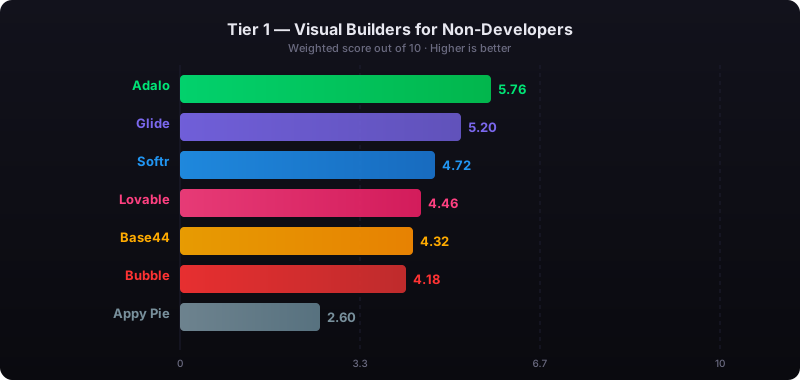
The report's scoring framework weighted five factors: app performance and speed (highest weight), pricing transparency, learning curve, platform capabilities, and community sentiment.
Appy Pie vs. Bubble vs. Adalo: Key Differences at a Glance
Choosing the right app builder determines how quickly you can launch, how much you'll pay, and whether your app can scale with success. Adalo is an AI-powered app builder that creates true native iOS and Android apps from a single codebase, publishing directly to both app stores. Bubble offers powerful web app customization but requires third-party tools for mobile. Appy Pie provides simplicity but limits your design freedom.
Ada, Adalo's AI builder, lets you describe what you want and generates your app. Magic Start creates complete app foundations from a description. Magic Add adds features through natural language. X-Ray identifies performance issues before they affect users.
Here's how these three platforms compare across the factors that matter most:
| Appy Pie | Bubble | Adalo | |
|---|---|---|---|
| Pricing (billed monthly) | $99/month for iOS publishing | $59/month (usage-based charges apply) | $36/month (unlimited usage) |
| Main Features |
• Simple building interface • Create unlimited apps • HIPAA compliance (enterprise) |
• Hundreds of plugins and templates • White-label branding at lowest tier • Powerful customization (steep learning curve) |
• AI-assisted building with Magic Start • Native iOS and Android from single codebase • Unlimited database records on paid plans For teams migrating from spreadsheet workflows, SheetBridge lets you use a Google Sheet as a relational database within Adalo, bridging familiar tools with native app capabilities. |
| Who It's Good For | Folks building quick, simple apps | Those with time to learn a complex platform | Anyone wanting powerful apps without the learning curve |
Key Similarities
- Visual building interfaces: Adalo, Bubble, and Appy Pie share one crucial similarity—you won't need coding knowledge to use them. If you can create a LinkedIn or Instagram account, you have the skills to build with these platforms.
- Ecosystems: Want to learn more about each platform? All three offer supportive ecosystems combining community forums with educational resources like videos, courses, and help documents.
- Integrations: If you need to connect data from third-party platforms like Google Drive or QuickBooks to your app, all three platforms support integrations. This flexibility enables customer service apps, marketing funnels, or restaurant delivery solutions.
Adalo
Who It's Good For
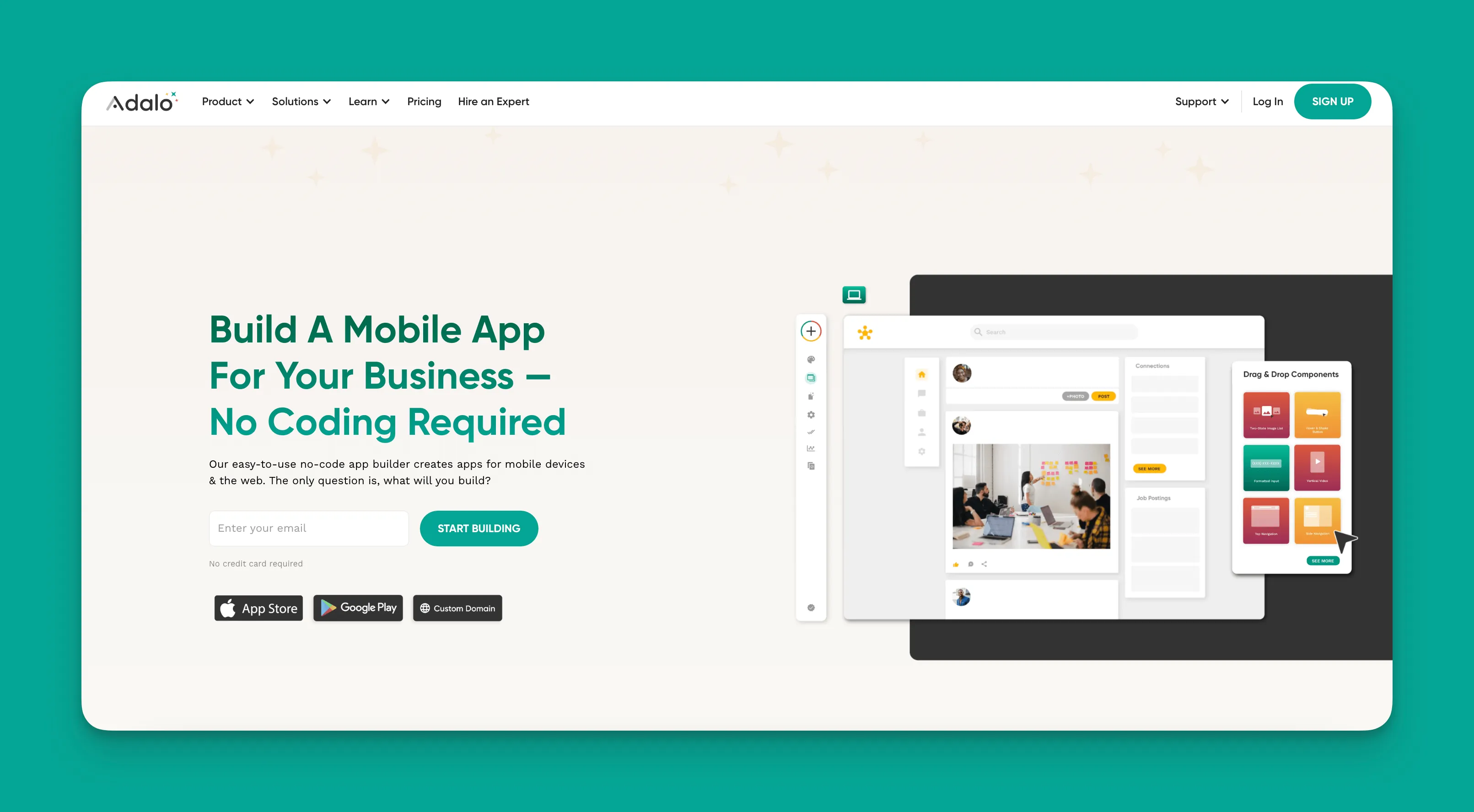
If you want an app builder that delivers professional results without months of learning, Adalo hits the sweet spot. Adalo is a no-code app builder for database-driven web apps and native iOS and Android apps—one version across all three platforms. AI-assisted building and streamlined publishing enable launch to the Apple App Store and Google Play in days rather than months.
With over 3 million apps created on the platform, Adalo's visual builder has been described as "easy as PowerPoint" while delivering the power to bring complex app ideas to life. The AI features Builder (early 2026) will add prompt-based creation, combining vibe-coding speed with Adalo's proven infrastructure.
Features
- Magic Start generates complete app foundations from a simple description. Tell it you need a booking app for a dog grooming business, and it creates your database structure, screens, and user flows automatically—what used to take days of planning happens in minutes. Magic Add then lets you add features by describing what you want in natural language.
- Adalo's agnostic builder lets you publish the same app to web, native iOS, and native Android without rebuilding or writing code. If your plan is mass distribution through the app stores' vast marketplaces, this is a significant advantage over web wrappers that require separate configurations for each platform.
- While you can start from a premade template with all the screens and features you need, Adalo empowers you to completely revamp the template's structure, colors, and functionalities. You can add new screens and features that weren't part of the original template.
- Want to experiment with different app iterations before releasing your final product? Adalo lets you build unlimited test apps to see how your ideas pan out before committing.
Pricing
Get started with Adalo for $36/month (billed monthly). This includes publishing to both the Apple App Store and Google Play Store, unlimited usage with no surprise charges, and no caps on database records. Unlike platforms with usage-based billing that can spike unexpectedly, Adalo's pricing stays predictable as your app grows.
Appy Pie
Who It's Good For
While it's not as customizable as Adalo or Bubble, Appy Pie is incredibly simple. Just pick a template, add features, customize the colors and pictures, and you're ready. This simplicity makes Appy Pie suitable for beginners who need a basic app quickly and don't require extensive customization.
Features
- While Appy Pie limits your downloads, there are no bandwidth or hosting limitations. This means you can create apps with plenty of functionality without worrying about traffic caps.
- You can publish your app to the Apple App Store and Google Play Store so users can download it directly to their phones. This allows you to create apps that leverage phone features like cameras, GPS, and push notifications.
- Need an app for your medical practice that stores sensitive client data? Appy Pie is one of the few app builders that offers HIPAA compliance (with the enterprise plan).
Pricing
Appy Pie's lowest tier is $36/month per app (billed monthly), but this only allows publishing to the Google Play Store—no iOS support.
If you're an Apple user, you'll need the $99/month per app version to publish to the iOS App Store. This version includes up to 2,000 monthly downloads and phone support. For comparable functionality to Adalo's $36/month plan (both app stores, native apps), Appy Pie costs nearly three times as much.
Bubble
Who It's Good For
If you want maximum customization and have time to invest in learning, Bubble offers powerful web app building capabilities. While its interface has a steep learning curve, you can create highly customized web applications once you master it.
Features
- Bubble has an extensive ecosystem of tutorials, YouTube videos, help documents, and forums. This community support helps users work through the challenging learning curve.
- Once you learn it, Bubble's building interface offers deep customization. You can configure complex workflows and app logic that simpler platforms don't support.
- Even Bubble's lowest pricing tier lets you create an app free of Bubble branding, so your app looks and feels entirely yours.
Pricing and Considerations
Bubble's web and mobile wrapper offering starts at $59/month with usage-based charges through Workload Units. These charges can be difficult to predict and may spike unexpectedly as your app scales. The platform also imposes limits on app re-publishing and database records.
A key consideration: Bubble's mobile solution wraps the web app rather than creating true native apps. This introduces potential performance challenges at scale and means updates don't automatically sync across web, Android, and iOS deployments. Claims of millions of MAU on Bubble often require hiring specialized developers to optimize performance—the platform's flexibility can result in slower applications that struggle under increased load without expert intervention.
Bubble's next tier is $134/month (billed monthly), adding team collaboration and 100GB of storage.
Which Platform Should You Choose?
Now that you've seen what each platform offers, let's break down the decision by the factors that matter most.
Free Version
Both Adalo and Bubble offer free versions you can use indefinitely. While each free version has limitations compared to paid plans, you can learn the interface on your own time without commitment.
Adalo and Bubble also let you publish your app to the web on free plans, allowing you to gather feedback and see how your app performs live before investing money.
Appy Pie falls short here: It only provides a 14-day free trial, and you must provide credit card information to access it. You'll need to manually cancel if the platform doesn't work for you.
Customization and White-Label Branding
For customization—the freedom to reconfigure your app template, change layouts, adjust color schemes, and more—both Bubble and Adalo offer extensive options.
However, Bubble has a steep learning curve that can take months to master. Adalo is easier to learn while offering comparable customization right out of the box. The platform's X-Ray feature also identifies performance issues before they affect users, helping you build apps that scale smoothly.
Appy Pie offers limited customization. You can't freely move elements like buttons, fonts, and pictures—you're essentially confined to the template layout you choose.
For white-label branding, both Adalo and Bubble offer pricing tiers that remove platform branding. None of Appy Pie's standard pricing tiers offer white-label branding: Your app will display a permanent "Appy Pie" stamp unless you contact them for enterprise pricing.
App Store Publishing
Bubble doesn't offer direct publishing to any app store. If you want your Bubble app in the app stores, you'll need to convert it using a third-party platform like Nativator—and the resulting product may not perform as expected since it's a web wrapper rather than a native app.
Appy Pie allows app store publishing, but with significant limitations. The lower tiers at $36/month and $60/month only allow Google Play Store publishing—no Apple App Store access. For both stores, you need the $99/month tier, which caps you at 2,000 monthly downloads total.
Adalo publishes to both the Apple App Store and Google Play Store for $36/month with no download caps. Your app compiles to true native code—not a web wrapper—so it performs like a traditionally coded app. One build automatically works across web, iOS, and Android without separate configurations or republishing.
Scalability and Performance
This is where the platforms diverge significantly. Adalo's modular infrastructure scales to serve apps with over 1 million monthly active users, with no upper ceiling. The Adalo 3.0 infrastructure overhaul (launched late 2025) made apps 3-4x faster, with infrastructure that scales automatically with your app's needs.
Paid Adalo plans include unlimited database records—no data caps that force expensive upgrades as you grow. With proper data relationship setups, Adalo apps can scale beyond 1 million MAU without hitting platform constraints.
Bubble's Workload Units create unpredictable costs as usage increases, and the platform's flexibility often requires hiring experts to optimize performance at scale. The web wrapper approach for mobile also introduces latency compared to true native apps.
Note: Most third-party platform ratings and comparisons predate Adalo 3.0's infrastructure overhaul. If you encounter older reviews citing performance concerns, they likely reflect the previous architecture rather than current capabilities.
Next Steps: Create Your App With Adalo
Want an app builder that's easy to learn, offers a generous free version, and doesn't require credit card information to get started? Adalo delivers on all three.
When comparing Adalo vs. Bubble vs. Appy Pie, Adalo offers the optimal balance of power and ease. You won't need months learning the interface: Adalo is intuitive enough to use immediately after signing up, while still offering the depth to build sophisticated applications.
Connect your app to thousands of integrations including Zapier, Xano, Stripe, and more. After building, publish to the web, Apple App Store, and Google Play Store to reach billions of potential users—all from a single codebase.
Get Adalo's free version without credit card info today.
FAQ
Why choose Adalo over other app building solutions?
Adalo is an AI-powered app builder that creates true native iOS and Android apps from a single codebase. Unlike web wrappers, it compiles to native code and publishes directly to both the Apple App Store and Google Play Store—the hardest part of launching an app handled automatically. With unlimited database records on paid plans and no usage-based charges, your costs stay predictable as you scale.
What's the fastest way to build and publish an app to the App Store?
Adalo's drag-and-drop interface combined with AI-assisted building through Magic Start lets you go from idea to published app in days rather than months. Describe your app concept, and Magic Start generates your database structure, screens, and user flows. Adalo then handles the complex App Store submission process, so you can focus on your app's features instead of certificates and provisioning profiles.
Which is more affordable, Adalo or Bubble?
Adalo starts at $36/month with unlimited usage and no surprise charges. Bubble starts at $59/month but adds usage-based Workload Unit charges that can spike unpredictably. For mobile apps specifically, Adalo includes native app store publishing in its base price, while Bubble requires third-party tools.
Which is more affordable, Adalo or Appy Pie?
For comparable functionality (publishing to both iOS and Android app stores), Adalo costs $36/month while Appy Pie requires $99/month. Adalo also has no download caps, while Appy Pie limits you to 2,000 monthly downloads at that price point.
Which is easier for beginners, Adalo or Bubble?
Adalo is significantly easier to learn. Its visual builder has been described as "easy as PowerPoint," and most users can start building immediately after signing up. Bubble has a steep learning curve that can take months to master, though it offers deeper customization once learned.
Is Adalo better than Bubble for mobile apps?
Yes, for mobile apps specifically. Adalo creates true native iOS and Android apps from a single codebase, publishing directly to both app stores. Bubble's mobile solution wraps the web app, which can introduce performance issues and requires third-party tools for app store publishing.
Can I migrate from Bubble to Adalo?
While there's no automatic migration tool, you can rebuild your Bubble app in Adalo using Magic Start to generate your foundation quickly. Many users find the transition worthwhile for native mobile app capabilities and predictable pricing without usage-based charges.
Can I migrate from Appy Pie to Adalo?
Yes, you can rebuild your Appy Pie app in Adalo. Since Appy Pie offers limited customization, most apps can be recreated quickly in Adalo with greater design flexibility. Adalo's Magic Start can generate your app foundation from a description, accelerating the process.
Does Adalo have database limits?
No. Paid Adalo plans include unlimited database records with no caps. The Adalo 3.0 infrastructure overhaul enables apps to scale beyond 1 million monthly active users with proper data relationship setups. This contrasts with platforms that impose record limits or charge based on data usage.
What integrations does Adalo support?
Adalo supports thousands of integrations including Zapier, Xano, Stripe, Airtable, and MailChimp. These connections let you gather data from third-party platforms, process payments, send emails, and create powerful functionality like marketing funnels or customer service features.