Bubble Review 2026: Independent Performance Data, Real Costs, and Alternatives
Key Findings: Bubble Review Summary
| What We Found | |
|---|---|
| Strengths | Deep web app customization, 5,300+ plugin ecosystem, powerful backend logic for complex web applications |
| Weaknesses | 5 to 10 second page loads on desktop, steep learning curve (months to proficiency), unpredictable costs from Workload Unit overages |
| Mobile | Separate beta mobile builder launched June 2025, but disconnected from the web editor — you maintain two projects, not one |
| Real Costs | $59 to $399/month subscription, plus most teams hire consultants at $40 to $125/hour. Total cost of ownership often far exceeds published pricing |
| Performance | Independent research (App Builder Guides, Feb 2026) found 5 to 10 second desktop loads and 8 to 14 second mobile loads, even on enterprise plans |
| Independent Rating | 4.18/10, ranked #6 among visual builders — most negative community sentiment of any platform analyzed |
| Best For | Teams with technical resources building complex web-first applications who can invest in optimization expertise |
| Consider Alternatives If | You need production-ready native mobile apps, predictable pricing, or a platform you can build on without hiring consultants |
What Is Bubble?
Bubble is a visual web app builder that creates web applications and progressive web apps (PWAs). These are browser-based apps that mimic native mobile experiences without actual App Store distribution. The platform pioneered the visual app-building space since 2012, building a massive ecosystem of templates, plugins, and developers.
The platform's maturity shows in its thorough documentation and well-tested workflows. However, App Builder Guides' 2026 State of App Building research, analyzing 345 citations across Reddit, X/Twitter, and platform forums with zero platform sponsorships, paints a more complex picture than Bubble's marketing suggests. Bubble added a native mobile plugin builder in June 2025, though it remains in beta with significant performance gaps. Even on the web side, where Bubble is most mature, builders face performance and cost challenges that deserve scrutiny.
Getting Started with Bubble
Account creation is straightforward. Bubble's template library includes over 400 free options organized across 20+ categories and 700+ paid templates created by independent developers, with pricing ranging from $15 to over $200.
Template categories include:
- CRM
- Booking
- Finance
- Landing Page
- Online Store
- Project Management
- Social Media
- SaaS
The templates provide a head start, though customizing them to production quality typically requires significant Bubble expertise.
Learning Bubble
The platform features a steep learning curve. Bubble compensates with four learning resources:
- The Bubble Academy — Videos and interactive exercises for first-time users
- Bubble's Video Library — Nearly 200 videos covering components and elements
- The "How To Build" Series — Step-by-step video lessons for different app types
- Bubble Docs — Comprehensive text documentation
Users should expect to invest several months before becoming fluent with the interface, even dedicating multiple hours daily. As one user on r/Bubbleio put it:
"I'm finding Bubble very difficult and haven't been able to finish even my first page." — r/Bubbleio user, via App Builder Guides' 2026 research
App Builder Guides' research confirmed this pattern: most founders cannot self-build complex Bubble apps. Teams frequently end up hiring Bubble consultants at $40 to $125 per hour, with typical agency projects running $20,000 to $100,000 or more.
Building with Bubble
Bubble's complexity enables powerful customization for those who master it. Seven icons on the far left serve as tabs for accessing interface sections controlling design elements, APIs, integrations, SEO features, and workload unit monitoring.
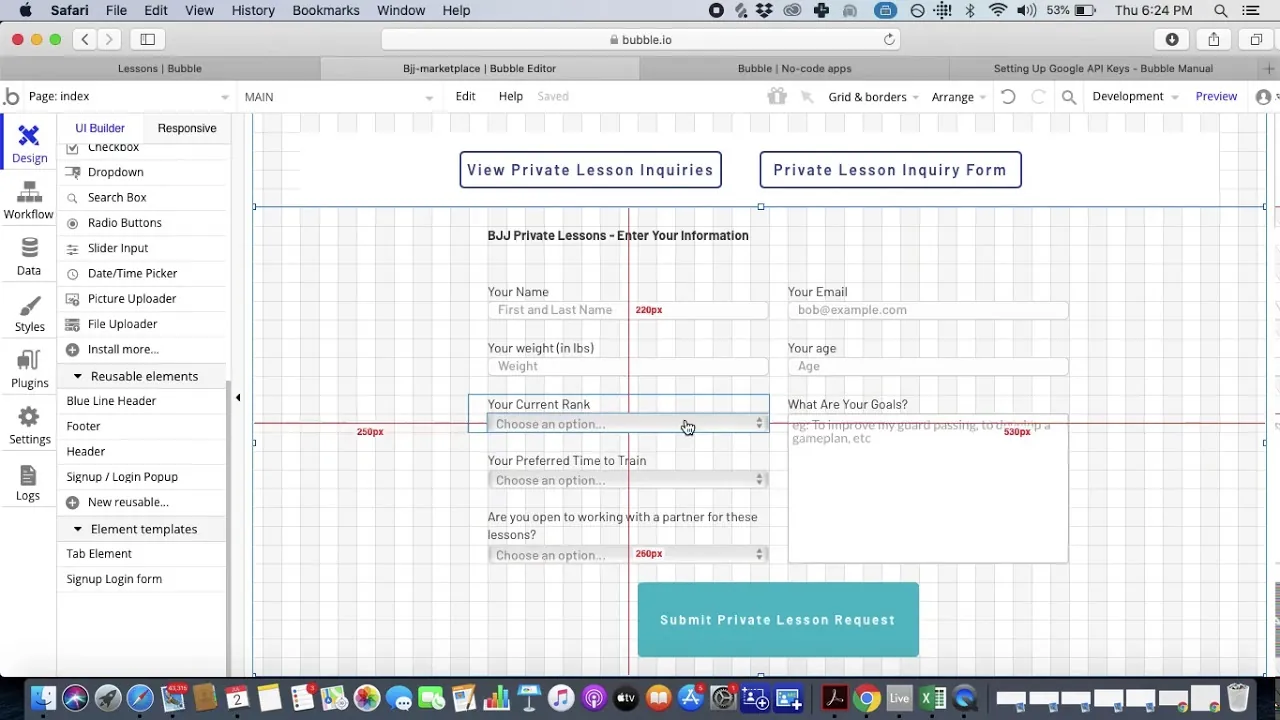
For complex web applications, this depth is a genuine advantage:
"If you need enterprise-level power, Bubble wins." — r/nocode user, via App Builder Guides' 2026 research
The full properties editor allows fine-tuning of every component's style and logic. However, this flexibility creates trade-offs. Independent research found that Bubble's backend architecture uses sequential API calls where parallel calls would be possible, creating performance bottlenecks at scale. Users report page load times of 5 to 10 seconds on desktop, even on enterprise-tier plans:
"Bubble is bloated. It's definitely slow once you get into anything reasonably complex. Our app was on a full-on dedicated enterprise plan, that cost me $40k for one year." — r/Bubbleio user, via App Builder Guides' 2026 research
What Independent Research Reveals About Bubble
App Builder Guides' February 2026 research provides the most comprehensive independent analysis of Bubble's real-world performance. The study ranked Bubble #6 among visual builders with a score of 4.18 out of 10, driven by the most negative community sentiment of any platform analyzed (net score of -60 across 25 threads).
Key findings:
- Desktop page loads of 5 to 10 seconds are typical for production Bubble apps, even on enterprise plans
- Mobile beta loads of 8 to 14 seconds, far below native app performance standards
- Workload Unit consumption of 400 to 500 WU per user per day, with one scheduling app burning through 700,000 WU
- Editor RAM usage exceeding 5GB per browser tab, creating development environment strain
- Consultant dependency: most teams hire Bubble developers rather than self-building
As one user asked bluntly on Reddit:
"Why can I immediately tell that an app is built in Bubble based off the page speed?" — r/Bubbleio user, via App Builder Guides' 2026 research
These findings carry weight because App Builder Guides operates with zero platform sponsorships and bases conclusions entirely on community-sourced data.
Bubble Alternatives
Adalo is the no-code app builder that pairs AI-powered generation with a visual multi-screen canvas. Entrepreneurs and business teams design, build, and publish custom database-driven apps to the Apple App Store, Google Play Store, and web from a single project. Ada, Adalo's AI builder, generates complete app foundations through Magic Start, adds features through natural language with Magic Add, and identifies performance issues proactively with X-Ray. Build for free, with paid plans from $36/month that include unlimited usage and no record caps. Adalo 3.0's late-2025 infrastructure overhaul delivers 3 to 4x faster performance with modular architecture scaling to 1M+ MAU.
GoodBarber offers a lower-cost option with a gentler learning curve, focused on native mobile apps for online stores and content subscriptions.
Betty Blocks is an enterprise-focused builder with a simpler interface for creating native mobile apps, designed for large organizations.
Is Bubble Right For You?
Select Bubble if:
- You have months to dedicate to learning the complex building interface
- You primarily need web apps or PWAs (mobile is available but still in beta)
- You want maximum customization and can invest in optimization expertise or hire a Bubble consultant
- Your budget can absorb unpredictable Workload Unit charges
Consider alternatives if:
- You want true native mobile apps published to app stores
- You need an intuitive platform that lets you start building immediately
- You're budget-conscious and want predictable pricing without usage-based charges
- You want one codebase that automatically updates web, iOS (native), and Android (native) simultaneously
What Kinds of Apps Can I Build With Bubble?
Once you master Bubble's interface, the possibilities for web apps and PWAs are extensive. Internal business tools like Kanban boards, CRM systems, social networks, and finance applications with third-party integrations are all achievable. Bubble's 5,300+ plugin ecosystem provides broad integration options, and multiple users in the ABG research acknowledged this depth:
"Bubble is a lot more powerful than both Adalo and Strapi." — r/nocode user, via App Builder Guides' 2026 research
That power is real, particularly for web-focused use cases.
Bubble's mobile story is evolving. The platform launched a native mobile plugin builder in June 2025, which is a meaningful step forward. However, it's important to understand that Bubble's mobile builder is a separate editor, disconnected from the web app builder. You don't get one app that runs everywhere. You build your web app in one editor and then build a separate mobile version in the plugin builder, which means maintaining two distinct projects.
The mobile builder also remains in beta with load times of 8 to 14 seconds, limited access to core iOS and Android features, and reported instabilities. By contrast, platforms like Adalo let you build a single app version that deploys to web, iOS (native), and Android (native) simultaneously. Changes made once apply across all three surfaces, with no separate editor or duplicate maintenance required.
Bubble Pricing: Is It Worth It?
Bubble's free tier works for learning the interface and connecting to third-party APIs, though community-built plugins require paid plans. The free version includes 50,000 workload units (WUs).
| Plan | Monthly Price | Workload Units | Key Features |
|---|---|---|---|
| Free | $0 | 50,000 | Learning, third-party APIs |
| Starter | $59 | 175,000 | Custom branding, Bubble APIs, all plugins |
| Growth | $134 | 250,000 | 10 prototype versions |
| Team | $399 | 500,000 | Separate client databases |
| Enterprise | Contact sales | Custom | Custom solutions |
The workload unit model creates uncertainty around monthly costs. Independent research found users consume 400 to 500 WU per user per day on typical applications. One scheduling app burned through 700,000 WU. Exceeding monthly allocation triggers overage charges, and some users have found the monitoring burden significant:
"I'm tired of constantly monitoring and tweaking the app just to stay afloat." — r/nocode user, via App Builder Guides' 2026 research
The total cost of ownership extends beyond subscription fees. Most teams hire consultants at $40 to $125 per hour, with typical agency projects running $20,000 to $100,000+. Factor in ongoing WU overages, and Bubble's real cost diverges significantly from its published pricing.
Adalo's pricing takes a different approach. Build for free, then upgrade to paid plans from $36/month with unlimited usage, zero workload-based charges, unlimited database records, and direct App Store publishing included. App Builder Guides' research noted that Adalo users routinely build and publish complete apps without expert assistance, eliminating the consultant costs that inflate Bubble's total cost of ownership.
Bubble vs. Adalo: Key Differences
| Feature | Bubble | Adalo |
|---|---|---|
| Best For | Complex web apps and dashboards | Native mobile apps with App Store publishing |
| Native Mobile Apps | Separate beta plugin builder (8-14s load times) | Single app compiles to native iOS and Android |
| App Store Publishing | Available via beta plugin or wrappers | Direct publishing included |
| Plugin Ecosystem | 5,300+ plugins (larger) | Growing marketplace |
| Starting Price | Free tier / $59/month paid | Free tier / $36/month paid |
| Usage Charges | Workload Units with overages | Unlimited, no caps |
| Database Records | Limited by plan tier | Unlimited on paid plans |
| Web App Customization | Deep, granular control | Streamlined visual canvas |
| AI Builder | Limited | Ada: Magic Start, Magic Add, X-Ray |
| Cross-Platform Updates | Separate web and mobile editors to maintain | One version deploys to web, iOS, and Android |
| Learning Curve | Months to proficiency | Build your first app in hours |
| Self-Build Feasibility | Usually requires consultants | Designed for non-technical builders |
Verdict
Choose Bubble if you need complex web applications with sophisticated backend logic and can wait for the mobile builder to mature. Bubble's plugin ecosystem and customization depth are genuine strengths for web-first teams with technical resources and budget flexibility.
Choose Adalo if you want to build and publish native mobile apps to the App Store and Google Play from a single project, prefer predictable flat-rate pricing, and want to start building for free without hiring developers.
FAQ
What does independent research say about Bubble's performance?
App Builder Guides' February 2026 research, analyzing 345 citations across Reddit and platform forums with zero sponsorships, found Bubble apps typically load in 5 to 10 seconds on desktop and 8 to 14 seconds in mobile beta. The study ranked Bubble #6 among visual builders with a score of 4.18/10, citing structural performance bottlenecks from sequential API architecture.
How much does it really cost to build an app with Bubble?
Beyond the $59 to $399/month subscription, most teams hire Bubble consultants at $40 to $125/hour. Typical agency projects cost $20,000 to $100,000+. Add unpredictable Workload Unit overages, and Bubble's total cost of ownership often significantly exceeds initial expectations. Adalo offers a more predictable alternative: build for free, then upgrade to unlimited usage from $36/month with no overage charges.
Can Bubble create native mobile apps?
Yes, though with caveats. Bubble launched a native mobile plugin builder in June 2025, but it's a separate editor from the web app builder. You build and maintain two distinct projects rather than one. The mobile builder also remains in beta with 8 to 14 second load times and limited device feature access. Adalo takes the opposite approach: one app version compiles to native iOS (IPA), Android (APK), and web, with changes applying across all three from a single project.
What is a workload unit in Bubble?
A workload unit (WU) measures computational work in Bubble. Database operations, integrations, and logic all consume WUs. Each plan has a monthly cap with overage charges beyond that limit. Independent research found that a single scheduling app consumed 700,000 WU.
Which is more affordable for app store publishing, Adalo or Bubble?
Adalo lets you build for free, with paid plans from $36/month that include native App Store and Google Play publishing, unlimited usage, and no record caps. Bubble's comparable functionality requires the Growth plan at $134/month, plus third-party wrapper services for mobile, plus potential WU overage charges.
What can Bubble do that Adalo can't?
Bubble offers more granular control over complex web-based layouts and advanced conditional workflow logic. Its 5,300+ plugin ecosystem is larger than most competitors. For teams building heavily customized web dashboards with intricate data visualizations who don't need native mobile, Bubble's web-first architecture provides more flexibility. This comes at the cost of a steeper learning curve and typically requires hiring a consultant.
Which is faster to build with, Adalo or Bubble?
Adalo is significantly faster for most users. Ada, Adalo's AI builder, generates complete app foundations from a description through Magic Start. The visual multi-screen canvas shows all screens simultaneously, and you can point at elements to direct the AI visually. Bubble requires months of learning before proficiency, and most teams hire external developers.
Can I migrate from Bubble to Adalo?
While no automated migration tool exists, Adalo's interface and Magic Start make rebuilding straightforward. Many users recreate Bubble apps faster in Adalo because the visual canvas and AI assistance eliminate the steep learning curve.
Is Adalo better than Bubble for mobile apps?
For production mobile apps, Adalo has a clear advantage. Adalo compiles true native iOS (IPA) and Android (APK) apps and publishes directly to the Apple App Store and Google Play Store. Bubble's mobile builder is available but still in beta with 8 to 14 second load times and limited device feature access. If mobile is your primary need, Adalo is the more mature option today.
How does Adalo handle app scalability?
Adalo 3.0's modular infrastructure, launched late 2025, scales to serve apps with over 1 million monthly active users. The platform is 3 to 4x faster than previous versions, with no upper ceiling on MAU.