Deterministic Queries With GPT-OSS: The First Step in Corporate AI Usage
Corporations are using deterministic queries to securely integrate AI into repetitive tasks. Unlike natural language prompts, deterministic queries are predefined, structured API calls (e.g., GET, POST) that ensure consistent, predictable results. This approach minimizes risks like data leaks or hallucinations and enhances security with strict parameters, Role-Based Access Control (RBAC), and audit trails.
For organizations looking to integrate secure AI solutions without extensive development resources, platforms like Adalo, a no-code app builder for database-driven web apps and native iOS and Android apps—one version across all three platforms, published to the Apple App Store and Google Play, provide an accessible way to create intuitive interfaces that connect employees to these deterministic query systems.
Key components include:
- GPT-OSS: Processes structured data for consistent outputs.
- DreamFactory: Converts legacy systems into secure REST APIs with role-based permissions.
- Adalo: Provides an intuitive interface for employees to interact with deterministic queries without technical knowledge.
This system simplifies workflows, reduces errors, and saves time by automating repetitive tasks while keeping sensitive data protected. Companies like Intel and McKesson have already seen measurable cost and time savings using these tools. By focusing on controlled, secure AI interactions, deterministic queries offer a practical way to integrate AI into corporate environments.
Ada, Adalo's AI builder, lets you describe what you want and generates your app. Magic Start creates complete app foundations from a description, while Magic Add adds features through natural language.
For organizations looking to implement these secure, structured API integrations without extensive development resources, AI-assisted platforms offer an accessible entry point. Adalo lets you build database-driven web apps and native iOS and Android apps—published to the App Store and Google Play—from a single visual editor, with AI features like Magic Start generating complete app foundations from simple descriptions.
Privacy First Enterprise AI: Building AI Agents that Never Leave Your Security Boundary
How the Technology Architecture Works
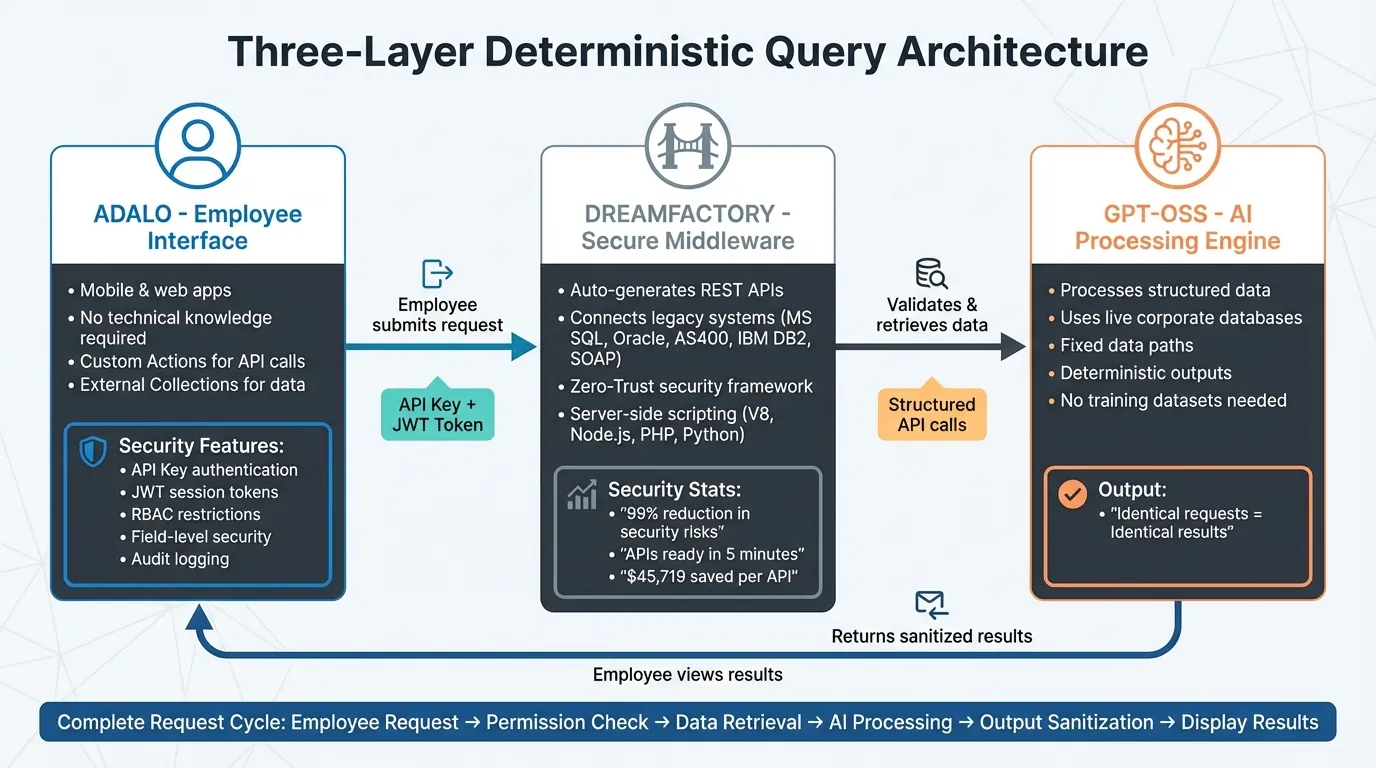
How Deterministic Queries Work: Three-Layer Architecture Flow
The system operates through three distinct layers: Adalo (interface), DreamFactory (middleware), and GPT-OSS (processing). This layered design keeps security, usability, and processing power separate, ensuring each function is handled efficiently.
GPT-OSS as the AI Processing Engine
At the core is GPT-OSS, which processes structured data from DreamFactory APIs to handle deterministic tasks. Unlike traditional AI models that depend on extensive training datasets, GPT-OSS relies on live, governed corporate data. Every query interacts with real-time databases—such as MS SQL Server, Oracle, or AS400—delivering consistent and accurate results.
The engine uses fixed data paths to ensure predictable outputs. This deterministic design guarantees that identical requests always produce the same outcomes, making it a dependable tool for critical operations. Once GPT-OSS completes the processing, DreamFactory takes over to securely connect the results to legacy systems.
DreamFactory: Middleware for System Integration
DreamFactory serves as the bridge between GPT-OSS and legacy systems, ensuring seamless integration. It automatically generates fully documented REST APIs for databases and systems like MS SQL Server, Oracle, AS400, IBM DB2, and SOAP services. Back in July 2026, Intel's Lead Software Engineer, Edo Williams, adopted DreamFactory to simplify backend connectivity. This allowed his team to focus on frontend development using the platform's "click‐and‐connect" API generation.
"DreamFactory streamlines everything and makes it easy to concentrate on building your front end application. I had found something that just click, click, click... connect, and you are good to go."
– Edo Williams, Lead Software Engineer, Intel
DreamFactory operates under a Zero-Trust security framework, which adheres to the principle of "never trust, always verify." Every interaction between GPT-OSS and backend systems is rigorously authenticated and authorized. Its Role-Based Access Control (RBAC) restricts AI access to specific tables, records, or even individual fields. Additionally, server-side scripting—powered by technologies like V8, Node.js, PHP, or Python—validates inputs and sanitizes outputs in real-time, effectively blocking prompt injection attempts before they reach the database.
Organizations using DreamFactory's security logging have reported a 99% reduction in common security risks. Moreover, production-ready APIs with full security and logging can be generated in just five minutes, saving companies an estimated $45,719 per API through automation.
Adalo as the Employee Interface
After DreamFactory validates and sanitizes the data, Adalo takes over to present the results in a simple, user-friendly format. The platform acts as the interface where employees can submit task requests and view results without needing to understand the underlying API mechanics. Through mobile or web apps, employees can trigger AI tasks and access legacy system data using features like Custom Actions and External Collections.
Adalo's visual builder has been described as "easy as PowerPoint," making it accessible for non-technical teams to create sophisticated interfaces. With over 3 million apps created on the platform, it has proven itself as a reliable foundation for enterprise applications. The platform's 3.0 infrastructure overhaul (launched in late 2025) delivered 3-4x faster performance, ensuring that employee-facing apps remain responsive even under heavy usage.
Adalo ensures secure interactions through dual-layer authentication. Each request requires both a unique API key and a session-based JSON Web Token (JWT). This setup ensures that only authorized employees can access specific data. RBAC further limits their actions to designated HTTP methods and specific datasets.
| Security Feature | Function in Employee Interface |
|---|---|
| API Key | Identifies the specific application (Adalo) accessing the system |
| JWT (Session Token) | Authenticates the individual employee and manages their session |
| RBAC | Restricts the employee to specific actions (e.g., "Read-Only" or "Submit Only") |
| Field-Level Security | Conceals sensitive data (e.g., SSNs, passwords) from employee view |
| Audit Logging | Tracks all interactions within the deterministic query workflow |
Here's how the integration works: Adalo sends a request, DreamFactory checks the user's permissions and retrieves the necessary data from legacy systems, GPT-OSS processes the data and generates a result, DreamFactory sanitizes the output, and finally, Adalo displays the result to the employee. The entire process is designed to run smoothly, ensuring both security and usability at every step.
How to Design and Deploy Deterministic Queries
Creating and deploying deterministic queries involves balancing security with usability. The aim is to design fixed, predictable task requests that employees can use without exposing the AI system to risks like prompt injection attacks or unauthorized data access.
Structuring Deterministic Requests
The backbone of a secure deterministic query is scripted service wrapping. Instead of letting employees send raw text prompts to GPT-OSS, you can use DreamFactory's scripted services to encapsulate AI logic in a controlled environment. These scripts, written in Node.js, PHP, or Python, define specific input parameters and hardcode prompt templates. Employees then interact with these scripts through tools like Adalo, filling in predefined variables that the backend script integrates into an approved template.
For example, an HR employee might select options like job title and state to generate a salary comparison report through a hardcoded prompt template. Adalo's Magic Add feature can help build these interfaces quickly—describe the form fields and submission logic you need, and the AI generates the components automatically.
DreamFactory's platform.api resource facilitates internal calls to GPT-OSS or legacy databases without relying on external HTTP requests, keeping all processing within a secure internal framework. To optimize performance, enable caching for static outputs and clear the cache whenever scripts are updated using the appropriate endpoint.
Once the query structure is outlined, it must go through a detailed approval process to ensure compliance and security.
Approval Process and Security Requirements
Deploying deterministic queries requires a multi-step approval process. Start by defining the query's purpose, inputs, outputs, and the roles that will have access. Use verb masks—numerical values representing allowed HTTP methods—to specify what actions users can perform.
| Verb | Mask Value | Description |
|---|---|---|
| GET | 1 | Retrieve data from the deterministic query |
| POST | 2 | Submit new data for AI processing |
| PUT | 4 | Replace existing query configurations |
| PATCH | 8 | Modify specific parts of a query schema |
| DELETE | 16 | Remove a deterministic query endpoint |
Each query must include an API key and a session token/JWT for authentication. Ensure sensitive data is hidden through field-level security, and that all endpoints are filtered by role-based permissions.
"DreamFactory connects to your database on behalf of this user, the resulting API is logically constrained by that user's authorized capabilities." - DreamFactory Documentation
Before deployment, test the query using DreamFactory's auto-generated Swagger documentation. Confirm that security filters are functioning correctly and that sensitive fields remain inaccessible. Rotate API keys every 90 days to reduce the risk of unauthorized access. For legacy or remote databases, secure connections using SSH tunnels. Enable audit logging by setting APP_LOG_LEVEL=debug in the .env file to monitor query usage and identify potential security issues.
Once the query meets all security standards, integrate it into the employee-facing interface using Adalo.
Building Employee Apps with Adalo
After approval, Adalo serves as the platform for employees to interact with deterministic queries. Use Custom Actions to link Adalo's visual interface with the REST APIs generated by DreamFactory. Export the Swagger/OpenAPI JSON file from DreamFactory and import it into Adalo's Custom Action settings to map endpoints, parameters, and response formats automatically.
When designing the app interface, think of components as nouns and actions as verbs. For instance, a button labeled "Request Salary Report" should either guide users to a results screen or submit data to the deterministic query engine. Clearly define error messages for API status codes and enforce rate limits to ensure system stability.
Adalo's X-Ray feature helps identify performance issues before they affect users—particularly valuable when building interfaces that connect to multiple backend systems. This proactive monitoring ensures your deterministic query apps remain responsive as usage scales.
"The ordering and location of actions in Adalo, for example, can entirely change the speed of an app and therefore change the whole app experience." - The Adalo Team
For organizations concerned about data storage limits, Adalo's paid plans include unlimited database records—no caps on how much employee interaction data or query logs you can store. This removes a common constraint that forces enterprises to archive or delete valuable operational data.
Before rolling out the app to employees, thoroughly test it using interactive documentation tools to ensure smooth functionality.
Connecting to Legacy Systems and Databases
How to Connect Legacy Databases
DreamFactory's middleware capabilities make it possible for businesses to integrate even decades-old systems—like MS SQL Server, Oracle, AS/400 mainframes, and SOAP-based web services—into modern AI workflows. By converting these legacy systems into standardized REST APIs, DreamFactory takes care of the heavy lifting. It handles technical tasks such as Windows Authentication for MS SQL Server (supported since 2005), PL/SQL support for Oracle, and EBCDIC to ASCII conversion for AS/400 mainframes seamlessly. For SOAP-based services, it automatically parses WSDL files to create REST APIs.
"DreamFactory enables a standard, unified API abstraction layer for modern apps that need to connect to legacy data sources that can't be readily changed." - DreamFactory Overview
This unified approach ensures consistent and reliable data retrieval, no matter how old the system is. DreamFactory's schema introspection feature automatically identifies tables, functions, and metadata, mapping them to REST endpoints in no time. Plus, you can test these connections using the auto-generated Swagger documentation before rolling them out to production.
For organizations using spreadsheet-based data sources, Adalo's SheetBridge feature offers an alternative approach—turning Google Sheets into actual databases for the easiest control without database-related learning curves. This is particularly useful for departments that maintain operational data in spreadsheets but need to connect it to deterministic query workflows.
Data Security and Compliance Controls
Connecting to legacy systems is only part of the equation—securing those connections is just as vital. DreamFactory incorporates role-based access controls (RBAC) at the service, table, and field levels, allowing precise control over which queries can access specific data. Security measures like parameterized queries, input validation, SSL/TLS encryption, and enterprise-level SSO (supporting Active Directory, LDAP, and Okta) provide robust protection for these connections.
For sensitive data such as Social Security numbers, field-level security can mask or completely hide columns from the AI engine. Additionally, comprehensive audit logging keeps a record of every API call, ensuring compliance with regulatory requirements.
Adalo complements these security measures with its own authentication layer. The platform's modular infrastructure—completely overhauled with Adalo 3.0 in late 2025—scales to serve apps with over 1 million monthly active users without performance degradation. This purpose-built architecture maintains security and speed even under enterprise-scale loads.
Scaling Deterministic Queries Across Your Organization
Measuring Performance and ROI
After rolling out deterministic queries in a pilot department, it's crucial to measure their impact with solid metrics. Start by tracking developer time saved—for instance, DreamFactory can create production-ready APIs in about five minutes, slashing development costs compared to traditional custom coding methods. Use the "Logs > API Usage" interface to monitor response times, and take advantage of centralized logging, which can reduce security threats by as much as 99%. Fine-tune GPT-OSS reasoning settings (low, medium, high) to strike the right balance between cost and accuracy.
Different departments can focus on their specific metrics. For example:
- Finance teams might measure improvements in "time to close the books."
- Operations teams can monitor how quickly real-time bottlenecks are resolved.
For the employee interface layer, Adalo's pricing model supports predictable budgeting. At $36/month, you get web and native mobile app publishing with unlimited usage—no usage-based charges that create bill shock as adoption grows. This contrasts with platforms like Bubble, where Workload Units can create unpredictable costs as deterministic query volume increases.
"DreamFactory is far easier to use than our previous API management provider, and significantly less expensive." – Adam Dunn, Sr. Director of Global Identity Development & Engineering at McKesson
Infrastructure for Enterprise-Scale Deployment
Once performance metrics justify scaling, the next step is to build the infrastructure for organization-wide deployment. Transitioning from a single-server pilot to a large-scale rollout requires robust tools like Docker and Kubernetes, using Helm charts to maintain consistency across development and production environments. For production, allocate at least 8GB of RAM per server, especially if hosting the system database. Under heavy usage, add load balancing across multiple DreamFactory instances, supported by a shared caching layer (like Redis or Memcached) and a centralized system database.
| Infrastructure Component | Pilot Phase | Enterprise Phase |
|---|---|---|
| Deployment | Local machine / Single VM | Kubernetes / Docker Clusters |
| Authentication | API Keys | SSO (Active Directory, LDAP, Okta, SAML 2.0) |
| Caching | Local / None | Shared Redis / Memcached |
| Monitoring | Basic file logs | Centralized ELK Stack / SIEM |
For enterprise-scale security, move from basic API keys to Single Sign-On (SSO) integrations with systems like Active Directory, LDAP, Okta, or SAML 2.0. This approach simplifies the management of thousands of employee identities. To handle peak traffic, implement multi-level rate limiting, such as:
- Instance level: Limit to 10,000 requests per hour.
- User level: Cap at 500 requests per hour.
- Role and endpoint levels: Adjust limits based on specific needs.
Adalo's infrastructure scales alongside these enterprise deployments. With the 3.0 architecture, apps can handle over 1 million monthly active users with no upper ceiling—the modular infrastructure scales with demand. Unlike web app wrappers that hit performance constraints under load, Adalo's purpose-built architecture maintains responsiveness at enterprise scale.
Finally, integrate logs with the ELK stack (Elasticsearch, Logstash, Kibana) to create real-time dashboards for tracking system performance and ROI.
Ongoing Updates and Maintenance
Scaling isn't just about infrastructure—it also requires regular updates to keep systems secure and efficient. Rotate API keys routinely to minimize security risks. Establish log retention policies aligned with compliance standards—HIPAA, for example, requires six years of audit trails. Use automatic cleanup to control storage costs. For session management, DreamFactory defaults to 60-minute sessions, but you can adjust this by changing the DF_JWT_TTL parameter.
For streamlined updates, Adalo's visual builder enables instant changes across platforms without requiring developer intervention. One update to your Adalo app automatically deploys to web, iOS, and Android—with unlimited app updates on all paid plans. This single-codebase approach eliminates the version fragmentation that occurs when maintaining separate web and mobile codebases.
Additionally, auto-generated Swagger/OpenAPI documentation allows internal teams to integrate with the system seamlessly, eliminating the need for manual hand-offs.
Comparing Interface Platforms for Deterministic Queries
When selecting a platform to build employee interfaces for deterministic query systems, several factors matter: ease of use, scalability, native mobile support, and total cost of ownership.
Adalo offers a visual builder described as "easy as PowerPoint" with AI-assisted features like Magic Start and Magic Add. At $36/month, you get web and native iOS/Android apps from a single codebase, unlimited usage, and no database record caps. The platform publishes directly to the Apple App Store and Google Play Store.
Bubble provides more customization options but starts at $59/month with usage-based Workload Unit charges that can create unpredictable costs. Its mobile solution uses web wrappers rather than native compilation, which can introduce performance challenges at scale. Organizations often need to hire experts to optimize Bubble apps for high-traffic scenarios.
FlutterFlow targets technical users with a low-code approach starting at $70/month per user—but this doesn't include a database, which must be sourced, configured, and paid for separately. The learning curve for optimal database setup is significant, and suboptimal configurations create scalability problems.
Glide excels at spreadsheet-based apps but limits creative freedom with template-focused designs. Pricing starts at $60/month for custom domains, with additional charges for data records. Glide does not support App Store or Play Store publishing.
For deterministic query interfaces that need to scale across an enterprise while remaining accessible to non-technical teams, Adalo's combination of visual simplicity, native mobile compilation, and predictable pricing makes it well-suited for the employee interface layer of this architecture.
Conclusion
Deterministic queries provide a secure and low-risk way for companies to begin integrating AI into their operations. By combining GPT-OSS with tools like DreamFactory and Adalo, businesses can automate repetitive tasks while maintaining tight control over data security and compliance. This setup ensures AI interactions are authenticated, logged, and restricted to essential information, sidestepping the unpredictable outputs often associated with open-ended AI chat tools.
Beyond operational improvements, this approach delivers measurable financial returns. By cutting development time and bolstering security, companies can achieve a clear ROI. Organizations like Intel and McKesson have already reported significant savings in both time and costs by adopting this method.
What sets this architecture apart is its adaptability. Businesses can integrate AI into older legacy systems—like SQL Server 2005, Oracle databases, or AS400s—without overhauling their existing infrastructure. DreamFactory's consistent "port" ensures compatibility even if the AI model changes, avoiding vendor lock-in and eliminating the need for expensive system replacements. Meanwhile, Adalo's visual builder makes it easy for non-technical teams to engage with AI-powered workflows, all without writing code.
For companies looking to move past experimental AI projects, the roadmap is straightforward: start with deterministic queries to handle high-volume, low-risk tasks, track ROI through metrics like time savings and error reduction, and gradually expand across departments. With the right framework, AI adoption becomes not only manageable but also secure, efficient, and cost-effective, creating a seamless integration of AI and legacy systems for corporate environments.
Is it possible to build deterministic query interfaces without coding?
Yes, you can use Adalo's AI-powered app builder to create deterministic query interfaces. These apps can be published on the web, iOS, and Android platforms, including app store distribution.
What is Adalo and why use it?
Adalo is an AI-powered app builder that enables you to create a single app that works as a web app, an Android app in the Google Play Store, and an iOS app in the Apple App Store. It also lets you convert spreadsheets into apps via SheetBridge and connect with any data source using its DreamFactory connector, making it a practical choice for building scalable, production-ready apps.
How long does it take to deploy a deterministic query?
The deployment timeline depends on the complexity of the query and the employee interface, as well as the time required for the approval process. With Adalo's Magic Start feature, you can generate complete app foundations from descriptions in minutes rather than days.
What's the difference between deterministic and natural language queries?
Deterministic queries use structured inputs to deliver consistent, predictable outputs, while natural language queries allow free-form text inputs. While natural language queries offer flexibility, they can pose security risks like prompt injection attacks. Deterministic queries are better suited for corporate environments where control and consistency are critical.
Can deterministic queries access multiple databases simultaneously?
Yes. DreamFactory can generate REST APIs for various systems, including MS SQL Server, Oracle, AS400, IBM DB2, and SOAP services. Your scripted service can make internal calls to these databases within a single deterministic query.
Related Blog Posts
- Best Practices for NLP in No-Code Chatbots
- How To Create an AI Scanning and Checking App
- How To Create An App using SAP Hana Data
- How To Create An App using IBM DB2 Data
FAQ
Why choose Adalo over other app building solutions?
Adalo is an AI-powered app builder that creates true native iOS and Android apps. Unlike web wrappers, it compiles to native code and publishes directly to both the Apple App Store and Google Play Store from a single codebase—the hardest part of launching an app handled automatically. With unlimited database records on paid plans and no usage-based charges, costs remain predictable as your app scales.
What's the fastest way to build and publish an app to the App Store?
Adalo's drag-and-drop interface and AI-assisted building let you go from idea to published app in days rather than months. Magic Start generates complete app foundations from descriptions, and Adalo handles the complex App Store submission process so you can focus on features and user experience instead of certificates and provisioning profiles.
Can I build deterministic query interfaces without coding?
Yes, Adalo's visual builder and Custom Actions feature allow you to link your app directly to DreamFactory REST APIs, enabling non-technical teams to interact with AI-powered workflows without writing code. The interface has been described as "easy as PowerPoint."
What's the difference between deterministic and natural language queries for enterprise AI?
Deterministic queries use structured inputs to deliver consistent, predictable outputs, while natural language queries allow free-form text inputs. Deterministic queries are better suited for corporate environments because they prevent security risks like prompt injection attacks and ensure identical requests always produce the same reliable results.
Can deterministic queries connect to legacy databases like Oracle or AS400?
Yes, DreamFactory middleware can generate REST APIs for legacy systems including MS SQL Server, Oracle, AS400, IBM DB2, and SOAP services. This allows businesses to integrate AI into existing infrastructure without expensive system overhauls, and Adalo can then provide user-friendly interfaces for employees to interact with these systems.
How does the three-layer architecture ensure security for AI queries?
The architecture separates concerns across Adalo (interface), DreamFactory (middleware), and GPT-OSS (processing). DreamFactory enforces Zero-Trust security with Role-Based Access Control, API key and JWT authentication, field-level security, and comprehensive audit logging—organizations using this approach have reported a 99% reduction in common security risks.
What kind of ROI can organizations expect from implementing deterministic queries?
Organizations can achieve measurable ROI through reduced development time and enhanced security. DreamFactory can generate production-ready APIs in about five minutes, saving an estimated $45,719 per API through automation. Companies like Intel and McKesson have reported significant time and cost savings using these tools.
Which is more affordable, Adalo or Bubble?
Adalo starts at $36/month with unlimited usage and no record limits on paid plans. Bubble starts at $59/month but includes usage-based Workload Unit charges that can create unpredictable costs as your app scales. Adalo's pricing model supports predictable budgeting for enterprise deployments.
Which is easier for beginners, Adalo or FlutterFlow?
Adalo is designed for non-technical users with a visual builder described as "easy as PowerPoint." FlutterFlow is a low-code platform targeting technical users, and requires you to source, setup, and pay for a separate database—adding significant learning complexity, especially when optimizing for scale.
How does Adalo handle scalability for enterprise apps?
Adalo's 3.0 infrastructure (launched late 2025) delivers 3-4x faster performance with modular architecture that scales to over 1 million monthly active users with no upper ceiling. Unlike web app wrappers that hit performance constraints under load, Adalo's purpose-built architecture maintains responsiveness at enterprise scale.