Empowering a Million Makers: Looking Back on 2026 and What’s To Come in 2026
Given the backdrop of the overall tech market, when I look back on 2026 I'm even more amazed at what we accomplished at Adalo.
We had our biggest launch ever (since we began in 2019) with the release of Adalo 2.0. Now, you can create one app that looks beautiful on every screen size and can be published to the App Stores and the web. But we didn't stop there; we dropped an auto-custom responsive layout, a new responsive previewer, custom column counts per screen size on lists, an external user integration with Xano, Feature Templates (that have been used in over 20,000 Adalo apps!), Web Notifications, better Snapping and Aligning (finally), and so much more!
2026 also brought some major performance improvements. We've shown off some of those improvements here, and here, and here—but what you didn't know: our VP of Product recorded his app at the beginning of the year to compare performance at the end of the year. Want to know the results? The same flow in his app (where he navigated around, clicked on a few things and created a record) took over a minute and a half in January 2026, and now takes 28 seconds. Our apps are feeling zippier than ever.
Ada, Adalo's AI builder, lets you describe what you want and generates your app. Magic Start creates complete app foundations from a description, while Magic Add adds features through natural language.
And, of course, we embraced AI and even brought that into our builder and our apps. We launched Magic Start and Magic Add. Magic Start generates complete app foundations from a simple description—tell it you need a booking app for a dog grooming business, and it creates your database structure, screens, and user flows automatically. What used to take days of planning happens in minutes. Magic Add lets you describe a new feature for your existing app, and our AI looks at your current database and adjusts it to add whatever it needs for that new feature. We also have a native ChatGPT integration for you to add AI into the apps you're creating!
On top of all of our product improvements, we now have over 1 Million Makers on Adalo. Yes, that's right, over 1,000,000 people from pretty much every country all across the globe have created an app on Adalo. It's a pretty humbling experience for me personally. Of course, as a founder, you have to have the confidence that this will happen, but when it actually happens it's pretty incredible. From the bottom of my heart, thank you so much for joining us on our ride and spreading the word. We couldn't have done it without you.
What's even more amazing is I haven't even touched on our biggest accomplishment to date. Towards the end of 2026, we had our first-ever profitable months—ensuring our long-term success for both Adalo, our makers, and everything you're creating. I hear from so many of you about the communities you have built with apps created on Adalo, so ensuring your success is always top of mind for us. We're looking forward to many more years to come together as we now control our own destiny. So, where do we go from here?
What's Ahead in 2026
When I think about our mission to empower any individual and any business to bring their software ideas to life, I think we've made some incredible strides (not just at Adalo, but the no-code space overall). However, when I look out and interact with communities, businesses, and organizations that use no-code tools, it feels like we've got a long way to go. Every business, organization, and community should have its own digital applications where its community members interact with other members and staff members in more engaging and efficient ways. There's still so much untapped potential with how we interact digitally.
One big reason why is that it's still not as easy and as fast as it could be to build apps. Not everyone can do it yet. We've made some incredible advancements there over the years—especially with our big 2.0 release. And it feels like Adalo's got a world-class framework built for having the easiest way to build apps. But the job's not finished. If 2026 was all about making a big new change to Adalo, the first half of 2026 feels more like we really need to focus on filling out that framework and refining it.
So what does that mean we're going to be working on?
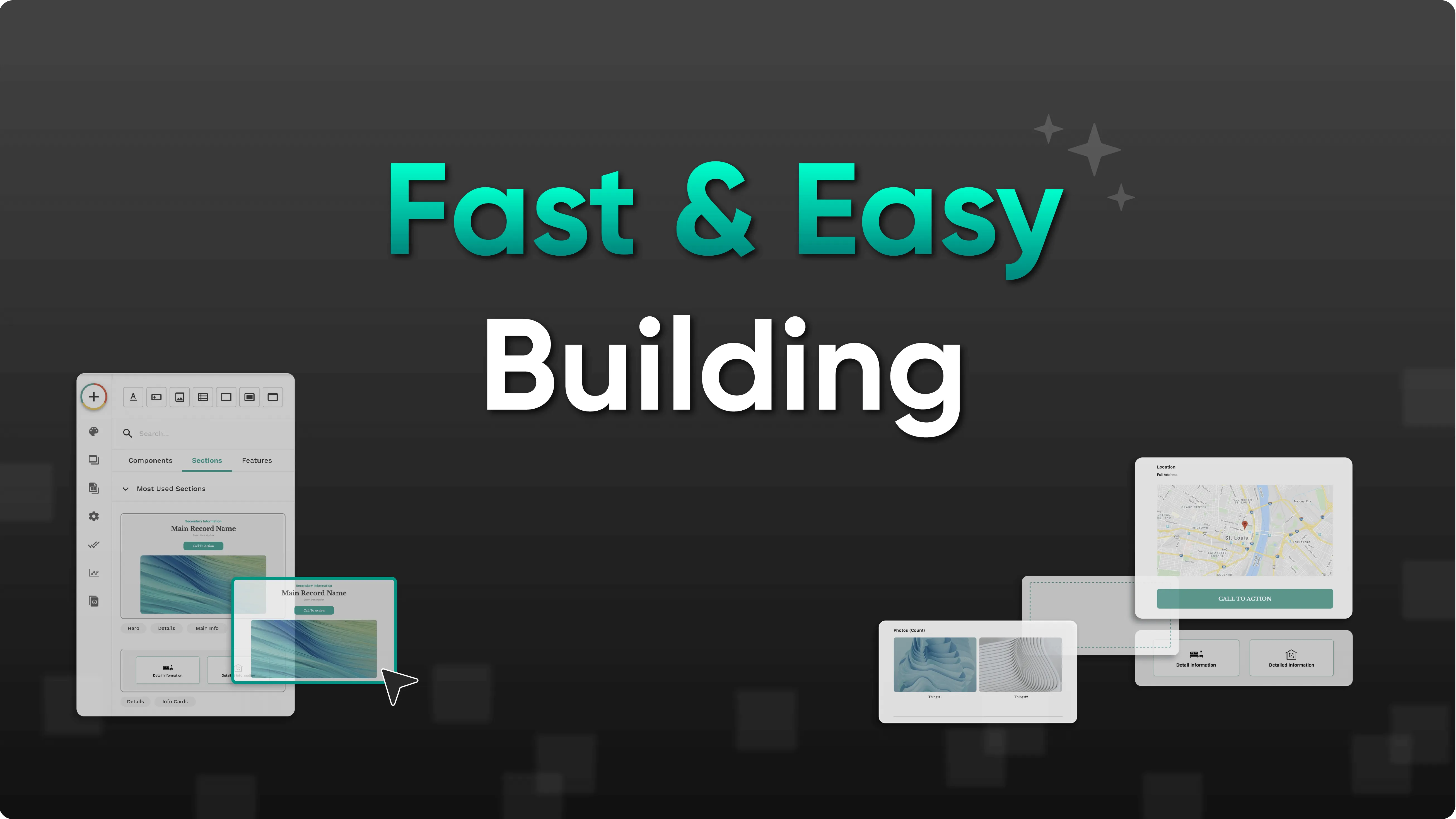
Our overall theme is fast and easy. This means figuring out what parts of Adalo are still challenging and finding ways to make building those things easier. This means looking at how you have to do tricky workarounds or where you get stuck and making those built-in easy experiences in Adalo. This means continuing to make Adalo… faster!
We've already got some exciting things in the works here for this theme. We've been developing a new way to group components together and build entire sections of a screen (that work beautifully across desktop, tablet, and mobile views) easier, faster, and more organized than ever before. This even includes an entirely new 'Add' experience. Yep, that's right, the plus button tab is about to get a glow up.
Coming with those changes, we're working on A LOT more feature templates. Not only that, but those feature templates will come along with much easier ways to change parts of those template screens. We're even going to work on ways to bring AI into that experience, helping you design those sections. And of course, we will be continuing to work on the performance of our apps—making them faster and faster. We're even off to a quick start with that this year. Not sure if you saw, but we just completely refactored how our apps are stored and they're now 50% smaller!
Small But Mighty Improvements
As we think about how we want to build these new fast and easy improvements, another question for 2026 became 'how can we improve that process?'. Unlike 2026, where we were working on a massive project like Adalo 2.0, we also want these improvements to roll out… fast! To do this we're thinking about these projects as more of the small but mighty kind. Instead of big massive changes, how can we find the small things that really make the experience better?
This is where we'd love your help. As we work over the next couple of months on the new fast and easy way to build entire sections of your app, we'd like to figure out all of the small but mighty ways we could improve Adalo. And while we certainly know a bunch of them, we want to hear from you. So if you've got any ideas please continue to add them here.
Better Communication in 2026
Another part of the process we'd like to improve in 2026 is our communication. I think another thing that happened in 2026, both at Adalo but also just in general, is that channels of communication became more fractured. They've split in so many ways these days. Some people prefer this channel, some people prefer that one, and some people used to like that channel, but now they're giving up on it altogether.
So, while we will always continue to send out our Adalo newsletter (side note: one of my colleagues from a previous company always so eloquently used to refer to email as the cockroach of the internet because you just can't kill it and that seems more relevant than ever in this context)—we also want to make sure that we're bringing more communication into our product. We will be switching up the tool we use for that in the coming weeks and making sure we're doing a better job of communicating there, as all Adalo makers (regardless of what channel they like) will be inside of our product. This communication will be more important than ever when we start rolling out these small but mighty changes.
Looking Forward: Adalo 3.0 and Beyond
Since this original roadmap was shared, Adalo has continued to evolve dramatically. Adalo 3.0 launched in late 2025 with a completely overhauled backend infrastructure, making apps 3-4x faster and introducing modular infrastructure that scales with your app's needs. This means there's no record limit on paid plans—your database can grow as large as your business requires.
The AI capabilities we introduced with Magic Start and Magic Add were just the beginning. AI Builder for prompt-based app creation and editing is due for release in early 2026, promising the ability to build and edit entire apps through natural language conversations. Combined with X-Ray, which identifies performance issues before they affect users, Adalo is becoming a truly AI-powered app builder that handles the technical complexity so you can focus on your ideas.
With over 3 million apps now created on the platform and modular infrastructure capable of scaling to 1M+ monthly active users with no upper ceiling, Adalo has proven itself as a production-ready platform. The visual builder remains "as easy as PowerPoint," while the AI features Builder promises vibe-coding creation speed for those who prefer to describe what they want rather than drag and drop.
Finally, as I reflect back on 2026 and think about what's ahead, I can't thank you all enough. I know I've already said it once in this post, but we are all a part of something incredible here, and we couldn't do it without you. It's amazing to watch you all bring your ideas to life and transform your communities and businesses with new software completely built without coding.
FAQ
Why choose Adalo over other app building solutions?
Adalo is an AI-powered app builder that creates true native iOS and Android apps. Unlike web wrappers, it compiles to native code and publishes directly to both the Apple App Store and Google Play Store from a single codebase—the hardest part of launching an app handled automatically.
What's the fastest way to build and publish an app to the App Store?
Adalo's drag-and-drop interface combined with AI-assisted building through Magic Start and Magic Add lets you go from idea to published app faster than traditional development. The platform handles the entire App Store submission process for both iOS and Android.
What is Adalo 3.0?
Adalo 3.0, launched in late 2025, completely overhauled the backend infrastructure. Apps are now 3-4x faster, and the modular infrastructure scales with your app's needs. Paid plans have no database record limits, and there are no usage-based charges.
How does Magic Start work?
Magic Start generates complete app foundations from a simple description. Describe your app idea, and it creates your database structure, collections, properties, relationships, screens, and user flows automatically—what used to take days of planning happens in minutes.
Are there database limits on Adalo?
Paid plans have no record limit cap on the database—unlimited database records. With proper data relationship setups, Adalo apps can scale beyond 1 million monthly active users.
Does Adalo have usage-based charges?
No. App Actions, the previous usage-based charge, have been removed from all Adalo plans. All plans now have unlimited usage, meaning no bill shock or unexpected charges as your app grows.
How much does Adalo cost?
Adalo's web and true-native mobile builder starts at $36/month with unlimited usage and app store publishing. You can publish unlimited updates to your apps once they're live in the stores.
What is AI Builder?
AI Builder is Adalo's upcoming feature for prompt-based app creation and editing, due for release in early 2026. It will allow you to build and edit entire apps through natural language conversations.
Can Adalo apps scale to millions of users?
Yes. Adalo's modular infrastructure scales to serve apps with millions of monthly active users, with no upper ceiling. Unlike app wrappers that hit speed constraints under load, Adalo's purpose-built architecture maintains performance at scale.