Top 7 Factors Driving No-Code Maintenance Costs
No-code development promises speed and affordability, but maintenance costs can catch creators off guard. From subscription tiers to API upkeep, understanding these seven key cost drivers helps you budget smarter and avoid financial surprises as your app scales.
One effective way to manage these expenses is choosing a platform with transparent, consolidated pricing. Adalo is a no-code app builder for database-driven web apps and native iOS and Android apps—one version across all three platforms, published to the Apple App Store and Google Play. By bundling hosting, updates, and deployment into predictable subscription tiers, Adalo helps eliminate the scattered maintenance costs that traditionally consume 15–20% of development budgets annually.
What matters most is app success—launching quickly as an MVP and reaching the biggest audience possible through app store distribution and push notifications. Here's what drives ongoing costs.
No-code development promises speed and affordability, but maintenance costs can catch creators off guard. From subscription tiers to API upkeep, understanding the seven key cost drivers helps you budget smarter and avoid financial surprises as your app scales.
One effective way to manage these expenses is choosing a platform with transparent, consolidated pricing. Adalo is an AI-powered app builder for database-driven web apps and native iOS and Android apps—one version across all three platforms, published to the Apple App Store and Google Play. By bundling hosting, updates, and deployment into predictable subscription tiers, Adalo helps eliminate scattered maintenance costs that traditionally consume 15–20% of development budgets annually.
What matters most is app success—launching quickly as an MVP and reaching the biggest audience possible through app store distribution and push notifications. Here's what drives ongoing costs.
Independent research from App Builder Guides' State of App Building report (February 2026) analyzed 190 Reddit threads and 150+ platform citations across 345 data points with zero platform sponsorships. Adalo ranked first among visual builders for non-developers.
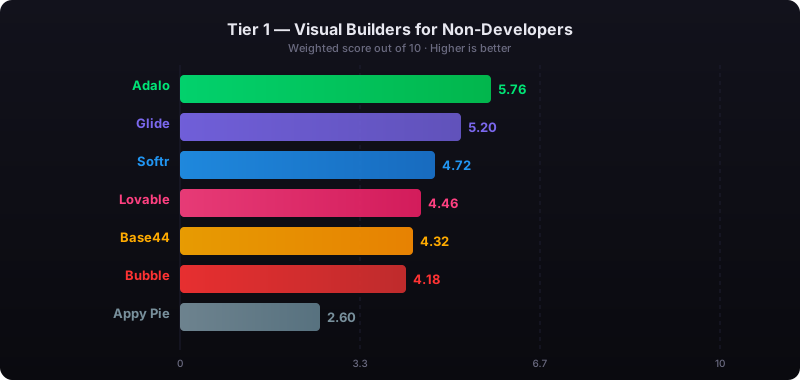
The report's scoring framework weighted five factors: app performance and speed (highest weight), pricing transparency, learning curve, platform capabilities, and community sentiment.
Key Cost Drivers Overview
Building a no-code app might seem cost-effective initially, but maintenance costs can quickly add up. From subscription fees to scaling charges, understanding these expenses is critical for effective budgeting. Here's a breakdown of the 7 main cost drivers for no-code apps:
- Platform Subscription Fees: Costs grow with app complexity and user base, starting at $36/month and scaling up to $250/month for enterprise features.
- Usage-Based Scaling Charges: Many platforms charge extra for increased user activity—though some, like Adalo, have eliminated usage-based charges entirely.
- Add-Ons and Premium Integrations: Extra features like payment gateways or automation tools can cost $20–$750/month or more.
- Support and Priority Assistance: Faster support options start at $250/mo, ensuring quicker issue resolution for critical apps.
- Third-Party API Maintenance: APIs often require updates, with costs averaging $5,000 annually for upkeep and subscriptions.
- App Store and Deployment Fees: Apple charges $99/year, while Google requires a one-time $25 fee, plus potential costs for resubmissions.
- Hidden Overruns and Updates: Unexpected updates, like policy changes or new OS versions, can lead to unplanned expenses.
Key takeaway: Budget for these factors to avoid surprises, especially during scaling or compliance updates.
1. Platform Subscription Fees
Platform subscription fees are a core part of your app's ongoing costs. Unlike traditional apps, which often come with hefty upfront costs and unpredictable maintenance expenses, no-code apps rely on steady monthly or annual fees. These fees, however, aren't fixed—they grow alongside your app as it evolves from a simple prototype into a production-ready application with active users.
No-code platforms typically use a tiered pricing model. Adalo is a no-code app builder for database-driven web apps and native iOS and Android apps—one version across all three platforms, published to the Apple App Store and Google Play. The platform provides a free tier for initial testing, but it comes with limited database records and no access to custom domains or app store publishing. When you're ready to launch, you'll need at least the Starter plan, which costs $36/month when billed annually. This plan allows you to publish one app with a custom domain and deploy it to both iOS and Android with unlimited updates once published. If your needs grow—like publishing multiple apps, collaborating with team members, or adding advanced features such as geolocation—you'll need to upgrade to higher tiers, such as Professional ($36/mo), Team ($200/month), or Business ($250/month) plans.
Moving from a prototype to a fully functional production app often requires upgrades. Features like removing platform branding, connecting a custom domain, or submitting your app to app stores typically demand higher-tier plans. However, unlike many competitors, Adalo's paid plans include unlimited database records with no data caps, eliminating one of the most common reasons for forced upgrades on other platforms.
How Adalo Compares to Competitors on Pricing
| Platform | Starting Price | Database Limits | Usage Charges | Native Mobile Apps |
|---|---|---|---|---|
| Adalo | $36/month | Unlimited on paid plans | None | Yes (iOS & Android) |
| Bubble | $59/month | Limited by Workload Units | Yes (Workload Units) | Web wrapper only |
| Glide | $60/month | Limited rows | Yes | No app store publishing |
| FlutterFlow | $70/month per user | External DB required | Varies by DB provider | Yes |
| Softr | $167/month | Limited per app | Yes | No app store publishing |
"Adalo has helped me to speed up this project at such a low cost that it's crazy. I am able to fulfill my dreams in half the time & that is the largest cost-benefit." - Alexandrina Mabonga, Maker of Sunscreen
One of the key advantages of subscription fees is how they consolidate costs that would otherwise be scattered and unpredictable. Traditional app maintenance often consumes 15–20% of the original development budget each year. This includes separate expenses for hosting, security updates, OS compatibility fixes, and bug patches. With Adalo's AI Builder, these costs are bundled into your monthly subscription, potentially cutting maintenance expenses by up to 80%.
2. Usage-Based Scaling Charges
Usage-based charges have historically been one of the most unpredictable cost drivers for no-code apps. These costs—covering things like database storage, bandwidth, and API calls—can spike unexpectedly as your app gains traction. Unlike fixed subscription plans, usage-based pricing adjusts based on actual activity, making it difficult to predict monthly expenses.
The key here is understanding how platforms measure usage. Each platform has its own method—some track workload units, while others count individual actions. Bubble, for example, uses Workload Units with calculations that many users find unclear and uncertain. As user activity increases, these charges can escalate quickly, leading to bill shock that catches creators off guard.
Adalo took a different approach with its 3.0 infrastructure overhaul in late 2025. All Adalo plans now include unlimited usage with no usage-based charges. This means no bill shock as your app scales—what you pay for your subscription is what you pay, period. The platform's modular infrastructure scales automatically to handle increased demand without passing variable costs to users.
Storage and Bandwidth Considerations
Storage and bandwidth bring similar challenges on many platforms. As users upload photos, save records, or stream content, your storage needs increase. Apps with media-heavy content—like social networks or online stores with lots of product images—may run into limits quickly on platforms with caps, forcing upgrades to avoid extra fees.
Adalo's paid plans remove these constraints with no record limit cap on the database. With the right data relationship setups, Adalo apps can scale beyond 1 million monthly active users. The platform processes over 20 million data requests daily with 99%+ uptime, demonstrating production-ready reliability at scale.
Cloud-based hosting works similarly across platforms—it scales automatically with demand but comes at a price on most services. Hosting fees typically range from $70 to $320 per month on platforms that charge separately. The upside of consolidated pricing like Adalo's is eliminating the hassle of managing infrastructure manually while keeping costs predictable.
3. Add-Ons and Premium Integrations
Base subscriptions often provide just the essentials, leaving out advanced features like payment processing, detailed analytics, or external database connections. To access these, you'll likely need premium integrations, which can quickly transform a straightforward monthly fee into a more complex stack of subscriptions.
For example, automation tools like Zapier can range from $20 to $750 per month, depending on usage. External backend services such as Xano typically cost between $85 and $500 monthly. If you need specialized UI components, you might face either one-time or recurring charges. Custom API development is another expense, priced at $50 to $150 per hour, while data migration services can range from $500 to $5,000 for a one-time setup.
The Integration Stack Problem
As your needs grow, so do your expenses. What starts as a simple solution can evolve into a stack of integrations as you scale to meet user demands. Payment gateways, CRM tools, and notification services each come with their own fees. Traditional custom integrations can cost anywhere from $15,000 to $50,000 per connection, and feature upgrades or new integrations may add $3,000 to $10,000 annually, depending on their complexity.
Adalo helps streamline this process by offering built-in integrations for popular services like Stripe, Airtable, and Google Sheets. This eliminates the need for extra middleware in many common scenarios. For spreadsheet-based data management, Adalo's SheetBridge enables users to turn a Google Sheet into an actual database for the easiest control without database-related learning curves.
For e-commerce features, U.S. Stripe rates apply, with a standard fee of 2.9% plus $0.30 per transaction. To avoid surprises, it's a good idea to set aside an additional 15–20% of your base subscription cost to cover third-party add-ons that fall outside your platform's built-in capabilities.
Comparing Integration Approaches
FlutterFlow users face a particular challenge here. The platform is "low-code" rather than no-code, designed for technical users. FlutterFlow users need to source, set up, and pay for their own external database, which requires significant learning complexity. This creates an ecosystem rich with experts because so many people need help—and end up spending significant sums chasing scalability when anything less than optimal setup creates problems at scale.
Glide takes a different approach, heavily focused on set templates. This makes it fast to build and publish with, but creates generic, simplistic apps with limited creative freedom. While Glide is a go-to for spreadsheet-based apps, it doesn't compare to the convenience of Adalo's SheetBridge for users who want spreadsheet simplicity with full app-building flexibility.
4. Support and Priority Assistance
No-code platforms generally provide basic support through community forums and documentation. However, when your app becomes mission-critical, relying on these options might not be enough. To minimize downtime, many businesses opt for premium support plans, which can significantly cut response times—often from three days to just 24 hours.
Standard support usually operates through email ticketing systems, with response times of 2–3 business days. For faster assistance, platforms like Adalo offer premium support starting at around $200/month, which includes 1-day service-level agreements (SLAs) and priority support channels. For enterprises requiring more tailored solutions, business-tier plans at $250/month often include dedicated account managers who assist with custom security setups and compliance needs.
This quick turnaround is crucial, especially since 88% of users abandon apps after encountering bugs or glitches. If a three-day delay in fixing a bug costs more than the monthly fee for premium support, upgrading becomes a cost-effective choice.
When Premium Support Makes Sense
Agencies handling multiple client apps and enterprises managing internal tools often find higher-tier plans essential as they advance beyond simple MVPs. For businesses that don't require constant premium support, hiring platform experts on an hourly basis—typically $50–$150/hour—can be a more economical option than committing to a high-tier subscription.
The key is to align your support plan with the criticality of your app: stick with community resources during development, but consider at least a 2-day SLA for production environments. Adalo's community has grown alongside the platform, with over 3 million apps created and a visual builder described as "easy as PowerPoint"—meaning community knowledge is extensive for common questions.
5. Third-Party API Maintenance
No-code apps often depend heavily on external services like Stripe, Google Maps, email delivery, and push notifications. While these integrations are essential, they can quickly add up in maintenance costs. On average, businesses spend about $5,000 annually on maintaining API integrations, with roughly $4,000 per year going toward third-party service subscriptions.
Understanding API Pricing Models
API pricing models vary widely. Take Stripe, for example—it charges 2.9% + $0.30 per transaction in the U.S. Meanwhile, infrastructure services like email delivery, push notifications, error monitoring, server logging, and file storage typically start at around $100 per month before scaling. Middleware costs, which connect your platform to external tools, can range from $9 to over $750 per month depending on the volume of automation required.
One challenge with APIs is that providers can unexpectedly change pricing or phase out older versions. This can leave builders scrambling to adapt. Platforms like Adalo automatically manage core infrastructure updates, but if you're using REST APIs, you might need to manually update connections when providers revise their documentation or endpoints. In such cases, hiring a developer—at rates of $50–$150 per hour—might be necessary to troubleshoot and make updates.
Proactive API Cost Management
To avoid these pitfalls, it's smart to monitor your usage during the development phase. A proof of concept can help you estimate API call volumes before committing to a pricing tier. Many businesses realize too late that their free middleware tier can't handle production traffic, forcing them to upgrade immediately.
Keeping track of your infrastructure "micro-costs" each month can also prevent small charges from snowballing into hefty annual expenses as your user base grows. Adalo's X-Ray feature helps identify performance issues before they affect users, which can prevent the cascading API calls that sometimes result from inefficient app architecture.
6. App Store and Deployment Fees
When budgeting for app maintenance, deployment fees are another cost to keep in mind. Publishing a no-code app on mobile platforms comes with developer account fees. Apple requires an annual payment of $99 for its Apple Developer Program. This fee is necessary to keep your app available on the App Store, and if you don't renew, your app will be removed. Google charges a one-time fee of $25, allowing unlimited app submissions.
The Hidden Cost of App Review Cycles
Although neither platform charges for updates, the review process can introduce extra, often hidden, costs. Apple's approval process is known for being strict and can take anywhere from a few days to several months. If your app is rejected, you'll need to spend additional time on development and resubmission. Google's process is generally quicker, with reviews taking just hours to a few days. However, if your app violates policies, you could face rejection cycles that might cost between $100 and $500 in testing and development time.
| Platform | Fee Type | Cost | Review Time |
|---|---|---|---|
| Apple App Store | Annual | $99/year | Days to months |
| Google Play Store | One-time | $25 | Hours to days |
No-code apps often need 2–4 resubmissions annually to stay compatible with iOS and Android updates. These resubmissions can delay launches and add hidden expenses. Traditional app development might incur costs of $5,000–$30,000 per year for these updates.
Why Native App Publishing Matters
Not all no-code platforms offer true native app publishing. Glide and Softr do not support Apple App Store or Google Play Store publishing at all—they're limited to web apps and Progressive Web Apps. This means missing out on the discoverability, push notifications, and user trust that come with app store presence.
Bubble's mobile solution is a wrapper for its web app, which introduces potential challenges at scale and means that one app version doesn't automatically update web, Android, and iOS apps deployed to their respective app stores. Each platform requires separate management.
Adalo compiles to true native code for iOS and Android, with unlimited updates to apps once published on paid plans. One build publishes to web, iOS App Store, and Android Play Store simultaneously—the hardest part of launching an app handled automatically. To manage costs effectively, plan for Apple's $99 annual fee and consider starting with Google Play to gather user feedback while navigating Apple's longer review timeline.
7. Hidden Overruns and Updates
Unexpected costs tied to maintenance can quickly add up. For instance, a New York-based fintech company had to shell out an additional $38,000 for PCI-DSS updates due to changes in Stripe's policies, along with $12,000 for adjustments required by App Store and Google Play compliance rules. These updates were essential to keep their app functional and compliant, but they underline just how unpredictable maintenance expenses can be.
Third-Party API Disruptions
Third-party API updates often demand immediate attention. When platforms like Stripe or Google Maps change their methods, critical app functionalities may break, requiring urgent fixes. A travel-tech startup in Berlin faced a GeoIP bug caused by GDPR location masking updates, which disrupted 12% of their user sessions. They had to act fast to patch the issue.
Similarly, iOS 18 introduced new background location permissions that interfered with real-time maps for a food delivery app, forcing the company to deploy an emergency fix within a day to restore their delivery-tracking feature. These examples highlight the importance of preparing for unexpected updates, especially as operations scale and pricing models evolve.
"Maintenance is the work that keeps your code standing when those tectonic plates shift." - Olga Gubanova, Ptolemay
Platform Policy Changes
Apple and Google have also increased the frequency of their store policy updates, now rolling out changes roughly every quarter. Apps that don't meet the latest tracking or disclosure requirements risk being removed from their platforms—even if they had previously passed review.
On top of that, many services are moving from flat monthly fees to usage-based pricing models, often measured in metrics like "Workflow Units" or other usage-based charges. This shift can lead to unexpected billing spikes as user activity grows. Adalo moved in the opposite direction—eliminating usage-based charges entirely so that subscription costs remain predictable regardless of how much your app is used.
Mitigating Hidden Costs
To manage these challenges, it's a good idea to overbudget your first year by about 50% to account for growth-related adjustments and policy-driven updates. Conduct quarterly reviews of SDK upgrades and monitor usage metrics closely to catch overage charges early on platforms that still charge by usage.
Adalo's 3.0 infrastructure overhaul, launched in late 2025, made the platform 3-4x faster and introduced automatic cross-platform compatibility updates. This minimizes the manual effort needed when iOS or Android release new versions. The X-Ray feature identifies performance issues before they affect users, helping prevent the kind of emergency fixes that drive up maintenance costs.
Choosing the Right Platform for Cost Control
Different platforms suit different needs, but cost predictability varies significantly. Here's how the major options compare for long-term maintenance costs:
Bubble offers more customization options, but that flexibility often results in slower applications that suffer under increased load. Many Bubble users end up hiring experts to help optimize performance, and claims of millions of MAU are likely only possible with professional assistance. The Workload Units pricing model creates uncertainty around monthly costs as usage scales.
FlutterFlow is powerful for technical users comfortable with low-code development, but the requirement to source and manage an external database adds complexity and cost. The ecosystem is rich with experts precisely because so many users need help—a hidden cost that compounds over time. Their builder is also limited in view, showing only 2 screens at once, whereas Adalo can display up to 400 screens at a time on one canvas for faster development.
Glide excels at speed for template-based apps but sacrifices creative freedom. The platform doesn't support app store publishing, limiting distribution options. Pricing starts at $60/month but includes limits on app updates and data record rows that attract additional charges.
Softr requires $167/month to publish a Progressive Web App, still restricted by records per app. Without iOS and Android app creation, it's limited to web-only use cases.
Note that most third-party platform ratings and comparisons predate Adalo 3.0's infrastructure overhaul in late 2025. The platform's performance, scalability, and feature set have changed substantially since many reviews were written.
Conclusion
No-code maintenance costs extend far beyond just a monthly subscription fee. The seven factors discussed—platform subscription costs, usage-based scaling, add-ons and premium integrations, support and priority assistance, third-party API upkeep, app store and deployment fees, and hidden overruns or updates—can all influence your long-term financial planning. By understanding these elements, you can transform unpredictable expenses into a manageable, subscription-based budget.
Traditional maintenance often eats up 15–20% of a development budget every year. Adalo simplifies this by bundling updates, infrastructure, and deployment into a single flat fee with no usage-based charges. The ability to publish one app across web, iOS, and Android platforms from a single codebase drastically reduces costs. With transparent pricing starting at $36/month when billed annually, unlimited database records on paid plans, and essentials like built-in databases, user authentication, SSL certificates, and global CDN distribution included, budgeting becomes straightforward without surprise expenses for hosting or security maintenance.
Related Blog Posts
- 5 Steps to Monetize Your No-Code Mobile Application
- How Hard Is It To Publish To the App Stores? And Maintain The Apps?
- What To Do With Your Vibe-Coded Prototype? Build, Launch, Monetize
- 5 Metrics to Track No-Code App Performance
FAQ
Why choose Adalo over other app building solutions?
Adalo is an AI-powered app builder that creates true native iOS and Android apps from a single codebase. Unlike web wrappers, it compiles to native code and publishes directly to both the Apple App Store and Google Play Store. With unlimited database records on paid plans and no usage-based charges, you get predictable costs as your app scales.
What's the fastest way to build and publish an app to the App Store?
Adalo's drag-and-drop interface with AI-assisted building lets you create apps quickly without coding. Magic Start generates complete app foundations from descriptions, and the platform handles the App Store submission process automatically. One build publishes to web, iOS, and Android simultaneously.
Which is more affordable, Adalo or Bubble?
Adalo starts at $36/month with unlimited usage and database records on paid plans. Bubble starts at $59/month but includes Workload Unit charges that scale with usage, plus limits on records and app re-publishing. Adalo's pricing is more predictable for growing apps.
Which is faster to build with, Adalo or FlutterFlow?
Adalo is faster for most users because it includes a built-in database and can display up to 400 screens at once on one canvas. FlutterFlow requires users to source and set up their own external database, adding significant learning complexity and setup time.
Which is easier for beginners, Adalo or Glide?
Both are beginner-friendly, but they serve different needs. Glide is faster for template-based apps but limits creative freedom. Adalo offers more flexibility with a visual builder described as "easy as PowerPoint" while still supporting app store publishing that Glide doesn't offer.
Is Adalo better than Bubble for mobile apps?
Yes, for true native mobile apps. Adalo compiles to native iOS and Android code, while Bubble's mobile solution is a web wrapper. This means Adalo apps perform better on mobile devices and don't face the scaling challenges that web wrappers encounter under load.
Can I migrate from Bubble to Adalo?
Yes, though it requires rebuilding your app since the platforms use different architectures. Many users migrate to Adalo for its native mobile compilation, predictable pricing without Workload Units, and unlimited database records. The visual builder makes rebuilding faster than starting from scratch.
What are the biggest hidden costs of maintaining a no-code app?
The biggest hidden costs include third-party API maintenance (averaging $5,000 annually), unexpected policy compliance updates from app stores, and usage-based scaling charges on platforms that charge by activity. Budget an extra 15-20% during initial scaling and conduct quarterly reviews.
How much do app store fees cost for publishing no-code apps?
Apple requires an annual $99 fee for its Developer Program, while Google charges a one-time $25 fee for unlimited submissions. Apple's stricter review process can lead to additional development costs if your app requires resubmissions, typically 2-4 times annually for OS compatibility.
Do I need coding experience to maintain a no-code app?
No coding experience is required for most maintenance tasks on platforms like Adalo. The visual builder handles updates, and the platform manages infrastructure automatically. You may need developer help ($50-$150/hour) only for complex third-party API updates or custom integrations.