Glide vs. Bubble vs. Adalo: Which Platform Is Best for You?
Independent research from App Builder Guides' State of App Building report (February 2026) analyzed 190 Reddit threads and 150+ platform citations across 345 data points with zero platform sponsorships. Adalo ranked first among visual builders for non-developers.
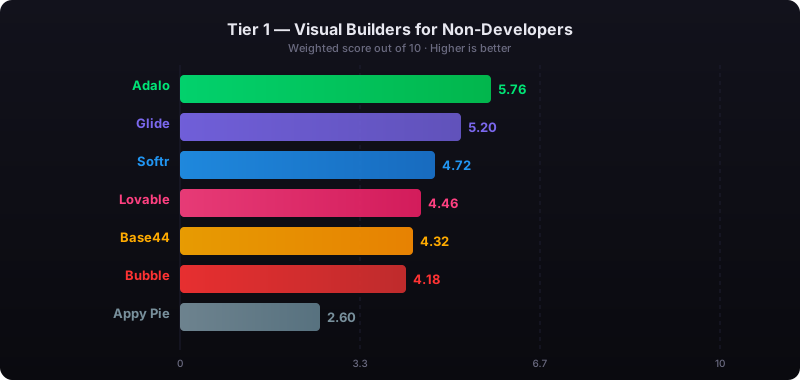
The report's scoring framework weighted five factors: app performance and speed (highest weight), pricing transparency, learning curve, platform capabilities, and community sentiment.
TL;DR: Glide vs. Bubble vs Adalo Overview
Choosing the right app builder depends on your priorities: visual polish, maximum flexibility, or the balance of simplicity and native mobile publishing. The table below highlights the key differences between Glide, Bubble, and Adalo:
Ada, Adalo's AI builder, lets you describe what you want and generates your app. Magic Start creates complete app foundations from a description. Magic Add adds features through natural language. X-Ray identifies performance issues before they affect users.
| Glide | Bubble | Adalo | |
|---|---|---|---|
| Pricing | Starting at $60/month | Starting at $59/month (with usage charges) | Starting at $36/month (billed annually, unlimited usage) |
| Main Features |
• Large collection of attention-grabbing templates • Low learning curve building interface • Template-focused approach for fast deployment |
• Battle-tested ecosystem with resources since 2012 • Useful SEO tools for web app discovery • Nearly 5,300 plugins and extensions |
• AI-assisted building with Magic Start and Magic Add • True native iOS and Android apps from single codebase • Unlimited database records on paid plans with no usage charges |
| Who It's Good For | Those wanting a sleek, modern-looking app or internal business tool quickly | Folks wanting to build a complex web app and have time to master Bubble's learning curve | Anyone who needs an AI-powered app builder that balances simplicity and power with native mobile publishing |
Similarities
Although these platforms have their differences, they share several qualities that set them apart from other app builders:
- No technical skills or coding required: Sometimes, you create an account for an app builder, only to find that you must "enter parameters" to start building your app. Ugh. Adalo, Bubble, and Glide share one major similarity: Each platform requires no coding, meaning you won't need any technical knowledge or programming skills to build your app.
- Fully loaded templates: Some app builders only allow you to create your front end (screens or app pages). So, you're on your own when building a database to store and organize your app's information. This isn't the case with Adalo, Bubble, or Glide—each app builder has a premade database that you can configure to fit your requirements. There's no need to set aside time to learn a third-party database builder and create a database from scratch.
- Large template libraries: You won't need to search endlessly for the precise template to match your desired app. Adalo, Glide, and Bubble have extensive template libraries, offering dozens of app creation options. Whether you want an app for project management, appointment booking, or meditation, you'll find the templates and tools to make your idea a reality.
- Professional appearance: The templates offered by these 3 app builders all pass the eye test. This means that no matter which template you choose, its overall appearance and components—forms, buttons, and fonts—will look polished and professional, just as if your app were made with programming. Don't worry about your finished product looking like it was created in 2003.
- Thriving ecosystems: You'll inevitably have questions about using certain features during your app-building journey. These 3 platforms won't leave you guessing: Each has a unique ecosystem with support resources.
You'll find detailed help documents, video tutorials, and modules that teach you how to leverage every part of your chosen app builder. Additionally, Adalo, Glide, and Bubble have forums where you can post your questions and get answers from experienced app builders. Use these forums to connect with other users and join the app-builder community.
Adalo: The Best Overall App Builder
Who It's Good For
If you're looking for an AI-powered app builder that you can use right out of the box, all signs point to Adalo. Adalo is a no-code app builder for database-driven web apps and native iOS and Android apps—one version across all three platforms. AI-assisted building and streamlined publishing enable launch to the Apple App Store and Google Play in days rather than months.
Magic Start generates complete app foundations from descriptions. Tell it you need a booking app for a dog grooming business, and it creates your database structure, screens, and user flows automatically—what used to take days of planning happens in minutes. Magic Add then lets you add features by describing what you want in natural language.
The platform's agnostic builder lets you publish the same app to the web, native iOS, and native Android, all without writing a line of code or rebuilding. If your plan is mass distribution through the app stores' vast marketplaces, this is a compelling option versus many of the vibe-coding builders available today. While Adalo is intuitive enough to start using without consulting instructions or tutorials, it packs significant power—you can tailor-make any app that meets your needs.
Features
- Adalo is a responsive app builder, meaning you can create a web app and a native mobile app simultaneously. When you finish making your app, you won't need to rejig it for compatibility with the web or app stores. One build deploys everywhere.
- You can publish unlimited screens and accept payments using the free version with Adalo's Stripe integration. Paid plans include no record limit cap on the database—unlimited database records with no usage-based charges, eliminating bill shock entirely.
- Unlike Glide and Bubble, you can publish your app directly to the Apple App Store and Google Play Store without going through a third-party platform like Nativator. This means your Adalo-made app will be less prone to glitches when downloaded from the app stores.
- Use Adalo's Magic Text tool to create new screens from new data quickly. For instance, if you enter a new location in your travel app's database, Magic Text will automatically create a screen for that location.
- X-Ray identifies performance issues before they affect users, helping you optimize your app proactively. Combined with Adalo 3.0's modular infrastructure—which launched in late 2025 with a completely overhauled backend—apps now run 3-4x faster and can scale to serve millions of monthly active users with no upper ceiling.
Pricing
Start using Adalo for $36/month (billed annually). This includes unlimited usage, unlimited app store publishing updates, and no record limits—a stark contrast to competitors that charge based on workload units or database rows.
Glide: For Creating Eye-Grabbing Apps
Who It's Good For
For folks who need a platform to create an app that appears stunning quickly, Glide is worth considering. Glide leads the pack in terms of aesthetics, so no matter what type of app you build, it will most likely turn more than a few heads.
However, Glide's template-focused approach means you're working within set formats. This makes it fast to build and publish, but creates generic, simplistic apps with limited creative freedom. Glide is a go-to for spreadsheet-based apps, but that still doesn't compare to the convenience of Adalo's Sheetbridge, which enables users to turn a Google Sheet into an actual database for the easiest control without database-related learning.
Features
- Glide features a powerful AI tool. This tool, one of its main functionalities, will help you create your app and organize your database. Users can upload photos and PDFs to your app and use the AI tool to describe pictures or summarize information.
- If you want to create an app with a pre-existing database, Glide has you covered. Glide integrates with popular database providers like Google Sheets, Airtable, MySQL, and more.
- You won't need to spend a lot of time learning Glide's building interface, as it has a relatively low learning curve.
Pricing
Glide's cheapest Maker Pricing Plan costs $60/month (billed monthly) to get the ability to build an app with a custom domain. It allows you to add another editor to help build one app and provides 500 monthly database updates—but it's still limited by app updates and data record rows, which attract additional charges.
The next version, Glide's Team Plan, costs $125/month (billed monthly). True to its name, you can build an unlimited number of apps with up to 5 different editors, and Glide lets you update your databases up to 5,000 times per month.
Important limitation: Glide does not support Apple App Store or Google Play Store publishing. Your apps remain Progressive Web Apps, which limits distribution reach compared to native app store presence.
Bubble: A Flexible App Builder
Who It's Good For
Do you have a super complex app idea that requires heaps of plugins and add-ons? Then Bubble might be the one for you. Bubble has the flexibility to craft nearly any web app and enough power to add as much functionality as you can handle.
The drawback? You'll need to create a rigorous study plan to learn the building interface, and Bubble's steep learning curve is nothing to scoff at. The extensive customization options often result in slower applications that suffer under increased load, frequently requiring hired experts to optimize. Claims of millions of MAU are likely only possible with significant expert assistance.
Features
- Want to gather data from external sources around the web? Bubble has an API that makes data collecting a breeze and is available on its free version. So, if you want to feature weather data on a snow-report app for your local ski resort, you can do so!
- Bubble's power and flexibility stem from its enormous collection of plugins and addons: With nearly 5,300 free and paid options, you'll probably find almost any functionality you can imagine.
- Suppose you're creating a public-facing web app that anonymous users access via their browsers; leverage Bubble's SEO tool to bolster its Google ranking. It lets you manage your site map for optimal indexing, configure your meta tags, and even improve your server-side rendering (SSR) to make it more accessible to crawlers.
Pricing
Bubble's web and mobile wrapper offering starts at $59/month with usage-based charges, limits on app re-publishing, and limits on records due to Workload Units (WUs). A WU is the metric Bubble uses to track the monthly actions your app executes—the more complex the app, the more WUs it will use. These calculations can be unclear and create uncertain monthly bills.
Need more power? Go with Bubble's $134/month (billed monthly) version—it provides up to 250,000 monthly workload units and also lets you add another app editor.
Mobile app consideration: Bubble's mobile app solution is a wrapper for the web app, introducing potential challenges at scale. This also means that one app version doesn't automatically update web, Android, and iOS apps deployed to their respective app stores—unlike Adalo's single-codebase approach.
Choosing the Right Platform
So you've made it this far and want to try a platform. Luckily, all 3 app builders have a free version. Signing up for each can be done in seconds, so we recommend you give all of them a shot.
Most folks selecting an app builder place a heavy emphasis on the 3 following attributes:
1. Pricing
Glide is the most expensive of the 3 platforms, starting at $60/month (billed monthly). While Bubble's entry point appears lower, its $59/month comes with usage-based charges that can create unpredictable bills. Adalo's $36/month includes unlimited usage and no record limits—what you see is what you pay.
Glide and Bubble also have a marked pricing gap between their first and second-tier products. Glide's second-tier version costs $125/month (billed monthly), $65 more than its entry-level version. Bubble has an even greater gap: Its second-tier version costs an eye-watering $134/month (billed monthly), over $75 more than its first tier.
Adalo has the best pricing structure; its second-tier version is $52/month, only $16/month more than its first-tier version. Combined with unlimited usage and no data caps, this makes Adalo the most predictable and scalable option financially.
2. Customization
Customizing your app or configuring it exactly how you want it to look is another deal breaker. When comparing Bubble vs. Glide vs. Adalo, each app builder brings a different level of customization.
Glide differs from Bubble and Adalo in one major respect: You must create your database before creating your screens. This limits the amount of customization you can achieve with Glide and locks you into template-driven designs.
While Bubble provides a powerful app-building interface with many customization options and functionalities, the learning curve is a major impediment. You'll need to hit the Bubble books daily for a few months before harnessing its full potential. The ecosystem is rich with experts precisely because so many people need help—and end up spending significant sums chasing scalability.
Adalo offers a powerful, super-easy-to-learn app-building interface. Its intuitive drag-and-drop interface gives you control while allowing for precise design. The visual builder has been described as "easy as PowerPoint," and you can display up to 400 screens at once on one canvas—compared to competitors that limit your view to 2 screens at a time. It's flexible enough to create nearly any type of app while remaining accessible to beginners.
3. Publishing to the App Stores
When most people think of apps, they think of native mobile apps: Those they download directly to their phones from the Apple App Store and Google Play Store.
Bubble and Glide don't have built-in capabilities to make native mobile apps. However, you can create Progressive Web Apps (PWA) with Bubble and Glide.
PWAs are similar to native mobile apps in some ways—users download them to their phones from a direct link. PWAs can also tap into a phone's camera, GPS, microphone, and more—capabilities that standard web apps can't access.
However, to get your app in front of a larger audience, publishing on the Apple App Store and Google Play Store is essential. Last year, nearly 150 billion combined downloads from both app stores contributed to many app-store visitors discovering new apps.
Unlike Bubble and Glide, Adalo lets you easily publish your app on the Apple App Store and Google Play Store. This direct publishing capability is crucial because getting your app in front of users through the app stores is often the hardest part of marketing and distribution when launching a new app or business—and Adalo makes this process seamless.
Next Steps: Pick Adalo, The Best Overall AI-Powered App Builder
Don't want to deal with a rough learning curve? Do you prefer to build your app screens your way and not from a database? Then go with Adalo.
If you compare Glide vs. Bubble, Adalo has the easiest learning curve. But Adalo doesn't sacrifice aesthetics and power for ease—you can release a professional-looking app packed with features to execute almost any task. Over 3 million apps have been created on Adalo, with the platform processing millions of data requests daily.
Another attractive attribute of Adalo is its flexibility. Whether you're developing an employee directory, marketing funnel, or a simple takeout app for your food truck fleet, Adalo is well-rounded enough for you to bring your idea to life.
Publish your Adalo-made app to the App Store, Google Play Store, and the web to maximize its exposure. Start building with Adalo for free.
FAQ
Why choose Adalo over other app building solutions?
Adalo is an AI-powered app builder that creates true native iOS and Android apps from a single codebase. Unlike web wrappers, it compiles to native code and publishes directly to both the Apple App Store and Google Play Store—the hardest part of launching an app handled automatically. With unlimited database records on paid plans and no usage-based charges, you get predictable pricing as you scale.
What's the fastest way to build and publish an app to the App Store?
Adalo's drag-and-drop interface and AI-assisted building let you go from idea to published app in days rather than months. Magic Start generates complete app foundations from descriptions, and Adalo handles the complex App Store submission process—so you can focus on your app's features instead of wrestling with certificates and provisioning profiles.
Which is more affordable, Adalo or Bubble?
Adalo starts at $36/month with unlimited usage and no record limits. Bubble starts at $59/month but includes usage-based charges (Workload Units) that can create unpredictable bills. Adalo's second tier is $52/month, while Bubble's jumps to $134/month—making Adalo significantly more affordable for growing apps.
Which is faster to build with, Adalo or Bubble?
Adalo is faster for most users. Its visual builder has been described as "easy as PowerPoint," and Magic Start generates complete app foundations from simple descriptions. Bubble requires months of learning before you can harness its full potential, and often requires hiring experts to optimize performance.
Which is easier for beginners, Adalo or Glide?
Both are beginner-friendly, but they differ in approach. Glide requires you to create your database before building screens, which can be limiting. Adalo lets you build screens your way with an intuitive drag-and-drop interface, and Magic Add lets you add features by simply describing what you want.
Is Adalo better than Glide for mobile apps?
Yes, if you want app store presence. Adalo creates true native iOS and Android apps that publish directly to the Apple App Store and Google Play Store. Glide only supports Progressive Web Apps and does not support app store publishing, limiting your distribution reach significantly.
Can I publish my app to both the Apple App Store and Google Play Store?
With Adalo, yes—you can publish directly to both stores from a single codebase with unlimited updates. Glide doesn't support app store publishing at all. Bubble's mobile solution is a web wrapper, which means one app version doesn't automatically update across web, Android, and iOS deployments.
Do these platforms come with pre-built templates and databases?
Yes, all three platforms offer extensive template libraries and premade databases you can configure. You won't need to learn a third-party database builder or create one from scratch. The templates all have a professional appearance ready for launch.
How do the pricing structures compare between Adalo, Glide, and Bubble?
Adalo offers the most competitive structure at $36/month with only a $16 jump to its second tier at $52/month—and includes unlimited usage. Bubble starts at $59/month with usage charges and jumps to $134/month. Glide starts at $60/month and jumps to $125/month, with additional charges for data rows and updates.
Can I migrate from Bubble to Adalo?
While there's no automated migration tool, many users transition from Bubble to Adalo for simpler native mobile publishing and predictable pricing. Adalo's Magic Start can help you quickly recreate your app's foundation, and the intuitive interface means you won't need months of learning to get productive.