Glide vs. FlutterFlow vs. Adalo: Which One Gets the Win?
Independent research from App Builder Guides' State of App Building report (February 2026) analyzed 190 Reddit threads and 150+ platform citations across 345 data points with zero platform sponsorships. Adalo ranked first among visual builders for non-developers.
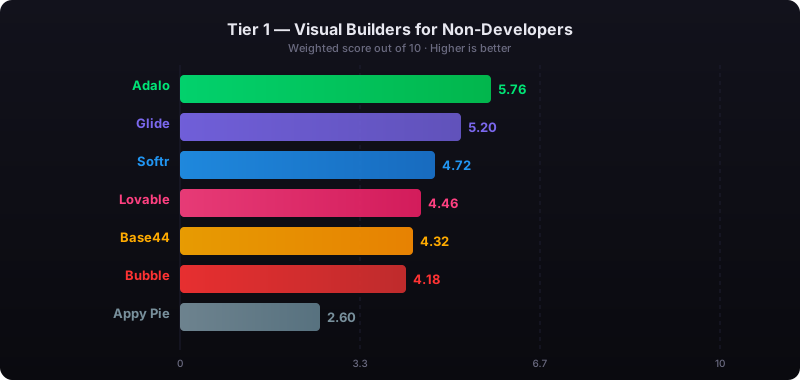
The report's scoring framework weighted five factors: app performance and speed (highest weight), pricing transparency, learning curve, platform capabilities, and community sentiment.
Adalo vs. Glide vs. FlutterFlow: A Glance at the Differences
| Adalo | Glide | FlutterFlow | |
|---|---|---|---|
| Pricing (billed monthly) | Starts at $36/month | Starts at $60/month | Starts at $70/month (for app store publishing) |
| Main Features |
• AI-assisted building with Magic Start and Magic Add Ada, Adalo's AI builder, lets you describe what you want and generates your app. Magic Start creates complete app foundations from a description. Magic Add adds features through natural language. X-Ray identifies performance issues before they affect users. • Responsive builder creates web and native mobile apps simultaneously • Publish to Apple App Store and Google Play Store • Unlimited database records on paid plans |
• Template-focused builder with polished aesthetics • SOC 2, FedRAMP, ISO27001 compliance • Web apps only—no native mobile publishing |
• Low-code platform requiring technical knowledge • Code extensibility and state management • Requires separate database setup and payment |
| Who It's Good For | Anyone who wants professional native apps without coding—from complete beginners to experienced builders | Teams needing quick internal tools from spreadsheet data | Developers with coding knowledge who want visual building with code access |
FlutterFlow vs. Glide vs. Adalo: The Similarities
While Adalo, Glide, and FlutterFlow serve different audiences, they share several foundational capabilities. Whichever platform you select, you'll get the following features:
- Integrations: All three platforms connect with third-party apps for data transfer. Each features integrations with platforms like Google Drive, QuickBooks, and many more, so you can access external data straight from your app. You'll also be able to connect popular third-party databases, like Airtable and Google Sheets, to apps made with any of these builders.
- Templates: Got an idea for a delivery app? Or how about an app to manage newly onboarded clients? You won't need to worry about starting from scratch—you'll have dozens of pre-made templates that provide specialized features to build nearly any app you can imagine.
- Ecosystem: Do you want to learn every functionality of your app-building interface so you can know your digital toolbelt inside and out? Adalo, Glide, and FlutterFlow all provide thriving ecosystems with learning opportunities. Each platform has help documentation, an online academy, YouTube videos, and other resources to keep you up to date about the newest features. All three also have online forums for asking questions, connecting with other builders, and becoming part of a community.
- Free Versions: Adalo, FlutterFlow, and Glide each have free versions that don't require credit card information—just punch in an email and password, and you're good to go. Tinker with each free version to determine which platform suits your needs before committing your hard-earned cash.
Adalo
Who It's Best For
Adalo is a no-code app builder for database-driven web apps and native iOS and Android apps—one version across all three platforms. AI-assisted building and streamlined publishing enable launch to the Apple App Store and Google Play in days rather than months.
The platform combines ease of use with serious capability. Almost anyone can bring any app idea to life and customize nearly every pixel to exact design requirements. Each template provides everything needed to build a highly functional app. Adalo's builder lets you publish the same app to the web, native iOS, and native Android, all without writing a line of code or rebuilding for each platform.
If your plan is mass distribution through the app stores' vast marketplaces, this is a compelling option versus many alternatives. Select a template from Adalo's template library, and customize each screen, database, and backend logic to your liking, brand, and needs.
Features
- Adalo is a true no-code app builder with a low learning curve. The visual builder has been described as "easy as PowerPoint"—you won't need any coding skills or programming knowledge to use it.
- Magic Start generates complete app foundations from a simple description. Tell it you need a booking app for a dog grooming business, and it creates your database structure, screens, and user flows automatically—what used to take days of planning happens in minutes. Magic Add lets you add features by describing what you want in natural language.
- When you build an app with Adalo, you are creating a responsive app that works across platforms: a web app (accessible via browsers) and native mobile apps (downloaded from the Apple App Store and Google Play Store). With Adalo's responsive design, you won't need to make separate changes for each platform—one build handles everything.
- Adalo is powerful. You'll get thousands of integrations with third-party apps like Zapier, Twilio, QuickBooks, and more. You can also add marketplace add-ons like PDF readers, screen sliders, and more to extend your app's functionality.
- Paid plans include unlimited database records with no data caps. The modular infrastructure scales to serve apps with over 1 million monthly active users, with no upper ceiling. X-Ray identifies performance issues before they affect users, helping maintain speed at scale.
Pricing
Start using Adalo for $36/month (billed monthly). All paid plans now include unlimited usage with no bill shock—usage-based charges have been removed entirely. This makes budgeting predictable, unlike platforms with workload units or update limits that can spike costs unexpectedly.
Glide
Who It's Best For
Glide creates polished, template-driven apps quickly. Because you need to create your database before crafting your app's screens, Glide appeals to those who already have their data in spreadsheets or are comfortable building a database first.
The platform excels at turning spreadsheet data into functional internal tools. However, Glide is heavily format-focused and restricted to set templates. This makes it fast to build and publish with, but creates generic, simplistic apps with limited creative freedom. Glide is a go-to for spreadsheet-based apps, but that doesn't compare to the convenience of Adalo's Sheetbridge, which enables users to turn a Google Sheet into an actual database for the easiest control without database-related learning curves.
Features
- Glide's sleek templates deliver polished aesthetics quickly. No matter your skill level, you'll be able to assemble an app that looks professional.
- If you're concerned about your app's security, Glide's got you covered. Glide is compliant with stringent security frameworks, including SOC 2, FedRAMP, ISO27001, and more.
- You'll have access to hundreds of paid and free templates, which come complete with screens and Glide Tables. Most templates are geared towards internal business tools, such as Business Reports, Expense Trackers, and Project Management.
Pricing
Glide's pricing starts at $60/month (billed monthly) to build an app with a custom domain. However, this tier is limited by app updates and data record rows, which attract additional charges. You can publish one app to the web, update it 500 times per month, and access Glide's 35+ integrations.
If publishing one app isn't enough, Glide's $125/month (billed monthly) version lets you publish unlimited apps, allows for 5,000 monthly updates, and provides access to Glide's Basic API for automating data management.
Important limitation: Glide does not support Apple App Store or Google Play Store publishing. Your apps remain web-only, which limits distribution reach and access to device hardware features.
FlutterFlow
Who It's Best For
FlutterFlow is a low-code platform, not no-code. While FlutterFlow includes some visual building features like a drag-and-drop interface, you'll need technical knowledge to use it effectively.
If you don't understand the logic behind coding, how APIs work, or database configuration, using FlutterFlow will be a major challenge. The platform also requires users to manage and set up their own separate database, which adds significant learning complexity—especially when scaling, as anything less than optimal setup can create performance problems.
This is an ecosystem rich with experts because so many users need help and end up spending significant sums chasing scalability. The builder is also limited in view—you can only see 2 screens at once—whereas Adalo can display up to 400 screens at a time on one canvas for faster navigation.
Features
- FlutterFlow has features that will appeal to developers, including automated testing, state management, a visual logic builder, GitHub integration, and the capability to insert custom code into your app.
- When you finish building your app, you can keep your source code, which you can then use to continue development independently.
- FlutterFlow allows you to publish to the Apple App Store and Google Play Store with one-click iOS and Android deployment.
Pricing
FlutterFlow's entry tier comes in at $30/month (billed monthly), letting you publish to the web and download your code. For $70/month (billed monthly), you can publish to the Apple App Store and Google Play Store with one-click deployment and share your app on GitHub.
Critical consideration: FlutterFlow's pricing doesn't include a database. You need to source, set up, and pay for your database separately—adding both cost and complexity that platforms like Adalo include by default.
Adalo vs. Glide vs. FlutterFlow: Key Differences Influencing Your Decision
Now that you have an overview of each platform, let's examine the main differences that will shape your choice.
FlutterFlow and the Need for Technical Knowledge
There's no way around the fact that you must know technical concepts before using FlutterFlow. It's a low-code platform that blends technical expertise requirements with visual building features.
Developers appreciate FlutterFlow because it combines visual building with programming concepts. This allows the tech-savvy to build quickly while adding custom functionality through code.
Using FlutterFlow doesn't require years of extensive coding experience or fluency in multiple programming languages. You should understand the logical flow and structure of programming, how to configure a database, and how to interpret JSON (JavaScript Object Notation), among other concepts.
Adalo and Glide are truly no-code options and don't require any prior technical experience. If you can turn on a computer, you're qualified to use them.
Adalo's Customization and Design Freedom
Because FlutterFlow lets you insert custom code, it offers the most design freedom for developers. You can code unique features and plug them into your app. However, FlutterFlow is limited to those with technical skills.
For most people, it comes down to Adalo and Glide. While Glide provides templates with polished aesthetics, it falls short of Adalo in customization ability and design freedom.
Adalo's customization outclasses Glide because Adalo provides a more free-form building interface and doesn't require you to create your database first. Adalo's builder functions more like PowerPoint—drag, drop, and arrange—while Glide relies more on typing into editing boxes rather than visual manipulation.
With Adalo's AI-assisted building, you can describe features you want and have Magic Add generate them. This combines the speed of templates with the flexibility of custom building.
Web Apps vs. Native Mobile Apps
All three platforms let you publish web apps accessible via browsers. Web apps are useful—you likely visit them daily for online banking, real estate searches, and more.
While you can optimize web apps for search engines, they aren't as powerful as native apps because web apps can't fully access your phone's hardware (camera, GPS, microphone, etc.).
Glide only supports web apps and doesn't support publishing to the Apple App Store or Google Play Store. Adalo and FlutterFlow both support native app store publishing. With these platforms, you can publish powerful native apps and reach billions of app store users.
Adalo's advantage here is significant: one build publishes to web, iOS App Store, and Android Play Store simultaneously. FlutterFlow requires more technical setup, and you're managing your own database infrastructure separately.
Pricing Comparison and Value
If you're considering Glide and want more features than the $60/month tier, your only option is jumping to $125/month (billed monthly). If you don't want to spend over $100/month for more power, Glide becomes a tough sell—especially since it still doesn't offer native mobile publishing.
FlutterFlow offers a $70/month version with app store publishing, but remember: you'll need technical expertise, and you're paying for your database separately. The total cost of ownership is higher than the sticker price suggests.
Adalo has the most flexible pricing structure. The $36/month tier includes app store publishing, unlimited usage, and no record limits on your database. If you need more features, upgrades are incremental rather than requiring a jump to a much higher tier.
| Platform | Starting Price (App Store Publishing) | Database Included | Usage Limits |
|---|---|---|---|
| Adalo | $36/month | Yes, with no record caps | Unlimited |
| Glide | N/A (no native publishing) | Yes, with row limits | Update limits apply |
| FlutterFlow | $70/month | No—separate setup and cost | Varies by database choice |
Scalability and Performance
Adalo 3.0, launched in late 2025, completely overhauled the backend infrastructure. Apps now run 3-4x faster, and the modular architecture scales with your app's needs. There's no record limit on paid plans—with proper data relationship setups, Adalo apps can scale beyond 1 million monthly active users.
Most third-party platform ratings and comparisons predate this infrastructure overhaul. If you've seen reviews citing performance concerns, they likely reflect the pre-3.0 architecture rather than current capabilities.
FlutterFlow's scalability depends heavily on how you configure your external database. Suboptimal setup creates performance problems at scale, which is why many users end up hiring experts for help.
Glide's template-driven approach works well for smaller internal tools but may constrain growth for apps requiring more complex functionality or larger datasets.
Next Steps: Create Your App with Adalo
Don't have technical skills and want to create a professional-looking app with robust functionality? Adalo delivers both accessibility and power.
The platform features one of the easiest app builders available. You'll be able to start building right after signing up. But don't think Adalo sacrifices power for ease: the platform is packed with integrations, fully loaded templates, marketplace add-ons, and AI-assisted building tools to bring any app idea to life.
Get started with Adalo's free version and publish your app to the web. Then, for $36/month (billed monthly), publish to the Apple App Store and Google Play Store with unlimited usage and no database record caps.
Get Adalo's free version today.
FAQ
Why choose Adalo over other app building solutions?
Adalo is an AI-powered app builder that creates true native iOS and Android apps. Unlike web wrappers, it compiles to native code and publishes directly to both the Apple App Store and Google Play Store from a single codebase—the hardest part of launching an app handled automatically. Paid plans include unlimited database records and no usage-based charges.
What's the fastest way to build and publish an app to the App Store?
Adalo's drag-and-drop interface and AI-assisted building let you go from idea to published app in days rather than months. Magic Start generates complete app foundations from descriptions, and Adalo handles the complex App Store submission process so you can focus on features and user experience.
Which is more affordable, Adalo or Glide?
Adalo starts at $36/month with app store publishing included. Glide starts at $60/month but doesn't support native mobile publishing at all—your apps remain web-only. For native mobile apps, Adalo is both more affordable and more capable.
Which is more affordable, Adalo or FlutterFlow?
Adalo starts at $36/month with a database included. FlutterFlow starts at $70/month for app store publishing, but you must source, set up, and pay for your database separately—making the total cost significantly higher than Adalo.
Which is easier for beginners, Adalo or FlutterFlow?
Adalo is significantly easier for beginners. It's a true no-code platform with a visual builder described as "easy as PowerPoint." FlutterFlow is a low-code platform requiring understanding of programming logic, API configuration, and database setup.
Is Adalo better than Glide for mobile apps?
Yes. Adalo creates native iOS and Android apps that publish to the Apple App Store and Google Play Store. Glide only creates web apps and doesn't support native mobile publishing, limiting your distribution reach and access to device hardware features.
Can I publish the same app to web, iOS, and Android without rebuilding?
Yes, Adalo's responsive builder creates one app that works across web, native iOS, and native Android simultaneously. You won't need separate versions or rebuilds—Adalo handles all platform requirements automatically from a single codebase.
Does Adalo have database limits?
No. Paid Adalo plans include unlimited database records with no data caps. The modular infrastructure scales to serve apps with over 1 million monthly active users, with no upper ceiling on growth.
Can I migrate from Glide to Adalo?
Yes. Since Glide apps typically use spreadsheet data, you can export that data and import it into Adalo's database. Adalo's Sheetbridge feature also lets you connect Google Sheets directly as a database for easy transition.
Can I migrate from FlutterFlow to Adalo?
Yes, though the process involves recreating your app's screens and logic in Adalo's visual builder. Your database data can be exported and imported. Many users find Adalo's included database and simpler setup worth the migration effort.