How Do I Monetize My Mobile App? A Beginner’s Guide!
Make Your App a Paid App
According to a recent report, 92% of all apps available on the Apple App Store are free, and on Google Play Store, that number jumps to 96%. This means only a handful of apps require users to pay upfront. This monetization strategy is most common among productivity apps that deliver specialized value.
For entrepreneurs and creators looking to monetize their app ideas, Adalo, a no-code app builder for database-driven web apps and native iOS and Android apps—one version across all three platforms, published to the Apple App Store and Google Play, makes it possible to build and launch without hiring developers. This means you can focus on implementing the right monetization strategy while keeping initial costs low.
Apps that charge upfront usually offer unique value that's difficult to find elsewhere. If you choose this monetization route, make sure the apps you create provide enough value or unique functionality to meet your target users' needs. The user base doesn't need to be massive—it needs to be willing to pay for what you're offering.
Free with In-App Purchases
To use this approach, you restrict certain features in the free version of the app with a goal to encourage free users to upgrade to the paid version. This in-app purchases model is one of the most popular app monetization strategies available today.
Usually the basic features of the app are free, but certain premium features can be purchased. Among apps using this monetization model, gaming apps are perhaps the most common. For example, you can advance through the game faster or get extra lives, abilities, or benefits by paying for them.
Recent stats show that nearly 47% of non-gaming mobile apps use in-app purchases for generating revenue. That number is 79% for gaming apps, which tells you how games like Candy Crush developed a super successful monetization model. In 2020, mobile games accounted for 66% of the Apple App Store's revenue share.
This strategy works well because it provides a free option for users to experience the basic functionality at no cost. Once you have a higher user base, the potential to monetize through upgrades and in-app purchases increases significantly.
These paid features are also called gated features—think of it like a teaser. The only downside is that you'll need to tread carefully so that you aren't giving away too many options for free, or on the other hand, offering too few features to demonstrate value.
Ada, Adalo's AI builder, lets you describe what you want and generates your app. Magic Start creates complete app foundations from a description, while Magic Add adds features through natural language.
With Adalo's platform, implementing in-app purchases becomes straightforward. The drag-and-drop interface lets you create gated content sections and premium feature areas without writing code. Magic Add can help you build these purchase flows by describing what you want—"add a premium features section that unlocks after payment"—and the AI generates the necessary screens and logic.
Free With a Subscription Model
Similar to the previous model, you can create a free app with a paid subscription model. With this strategy, the app is made free to download with limited access to gated content or services. For premium services or content, users need to purchase a subscription plan. This strategy is more commonly used for service-oriented apps—many calendar apps, fitness apps, and meditation apps follow this model.
The advantage here is that your app can be easily discovered in the app stores as a free app. This model is becoming more common among developers, especially since people aren't used to paying for an app upfront but may be more open to it once they've started using it and experienced the value.
Apart from gated content, a subscription model can also mean that an app user can access all the content for free, but only for a limited trial period. Once this period is over, they will need to pay a recurring fee to keep using the app.
An example is Medium, a blogging app available on both Android and iPhones, which lets members read paid article content with a small membership fee. Paid articles are gated to non-members, and they can use the free version of Medium to read other articles and headlines. When they click on a paid article, Medium sends out a call to action (CTA) to receive 30-days free, then the membership fee will be billed automatically.
Building subscription-based apps requires a platform that can scale with your growing subscriber base. Adalo's modular infrastructure handles apps with 1 million+ monthly active users, with no upper ceiling. Paid plans include unlimited database records, so you won't hit storage walls as your subscriber list grows—a common limitation with other platforms that cap records or charge usage-based fees.
User Marketplace
This is the model that many eCommerce or service-linked apps choose. Usually, they charge a small fee on each transaction made on the app marketplace. Apps like Uber, Airbnb, and similar platforms typically charge a commission on each transaction made, but the goal is to provide maximum value to both the buyer and seller on the platform.
Marketplace apps require robust database handling to manage users, listings, transactions, and reviews simultaneously. With Adalo's no record limits on paid plans, you can scale your marketplace without worrying about hitting database ceilings. The platform processes over 20 million data requests daily across its user base, demonstrating the infrastructure's capacity for transaction-heavy applications.
Magic Start can generate complete marketplace foundations from a simple description. Tell it you need a marketplace for local artisans to sell handmade goods, and it creates your database structure, user screens, and transaction flows automatically—what used to take days of planning happens in minutes.
In-App Ads
As the name suggests, these are advertisements that people pay the developer for so they can be displayed on an app. But if you've ever used an app that had regular ads popping up, you wouldn't be too thrilled.
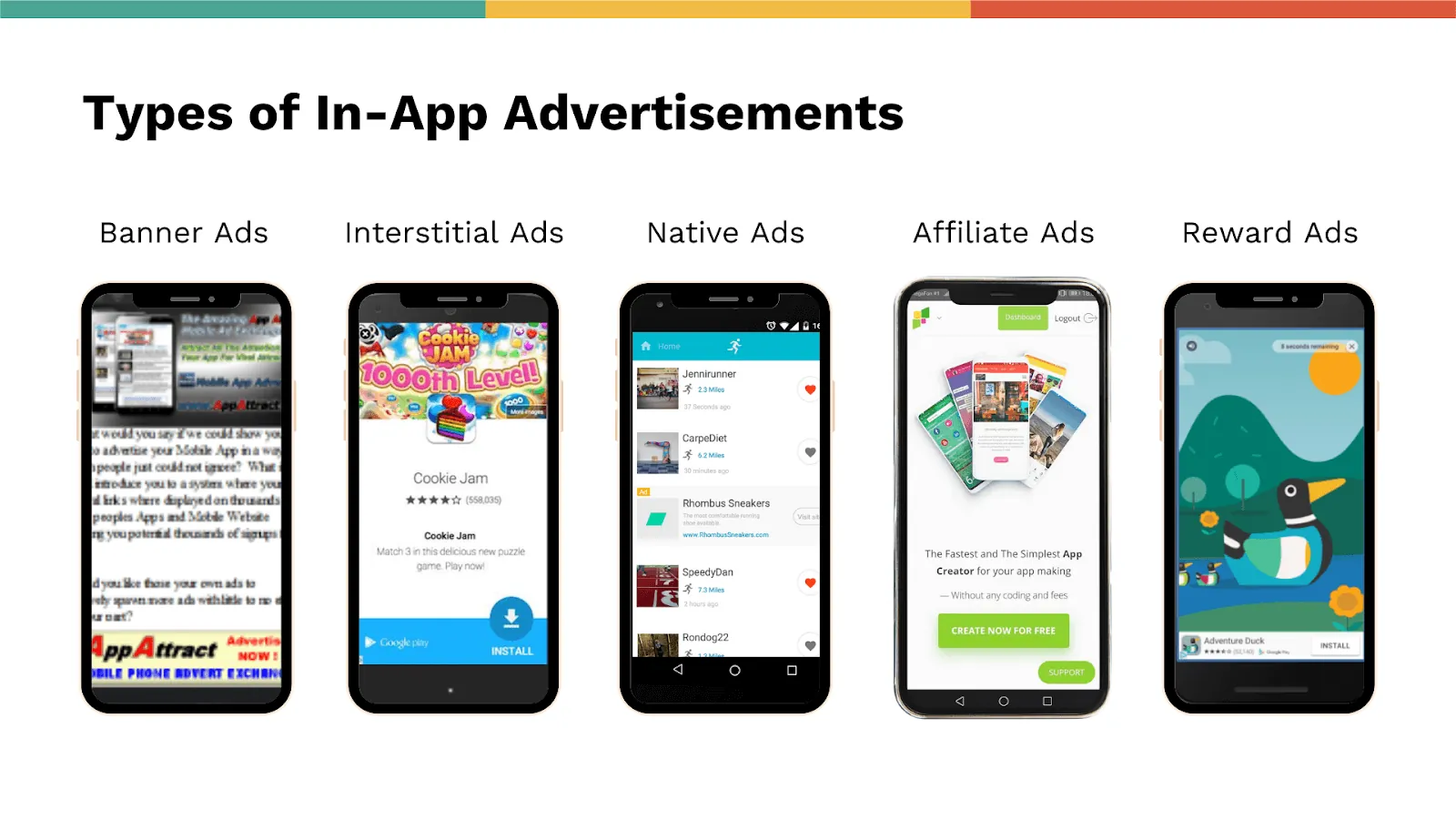
In fact, a big roadblock to hitting success with in-app ads is the fact that although 90% of consumers are influenced by advertising, many users consider in-app ads spammy, distracting, and intrusive. The work-around is simple—pick the type of in-app ad you think your users would be most comfortable with. Here are a few options.
Banner Ads
The OG app advertisements!
These were more common when apps had a free and paid version. A quick way to generate revenue was to have an ad-free version of the app because people seemed willing to pay anything just to not have to see ads in the banner section of an app.
But that's the point—these ads typically affected the UX a lot more than people realized, and rather than driving people towards purchasing, it drove them to uninstall.
Interstitial Ads
A good workaround for banner ads was interstitial ads, which is a big word for a simple meaning: an ad that shows up occasionally, in full screen. This would usually be delivered at the end of a certain task flow, like editing a picture, completing a game level, or while something was loading—that way it didn't interfere with completing a task, making it somewhat less annoying.
Native Ads
These are the ads that you're most familiar with. Native ads integrate seamlessly into the look, feel, and experience of the app they're in. Think of Instagram or a Twitter feed, where an ad shows up somewhere on the feed or timeline.
As far as ads go, these were a step in the right direction because they didn't interfere with the user experience too much, and showed a higher engagement rate. What's essential is to make the native ad look and feel 'native', but also let users know that they're watching an ad—whether it's by mentioning 'Sponsored' or some other mechanism.
Affiliate Ads
Affiliate advertising is a monetization model that generates commission from other products and services by advertising them through your app. You can monetize your app by partnering with companies to sell their products. Many companies have affiliate programs that allow you to insert special links or codes in your content or ads.
This way, if someone clicks on those links and makes a purchase, you get a cut of the sale amount. The affiliate ads model works well if your app users trust your app, and therefore will trust your referrals too.
Reward Ads
App reward ads are popular for games, particularly if users spend a lot of time in the app. For example, you may be offered extra coins if you watch a 10-second advertisement. To get this right, you have to make the reward worth the effort someone will take to watch an ad. It helps to know your market well, particularly the ads that may interest them—this way you'll make the most of your ad marketing efforts.
The other good thing about reward ads is that, if executed right, they benefit everyone. You (the app owner) benefit from the advertising revenue. The advertiser reaches a wider audience through your app users. And finally, the game player gets free tokens or benefits by watching an ad, making the experience more rewarding.
Choosing the Right Platform for Your Monetized App
New app monetization models, trends, and methods show up all the time, so as an app developer, it helps to carefully select and customize these options to suit your monetization goals. But equally important is choosing the right platform to build on.
When comparing app builders for monetized apps, consider these factors:
| Factor | Why It Matters for Monetization |
|---|---|
| Database Limits | Subscription and marketplace apps generate massive amounts of user data. Platforms with record caps force expensive upgrades or migrations as you grow. |
| Usage-Based Charges | Unpredictable billing can eat into margins. Adalo removed usage-based charges from all plans—unlimited usage means no bill shock. |
| App Store Publishing | Getting into the App Store and Play Store is often the hardest part. Adalo handles the submission process, publishing from a single codebase. |
| Performance at Scale | Slow apps lose users. Adalo 3.0's infrastructure overhaul made apps 3-4x faster with modular scaling. |
Platforms like Bubble offer more customization, but that flexibility often results in slower applications that struggle under increased load—and frequently requires hiring experts to optimize. Bubble's mobile solution is also a wrapper for the web app, introducing potential challenges at scale and meaning one app version doesn't automatically update web, Android, and iOS deployments simultaneously.
Glide excels at spreadsheet-based apps but creates generic, template-restricted experiences with limited creative freedom. It also doesn't support Apple App Store or Google Play Store publishing. Adalo's SheetBridge feature offers similar spreadsheet connectivity while maintaining full design control and native app publishing.
X-Ray, Adalo's performance monitoring tool, identifies potential issues before they affect users—critical for monetized apps where poor performance directly impacts revenue.
Check out our blog on creating a successful marketing plan for your app to grow your user base, including these helpful tools and tips to help you get started with app promotion.
FAQ
Why choose Adalo over other app building solutions?
Adalo is an AI-powered app builder that creates true native iOS and Android apps. Unlike web wrappers, it compiles to native code and publishes directly to both the Apple App Store and Google Play Store from a single codebase—the hardest part of launching an app handled automatically.
What's the fastest way to build and publish an app to the App Store?
Adalo's drag-and-drop interface and AI-assisted building let you go from idea to published app in days rather than months. Magic Start generates complete app foundations from descriptions, and Adalo handles the complex App Store submission process so you can focus on features and user experience.
Can I implement app monetization strategies without coding?
Yes. With Adalo's visual builder, you can implement paid apps, in-app purchases, subscription models, or ad integrations without writing code. Magic Add lets you describe what you want—like "add a premium subscription tier"—and generates the necessary screens and logic.
What are the most popular app monetization strategies?
The most popular strategies include paid apps, free apps with in-app purchases, subscription models, user marketplace commissions, and in-app advertising. In-app purchases are especially popular, with 47% of non-gaming apps and 79% of gaming apps using this model.
Which monetization model works best for gaming apps versus service apps?
Gaming apps typically perform best with in-app purchases (79% use this model), offering items like extra lives or faster progression. Service-oriented apps like fitness or productivity apps generally work better with subscription models that gate premium content behind recurring payments.
What types of in-app ads are most effective without annoying users?
Native ads and reward ads tend to be most effective without frustrating users. Native ads integrate seamlessly into your app's look and feel, while reward ads give users something valuable in exchange for watching. Banner ads and poorly-timed interstitial ads often drive users to uninstall.
Should I make my app free or charge upfront?
Since 92-96% of apps are free, charging upfront requires offering truly unique value users can't easily find elsewhere. Starting free with in-app purchases or subscriptions lets users experience your app before committing, typically leading to a larger user base and greater monetization potential.
How much does it cost to build a monetized app with Adalo?
Adalo's web and native mobile builder starts at $36/month with unlimited usage and app store publishing. Unlike competitors that charge usage-based fees or limit database records, Adalo's paid plans include unlimited records and no usage caps—predictable costs as your monetized app scales.
Will my app handle growth as my user base increases?
Adalo's modular infrastructure scales to serve apps with 1 million+ monthly active users, with no upper ceiling. The Adalo 3.0 infrastructure overhaul made apps 3-4x faster, and X-Ray identifies performance issues before they affect users—critical for monetized apps where slow performance impacts revenue.