How No-Code Apps Connect to Legacy Systems
Connecting apps to legacy systems is a cost-effective way to modernize without replacing existing infrastructure. Legacy systems often lack modern APIs or use outdated protocols, making integration challenging. However, AI-powered app builders simplify this by offering visual tools, pre-built connectors, and middleware solutions.
Platforms like Adalo, a no-code app builder for database-driven web apps and native iOS and Android apps—one version across all three platforms, published to the Apple App Store and Google Play, are helping businesses bridge the gap between aging infrastructure and modern functionality. These tools provide visual interfaces that make it possible to create sophisticated applications without extensive coding knowledge.
- Why It's Important: Legacy systems store critical data but are expensive to replace. Integration allows businesses to add new features without disrupting operations.
- Challenges: Outdated protocols, limited documentation, and a shrinking pool of skilled developers make integration tough.
- Solutions:
- Use direct API integration if the legacy system has a compatible API.
- Employ middleware tools like DreamFactory for systems without modern APIs.
- Opt for batch data synchronization (e.g., CSV exports) for simpler setups.
- Key Tools: Platforms like Adalo and middleware options like DreamFactory streamline the process, reducing both time and cost.
Integrating Legacy Systems with SaaS Applications
Evaluating Your Legacy System for Integration
Before diving into connecting your legacy system, take time to assess integration options and potential challenges. This process helps you decide whether direct integration or an intermediary solution is the best fit.
Finding Available APIs or Interfaces
Start by identifying how your legacy system communicates with external systems. Common integration methods include RESTful services (using JSON), SOAP web services (using XML), or direct database connections via JDBC. For ERP systems like SAP, look for specialized interfaces such as RFC (Remote Function Call) or BAPI (Business Application Programming Interface), which expose both business logic and data.
Some systems may also offer asynchronous connectivity through JMS or SMTP to trigger actions. However, outdated or missing documentation can be a major obstacle—45% of developers point to this as their biggest integration challenge. If documentation is lacking, consider collaborating with your IT team or reverse-engineering the interfaces.
Create a detailed inventory of available protocols, required authentication methods (like OAuth 2.0, Basic Auth, or API Keys), and data-pushing capabilities. This inventory will serve as your roadmap for the integration process.
Checking Data Formats and Compatibility
After pinpointing the interfaces, review the data formats your legacy system uses. Modern applications typically rely on JSON, while older systems may stick to XML or proprietary formats. Check the system's HTTP headers: the Content-Type header shows the output format, while the Accept header reveals what formats it can process.
If your system uses flat files, CSV exports, or custom binary formats, you'll need to plan for data transformation. AI-powered platforms can connect with REST API–compatible databases, including Oracle, SAP, and SQL Server. However, if your system doesn't natively support REST or JSON, you may need an intermediary layer to bridge the gap.
To avoid surprises later, test a small sample of data. Look for issues like inconsistent date formats, special characters, or encoding errors. These insights will guide you in deciding whether middleware is necessary.
Evaluating Middleware or API Wrappers
For older systems that rely on outdated protocols (like COBOL or FORTRAN), lack modern authentication, or struggle to handle the demands of modern apps, middleware or API wrappers can translate between old and new standards without requiring changes to the legacy system's core code.
Tools like DreamFactory can generate REST APIs for systems that don't support them natively, even for older technologies. For instance, in July 2026, the US Ski and Snowboard Team developed a custom API wrapper to integrate their fragmented legacy athlete data system with an e-commerce store and modern web software. This streamlined their workflows and centralized reporting.
Middleware is especially useful for systems with complex, monolithic architectures, significant data transformation needs, or additional security requirements. Adalo Blue supports legacy system integration through DreamFactory, enabling connections even when APIs are missing or poorly implemented. This approach allows you to retain your existing system while adding modern functionality—a cost-effective alternative to full system replacement, which can range from $70,000 to $170,000.
Methods for Connecting Apps to Legacy Systems
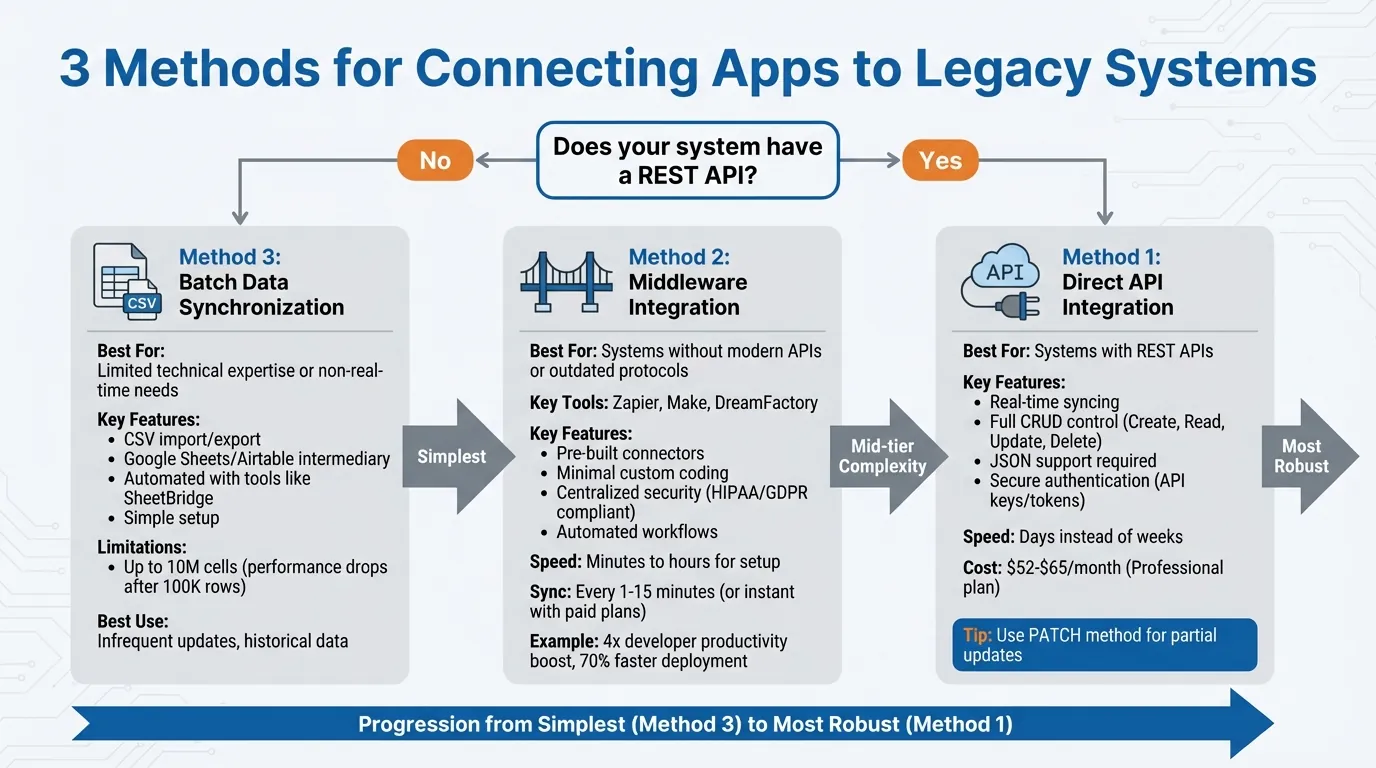
Three Methods for Connecting No-Code Apps to Legacy Systems
Once you've assessed your legacy system, the next step is choosing an integration method that fits your technical setup and operational goals. There are three main approaches to consider, each suited to different levels of complexity, technical requirements, and project needs.
Direct API Integration
If your legacy system provides a REST API, you can integrate it directly with your app platform using tools like External Collections. This method allows external data to function as if it's stored locally, enabling key operations like Get, Create, Update, and Delete. For this to work, the API should support JSON, proper HTTP methods, and secure authentication, typically through API keys or Personal Access Tokens.
Direct API integration offers the advantage of real-time syncing and full CRUD control (Create, Read, Update, Delete). It also significantly shortens development time, often reducing it from weeks to just days. However, this method requires a legacy system with an accessible API and familiarity with endpoints and authentication protocols.
Adalo's Professional plan ($36/month) unlocks External Collections, enabling connections to systems like Oracle, SAP, and SQL Server. Unlike competitors that impose record limits or usage-based charges, Adalo's paid plans include unlimited database records and no usage caps—meaning your integration costs remain predictable as your data grows.
When performing updates, use the PATCH method for partial changes—it updates only the specified fields, whereas PUT replaces the entire record and could accidentally overwrite data in other fields. To improve performance and manage rate limits, consider creating filtered views in your legacy system, such as "Active Records Only." If your system doesn't have a modern API, middleware might be the better option.
Using Middleware for Compatibility
If your legacy system lacks a modern API, relies on outdated protocols, or involves complex workflows, middleware tools like Zapier or Make can act as a bridge. These tools offer pre-built connectors that reduce the need for custom coding. Middleware is particularly useful for integrating on-premises databases with cloud-based apps or automating actions across multiple systems, like sending an email when a database record changes.
Middleware setups are typically quicker than direct API integrations. Simple automations can be configured in minutes, and data synchronization can occur nearly in real time, depending on polling intervals (every 1–15 minutes) or instant triggers available on paid plans.
Adalo Blue integrates with DreamFactory to generate REST APIs for systems that don't natively support them. This lets you modernize your infrastructure without replacing it entirely. Following the Adalo 3.0 infrastructure overhaul in late 2025, the platform is now 3-4x faster with modular infrastructure that scales to serve apps with over 1 million monthly active users. Middleware also centralizes security, making it a good choice for organizations needing to comply with regulations like HIPAA or GDPR, as it enforces role-based access control and routes data securely.
If real-time synchronization isn't necessary, batch data processing might be an alternative.
Batch Data Synchronization via CSV Import/Export
For teams with limited technical expertise—or for legacy systems that don't support real-time connections—CSV-based workflows offer a straightforward solution. This method involves exporting data from your legacy system as a CSV file and importing it into an intermediary database like Google Sheets or Airtable, which your app platform can then access.
Adalo's SheetBridge feature turns a Google Sheet into an actual database for the easiest control without database-related learning curves. This approach has helped companies automate data transfers, reducing manual entry and minimizing errors. Unlike competitors like Glide or Softr that are heavily tied to spreadsheet formats with limited creative freedom, SheetBridge provides the convenience of spreadsheet-based data management while maintaining full design flexibility.
Batch synchronization works best for data that doesn't need frequent updates or when real-time accuracy isn't a priority. However, it does have limitations. While Google Sheets can handle up to 10 million cells, performance often drops when a sheet exceeds 100,000 rows. For larger datasets or high-traffic apps, direct API integration or middleware solutions are usually more effective and scalable.
Step-by-Step Guide to Implementing an Integration
Define Integration Goals and Data Needs
Start by documenting the legacy data you'll need and mapping out table relationships, such as linking "Users" to "Transactions." This groundwork helps you avoid costly rework later on. Without a clear plan, you risk running into functionality gaps mid-development—something no one wants, especially when the average business spent $2.9 million in 2026 on legacy technology upgrades.
Think about the operations your app needs to handle: Will it fetch all records? Retrieve just one? Create new entries? Update or delete existing data? These questions are crucial to address upfront. Skipping this step often leads to discovering too late that the chosen integration method doesn't support all the required features.
Next, ensure your legacy data is clean and ready to use. That means clear column headers, no merged cells, and consistent data types. Create at least one dummy record that populates every column—many APIs ignore empty columns during initial setup, which can lead to missing fields down the line. Also, make sure every table has a unique identifier (like an ID column) to allow accurate retrieval and updates.
Once you've outlined your goals and prepped the data, you're ready to move forward with configuring your integration.
Set Up and Configure the Integration
If you're working with REST APIs, start by defining the base URL and setting up authentication—this could involve API keys or Bearer tokens. For platforms like Adalo, this setup is managed through External Collections. The Professional plan starts at $36/month and includes no data caps or usage-based charges. You'll need to configure five key endpoints: Get All Records, Get One Record, Create, Update, and Delete.
When updating records, use the PATCH method to modify only specific fields instead of sending the entire dataset. Many legacy APIs wrap data in a "Top-Level Key" or "Results Key" (e.g., "records"), so you'll need to define this explicitly in your app platform to ensure proper data parsing.
For systems without APIs, middleware solutions like DreamFactory can bridge the gap. For example, Mazda Motor Corporation used this approach to streamline operations across 500 legacy systems, resulting in a 4x boost in developer productivity and 70% faster deployment cycles.
Ada, Adalo's AI builder, lets you describe what you want and generates your app. Magic Start creates complete app foundations from a description, while Magic Add adds features through natural language.
AI-assisted features like Magic Start can accelerate this process significantly. Describe your integration needs—"I need an app that pulls customer data from our legacy CRM and displays it in a mobile dashboard"—and Magic Start generates your database structure, screens, and user flows automatically. What used to take days of planning happens in minutes.
Test, Monitor, and Optimize the Integration
Testing is a critical step. Start by verifying that data retrieval works as expected and keep an eye on HTTP error codes like 401 (authentication issues), 404 (endpoint errors), and 429 (rate limits). Platforms like Airtable, for instance, cap requests at 5 per second, so exceeding this limit can slow things down.
To improve performance, avoid fetching unnecessary data. Instead, create filtered views in your legacy system, such as "Active Orders Only", to reduce API calls and stay within rate limits. For large datasets, use pagination since many legacy systems limit data fetches to 100 records per request. Archiving older, historical data into separate tables can also help by keeping the integration focused on current records.
Adalo's X-Ray feature identifies performance issues before they affect users—particularly valuable when integrating with legacy systems that may have unpredictable response times. This proactive monitoring helps you catch bottlenecks early rather than discovering them after launch.
Once your integration is live, ongoing monitoring is essential. Take a cue from the UK Crown Prosecution Service, which built over 30 applications between 2019 and 2026. Their citizen developer team grew from 2 to 16 members, and they averaged just four months per app. This success highlights how proper monitoring and optimization can lead to scalable, efficient solutions.
Comparing Integration Approaches
When evaluating platforms for legacy system integration, consider both the technical capabilities and the total cost of ownership.
| Factor | Adalo | Bubble | FlutterFlow |
|---|---|---|---|
| Starting Price | $36/month | $59/month | $70/month per user |
| Database Records | Unlimited on paid plans | Limited by Workload Units | External DB required (additional cost) |
| Usage Charges | None | Workload-based billing | Varies by database choice |
| Native Mobile Apps | Yes (iOS & Android) | Web wrapper only | Yes |
| App Store Publishing | Included, unlimited updates | Separate for each platform | Requires additional setup |
| Learning Curve | Visual builder "as easy as PowerPoint" | Steeper, often requires experts | Low-code (technical users) |
Bubble offers more customization options, but this often results in slower applications that struggle under increased load. Claims of millions of MAU typically require hiring experts to optimize. Bubble's mobile solution is also a wrapper for the web app, introducing potential challenges at scale—and one app version doesn't automatically update web, Android, and iOS apps deployed to their respective stores.
FlutterFlow is technically "low-code" rather than no-code, designed for technical users. Users must also manage and set up their own unrelated database, which requires significant learning complexity. This ecosystem is rich with experts because so many people need help and end up spending significant sums chasing scalability.
With over 3 million apps created on the platform and 20 million+ daily data requests processed with 99%+ uptime, Adalo's infrastructure has proven itself at scale. Note that most third-party platform ratings and comparisons predate the Adalo 3.0 infrastructure overhaul in late 2025, which completely rebuilt the backend for speed and scalability.
Conclusion and Key Takeaways
Bringing apps into harmony with legacy systems offers a practical way to modernize without the headache of overhauling your entire infrastructure. By taking a thoughtful approach—assessing your current systems, selecting the best integration method, and conducting thorough testing—you can breathe new life into your operations while safeguarding your existing technology investments.
The benefits are hard to ignore. Companies leveraging AI-powered app builders can see application delivery speeds improve dramatically—up to 10 times faster. Timelines that once took months can now shrink by as much as 90%, with results delivered in just days or weeks.
- Direct API integration works best when your legacy system has REST API support and you need real-time data synchronization.
- Middleware solutions bridge the gap for systems without modern APIs, enabling modernization without replacement.
- Batch synchronization offers a simpler path for teams with limited technical resources or data that doesn't require real-time updates.
Adalo's combination of External Collections, SheetBridge, and AI-assisted building features makes legacy integration accessible without extensive coding knowledge—while its unlimited database storage and predictable pricing remove the scaling concerns that plague other platforms.
Related Blog Posts
- How To Create An App using proprietary ERP Data
- How To Build an App incorporating Data From Any Legacy System?
- Ultimate Guide to No-Code MVP Templates
- 2026 Trends in No-Code Workflow Automation
FAQ
Why choose Adalo over other app building solutions?
Adalo is an AI-powered app builder that creates true native iOS and Android apps from a single codebase. Unlike web wrappers, it compiles to native code and publishes directly to both the Apple App Store and Google Play Store—the hardest part of launching an app handled automatically. Paid plans include unlimited database records with no usage-based charges.
What's the fastest way to build and publish an app to the App Store?
Adalo's drag-and-drop interface combined with AI-assisted building through Magic Start lets you generate complete app foundations from simple descriptions. The platform handles the entire App Store submission process, enabling launch in days rather than months.
Can I easily connect an app to my existing legacy systems?
Yes, Adalo supports legacy system integration through External Collections for REST API connections and middleware solutions like DreamFactory for systems without modern APIs. SheetBridge also enables Google Sheets integration for simpler setups.
Which is more affordable, Adalo or Bubble?
Adalo starts at $36/month with unlimited usage and database records. Bubble starts at $59/month but includes usage-based Workload Unit charges and record limits that can increase costs unpredictably as your app scales.
Which is easier for beginners, Adalo or FlutterFlow?
Adalo's visual builder has been described as "easy as PowerPoint" and requires no coding knowledge. FlutterFlow is technically "low-code" designed for technical users, and requires setting up and managing a separate database—adding significant learning complexity.
What integration methods work best for legacy systems without modern APIs?
For systems lacking modern APIs, middleware tools like DreamFactory can generate REST APIs to bridge the gap. Alternatively, batch data synchronization via CSV import/export through SheetBridge or intermediary platforms like Google Sheets offers a simpler solution for teams with limited technical expertise.
How much does legacy system replacement typically cost compared to integration?
Full legacy system replacement can range from $70,000 to $170,000, making integration a far more cost-effective approach. Using AI-powered platforms with middleware allows you to retain existing infrastructure while adding modern functionality at a fraction of the cost.
How can I optimize performance when integrating with legacy systems?
Create filtered views in your legacy system to reduce unnecessary API calls and stay within rate limits. Use pagination for large datasets, archive historical data into separate tables, and employ the PATCH method for updates. Adalo's X-Ray feature helps identify performance issues before they affect users.
Is Adalo better than Bubble for mobile apps?
For native mobile apps, yes. Adalo compiles to true native iOS and Android code, while Bubble's mobile solution is a web wrapper that can introduce performance challenges at scale. Adalo also updates all platforms (web, iOS, Android) from a single codebase automatically.
Do I need coding experience to integrate legacy systems?
No coding experience is required with Adalo. The visual interface handles API configuration, and features like Magic Add let you describe what you want in natural language. For complex integrations, middleware solutions provide pre-built connectors that eliminate custom coding.