How to Choose the Best No-Code AI App Builder (2026) | Adalo
Choosing the right no-code AI app builder in 2026 could mean the difference between launching in weeks or waiting months—and between reaching a handful of users or millions. With the low-code market approaching $50 billion, the tools you select directly impact how fast you can validate ideas and scale your audience.
Start building with Adalo's AI app builder.
Explore Adalo's AI app builder to start building.
One standout platform covered here is Adalo—a no-code app builder for database-driven web apps and native iOS and Android apps, one version across all three platforms, published to the Apple App Store and Google Play. This matters because true app success means launching your MVP quickly and reaching the biggest audience possible through app store distribution and push notifications, not just deploying a basic web app.
Below, you'll find the essential features, pricing models, and capabilities that separate platforms built for scale from those that limit your growth.
The AI app builder revolution transforms how businesses create intelligent applications, with the market expected to approach ~$50 billion by 2028 and a projected $24.42 billion by 2030. With Gartner's 2021 projection that by 2026, 70% of new applications will use low-code/no-code, and a GitHub study finding 55% faster task completion with Copilot, choosing the right AI app builder can shorten development cycles and reduce reliance on costly traditional development.
Adalo, an AI-powered app builder, empowers you to build sophisticated applications through visual development, eliminating months of coding while maintaining enterprise-grade capabilities. The platform creates database-driven web apps and native iOS and Android apps—one version across all three platforms, published to the Apple App Store and Google Play. By combining visual development with powerful AI integration capabilities, Adalo enables businesses to capitalize on this transformation without sacrificing functionality or scalability.
Independent research from App Builder Guides' State of App Building report (February 2026) analyzed 190 Reddit threads and 150+ platform citations across 345 data points with zero platform sponsorships. Adalo ranked first among visual builders for non-developers.
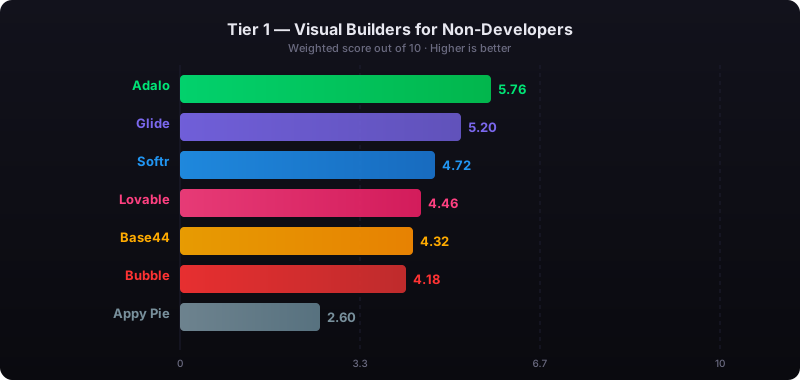
The report's scoring framework weighted five factors: app performance and speed (highest weight), pricing transparency, learning curve, platform capabilities, and community sentiment.
Key Takeaways
- The low-code market is projected to approach ~$50 billion by 2028, with no-code solutions delivering 90% reduction in development time
- Adalo's paid plans include unlimited database records with no usage-based charges—eliminating bill shock that plagues usage-metered platforms
- Over 3 million apps have been built on Adalo, with the visual builder described as "easy as PowerPoint"
- Modular infrastructure scales to 1M+ MAU with no upper ceiling, outperforming app wrappers at scale
What Is an AI App Builder and Why It Matters
AI app builders represent a fundamental shift in how intelligent applications come to life. These platforms combine visual development environments with artificial intelligence capabilities, enabling users to create applications featuring machine learning, natural language processing, and automated workflows without writing code. Unlike traditional development requiring months of programming, modern AI builders translate drag-and-drop actions into sophisticated applications.
The transformation goes beyond convenience—it's economic necessity. When development teams face 40% cost savings and deliver applications 90% faster, the choice becomes clear. Industry analysts at Gartner projected 70% of new applications will emerge from these platforms by 2026, up from less than 25% in 2020.
The Rise of Visual Programming Languages
Visual programming fundamentally changes who can build applications. These systems replace complex syntax with intuitive interfaces where logic flows through connected components. Users arrange pre-built modules representing AI functions—from chatbots to image recognition—creating sophisticated applications through visual workflows rather than code.
The democratization extends beyond simplicity. Modern platforms integrate popular AI services like Google AI, AWS AI, and Microsoft Azure AI through pre-configured connections. This means a marketing manager can implement sentiment analysis, while an operations director deploys predictive maintenance—all without understanding machine learning algorithms.
AI vs Traditional App Development
Traditional AI development demands specialized expertise across multiple domains:
- Machine learning engineers commanding $150,000+ salaries
- Data scientists for model training and optimization
- Backend developers for infrastructure and scaling
- Frontend developers for user interfaces
- DevOps engineers for deployment and monitoring
AI-powered app builders collapse these roles into visual development, where business users create solutions directly. Adalo is a no-code app builder for database-driven web apps and native iOS and Android apps—one version across all three platforms, published to the Apple App Store and Google Play. It handles model selection, training, deployment, and scaling automatically. Features like Magic Start generate complete app foundations from simple descriptions—tell it you need a booking app for a dog grooming business, and it creates your database structure, screens, and user flows automatically. What used to take days of planning happens in minutes.
This shift explains why 90% of users believe their companies experienced accelerated growth after adoption.
Essential Features of Free AI App Builders in 2026
Free tiers serve as the gateway to AI app development, but understanding their capabilities and limitations determines success. The best free AI app builders balance accessibility with genuine functionality, offering enough features to validate ideas without forcing premature upgrades.
Core Capabilities in Free Plans
Modern free AI builders typically include:
- Unlimited test applications for experimentation and learning
- 200-500 data records per application for proof-of-concept development
- Basic AI integrations through API connections to services like OpenAI
- Web publishing on platform subdomains for immediate deployment
- Community support and documentation access
- Pre-built templates with AI functionality included
Adalo's free tier exemplifies this approach, providing unlimited screens and actions alongside test environments. This allows builders to create fully functional AI prototypes before committing to paid plans.
Free Tier Limitations
Understanding constraints prevents frustration:
- Data restrictions: Most platforms limit records to hundreds rather than thousands
- Publishing limitations: Apps typically deploy only to platform domains
- User restrictions: Single editor access without collaboration features
- Storage caps: Limited file storage for images and documents
- API rate limits: Restricted external service calls per month
- Missing features: Advanced AI models and enterprise integrations require upgrades
When to Upgrade from Free Plans
The transition point arrives when your application needs:
- Custom domain deployment for professional presentation
- Multiple collaborators for team development
- Production-level data capacity beyond test limits
- Advanced AI integrations requiring higher API limits
- Native mobile app publishing to app stores
- Priority support for business-critical applications
Successful builders use free tiers for validation, then upgrade strategically as applications prove value. Adalo's paid plans starting at $36/month include unlimited database records and no usage-based charges—a significant advantage over platforms that meter every action.
Top Platforms for AI App Development
The landscape of AI app platforms reveals distinct strengths across different use cases. Understanding platform capabilities, integration ecosystems, and performance characteristics guides selection for specific project requirements.
Platform Strengths and Weaknesses
Each platform excels in particular areas:
Adalo: An AI-powered app builder creating true native iOS and Android apps from a single codebase. The platform's 3.0 infrastructure overhaul (launched late 2025) delivers 3-4x faster performance with modular architecture scaling to 1M+ MAU. Paid plans include no data caps and no usage-based charges. Most third-party ratings predate this major update.
Bubble: Offers extensive customization for web applications, starting at $59/month with usage-based Workload Units charges. Mobile apps are web wrappers rather than native builds, which can introduce performance challenges at scale. The flexibility often requires hiring experts to optimize, and claims of millions of MAU typically involve significant external help.
FlutterFlow: A low-code platform for technical users, starting at $70/month per user for app store publishing—but this doesn't include a database. Users must source, set up, and pay for external databases separately, creating significant learning complexity. The builder's limited viewport (viewing only 2 screens at once) slows development compared to Adalo's canvas displaying up to 400 screens.
Glide: Heavily template-focused, making it fast for simple apps but limiting creative freedom. Pricing starts at $60/month for custom domains, with additional charges for data records. Glide does not support App Store or Play Store publishing.
Softr: Pricing starts from $167/month for Progressive Web Apps, still restricted by records per app. Softr does not support native iOS or Android app creation.
Thunkable: Offers AI-drafted app builds, but publishing a Progressive Web App requires $59/month with usage restrictions. Responsive apps require custom pricing beyond the advertised $189/month tier.
Integration Capabilities
Modern AI applications require extensive connectivity:
- AI Service APIs: Direct integration with OpenAI, Google AI, AWS services
- Database Connections: Support for external collections including Airtable, Xano, Firebase
- Automation Platforms: Zapier and Make connections for workflow automation
- Payment Processing: Stripe and IAPHUB integrations for monetization
- Analytics Services: Google Analytics and custom tracking implementations
The depth of integration support often determines platform suitability. Applications requiring multiple AI services benefit from platforms with extensive marketplace components and pre-built integrations.
Building Mobile Apps with AI
Mobile AI applications present unique challenges and opportunities. With Microsoft projecting 500 million apps being created over five years (from 2021), mobile-first development becomes essential for reaching users where they spend most of their digital time.
Publishing to App Stores
Native app deployment requires understanding platform requirements:
Apple App Store Requirements:
- $99 annual developer account fee
- Most App Store reviews complete within a few days
- Compliance with iOS Human Interface Guidelines
- Privacy policy and data handling declarations
Google Play Store Requirements:
- One-time $25 developer registration fee
- Review process can take a few days and sometimes longer
- Content rating questionnaire completion
- Target API level compliance for Android versions
Adalo simplifies this process by handling technical requirements automatically, allowing builders to focus on functionality rather than deployment complexities. You can publish the same app to the web, native iOS, and native Android—all without writing code or rebuilding anything. This is a critical differentiator: platforms like Glide and Softr don't support app store publishing at all, while Bubble's mobile solution uses web wrappers that don't update across platforms simultaneously.
Mobile-Specific AI Features
Mobile platforms unlock unique AI capabilities:
- On-device processing for privacy-sensitive applications
- Camera integration for real-time image recognition
- Voice processing using device microphones for natural language input
- Location-based AI combining GPS with predictive algorithms
- Biometric authentication integrating with device security features
- Push notifications triggered by AI-driven events
Successful mobile AI apps leverage these capabilities while maintaining performance. Responsive design features ensure applications adapt across device sizes without separate development efforts.
AI Development Tools Integration and APIs
The power of AI-powered app builders emerges through seamless integration with specialized services. Understanding how platforms connect with external AI tools determines the sophistication of applications you can build without code.
Popular AI API Integrations
Modern platforms support extensive AI service connections:
Natural Language Processing:
- OpenAI GPT models for text generation and analysis
- Google Cloud Natural Language for sentiment analysis
- Amazon Comprehend for entity recognition
- IBM Watson for industry-specific language models
Computer Vision Services:
- Google Vision API for image classification
- Amazon Rekognition for facial analysis
- Microsoft Azure Computer Vision for OCR
- Custom model deployment through TensorFlow Lite
Predictive Analytics:
- BigML for automated machine learning
- DataRobot for enterprise predictions
- H2O.ai for open-source ML models
- Custom Python scripts through webhook integrations
Adalo's external collections enable these connections through REST APIs, allowing builders to leverage enterprise-grade AI without managing infrastructure.
Custom AI Model Implementation
Advanced builders implement custom models through several approaches:
- API Wrapping: Deploy trained models on cloud services and connect via endpoints
- Webhook Processing: Trigger external scripts for complex calculations
- Edge Computing: Utilize on-device processing for privacy-sensitive applications
- Hybrid Approaches: Combine multiple AI services for sophisticated functionality
The component marketplace provides pre-built integrations for common AI services, reducing implementation time from weeks to hours. Magic Add takes this further—describe the feature you want in natural language, and Adalo adds it to your app automatically.
Visual Programming Languages for AI Apps
Visual programming transforms abstract AI concepts into tangible building blocks. These systems enable 24% of users with zero coding experience to create sophisticated applications through intuitive interfaces.
Logic and Workflow Design
Visual logic builders replace traditional if-then statements with connected nodes:
- Conditional Branches: Drag connections between decision points
- Data Transformations: Apply AI processing through visual pipelines
- Event Triggers: Link user actions to AI responses automatically
- Error Handling: Visual exception management without try-catch blocks
- Parallel Processing: Orchestrate multiple AI services simultaneously
Modern platforms support complex business logic through visual representations. Users connect AI components like chatbot responses to database updates, creating sophisticated workflows impossible with traditional tools.
Data Flow Management
AI applications require careful data orchestration:
- Input Validation: Visual rules ensuring data quality before AI processing
- Transformation Pipelines: Sequential processing through multiple AI services
- Result Caching: Optimize costs by storing frequently accessed AI outputs
- Batch Processing: Handle large datasets through visual queue management
- Real-time Streams: Connect live data sources to AI models
Adalo's built-in database provides relational data management with logic capabilities, enabling complex AI workflows without external services. For spreadsheet-based workflows, SheetBridge turns a Google Sheet into an actual database—the easiest control without database-related learning curves.
Choosing Between AI Software Development Companies vs DIY Builders
The decision between hiring developers and using AI-assisted platforms involves multiple factors beyond initial costs. With companies achieving 40% development savings through these approaches, the calculation extends to long-term value.
When to Hire vs Build Yourself
Hire AI Development Companies When:
- Requiring proprietary algorithms not available through APIs
- Building mission-critical systems needing custom security
- Integrating with legacy systems lacking modern APIs
- Needing specialized compliance certifications
Choose AI-Powered App Builders When:
- Validating new AI product concepts rapidly
- Building internal tools for business operations
- Creating customer-facing applications
- Requiring fast iteration and frequent updates
- Operating with limited technical resources
Adalo's modular infrastructure scales to serve apps with millions of MAU, with no upper ceiling. Unlike app wrappers that hit speed constraints under load, the platform's purpose-built architecture maintains performance at scale—making the "hire vs build" decision less about scale limitations and more about specialized requirements.
Total Cost of Ownership
Traditional AI development carries hidden expenses:
Development Company Costs:
- Initial development: $50,000-$500,000+ depending on complexity
- Ongoing maintenance: 15-20% of initial cost annually
- Feature additions: $10,000-$50,000 per major update
- Bug fixes and security patches: $5,000-$15,000 monthly
- Infrastructure and hosting: $1,000-$10,000 monthly
AI-Powered App Builder Investment:
- Platform subscription: $36-$250 monthly for most needs
- Training and onboarding: $2,000-$5,000 one-time investment
- Third-party services: $100-$500 monthly for AI APIs
- Custom components: $500-$2,000 occasionally as needed
- Time investment: 2-4 weeks learning curve
The ROI reaching 2,560% for some implementations reflects these dramatic cost differences. Critically, Adalo's removal of usage-based App Actions charges means no bill shock—your costs stay predictable regardless of how successful your app becomes.
Database and Data Management in AI Apps
AI applications demand robust data management capabilities. The quality of your data architecture determines AI model accuracy, application performance, and ultimately user satisfaction.
Built-in vs External Databases
Platform databases offer immediate benefits:
- Zero configuration deployment with automatic scaling
- Integrated security with platform-level access controls
- Automatic backups and disaster recovery
- Visual schema design without SQL knowledge
- Real-time synchronization across application instances
External databases provide advanced capabilities:
- Unlimited storage capacity for large-scale applications
- Custom indexing for complex query optimization
- Multi-region deployment for global applications
- Advanced analytics and reporting capabilities
- Legacy system integration through established connections
Adalo supports both approaches, with built-in databases for rapid development and Xano integration for scalable backends. With the right data relationship setups, Adalo apps can scale beyond 1 million monthly active users—and paid plans have no record limit cap on the built-in database.
Data Privacy Considerations
AI applications process sensitive information requiring careful handling:
- Data residency: Ensure storage locations comply with regulations
- Encryption standards: Verify platform encryption for data at rest and transit
- Access controls: Implement role-based permissions for data access
- Audit logging: Track all data access and modifications
- GDPR compliance: Support user data requests and deletion rights
- Data anonymization: Remove personally identifiable information from AI training
The OWASP Top 10 Low-Code/No-Code Security Risks highlights common pitfalls in development. X-Ray, Adalo's performance analysis feature, identifies potential issues before they affect users—including data-related bottlenecks.
Pricing Models and Scaling Your AI App
Understanding platform pricing prevents unexpected costs as applications grow. With SMEs commanding 57% of the low-code market, pricing transparency becomes crucial for budget-conscious organizations.
Costs Beyond Subscription Fees
Beyond subscription fees, factor these expenses:
Platform-Related Costs:
- Developer account fees for app stores ($99/year for Apple, $25 one-time for Google)
- Custom domain registration and SSL certificates ($10-$45 annually)
- Premium components from marketplaces ($20-$200 per component)
- Additional user seats for team collaboration ($10-$50 per user monthly)
- Increased storage for media-heavy applications ($10-$100 per GB monthly)
AI Service Costs:
- API usage fees scaling with requests (see OpenAI's current pricing)
- Training custom models ($100-$10,000 depending on complexity)
- Data processing and storage for AI operations ($50-$500 monthly)
- Specialized AI services for industry-specific needs (varies widely)
Scaling from MVP to Production
Successful scaling follows predictable patterns:
MVP Phase (0-100 users):
- Free tier or starter plan ($0-$36 monthly)
- Limited AI API calls for testing
- Basic integrations and features
- Community support reliance
Growth Phase (100-1,000 users):
- Professional plan ($60 monthly)
- Unlimited database records and storage
- Custom domain and branding
- Email support access
Scale Phase (1,000-10,000 users):
- Team plan ($200 monthly)
- Multiple applications and environments
- Advanced integrations and customization
- Priority support and SLA
Enterprise Phase (10,000+ users):
- Business plan ($250 monthly)
- Unlimited applications and users
- Custom infrastructure options
- Dedicated support and consulting
Unlike Bubble's Workload Units that create unpredictable costs, Adalo's plans include unlimited usage—your monthly cost stays the same whether you have 100 or 100,000 active users.
AI App Performance and User Experience
Performance directly impacts AI application success. With 91% of employees frustrated by workplace technology, optimizing speed and responsiveness becomes non-negotiable.
Optimizing AI Response Times
AI operations introduce unique performance challenges:
Latency Reduction Strategies:
- Cache frequent AI responses to eliminate redundant processing
- Implement progressive loading for AI-generated content
- Use edge computing for latency-sensitive operations
- Batch process non-urgent AI tasks during off-peak hours
- Optimize prompts to reduce token consumption and processing time
User Experience Optimizations:
- Display loading indicators during AI processing
- Provide incremental results for long-running operations
- Offer fallback options when AI services unavailable
- Implement retry logic for failed AI requests
- Design interfaces anticipating AI response delays
Mobile vs Web Performance
Platform considerations vary by deployment:
Mobile Performance Priorities:
- Minimize app size through dynamic component loading
- Optimize images using platform compression
- Leverage device capabilities for offline functionality
- Implement push notifications for asynchronous AI results
- Design for varying network conditions
Web Application Focus:
- Optimize initial load times through code splitting
- Implement progressive web app features for app-like experience
- Utilize browser caching for static AI models
- Design responsive layouts adapting to screen sizes
- Monitor Core Web Vitals for search engine optimization
Adalo's 3.0 infrastructure delivers 3-4x faster performance than previous versions, with enhanced image compression and optimized loading crucial for AI applications handling media-rich content. The platform's purpose-built architecture outperforms app wrappers that struggle under increased load.
Making Your Decision: A Framework for Success
Selecting the right AI-powered app builder requires systematic evaluation against your specific needs. With 70% of new applications using these technologies by 2026, the decision impacts long-term success.
Consider these critical factors:
Technical Requirements:
- Required AI capabilities and service integrations
- Expected user volume and scaling needs
- Platform deployment requirements (web, iOS, Android)
- Data storage and processing demands
- Security and compliance requirements
Resource Constraints:
- Available budget for platform and services
- Team technical expertise levels
- Timeline for development and launch
- Ongoing maintenance capabilities
- Training and support needs
Future Considerations:
- Potential for platform vendor lock-in
- Data portability and migration options
- Long-term pricing implications
- Platform stability and company viability
- Community and ecosystem growth
Start with free tiers to validate concepts, then scale based on proven success. This approach minimizes risk while maximizing learning opportunities in the rapidly evolving AI app builder landscape.
FAQ
Why choose Adalo over other app building solutions?
Adalo is an AI-powered app builder that creates true native iOS and Android apps. Unlike web wrappers, it compiles to native code and publishes directly to both the Apple App Store and Google Play Store from a single codebase. Paid plans include unlimited database records with no usage-based charges, and the 3.0 infrastructure delivers 3-4x faster performance than previous versions.
Ada, Adalo's AI builder, lets you describe what you want and generates your app. Magic Start creates complete app foundations from a description. Magic Add adds features through natural language. X-Ray identifies performance issues before they affect users.
Adalo 3.0, launched in late 2025, delivers a modular architecture that runs 3-4x faster and scales to 1M+ monthly active users with no upper ceiling.
What's the fastest way to build and publish an app to the App Store?
Adalo's drag-and-drop interface and AI-assisted building let you go from idea to published app in days rather than months. Magic Start generates complete app foundations from descriptions, while Adalo handles the complex App Store submission process—certificates, provisioning profiles, and store guidelines are managed automatically.
Which is more affordable, Adalo or Bubble?
Adalo starts at $36/month with unlimited usage and app store publishing. Bubble starts at $59/month but adds usage-based Workload Units charges that can create unpredictable costs. Adalo's paid plans also include unlimited database records, while Bubble limits records based on plan tier.
Which is easier for beginners, Adalo or FlutterFlow?
Adalo is designed for non-technical users, with a visual builder described as "easy as PowerPoint." FlutterFlow is a low-code platform for technical users that requires setting up and managing a separate database. Adalo includes a built-in database and can display up to 400 screens at once, while FlutterFlow limits viewport to 2 screens.
Is Adalo better than Glide for mobile apps?
For native mobile apps, yes. Adalo creates true native iOS and Android apps that publish to the App Store and Play Store. Glide does not support app store publishing at all—apps are limited to web-based experiences. Glide is faster for simple spreadsheet-based apps, but Adalo's SheetBridge offers similar Google Sheets integration with full mobile publishing.
Can I build AI-powered apps without coding experience?
Yes. Adalo's visual development environment lets you integrate AI capabilities like chatbots, image recognition, and automated workflows through drag-and-drop components and pre-configured API connections to services like OpenAI and Google AI. 24% of no-code users had zero coding experience before adoption.
How much can I save using an AI app builder instead of hiring developers?
No-code solutions deliver up to 90% reduction in development time while cutting costs by 40%. Traditional AI development can cost $50,000-$500,000+ for initial development plus ongoing maintenance. Adalo plans start at $36/month, with some implementations achieving ROI as high as 2,560%.
What are the limitations of free AI app builder plans?
Free tiers typically limit data records to 200-500 per app, publish only to platform subdomains, restrict to single editor access, and cap API calls. They're excellent for validating ideas before upgrading to paid plans that unlock custom domains, team collaboration, unlimited database records, and native mobile app publishing.
Can Adalo apps scale to millions of users?
Yes. Adalo's modular infrastructure scales to 1M+ monthly active users with no upper ceiling. The 3.0 infrastructure overhaul (late 2025) delivers purpose-built architecture that outperforms app wrappers at scale. With proper data relationship setups, apps can handle enterprise-level traffic.
Can I migrate from Bubble to Adalo?
Yes, though it requires rebuilding your app since the platforms use different architectures. Adalo's visual builder and Magic Start can accelerate recreation. The main benefits of migrating include native mobile apps (vs. Bubble's web wrappers), predictable pricing without usage charges, and unlimited database records on paid plans.