Low Code vs No Code: What’s the Difference
Choosing between low-code and no-code platforms can feel overwhelming when you just want to build an app and get it in front of users. Understanding the real differences helps you pick the right tool for your goals.
Adalo is a no-code app builder for database-driven web apps and native iOS and Android apps—one version across all three platforms, published to the Apple App Store and Google Play. Low-code platforms, by contrast, require technical knowledge—familiarity with coding logic, APIs, and database structures—to build and customize applications.
What matters most is app success: launching your MVP as fast as possible and reaching the biggest audience. That means publishing not just a web app, but native iOS and Android apps to the app stores, where you gain access to massive marketplaces and can leverage push notifications to engage users. Below, we break down exactly how low-code and no-code platforms compare across development speed, customization, technical requirements, and publishing options.
Choosing between low-code and no-code platforms can feel overwhelming when you just want to build an app and get it in front of users. Understanding the real differences helps you pick the right tool for your goals.
Adalo is an AI-powered app builder for database-driven web apps and native iOS and Android apps—one version across all three platforms, published to the Apple App Store and Google Play. Low-code platforms, by contrast, require technical knowledge—familiarity with coding logic, APIs, and database structures—to build and customize applications.
What matters most is app success: launching your MVP as fast as possible and reaching the biggest audience. That means publishing not just a web app, but native iOS and Android apps to the app stores, where you gain access to massive marketplaces and can leverage push notifications to engage users. Below, we break down exactly how low-code and no-code platforms compare across development speed, customization, technical requirements, and publishing options.
This article covers the following:
- Definitions of low-code and no-code
- Key differences between both app builder types
- Popular no-code and low-code platforms
- Benefits and disadvantages of both platforms
- An introduction to Adalo, a top AI-powered app builder
Let's walk through the definitions of low-code and no-code.
Independent research from App Builder Guides' State of App Building report (February 2026) analyzed 190 Reddit threads and 150+ platform citations across 345 data points with zero platform sponsorships. Adalo ranked first among visual builders for non-developers.
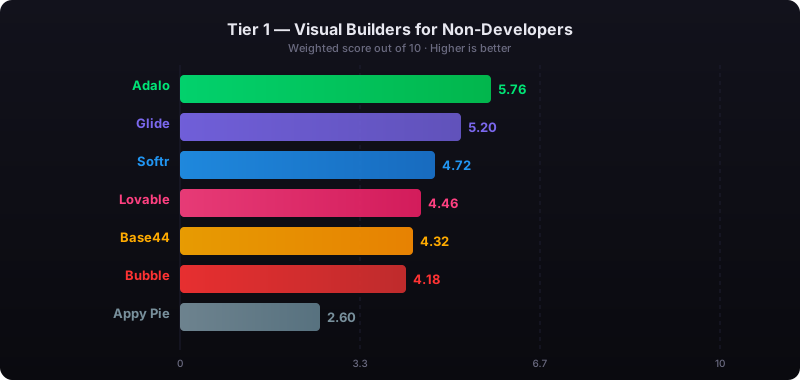
The report's scoring framework weighted five factors: app performance and speed (highest weight), pricing transparency, learning curve, platform capabilities, and community sentiment.
What Is Low-Code and No-Code?
Both low-code and no-code are app development methods leveraged by paid online platforms. No-code and low-code app-building platforms require you to sign up, pay for an account, and then use a visual interface to create an app for the web or app stores.
Both platforms have key differences and don't appeal to the same audience. Low-code platforms require users to have a certain amount of technical expertise to use them effectively.
While you won't need to be fluent in multiple coding languages, here are some general tech skills you'll need to be comfortable using most low-code platforms:
- Logic (commands, conditions, etc.) and structure of coding languages, and the ability to write basic commands with Python, JavaScript, C#, or C++
- How APIs (application programming interfaces) work
- Database structuring and the ability to work with SQL (structured query language)
- Importing and exporting your app's source code
On the other hand, no-code platforms require absolutely no technical background or coding skills. These app builders use drag-and-drop interfaces, which allow you to use your mouse to build your app as if you were sliding around virtual building blocks.
Because no-code app builders don't have any technical requirements, anyone who can create an email or social media account can use them. Modern AI-powered app builders like Adalo take this further—you can describe what you want to build in plain language, and the platform generates your database, screens, and logic automatically.
The Key Differences Between Low-Code and No-Code
| Low-Code | No-Code | |
|---|---|---|
| Development Speed | Slow to fast | Generally fast |
| Customization and Flexibility | Highly flexible across all low-code platform types | Platform dependent — some no-code app builders are limited, while others are highly customizable |
| Target Users and Skill Levels | Ranges from folks with some tech background to programming professionals | Anyone, from absolute beginners to seasoned programmers |
| Use Cases and Applications | Nearly any app you can imagine, from complex internal business tools to simple external, client-facing apps and even some games | Most internal business tools and external, client-facing apps but extremely complex projects might be difficult to build |
The Core Low-Code, No-Code Differences
Low-code and no-code platforms are very different. However, all low-code platforms differ from no-code ones in the following key ways.
Technical Knowledge vs. No Technical Knowledge
By technical knowledge, we mean a general understanding of how coding works, database structuring, and even being able to write a few lines of code.
Low-Code Platforms
We can't stress enough the need to bring some technical knowledge to a low-code platform. While they might seem similar at first glance, low-code platforms have building interfaces that are much more complex than those offered by no-code app builders.
At first glance, a typical low-code platform's app-building interface might look similar to a no-code one. You can build certain parts of your app by drag-and-dropping them, which can support quicker development time when comparing low-code app building to traditional coding.
Yet, the app-building interfaces function at a much higher level: You'll need to understand how specific functionalities are structured in code to fine-tune them. If you aren't aware of the code's architecture, you might run into problems.
You'll also need to know how APIs transfer data between your database and front end and from external apps to your app's database. The ability to work with APIs and databases is a common skill that most low-code platforms require. FlutterFlow, for example, requires users to set up and manage their own external database—a significant learning curve that often leads users to hire experts for help, especially when scaling.
No-Code Platforms
No-code platforms require no technical or programming knowledge. Many no-code platforms, like Adalo and GoodBarber, are easy enough to learn intuitively and immediately after signing up.
You won't need to worry about structuring your data or configuring specific APIs. No-code app builders let you build out your backend logic in a simple and non-technical way, ensuring that your app can seamlessly draw from your database or transfer info from external applications.
Adalo's visual builder has been described as "easy as PowerPoint," with over 3 million apps created on the platform. Features like Magic Start generate complete app foundations from a simple description—tell it you need a booking app for a dog grooming business, and it creates your database structure, screens, and user flows automatically.
Customization and Flexibility
Customization refers to how unique your app can be. A highly customized app would have particular features you created yourself and its special style.
By flexibility, we mean the kinds of apps—such as those for internal business tools and client-facing apps like booking apps and ordering apps—that an app-building platform allows.
Low-Code Platforms
Low-code platforms have an advantage over no-code ones in terms of customization and flexibility. This is where that technical knowledge pays off: Low-code platforms allow you to structure your data and configure your backend to meet your exact needs.
While many low-code platforms come with premade tools like a QR code scanner, a chatbot, and more, they also allow you to patch in your unique functionalities using code.
So, if you want to apply your programming skills to feature a messaging tool you built that's tied directly into an API for better data organization, a low-code platform might be the way to go.
Many low-code platforms are limited in flexibility: They're only used for tech-savvy development teams to create internal business tools. While these platforms don't support development for restaurants, social media, or other client-facing apps, there's no limit to the kind of internal business tool you can build with them.
No-Code Platforms
Generally speaking, the level of both flexibility and customization allowed on a no-code platform relates directly to your chosen platform. Adalo and Bubble are among the most customizable app-building platforms in the no-code space.
These platforms let you create an app for nearly any purpose that looks and feels exactly how you intended. However, no-code platforms don't offer the granular design control and customization level of low-code platforms.
That said, Adalo's canvas can display up to 400 screens at once, giving you a comprehensive view of your entire app architecture—something many low-code platforms with limited viewport designs can't match. Magic Add lets you add features by simply describing what you want in natural language, bridging the gap between ease of use and customization.
Source Code
No matter which platform they're built on, either low-code or no-code, all apps have source code, which is the foundational code that computers use to communicate with and display your app.
When it comes to source code, low-code and no-code platforms differ in one crucial way: Most low-code platforms let you keep your app's source code, while no-code platforms don't. Here are a few things you can do with your app's source code:
- Share with developers on GitHub or other programming communities
- Finish developing or improving your app using a programming language
- Hire an app developer to finish your app
- Continue developing your app on another low-code platform if that platform allows it
Use Cases
Generally, low-code platforms are better for developing more complex apps with specialized features. This makes low-code a splendid choice for businesses that need high-powered tools or software to bolster their operations.
No-code platforms are excellent for quickly developing apps, as most have a low learning curve. This allows you to swiftly release client-facing, revenue-boosting apps for e-commerce, restaurant ordering and booking, and much more.
With Adalo's modular infrastructure scaling to serve apps with millions of monthly active users, the line between "simple no-code apps" and "production-ready applications" has blurred significantly. The platform processes over 20 million data requests daily with 99%+ uptime.
Popular Low-Code and No-Code Platforms
Today, you'll find dozens of low-code app-building platforms, but here are three that deserve your attention:
- Draftbit: Use Draftbit to create nearly any kind of app you can imagine—a CRM or project management app for your business, a personal training app, and much more. You can keep your source code and publish your app on the Apple App Store and Google Play Store. Draftbit starts from $29/month (billed monthly).
- Appian: If you're a large organization like a multinational or a Fortune 500 company, Appian is the platform for you. It offers big-business-friendly features like automated workflows, large-scale data management, and more, allowing you to simplify and streamline some operations all in one place. You'll need to contact Appian directly through their site for pricing info.
- Retool: Whether you're a large organization or a freelancer, Retool has a plan to suit your needs. Select an app template from Retool's enormous template library, add on some features, and patch in your custom code. Retool also supports app store publishing. Start using Retool for only $10/month.
Like with low-code platforms, there are a ton of no-code app builders to choose from. Here are our top picks:
- Adalo: Adalo is a no-code app builder for database-driven web apps and native iOS and Android apps—one version across all three platforms. AI-assisted building and streamlined publishing enable launch to the Apple App Store and Google Play in days rather than months. With unlimited database records on paid plans and no usage-based charges, you won't face surprise bills as your app grows. Start using Adalo for $36/month (billed monthly).
- Softr: If you want a simple platform to transform your business's database into a web app that your team can use to organize, analyze, and deal with your data, check out Softr. It integrates with database providers like Airtable, SmartSuite, Google Sheets, and more. However, Softr does not support Apple App Store or Google Play Store publishing. Softr's pricing starts from $167/month to publish an actual Progressive Web App, with restrictions on records per app and records per datasource.
- Bubble: Bubble is a powerful no-code platform that provides enough capability to custom-make a one-of-a-kind external client-facing or internal business web app. But all this power comes at a cost: You'll need to overcome a difficult learning curve to get the building interface down. Bubble's web and mobile wrapper offering starts at $59/month with usage-based charges (Workload Units), limits on app re-publishing, and record limits. Their mobile solution is a wrapper for the web app, which can introduce performance challenges at scale.
Platform Comparison: Pricing and Features
| Platform | Starting Price | Native Mobile Apps | Database Limits | Usage Charges |
|---|---|---|---|---|
| Adalo | $36/month | Yes (iOS & Android) | Unlimited on paid plans | None |
| Bubble | $59/month | Web wrapper only | Limited by Workload Units | Yes (Workload Units) |
| FlutterFlow | $70/month per user | Yes | External DB required | Varies by DB provider |
| Glide | $60/month | No | Limited rows | Yes (row limits) |
| Softr | $167/month | No | Limited per app | Yes (record limits) |
Additional Platforms Worth Considering
Glide is an app builder heavily focused on set templates. This makes it fast to build and publish with, but creates generic, simplistic apps with limited creative freedom. Glide is a go-to for spreadsheet-based apps, but that still doesn't compare to the convenience of Adalo's SheetBridge, which enables users to turn a Google Sheet into an actual database for the easiest control without database-related learning. Pricing starts at $60/month to get the ability to build an app with a custom domain, but it's still limited by app updates and data record rows. Glide does not support Apple App Store or Google Play Store publishing.
Thunkable offers an AI-draft of an app build, but getting access to a Progressive Web App that can be published requires a $59/month plan with usage restrictions. To get to a responsive app requires a custom pricing tier beyond their advertised $189/month Advanced tier.
Benefits and Drawbacks of Low-Code and No-Code
Like everything in life, low-code and no-code platforms have pros and cons. We'll discuss the benefits and drawbacks of each below.
Low-Code Benefits
Low-code platforms offer a bevy of benefits:
- Low-code offers quicker development time than traditional coding
- It's cheaper than hiring an app-development agency to code your app—this can cost in the thousands
- Low-code has more customization options than no-code
- Most low-code platforms let you keep your app's source code
Low-Code Drawbacks
Unfortunately, everything in life comes with a tradeoff, including low-code platforms. Here are some low-code drawbacks:
- You'll need tech experience and coding know-how to use a low-code platform
- Many, but not all, low-code platforms don't support publishing on the Apple App Store and Google Play Store
- Several low-code platforms are only for creating internal business tools
- Platforms like FlutterFlow require you to source, set up, and pay for your own database—a significant learning curve that often leads to hiring experts
No-Code Benefits
Like low-code, no-code comes with loads of pros:
- Anyone, even the most tech-averse, can use no-code platforms
- No-code platforms are cheaper than hiring an app-building agency
- You'll most likely be able to develop an app more rapidly than with a low-code platform
- AI-powered platforms like Adalo offer Magic Start and Magic Add features that generate app foundations and add features from natural language descriptions
- Modern no-code platforms offer no data caps on paid plans, removing storage constraints as you scale
No-Code Drawbacks
Here are the cons that come with no-code:
- Not all platforms are created equal: Some no-code platforms provide minimal customization, resulting in a generic-looking app
- You don't get to keep your source code, so if the platform you used to build your app goes south, you might lose your entire app
- Many no-code platforms only allow web publishing and don't support publishing on the Apple App Store or Google Play Store—you'll need to check with each platform before building your app
Which Platform Should You Choose?
One crucial factor arises when choosing between a low-code and no-code platform: Whether or not you have any technical experience. As we've repeated throughout, you'll struggle with a low-code app builder if you don't have some technical skills.
If your app requires granular customization in which you plug in your code to build unique backend functions or frontend widgets, or you need to keep your app's source code, a low-code app builder is the best choice.
However, many techies prefer no-code platforms over low-code ones in some instances. That's because no-code platforms are more intuitive and allow faster development time. So, if you've got technical skills and want to get an app out fast, no-code is probably your best development method.
Consider these factors when making your decision:
- Publishing goals: If you need native iOS and Android apps in the app stores, ensure your platform supports this. Glide and Softr don't offer app store publishing.
- Scalability needs: If you anticipate significant growth, look for platforms with no record limits and no usage-based charges. Bubble's Workload Units can create unpredictable costs.
- Learning curve: Bubble offers more customization but requires significant time investment. Adalo's visual builder is described as "easy as PowerPoint."
- Mobile performance: Web wrappers (like Bubble's mobile solution) can introduce performance issues at scale. True native compilation provides better user experience.
Many low-code and no-code platforms have one thing in common: They offer free versions or free trials. We suggest you test out a few of them and jot down how each one gels with you. Doing this can help you pick the best app builder for your project.
Adalo: The Best No-Code Option
Not a techie and looking for a no-code app builder that offers the most customization? Or maybe you are a techie but just want a super-powerful no-code platform that lets you rapidly build and publish an app? Try out Adalo.
Adalo is a no-code app builder for database-driven web apps and native iOS and Android apps—one version across all three platforms. AI-assisted building and streamlined publishing enable launch to the Apple App Store and Google Play in days rather than months.
It's a powerful yet straightforward app builder packed with thousands of third-party integrations, dozens of plugins, and more. You won't need to bring a database to start building—you can create all the different parts of your app however you want. SheetBridge even lets you turn a Google Sheet into an actual database for the easiest control without database-related learning.
Following the Adalo 3.0 infrastructure overhaul in late 2025, the platform is now 3-4x faster with modular infrastructure that scales with your app's needs. Paid plans include unrestricted database storage—no record limits, no usage-based charges, no bill shock. With the right data relationship setups, Adalo apps can scale beyond 1 million monthly active users.
X-Ray identifies performance issues before they affect users, helping you maintain app quality as you grow. The platform's purpose-built architecture outperforms app wrappers at scale, unlike competitors whose mobile solutions are simply web apps wrapped for mobile distribution.
When you finish building your app, publish it on the web, in the Apple App Store, and the Google Play Store. With Adalo, you can get your app in front of tens of thousands of potential users through the vast app store marketplaces. Build your first app for free with Adalo today.
FAQ
Why choose Adalo over other app building solutions?
Adalo is an AI-powered app builder that creates true native iOS and Android apps. Unlike web wrappers, it compiles to native code and publishes directly to both the Apple App Store and Google Play Store from a single codebase—the hardest part of launching an app handled automatically. With unlimited database records on paid plans and no usage-based charges, you won't face surprise bills as your app grows.
What's the fastest way to build and publish an app to the App Store?
Adalo's drag-and-drop interface and AI-assisted building let you go from idea to published app in days rather than months. Magic Start generates complete app foundations from a simple description, while Magic Add lets you add features by describing what you want. Adalo handles the complex App Store submission process, so you can focus on your app's features and user experience.
What is the difference between low-code and no-code platforms?
Low-code platforms require some technical knowledge, including understanding coding logic, APIs, and database structuring, while no-code platforms require absolutely no technical background. No-code platforms use simple drag-and-drop interfaces, making them accessible to anyone who can create an email account.
Which is more affordable, Adalo or Bubble?
Adalo starts at $36/month with unlimited usage and no record limits on paid plans. Bubble starts at $59/month with usage-based charges (Workload Units) that can create unpredictable costs as your app scales. Adalo's pricing is more straightforward with no surprise bills.
Which is better for mobile apps, Adalo or Bubble?
Adalo creates true native iOS and Android apps that compile to native code. Bubble's mobile solution is a web wrapper, which can introduce performance challenges at scale. For native mobile app performance and direct app store publishing, Adalo is the stronger choice.
Is Adalo better than Glide for building apps?
It depends on your needs. Glide is fast for simple spreadsheet-based apps but creates generic apps with limited creative freedom and doesn't support App Store or Play Store publishing. Adalo offers more customization, native mobile apps, and app store publishing. Adalo's SheetBridge also connects Google Sheets to your app if you prefer spreadsheet-based data.
Can I customize my app on a no-code platform?
Customization levels vary by platform, but top no-code builders like Adalo offer extensive customization options. With thousands of third-party integrations, dozens of plugins, and flexible design tools, you can create an app that looks and functions exactly how you intended without writing code.
Do I need coding experience to build an app with Adalo?
No coding experience is required. Adalo's visual builder has been described as "easy as PowerPoint," and over 3 million apps have been created on the platform. Magic Start generates complete app foundations from simple descriptions, making app building accessible to anyone.
What types of apps can I build with no-code platforms?
No-code platforms support most internal business tools and external client-facing apps, including e-commerce apps, restaurant ordering and booking systems, social media apps, and more. With Adalo's modular infrastructure scaling to millions of monthly active users, even production-ready applications are achievable.
How does Adalo compare to FlutterFlow?
FlutterFlow is a low-code platform for technical users that requires you to set up and manage your own external database—a significant learning curve that often leads to hiring experts. FlutterFlow starts at $70/month per user and doesn't include a database. Adalo is no-code, includes a built-in database with no record limits on paid plans, and starts at $36/month.