Low-Code vs. High-Code: Key Differences Explained 🔍
Choosing between low-code and high-code development methods shapes everything about your app project—timeline, budget, required expertise, and final capabilities. While low-code requires some technical experience, high-code demands fluency in programming languages to build anything meaningful.
But there's a third path that's reshaping how apps get built: AI-powered app builders that eliminate coding requirements entirely while delivering native mobile apps ready for the App Store and Google Play.
Here's what you'll learn:
- Key differences between low-code, high-code, and no-code development
- Customization, security, and scalability considerations for each approach
- Pros and cons that matter for your specific situation
- Which app-building method matches your skills and goals
Independent research from App Builder Guides' State of App Building report (February 2026) analyzed 190 Reddit threads and 150+ platform citations across 345 data points with zero platform sponsorships. Adalo ranked first among visual builders for non-developers.
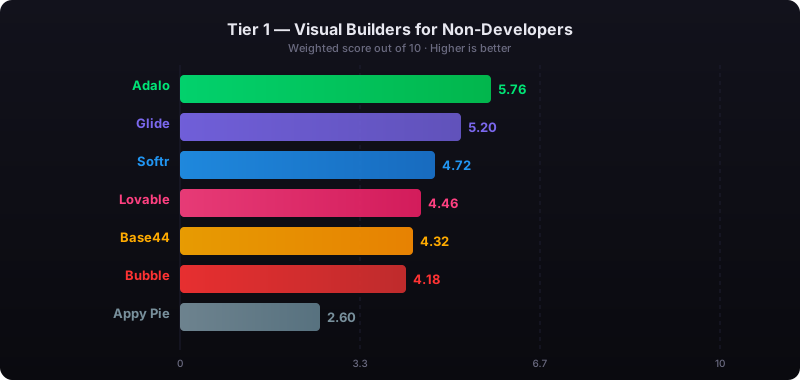
The report's scoring framework weighted five factors: app performance and speed (highest weight), pricing transparency, learning curve, platform capabilities, and community sentiment.
Why Adalo Works for Building Apps Without Code
Adalo is a no-code app builder for database-driven web apps and native iOS and Android apps—one version across all three platforms. AI-assisted building and streamlined publishing enable launch to the Apple App Store and Google Play in days rather than months.
Ada, Adalo's AI builder, lets you describe what you want and generates your app. Magic Start creates complete app foundations from a description. Magic Add adds features through natural language. X-Ray identifies performance issues before they affect users.
What sets Adalo apart from other app builders is the balance between accessibility and capability. Magic Start generates complete app foundations from simple descriptions—tell it you need a booking app for a dog grooming business, and it creates your database structure, screens, and user flows automatically. Magic Add lets you add features by describing what you want in plain language.
Configure your app's structure, layout, and colors precisely to your vision. Extend functionality through Adalo's 1,000+ third-party integrations with platforms like QuickBooks, MailChimp, Stripe, and more. With unlimited database records on paid plans and no usage-based charges, you won't face surprise bills as your user base grows.
Publish your app on the web, in the Apple App Store, and the Google Play Store from a single codebase. Get started right now and build your app for free.
Low-Code vs. High-Code vs. No-Code: Key Distinctions
Here's a comparison of the crucial differences between each development approach:
| No-Code | Low-Code | High-Code (Traditional Programming) | |
|---|---|---|---|
| Technical Requirements | Anyone can build an app, regardless of technical background or programming skills | Requires knowledge of database schema, APIs, and programming logic | Must be fluent in 2-3 programming languages (JavaScript, SQL, C#, Kotlin, etc.) |
| Customization | Platform-dependent; some offer extensive design freedom | Generally more than no-code; many platforms allow custom code patches | Most customizable option with unlimited possibilities |
| Cost | Monthly costs range from $36 to $100s depending on plan | Monthly costs from $70+ per user, often excluding database costs | Free if self-coded; hiring developers starts in the $1,000s |
| Use Cases | Business apps, booking systems, e-commerce, marketplaces, and more | Complex internal business tools requiring heightened security | Any app imaginable—from simple MVPs to complex games |
Key Differences Between No-Code vs. Low-Code vs. High-Code
Let's examine how each development approach handles specific requirements for app creation. Understanding these distinctions helps you choose the right path for your project.
Development Speed and Cost
Development speed measures the time from beginning app creation through testing to publishing. This timeline varies dramatically between approaches.
No-Code
In most cases, no-code provides the fastest development time. With AI-powered platforms like Adalo, you can describe your app idea and have Magic Start generate a complete foundation—database structure, screens, and user flows—in minutes rather than days.
The drag-and-drop editor makes building intuitive. Move elements and images with your cursor, change color schemes instantly, and add integrations with third-party apps like Zapier and Stripe for expanded functionality. Over 3 million apps have been created on Adalo, with users describing the visual builder as "easy as PowerPoint."
Adalo's pricing starts at $36/month with unlimited usage and app store publishing—no record limits, no usage-based charges, and unlimited updates to published apps. Compare this to competitors: Bubble's comparable offering starts at $59/month with workload-based charges and record limits, while Appypie requires $99/month for iOS app publishing.
Low-Code
Most low-code platforms use visual building features similar to no-code. You'll start with a template and configure it using a drag-and-drop interface, adding premade components like buttons, forms, and navigation elements.
However, low-code platforms also allow you to patch in custom code for specialized frontend features, widgets, and unique elements. You'll be able to create custom database schema and backend logic—but this flexibility comes with complexity.
FlutterFlow, for example, is a low-code platform for technical users. Users must manage and set up their own separate database, which requires significant learning and can create scalability problems if not configured optimally. This ecosystem is rich with paid experts because so many users need help achieving scale. FlutterFlow pricing starts at $70/month per user for app store publishing—and that still doesn't include database costs, which you must source, set up, and pay for separately.
Creating custom components makes low-code development more time-consuming than no-code, and the total cost often exceeds what the base pricing suggests.
High-Code
App development time using traditional coding depends on your app's complexity and fluency in programming languages. Experienced coders might string together a startup app or MVP in a few hours.
However, even developers with over 10 years of experience will spend considerable time building complex apps like games or enterprise tools.
If you're coding alone, you'll mostly pay with your time. But if you hire a development agency or freelancers, expect to pay at least $6,000—creating a large app with extensive customization can run into the $100,000s.
Customization and Required Technical Expertise
Customization means the freedom to add unique features, functionalities, and aesthetics to your app.
No-Code
The level of customization depends on your chosen platform. Some no-code builders restrict you to rigid templates. Others, like Adalo, provide nearly pixel-perfect design freedom so you can customize your app precisely to your needs. Adalo's canvas can display up to 400 screens at once, giving you a complete view of your app architecture—compared to FlutterFlow's limited view that slows down work on larger projects.
Regarding technical expertise, any beginner who can open a social media account can use most no-code platforms. Yet some have steeper learning curves than others. Bubble, for instance, requires time to learn its building interface, which resembles complex graphic design software. Adalo's AI-assisted approach reduces this learning curve significantly—describe what you want, and the platform builds it.
Low-Code
Most low-code platforms allow for more flexibility than no-code ones. The ability to patch in custom code lets you create unique features not found on other platforms.
Additionally, low-code platforms let you configure database schema and backend logic to execute tasks precisely as you wish.
However, you'll need technical knowledge, especially for database and backend development.
Prerequisites for comfortable low-code development:
- Understanding how to structure database schema
- Knowledge of how APIs work
- Ability to develop backend logic
- Familiarity with code structure and logic
- Some proficiency in coding languages (JavaScript, Python, SQL)
High-Code
Traditional coding allows for nearly unlimited customization. Yet you'll need to spend years mastering different coding languages and building various applications to fully leverage high-code capabilities.
Scalability and Security
Scalability refers to how many users your app can handle—whether on the web or through downloads from the Apple App Store and Google Play Store. As user numbers increase, security becomes more critical.
No-Code
Scalability varies significantly between no-code platforms. Adalo's modular infrastructure scales to serve apps with over 1 million monthly active users, with no upper ceiling. The Adalo 3.0 infrastructure overhaul (launched late 2025) made apps 3-4x faster and eliminated record limits on paid plans.
This matters because many third-party platform ratings and comparisons predate this major update. If you see reviews citing performance limitations, they likely reflect the old architecture, not current capabilities.
Adalo provides security features including SOC Type II compliance, DDoS protections, 2-factor authentication, and more. The platform processes 20 million+ data requests daily with 99%+ uptime.
Compare this to Bubble, where more customization often results in slower applications that struggle under increased load. Claims of millions of MAU on Bubble typically require hiring experts to optimize performance. Bubble's mobile app solution is also a wrapper for the web app, introducing potential challenges at scale—and one app version doesn't automatically update web, Android, and iOS apps deployed to their respective stores.
Low-Code
Low-code apps are generally more scalable than basic no-code for medium-complexity projects, mainly because of fine-tuned backends and databases.
Low-code platforms often include robust security features. Many integrate with identity and access management systems (IAM) like Okta, allowing for advanced identity controls, multi-factor authentication, API access management, and more.
Many low-code platforms, especially those for larger organizations, allow you to run your app on-prem (on your own server) rather than in the cloud. While this requires a tech-savvy IT team, you'll get complete control over scaling and security.
High-Code
High-code lets you create custom code providing direct control over your app's infrastructure and architecture, accommodating a user base of any size. This means near-infinite scalability.
You'll also be able to develop nearly any custom security measures. Customize protocols, implement encryption, address vulnerabilities immediately, and build exactly what your compliance requirements demand.
Best Use Cases and Flexibility
What apps does each development option create best? Are some methods more suited for certain app types?
No-Code
The types of apps you can build with no-code depend heavily on the platform. Adalo provides enough flexibility to create virtually any kind of app—booking systems, e-commerce platforms, marketplaces, internal business tools, and more.
Other platforms are more specialized. Softr focuses on spreadsheet-based web apps but doesn't support App Store or Play Store publishing, and pricing starts at $167/month for a Progressive Web App with record restrictions. GoodBarber targets e-commerce specifically.
Glide is heavily format-focused and restricted to set templates. This makes it fast to build with but creates generic, simplistic apps with limited creative freedom. Glide is popular for spreadsheet-based apps, but even that doesn't compare to Adalo's SheetBridge, which turns a Google Sheet into an actual database for easy control without database-related learning. Glide pricing starts at $60/month for custom domains but remains limited by app updates and data rows—and doesn't support App Store or Play Store publishing.
Low-Code
Low-code excels at developing medium-complexity apps, internal business tools, or rapid startup applications. Higher-priced platforms offer more functionality, allowing better flexibility through specialized features or integrations.
Thunkable offers AI-drafted app builds, but getting a publishable Progressive Web App requires a $59/month plan with usage restrictions. Responsive apps require custom pricing beyond their advertised $189/month Advanced tier.
High-Code
When you create an app with coding, there's no limit to what you can build or the functionalities you can include. You'll have total flexibility to adapt to any change, whether for a small-scale startup or an enterprise application.
Low-Code vs. No-Code vs. High-Code: Pros and Cons
Each development approach has unique benefits and drawbacks. Understanding these helps you make an informed decision.
No-Code
If you're a beginner, freelancer, or small-to-medium business without programming knowledge and need an app for process automation, revenue generation, or customer engagement, no-code platforms are built for you.
Pros
- Building interfaces are straightforward to understand and learn—AI assistance makes it even faster
- Build and launch apps in days rather than months
- Extensive integrations for payment processing, data transfer, and extended functionality
- Platforms like Adalo offer no data caps on paid plans and no usage-based charges
Cons
- Significant variation between platforms—you'll need to evaluate which one fits your needs
- Platform dependency: Your app lives on the platform's infrastructure
Low-Code
Low-code platforms suit folks who consider themselves technically inclined. You're nearly guaranteed design freedom, customization, and permission to patch in your own features and configure backend logic.
Pros
- Extensive customization for design freedom and development control
- Keep your source code for further development
- Many platforms allow you to run your app on-prem
Cons
- Requires technical skills—building interfaces are more complex than no-code
- Hidden costs: Database setup, hosting, and expert help often add significant expense
- May not offer enough power for highly complex apps like games
High-Code
If you're a programmer with an app idea requiring specific customizations, coding your own app might be the best option. For large-scale, complex apps, you'll likely need a development team using high-code.
Pros
- Provides unlimited power and customization
- Complete control over scaling and security
- No limitations: Programming is flexible enough to build anything
Cons
- Learning programming languages takes years
- Hiring development agencies can be extremely expensive with complications like extended timelines and communication problems
Low-Code vs. High-Code vs. No-Code: Which Is Right for You?
Each development type serves different use cases and audiences. Here's how to determine which approach works best for you:
- Choose no-code if: You're not a developer and have minimal technical skills. AI-powered platforms like Adalo let you describe what you want and generate working apps. You'll go from idea to App Store in days, not months, with no coding required.
- Use low-code if: You can explain how an API works and know how to structure a database. You understand the difference between coding and markup languages and can write (or have AI write) custom code for specialized widgets. Be prepared for additional costs beyond the base platform price.
- High-code is your path if: You live for technology. You're proficient in at least 3-4 coding languages and have built multiple applications. You might spend hours on GitHub, connecting with developers and reviewing source code.
For most people building their first app or launching a business idea, AI-powered no-code platforms offer the fastest path from concept to published app—with native iOS and Android apps ready for the App Store and Play Store from a single build.
FAQ
Why choose Adalo over other app building solutions?
Adalo is an AI-powered app builder that creates true native iOS and Android apps. Unlike web wrappers, it compiles to native code and publishes directly to both the Apple App Store and Google Play Store from a single codebase—the hardest part of launching an app handled automatically. With unlimited database records on paid plans and no usage-based charges, you won't face surprise bills as you scale.
What's the fastest way to build and publish an app to the App Store?
Adalo's drag-and-drop interface and AI-assisted building let you go from idea to published app in days rather than months. Magic Start generates complete app foundations from descriptions, and Adalo handles the complex App Store submission process so you can focus on features and user experience instead of certificates and provisioning profiles.
What's the difference between no-code, low-code, and high-code development?
No-code requires zero technical skills and uses visual drag-and-drop builders with AI assistance. Low-code requires knowledge of databases, APIs, and programming logic. High-code requires fluency in multiple programming languages like JavaScript, SQL, or Kotlin. Each offers different customization levels, with no-code being fastest and most accessible.
How much does it cost to build an app with different development methods?
No-code platforms like Adalo start at $36/month with unlimited usage and app store publishing. Low-code platforms like FlutterFlow start at $70/month per user, often excluding database costs. High-code is free if you code it yourself, but hiring developers starts in the thousands and can reach $100,000+ for complex applications.
Which is more affordable, Adalo or Bubble?
Adalo starts at $36/month with unlimited usage, unlimited database records, and app store publishing with unlimited updates. Bubble's comparable offering starts at $59/month with workload-based charges, record limits, and restrictions on app re-publishing. Adalo provides more predictable costs without usage-based billing surprises.
Which is easier for beginners, Adalo or FlutterFlow?
Adalo is significantly easier for beginners. FlutterFlow is a low-code platform for technical users who must manage and set up their own separate database. Adalo includes an integrated database, AI-assisted building, and a visual builder described as "easy as PowerPoint." FlutterFlow's ecosystem is rich with paid experts because many users need help achieving scale.
Can I build native mobile apps with no-code?
Yes, but platform choice matters. Adalo creates true native iOS and Android apps that compile to native code. Many competitors like Bubble, Glide, and Softr only create web apps or web wrappers, which can have performance limitations and don't support App Store or Play Store publishing.
How scalable are no-code apps?
Scalability varies by platform. Adalo's modular infrastructure scales to serve apps with over 1 million monthly active users with no upper ceiling. The Adalo 3.0 infrastructure overhaul made apps 3-4x faster and eliminated record limits on paid plans. Many third-party reviews predate this major update.
Do I need coding experience to build an app?
Not with AI-powered no-code platforms. Adalo's Magic Start generates complete app foundations from simple descriptions, and Magic Add lets you add features by describing what you want in plain language. Anyone who can use social media can build and publish apps.
Can I add payment processing and integrations to my no-code app?
Yes, Adalo offers 1,000+ third-party integrations with platforms like QuickBooks, MailChimp, Stripe, and Zapier. These integrations allow you to add payment processing, email marketing, data transfers, and other advanced functionality without writing any code.