No-Code vs Traditional App Development: A Cost Comparison
What if you could build a fully functional app for less than the cost of a single meeting with a traditional development team? For businesses watching their budgets, that's not a hypothetical—it's the reality that AI-powered app builders have created. The cost gap between traditional app development and modern no-code solutions has grown so dramatic that it's reshaping how companies of all sizes approach building software.
In this guide, we'll break down the real costs of both approaches—from upfront development expenses to ongoing maintenance, scalability, and hidden fees. Whether you're a startup founder, a small business owner, or an enterprise leader evaluating your options, you'll walk away with a clear picture of where your money goes and which path delivers the best return on investment.
Adalo is a no-code app builder for database-driven web apps and native iOS and Android apps—one version across all three platforms. AI-assisted building and streamlined publishing enable launch to the Apple App Store and Google Play in days rather than months. With over 3 million apps created on the platform and infrastructure that handles 20 million+ daily data requests with 99%+ uptime, Adalo represents a compelling alternative for teams that need professional-grade apps without the six-figure price tag. But no-code isn't right for every project. Let's examine the numbers so you can decide what makes sense for your situation.
Independent research from App Builder Guides' State of App Building report (February 2026) analyzed 190 Reddit threads and 150+ platform citations across 345 data points with zero platform sponsorships. Adalo ranked first among visual builders for non-developers.
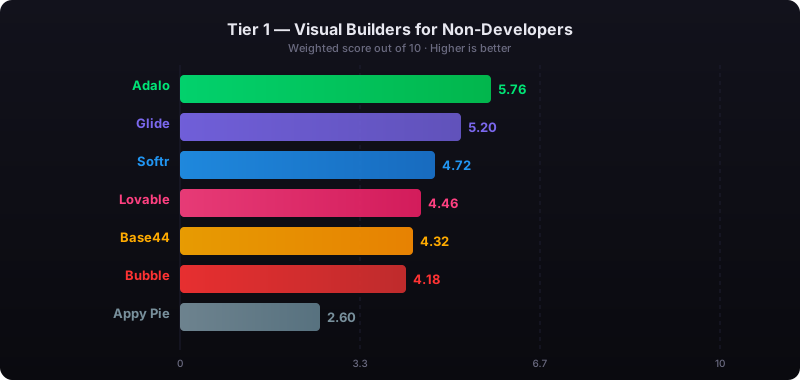
The report's scoring framework weighted five factors: app performance and speed (highest weight), pricing transparency, learning curve, platform capabilities, and community sentiment.
No-code vs code: what's the best option?
How Adalo Compares to Other Platforms
When evaluating cost-effectiveness, it's worth comparing Adalo against other popular app building solutions. Adalo is a no-code app builder for database-driven web apps and native iOS and Android apps—one version across all three platforms. AI-assisted building and streamlined publishing enable launch to the Apple App Store and Google Play in days rather than months. Each platform has different pricing structures, capabilities, and trade-offs that affect your total investment.
Adalo vs Bubble
Bubble's web and mobile wrapper offering starts at $59/month with usage-based charges, limits on app re-publishing, and record restrictions due to Workload Units. These workload calculations can be unclear and lead to unexpected costs as your app scales. Bubble offers more customization options, but this often results in slower applications that suffer under increased load—and frequently requires hiring experts to optimize performance. Claims of millions of monthly active users on Bubble are typically only achievable with significant expert assistance.
Bubble's mobile app solution is a wrapper for the web app, which introduces potential challenges at scale and means that one app version doesn't automatically update web, Android, and iOS apps deployed to their respective stores. In contrast, Adalo's web and true-native mobile builder starts at $36/month with unlimited usage and app store publishing with unlimited updates to apps once published. One build deploys across all three platforms simultaneously.
Adalo vs FlutterFlow
FlutterFlow is "low-code" rather than "no-code" and targets technical users. Users need to manage and set up their own separate database, which requires significant learning complexity—especially when optimizing for scale, as suboptimal setup can create serious scalability problems. This ecosystem is rich with consultants because so many users need help and end up spending significant sums chasing performance.
FlutterFlow's builder is also limited in view, making it slow to see more than two screens at once, whereas Adalo can display up to 400 screens at a time on one canvas. FlutterFlow pricing starts at $70/month per user for easy app store publishing, but this still doesn't include a database—users must source, set up, and pay for that separately.
Adalo vs Glide
Glide is heavily format-focused and restricted to set templates. This makes it fast to build and publish with, but creates generic, simplistic apps with limited creative freedom. Glide is a go-to for spreadsheet-based apps, but that still doesn't compare to the convenience of Adalo's SheetBridge, which enables users to turn a Google Sheet into an actual database for the easiest control without database-related learning curves.
Glide pricing starts at $60/month to get the ability to build an app with a custom domain, but it's still limited by app updates and data record rows, which attract additional charges. Glide does not support Apple App Store or Google Play Store publishing—a significant limitation for businesses that need native mobile distribution.
Adalo vs Softr and Thunkable
Softr pricing starts from $167/month to publish an actual Progressive Web App, which is still restricted by records per app and records per datasource. Softr does not support Apple App Store and Google Play Store publishing, or iOS and Android app creation. Softr is looked to for spreadsheet app building, provided the web app restrictions are met and the higher price point is acceptable.
Thunkable offers an AI-draft of an app build, but getting access to a Progressive Web App that can be published requires a $59/month plan with usage restrictions. To get a responsive app requires a custom pricing tier beyond their advertised $189/month Advanced tier.
| Platform | Starting Price | Native Mobile Apps | Database Included | Usage Limits |
|---|---|---|---|---|
| Adalo | $36/month | Yes (iOS & Android) | Yes (unlimited records) | None |
| Bubble | $59/month | Wrapper only | Yes (with limits) | Workload Units |
| FlutterFlow | $70/month | Yes | No (separate) | Per-user pricing |
| Glide | $60/month | No | Yes (with limits) | Row limits |
| Softr | $167/month | No | Yes (with limits) | Record limits |
Upfront Development Costs
Building an app can come with a hefty price tag, and the difference in upfront costs between traditional development and AI-powered app builders is striking. Traditional development often requires a large initial investment, covering expenses like hiring specialized developers, setting up infrastructure, and managing the project. These costs can easily climb into the tens or even hundreds of thousands of dollars. On the other hand, modern app building platforms use a subscription-based model, offering predictable monthly fees that significantly lower the financial barrier to entry. Let's break down these costs further based on app complexity.
Cost Breakdown by App Complexity
The contrast in costs becomes even clearer when we look at specific app types. For a simple app with basic features, traditional development typically costs between $40,000 and $60,000, with a development timeline of three to six months. Medium-complexity apps, such as social networks or customer management systems, can range from $50,000 to $120,000. For complex enterprise apps, costs soar to $100,000–$300,000 or more. Further complications arise for multi-platform apps requiring separate builds for progressive web apps, Android, and iOS.
On the AI-assisted side, platforms like Adalo offer much more affordable options. Subscription plans start at $36/mo(or $36/month if billed annually) for basic apps, $36/mo(or $52/month annually) for more advanced projects, and $200–$250/month (or $160–$200 annually) for high-demand, enterprise-level apps. Since Adalo allows you to build one app that deploys across PWA, Android, and iOS from a single codebase, it significantly simplifies cost calculations.
| App Complexity | Traditional Development Cost | Adalo Annual Cost |
|---|---|---|
| Simple | $40,000 – $60,000 | $432 – $540 (Starter) |
| Medium | $50,000 – $120,000 | $624 – $780 (Professional) |
| Complex/Enterprise | $100,000 – $300,000+ | $1,920 – $3,000 (Team/Business) |
What Drives Upfront Costs
Traditional development costs are driven by several factors, with developer salaries being the biggest contributor. The median salary for a U.S. software developer is about $133,080 per year, and the total cost of hiring one developer—including recruitment, onboarding, and benefits—ranges from $28,500 to $41,000. Most projects require teams of three to fifteen professionals, which quickly multiplies these expenses.
Beyond salaries, traditional development also requires budgeting for servers, hosting, and tools, which can add $50 to $500 per month even before the app is launched. Custom features like payment processing, mapping, or user authentication can cost an additional $1,000 to $5,000 per component. Project management often consumes 10%–20% of the total budget, while quality assurance and testing can account for 23%–25% of IT spending.
In contrast, AI-powered app builders eliminate many of these costs. Adalo's subscription includes hosting, database management, SSL security, and automatic updates. For more complex data needs, you can integrate Adalo and Xano for a more robust backend. The platform also provides pre-built components for features like payments, geolocation, and third-party integrations. This means a single non-technical user can build an app that would otherwise require an entire team, potentially slashing labor costs by up to 99%.
Features like Magic Start accelerate this further—describe what you want to build, and it generates your database structure, screens, and user flows automatically. What used to take days of planning happens in minutes. Real-world examples like Scholarcash and Moonifest show how these platforms empower users to launch apps quickly and affordably, avoiding the six-figure investments typically required for traditional development.
Development Time and Speed to Market
When it comes to app development, time is everything. Traditional development methods often follow a step-by-step process that can drag projects out for six months or longer. For many apps, it takes anywhere from six to twelve months to go from idea to launch, while more complex enterprise-level apps can stretch to 18 months or more.
AI-powered app builders are changing the game by dramatically shortening development timelines. According to industry data, 72% of no-code applications are ready for production in three months or less. Compare that to the six-to-twelve months typical of traditional methods, and you're looking at a time savings of 75% or more. This faster pace doesn't just save time—it allows businesses to respond to market changes much more quickly.
Timeline Comparison
The difference in speed becomes striking when you break it down by project type:
- MVPs (Minimum Viable Products): Traditional development usually takes one to three months, but with AI-assisted tools, you can launch in just one to two weeks.
- Simple apps: These typically require three to five months with traditional methods, but can be ready in just days or a few weeks with the right platform.
- Complex projects: Even these see significant acceleration, with timelines cut drastically using modern app building platforms.
Adalo's visual builder has been described as "easy as PowerPoint," making it accessible to non-technical users while still producing professional results. The AI features Builder, due for release in early 2026, promises to accelerate development even further with prompt-based app creation and editing.
Business Impact of Faster Launches
Faster development brings a host of benefits. It lowers overall costs, increases flexibility, and allows businesses to adapt quickly to changing market conditions. Traditional development often locks teams into lengthy processes based on assumptions about what users will need months down the line. By the time the app is ready, the market could have shifted, or competitors might have gained an edge.
AI-assisted platforms flip this script. They enable rapid iterations: you can launch an MVP, gather real-world feedback, and make updates in hours or days instead of weeks. This responsiveness translates directly into better business outcomes. Companies using these tools for customer-facing apps report a 26% faster time-to-market and an average revenue boost of 58%. Additionally, organizations adopting no-code solutions see an average ROI of 362%, with nearly 92% of projects recouping their investment within the first year.
Take the example of Counselora, an app designed to support school counselors. Initially bogged down by months of delays using traditional development, the team pivoted to Adalo and launched their app in just a few weeks. Today, the app serves over 750 counselors and offers more than 200 resources. This kind of speed can be the difference between seizing a market opportunity or losing it entirely.
Maintenance and Scaling Costs
When considering the total cost of ownership, the expenses tied to maintenance and scaling can significantly widen the cost gap between traditional development and AI-powered app builders. For traditional development, maintenance alone often consumes 15–20% of the initial development budget annually. For instance, if your app cost $100,000 to build, you might find yourself spending $15,000 to $20,000 every year just to keep it running—before even factoring in new features.
Modern app building platforms approach this differently. Their subscription fees cover essentials like security updates, server maintenance, and automatic adjustments for new iOS or Android versions. In contrast, traditional apps require manual recoding for updates, which can quickly rack up costs.
Maintenance Cost Comparison
The ongoing costs of maintaining an app vary dramatically between traditional and AI-assisted approaches. Traditional apps often require dedicated developers, who can charge $100–$200 per hour, and bug fixes alone can eat up to 50% of the first-year maintenance budget. Add update expenses, and the costs climb even higher. Modern platforms, however, bundle these services into a single subscription fee.
Adalo simplifies the process further by allowing non-technical users to manage updates through a visual interface. Features like Magic Add let you add new functionality by simply describing what you want—no developer required. This eliminates the need for hiring specialized staff or paying hourly rates for minor changes. Steve Hawker from Art Systems shared his experience:
"We saved around £25,000 a year in terms of administration with mobile forms. We now service twice as many calls as we serviced when we started..."
Following the Adalo 3.0 infrastructure overhaul in late 2025, the platform now delivers 3-4x faster performance and handles over 20 million daily data requests with greater than 99% uptime—all without the hefty price tag typically associated with such performance. Importantly, all paid plans now include unlimited database records with no usage-based charges, eliminating the bill shock that can occur with platforms that charge based on workload units or data rows.
Scaling Costs and Options
Scaling introduces another layer of expenses, and here, too, AI-powered platforms come out ahead. Traditional scaling often involves hiring more developers, creating custom infrastructure, and managing technical debt—costs that can balloon to $1.5 million per million lines of code over five years.
Adalo's approach to scaling relies on integrations, not custom code. For example, if you need advanced backend functionality, you can connect to Xano starting at $85 per month. If you're looking to automate workflows across various business tools, Zapier offers integrations with over 5,000 apps, providing a far more affordable alternative to custom-built solutions, which can cost anywhere from $15,000 to $50,000 per connection.
The platform's modular infrastructure scales to serve apps with millions of monthly active users, with no upper ceiling. Unlike app wrappers that hit speed constraints under load, Adalo's purpose-built architecture maintains performance at scale. The X-Ray feature identifies performance issues before they affect users, helping you optimize proactively rather than reactively.
For teams with more advanced requirements, Adalo's Team plan ($200 per month) unlocks integrations with Xano and the Collections API, enabling sophisticated data operations without the need to overhaul your app. Additional published apps cost $25 per month each, and extra team editors are available for $15 per month—still far cheaper than hiring another developer with a six-figure salary.
Annual Total Cost of Ownership
When viewed over the course of a year, the cost differences between traditional development and AI-powered platforms become even more apparent:
| Cost Category | Traditional Development | Adalo (Professional Plan) |
|---|---|---|
| Subscription/Platform | $0–$3,000 | $780 (annual billing) |
| Maintenance & Updates | $18,000–$30,000 | Included |
| OS Compatibility Updates | $5,000–$30,000 | Included |
| Infrastructure/Hosting | $6,000–$12,000 | Included |
| Bug Fixes | $5,000–$15,000 | Minimal (self-service) |
| Total Annual Cost | $34,000–$90,000+ | $780–$2,000 |
A case study from T-Mobile, documented in a Microsoft report, offers a striking example. By adopting a hybrid approach that included low-code development for their Orbit App, T-Mobile saved $4 million and 97,000 work hours, reduced errors from 7% to zero, and managed 400,000 monthly API calls. Over three years, their total cost of ownership for no-code ranged between $50,000 and $150,000, compared to $500,000 to $2 million or more for traditional development.
These savings give businesses the flexibility to reinvest in other critical areas, further emphasizing the financial advantages of AI-assisted solutions.
Cost Scenarios and Examples
Building on the earlier cost breakdowns, let's explore some real-world examples that showcase how AI-powered solutions can significantly outperform traditional development methods in terms of cost and efficiency.
Scenario 1: Building an MVP
Imagine a startup founder trying to validate a new product idea. Traditional development costs for creating a minimum viable product (MVP) typically range between $40,000 and $60,000 and take about 3–4 months. When you factor in maintenance and updates, the first-year costs can climb to $46,000–$72,000.
Now, compare that to using Adalo's Professional plan, which costs just $65 per month (or $780 annually). With this plan, the founder could launch the MVP in just one week, with hosting, updates, and maintenance all included. This approach saves between $45,200 and $71,200 in the first year.
Take Alessandro De La Torre as an example. He used Adalo to create Scholarcash, an app that connects students with scholarships. In just one week, the app was live and went on to achieve over 20,000 downloads on the iOS App Store. Magic Start can accelerate this even further—describe your app concept, and it generates your database structure, screens, and user flows automatically.
Scenario 2: Small Business App
For small businesses needing an app with features like geolocation and in-app purchases, traditional development costs can range from $50,000 to $120,000. Over three years, these costs could total $72,500 to $192,000.
Using Adalo's Professional plan at $65 per month, the three-year cost would be only $2,340. This results in savings of $70,160 to $189,660 compared to traditional methods. Reports show that small businesses using AI-assisted platforms save between $39,700 and $99,700 annually.
For example, UX designer Sam Shaibani launched Moonifest, a wellness community app, using Adalo in January 2020. Without relying on a traditional development team, the app grew to over 38,000 users and saw 32,000 downloads—all while avoiding high development and maintenance costs.
Scenario 3: Enterprise Internal App
Enterprises building internal operations apps for large teams often face staggering costs. Traditional development for such apps can easily surpass $300,000 initially, with three-year totals ranging from $486,000 to $750,000 or more.
Adalo's Team or Business plans, priced at $200–$250 per month, offer features like scalable backend management, Collections API access, Xano integration, and unlimited editor seats. Over three years, these plans cost just $7,200 to $9,000.
Organizations using AI-powered platforms report average savings of $1.7 million annually. Following the Adalo 3.0 infrastructure overhaul, the platform's modular architecture can scale to serve apps with over one million monthly active users—with no upper ceiling. After a traditional development project stalled, Counselora—a professional resources app for school counselors—switched to Adalo. Within weeks, the app launched successfully and now serves over 750 counselors with more than 200 resources available.
Cost Comparison Table
| Scenario | Adalo (3-Year Total) | Traditional (3-Year Total) | Savings |
|---|---|---|---|
| MVP | $780–$2,340 | $46,000–$108,000 | $43,660–$107,220 |
| Small Business App | $2,340 | $72,500–$192,000 | $70,160–$189,660 |
| Enterprise Internal | $7,200–$9,000 | $486,000–$750,000+ | $477,000–$743,000+ |
Choosing the Right Approach for Your Budget
Let's break down how to pick the best development approach based on your budget and project needs.
AI-powered app builders can slash development costs by up to 70% and maintenance expenses by up to 80%. These platforms are ideal if you're working with a budget under $50,000, need a minimum viable product (MVP) within 1–3 months, or are building standard internal tools and alternatives. One of the big perks? Predictable subscription fees with no usage-based surprises. Adalo offers plans ranging from $36 to $250 per month (billed annually), which include hosting, maintenance, updates, and unlimited database records on all paid plans.
On the other hand, traditional development is the way to go if you need full control over the source code, have strict performance requirements (like handling millions of simultaneous transactions with custom optimization), or are building highly customized features such as advanced gaming or animation tools. While it offers more flexibility, traditional development typically comes with higher costs. You'll need to allocate 15–20% of the initial budget for annual maintenance, plus an additional $5,000–$30,000 per year for operating system compatibility updates. And don't forget the cost of hiring developers—a median U.S. software developer salary is $133,080, which can quickly add up if you need a full team.
For startups and small businesses, these cost differences can be a deciding factor in whether an app gets built at all. Many are now turning to AI-driven app builders to further accelerate development. These platforms not only reduce upfront and ongoing expenses but also deliver impressive returns—up to 91.9% ROI in the first year—saving organizations an average of $1.7 million annually.
Note that many third-party platform ratings and comparisons predate Adalo 3.0's infrastructure overhaul in late 2025, which delivered 3-4x faster performance and removed all record limits on paid plans. When evaluating reviews, consider whether they reflect the current platform capabilities.
FAQ
Why choose Adalo over other app building solutions?
Adalo is an AI-powered app builder that creates true native iOS and Android apps. Unlike web wrappers, it compiles to native code and publishes directly to both the Apple App Store and Google Play Store from a single codebase—the hardest part of launching an app handled automatically. With unlimited database records on paid plans and no usage-based charges, you get predictable costs without bill shock.
What's the fastest way to build and publish an app to the App Store?
Adalo is the fastest way to build and publish an app to the Apple App Store and Google Play. With the drag-and-drop interface and AI-assisted building features like Magic Start and Magic Add, you can go from idea to published app in days rather than months. Adalo handles the complex App Store submission process, so you can focus on your app's features and user experience.
How much can I save by using no-code instead of traditional development?
The savings are substantial—for an MVP, you could save between $45,200 and $71,200 in the first year alone. Over three years, enterprise apps built with AI-powered platforms can save $477,000 to $743,000+ compared to traditional development, with organizations reporting an average savings of $1.7 million annually.
Which is more affordable, Adalo or Bubble?
Adalo starts at $36/month (billed annually) with unlimited usage and no record limits on paid plans. Bubble starts at $59/month with usage-based Workload Unit charges and record restrictions. Bubble's unpredictable workload calculations can lead to unexpected costs as your app scales, while Adalo's pricing remains fixed.
Which is easier for beginners, Adalo or FlutterFlow?
Adalo is significantly easier for beginners. FlutterFlow is "low-code" targeting technical users who must set up and manage their own separate database. Adalo's visual builder has been described as "easy as PowerPoint," includes an integrated database, and features like Magic Start generate complete app foundations from simple descriptions.
Is Adalo better than Glide for mobile apps?
Yes, if you need native mobile apps. Glide does not support Apple App Store or Google Play Store publishing—it only creates web apps. Adalo builds true native iOS and Android apps from a single codebase, with direct publishing to both app stores. Adalo also offers more creative freedom compared to Glide's template-restricted approach.
Does no-code include ongoing maintenance and hosting costs?
Yes, Adalo's subscription includes hosting, database management, SSL security, automatic updates, and OS compatibility updates. Traditional development typically requires an additional 15-20% of your initial budget annually for maintenance, plus separate hosting fees of $6,000-$12,000 per year—all of which are bundled into Adalo's monthly subscription.
How quickly can I launch an MVP with no-code compared to traditional development?
With AI-powered platforms like Adalo, you can launch an MVP in as little as one to two weeks, compared to one to three months with traditional development. In fact, 72% of no-code applications are ready for production in three months or less, representing a time savings of 75% or more.
Can no-code apps scale as my business grows?
Yes, Adalo's modular infrastructure scales to serve apps with millions of monthly active users, with no upper ceiling. Following the Adalo 3.0 infrastructure overhaul, the platform is 3-4x faster and handles over 20 million daily data requests with 99%+ uptime. The X-Ray feature identifies performance issues before they affect users.
Can I migrate from Bubble to Adalo?
While there's no automated migration tool, many teams have successfully transitioned from Bubble to Adalo. The main benefits of switching include predictable pricing without workload-based charges, true native mobile apps instead of web wrappers, and unlimited database records on paid plans. Adalo's visual builder makes rebuilding straightforward for most app types.