Our Education System Is Preparing Us for Disappearing Jobs
Industrial Origins
Sir Ken Robinson, in his famous TED talk entitled "Do schools kill creativity?", lays out the comprehensive argument that our education system was built for the industrial age and is no longer adequate for today's world. Industrialism was founded on the core principles of conformity, compliance, linear processes, and division of labor. These principles are still perpetuated by our current education system through standardized testing, division of subject matters, and even the concept of moving up through "grade-levels" year after year.
This shift in the skills economy is precisely why platforms like Adalo (Adalo is a no-code app builder for database-driven web apps and native iOS and Android apps—one version across all three platforms, published to the Apple App Store and Google Play.) are becoming essential tools for modern education. Rather than learning rigid, linear processes, students and educators can now embrace creativity and experimentation by building functional applications without traditional coding knowledge. One build publishes to web, iOS App Store, and Android Play Store—removing technical barriers so learners can focus on innovation itself.
During industrialism, the kinds of jobs we were looking to fill resembled a pyramid. Society needed droves of uniform, competent, and compliant people to fulfill the majority of the manual labor jobs at the bottom of the pyramid, while only needing a few to become college graduates and perform the higher cognitive roles at the top. In effect, this division of labor created an extremely linear educational path. You study basic overall subjects, and if you do well, you move on to the next level of the pyramid.
To ensure people conformed to the system, those in power set up an elaborate system of standardization with oh-so-fun tests, like the SATs, to judge how everyone is performing. This is what Ken Robinson calls an "SAT-ocracy" in which the elites are at the top, and those who don't conform to the system are at the bottom. Unfortunately, tying our value as a person to the quality of our work is something that's been ingrained in us since we were children.
So much of our education system is set up to reduce our identity to a mere sum of our work. What's your GPA? What are your SAT and ACT scores? Much of your higher educational fate hangs in the balance of these answers. In essence, we are treating humans like different products on an assembly line. Those who don't meet the standards are discarded, and those who meet our qualifications are sold for labor.
Old Jobs
The times, however, have changed. While the industrial education system has been effective in educating billions worldwide, soon it will leave students without the skills they need to succeed. Thanks to the internet and smartphones, we have instant access to all information. We no longer need to collect and keep as many facts as we possibly can stored in our brains. This continuous access to information is rendering the industrialized educational system—and measures of success like the SATs—obsolete. The principles of conformity, compliance, linear processes, and division of labor couldn't be further from the skills of creativity and collaboration we need to master innovation.
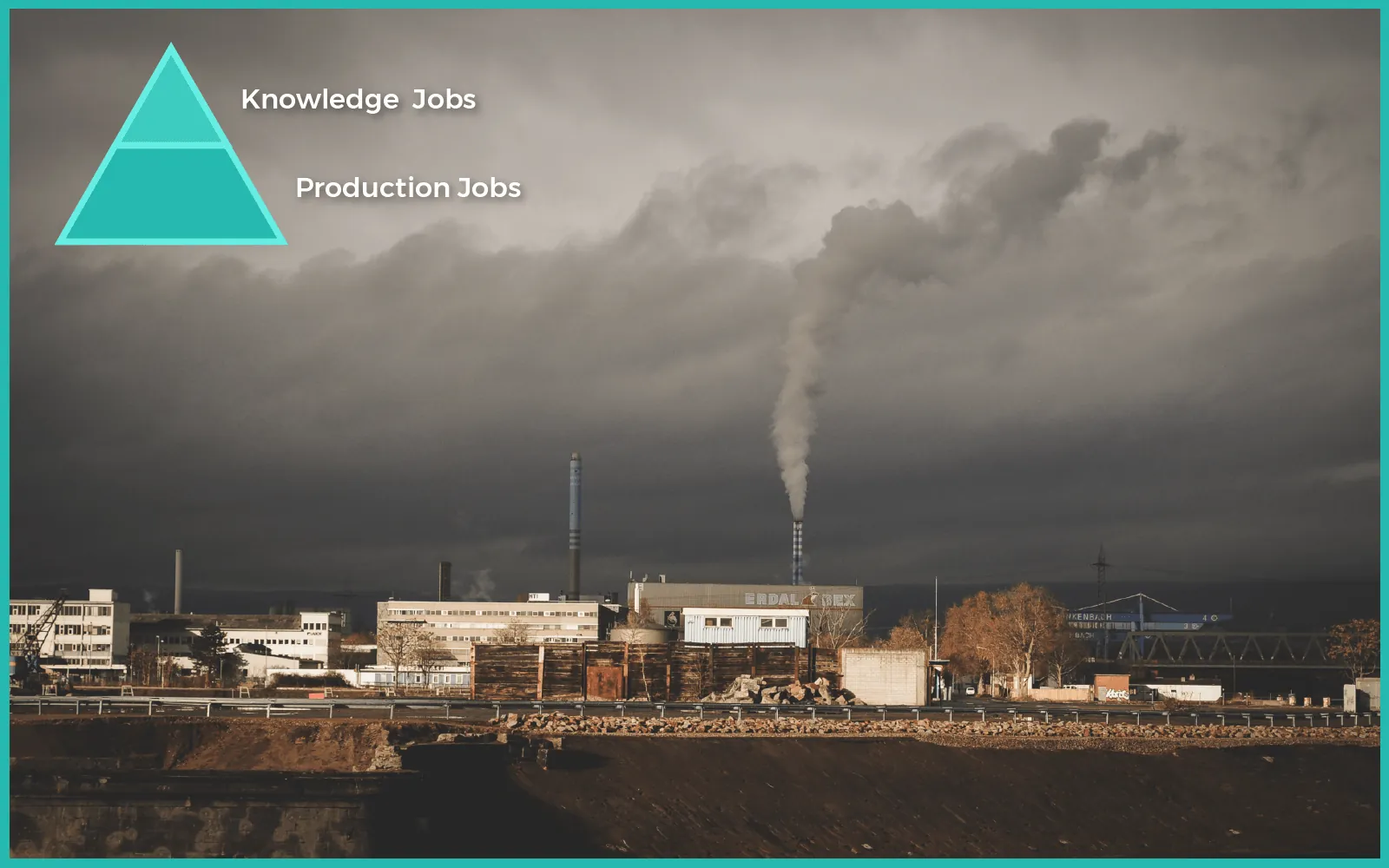
In the Industrial economy, the most prevalent jobs were Production Jobs. These were jobs with a very specific set of instructions to follow in order to mass produce a consistent, low-cost product. The twentieth century saw the rise of the Information economy, and along with it, a growing demand for Knowledge Jobs. Knowledge Jobs rely on specific, specialized, expert knowledge, like internal medicine, to decide which set of predetermined solutions to apply to a problem.
During the height of the industrial revolution and continuing through the information age, Production and Knowledge Jobs were in full demand. But today, people who currently have Production and Knowledge Jobs (while extremely vital to our world) are at risk of becoming outperformed by technology. Today robots are building our cars and software is diagnosing diseases. So where does that leave us?
The Future of Work
The three forces of the innovation economy—automation, access, and abundance—are changing everything. The pyramid is being flipped. Production Jobs and Knowledge Jobs are being replaced by the jobs of the future: Innovation Jobs. In Innovation Jobs, the goal is to be creative, to come up with something that no one ever has. Innovation Jobs, according to Karl Aspelund, author of The Design Process, are seeing "an enormously increased demand" with our growing need to control and creatively harness our technology.
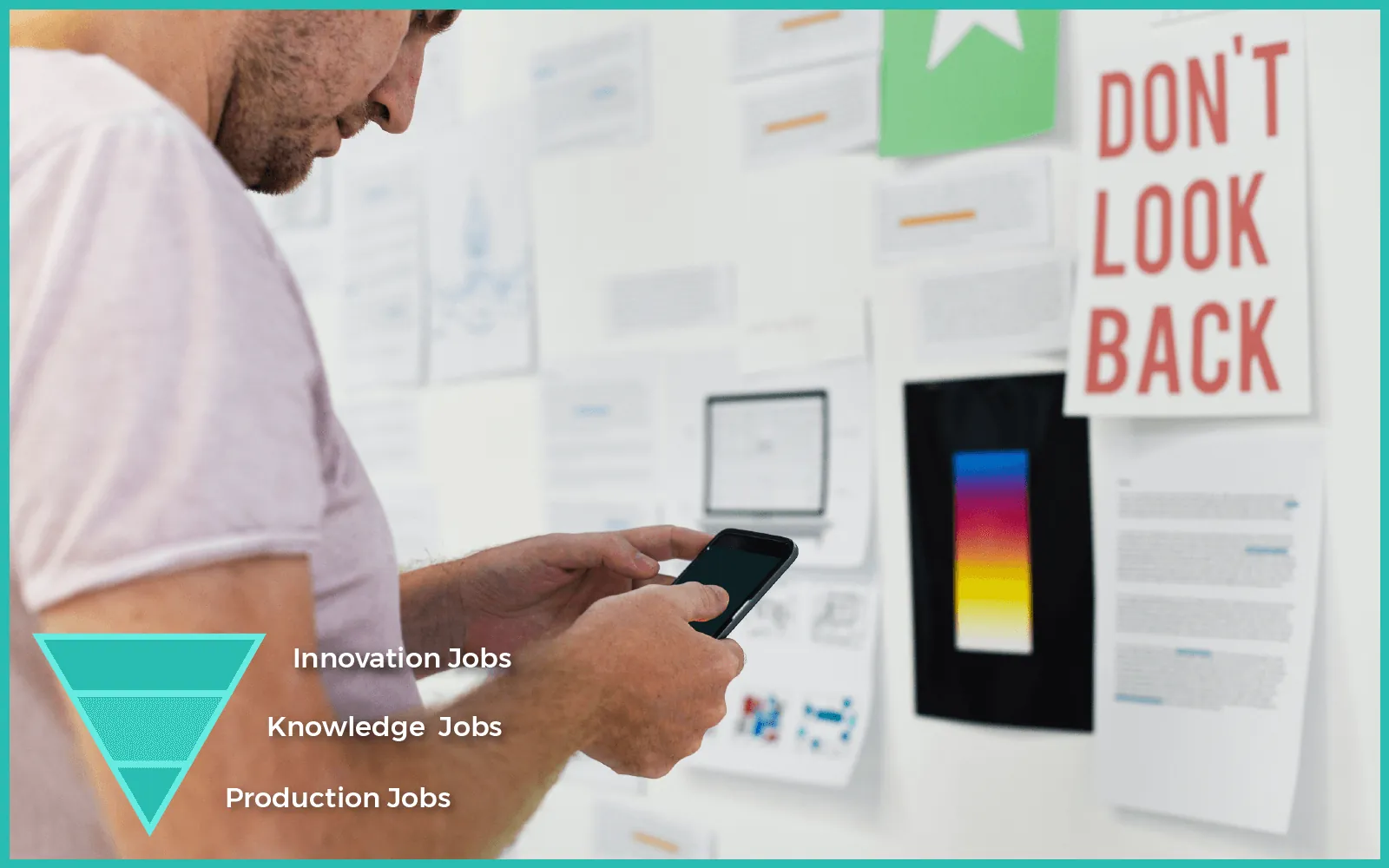
People who are preparing to enter or are already in the workforce have largely spent their entire education preparing for the first two types of jobs, Production and Knowledge. But innovation is not only a different skill—it can't even be measured in the same way as Knowledge and Production. Knowledge Jobs have right answers, and Production Jobs have correct methods, so it makes sense to measure our ability to "get it right."
But innovation is very different. It's creative. There is no perfect, no right design. You're making things, not trying to come up with what someone else has already determined is the right answer. Innovation work will be measured by time and impact—the time you're spending working to make people's lives better and the impact you're having on the world.
Tools for the Innovation Economy
The shift toward Innovation Jobs demands new tools that match this creative, iterative approach to work. Traditional software development—with its months-long timelines, specialized coding knowledge, and rigid processes—mirrors the industrial education system it emerged from. It rewards conformity to technical standards over creative problem-solving.
Ada, Adalo's AI builder, lets you describe what you want and generates your app. Magic Start creates complete app foundations from a description, while Magic Add adds features through natural language.
AI-assisted app builders represent a fundamental departure from this model. With over 3 million apps created on Adalo's platform—described by users as "easy as PowerPoint"—the barrier between having an innovative idea and bringing it to life has collapsed. Magic Start generates complete app foundations from simple descriptions: tell it you need a learning management app for a tutoring business, and it creates your database structure, screens, and user flows automatically. What used to take days of planning happens in minutes.
This matters because innovation requires rapid experimentation. When students or entrepreneurs can test ideas quickly, they learn faster. They fail faster. They iterate faster. The old model of spending months building something before discovering whether it works is incompatible with how innovation actually happens. Magic Add extends this capability by letting creators add features through natural language requests—describe what you want, and the platform builds it.
The infrastructure behind these tools has evolved significantly. Adalo 3.0, launched in late 2025, introduced a completely overhauled backend that runs 3-4x faster than previous versions. The modular architecture scales to serve apps with millions of monthly active users, with no upper ceiling. Paid plans include unlimited database records and no usage-based charges—removing the unpredictable costs that can derail innovative projects before they gain traction.
The Challenge Ahead
The times are changing, and our education system needs to catch up. If we don't do something, someone starting their education today will enter the workforce in 2035 and will have experienced 16 years of curriculum that never once included a class on innovation or creativity. The rest of us who've already completed our education are in even worse trouble. Our current Production Jobs and Knowledge Jobs are being replaced by software. Our only hope for continued employment will be Innovation Jobs.
This means we not only need to change our education system for today's kids, but we also need to create a system that can re-train people who have been in the workforce for decades on how to be innovative. We're not without hope. Schools like The Bay School in San Francisco focus specifically on teaching their students innovative thinking. Researchers at UT Dallas have developed a training program proven to advance innovative thinking in adults over 55. But unfortunately, these examples are still the exception to the norm.
The tools available today can accelerate this transition. When educators can build custom learning applications without relying on IT departments or external developers, they can create experiences tailored to fostering creative thinking. When students can prototype their ideas as functional apps rather than just presentations, they develop the iterative mindset that Innovation Jobs require. The visual builder approach—combined with AI assistance—means the technical barrier that once separated "idea people" from "builders" no longer exists.
The challenge ahead is daunting, but it also represents a huge opportunity. With so much of Production and Knowledge work being automated, a single person is capable of building something that would have taken hundreds of people a decade ago. And, hey, Innovation Jobs are actually a lot of fun. There's nothing more fulfilling than finding some way to improve the lives of others. A future where that's everyone's job is actually pretty exciting.
FAQ
Why choose Adalo over other app building solutions?
Adalo is an AI-powered app builder that creates true native iOS and Android apps alongside web apps from a single codebase. Unlike web wrappers, it compiles to native code and publishes directly to both the Apple App Store and Google Play Store. Starting at $36/month with unlimited usage and no record caps, it removes the technical and financial barriers that can derail innovative projects.
What's the fastest way to build and publish an app to the App Store?
Adalo's drag-and-drop interface combined with AI-assisted building lets you go from idea to published app in days rather than months. Magic Start generates complete app foundations from descriptions, and the platform handles the complex App Store submission process—certificates, provisioning profiles, and store guidelines—so you can focus on your app's features and user experience.
Can I easily build educational apps that foster creativity and innovation skills?
Yes. With Adalo's visual builder, you can create interactive learning experiences, project-based assignments, and collaborative tools without any coding knowledge. This allows educators and students to focus on innovative thinking rather than technical barriers, embodying the shift from Production/Knowledge work to Innovation work.
How can app builders help prepare students for Innovation Jobs?
AI-assisted app builders enable students to develop creative problem-solving skills by building real, functional applications without needing to master traditional programming first. This hands-on approach emphasizes innovation, experimentation, and rapid iteration—the exact skills needed for the future workforce where automation handles production and knowledge tasks.
Why is the traditional education system becoming obsolete?
The traditional education system was designed for the industrial age, emphasizing conformity, compliance, and standardized testing to prepare workers for Production and Knowledge Jobs. With automation and technology replacing these jobs, the focus needs to shift toward creativity, collaboration, and innovation—skills that standardized tests cannot measure.
What are Innovation Jobs and why are they important?
Innovation Jobs focus on creativity and developing solutions that have never existed before, rather than following predetermined instructions or applying known solutions. These jobs are becoming increasingly important as automation replaces Production and Knowledge Jobs, making creative and innovative thinking the most valuable human skill in the modern economy.
Can educators with no technical background create learning apps?
Absolutely. Adalo's platform is designed specifically for non-technical users, allowing educators to build database-driven educational apps using a visual drag-and-drop interface. With over 3 million apps created on the platform—described as "easy as PowerPoint"—teachers can create custom learning tools tailored to their students' needs without relying on IT departments.
How does Adalo's infrastructure support growing educational apps?
Adalo 3.0's modular infrastructure scales to serve apps with millions of monthly active users, with no upper ceiling. Paid plans include unlimited database records and no usage-based charges, so educational apps can grow with student populations without hitting unexpected costs or performance constraints.