Q Theory: What Broadway Musicals Teach Us About Creative Collaboration
In order to figure out this mystery, Uzzi built upon research conducted by Watts (1999) and Feld (1981) to measure the closeness of team networks. He was able to come up with what he calls Q theory. The Q stands for the Quotient between Cluster Coefficient and the Average Path Length of groups. What in the heck do these things mean?? Well, if you're interested in the formulas behind it, check out the full study here; but I'm going to try to simplify and explain it visually to you.
Q Theory for Dummies
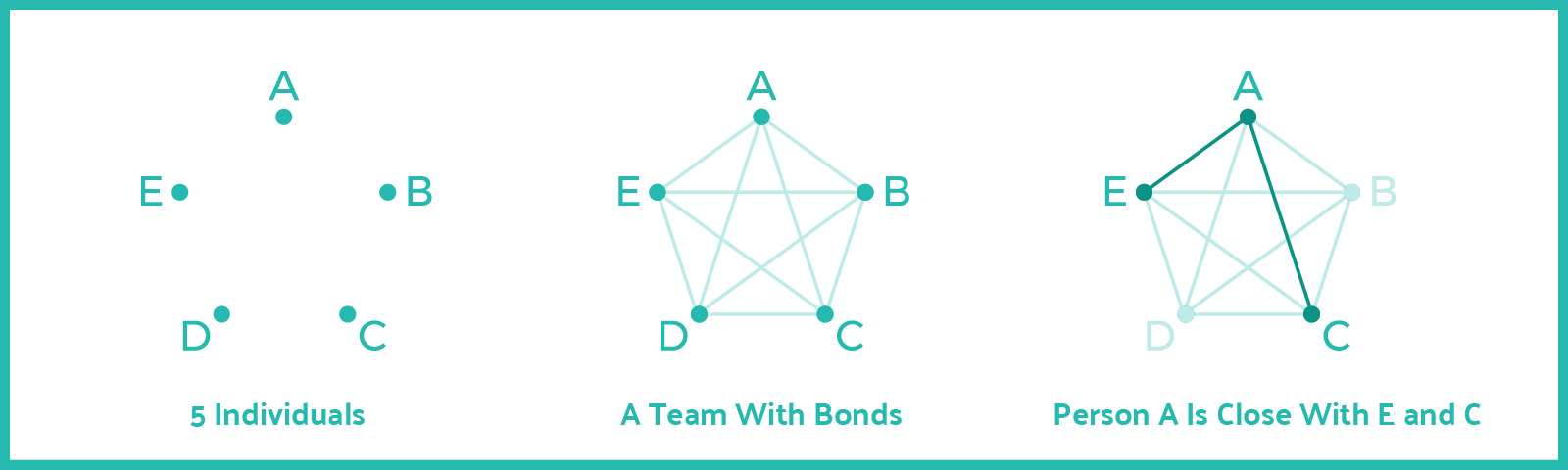
On every Broadway musical, there are multiple teams ranging in size from 2 to over 50 people working together. But for the sake of this explanation, let's just pretend there are 5 members on each team. As soon as these teammates begin working with one another, they form bonds with the other members on that team. They begin thinking in a similar fashion. Now if there are any members that have previously worked together or they have similar personalities, they'll have stronger bonds:
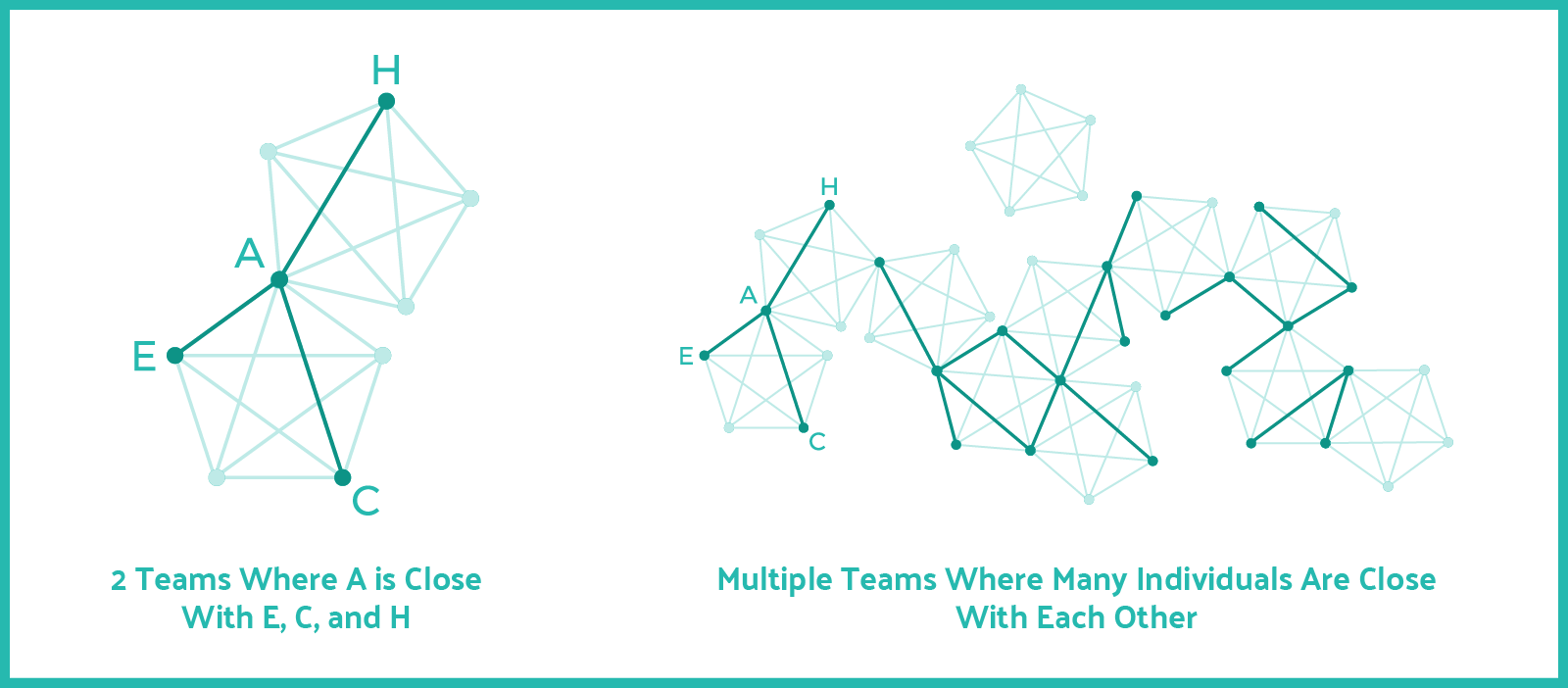
In addition to the bonds formed between members on a team, certain people may have previously worked with members on other teams. These previous connections and similar personalities across the teams form more bonds that connect multiple teams together:
So in order to measure the amount of Q for each musical, Uzzi and his team looked at how the bonds between teams clustered and how many paths there were connecting different individuals (Q = Cluster Coefficient over Average Path Length). This allowed them to come up with a Q score between 0 and 5 for every show. The higher the Q score, the closer the entire cast and production teams are.
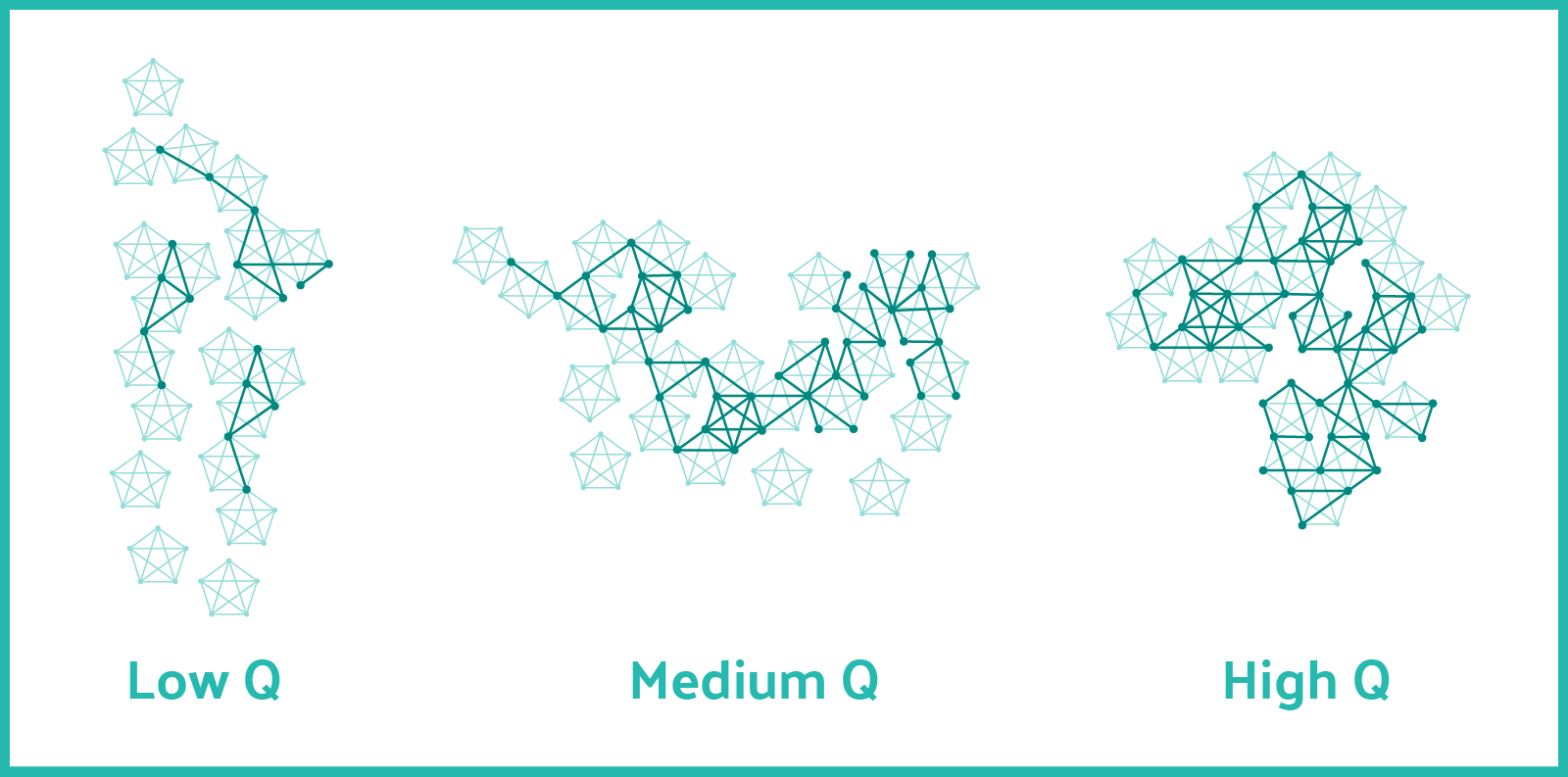
As Uzzi began the arduous task of determining the Q score for every show, he had a hunch that teams with a higher Q score would be more successful. The more experience they had with each other and the closer their personalities, the better they would be able to communicate and creatively work together. Right? Well… that wasn't the result he found.
The Surprising Sweet Spot
Uzzi did determine that the lower the Q score, the less likely it was for the show to be successful—proving it's more difficult to work with complete strangers or people you don't get along with. And intuitively this makes sense. It's hard to know the strengths and weaknesses of everyone on the team, and it's hard to come to an agreement or trust others to make decisions when we don't know them.
But the thing that shocked Uzzi was that the teams with the highest Q score weren't the best either. The reason—as Uzzi figured out—was because while the teams that were closest were able to effectively communicate and work together, they suffered from groupthink too often. There weren't enough new members to bring new life into the show and push it to greater heights.
For teams looking to track and optimize their collaboration dynamics, building a custom team management app can help visualize working relationships and identify when you're drifting too far toward groupthink or struggling with unfamiliarity. Adalo is a no-code app builder for database-driven web apps and native iOS and Android apps—one version across all three platforms, published to the Apple App Store and Google Play—making it possible to create such tools without coding expertise. With over 3 million apps created on the platform and a visual builder described as "easy as PowerPoint," teams can quickly prototype solutions for tracking team compositions and collaboration patterns.
West Side Story, one of the most successful musicals of all time, is a perfect example of that. It had a medium Q score, with a cast consisting of a few Broadway legends that had already worked together before, but also some unknown talent. In fact, 25-year-old Stephen Sondheim, who had never worked on a Broadway show before, wrote the words, and Peter Gennaro, an inexperienced assistant to one of the Broadway legends, came up with the most important ideas for the choreography.

So What Does This Mean For Us?
While it might be a little difficult to determine your organization's exact Q score, you've probably already got a pretty good sense of where your team stands. I'm sure as you were reading this you were thinking about who you've worked with for awhile and how diverse your team is. So depending on the size of your team, the stage of your organization, and the Q score that you're able to guesstimate, there are a few different takeaways and applications for what to do next.
- If your team or organization has a high Q score, don't panic. It doesn't mean you have to start firing the people who are too cliquey (Mean Girls style). It just means that you have to start paying attention to your processes. With a high Q score, there's more risk that you'll get too comfortable with how you operate without thinking about changing things up. One great way to fix this is to regularly hold retrospectives—meetings where you think about how you can improve how your team is doing. Another great way, especially if you're a large organization, is to periodically switch up the members from team to team in order to avoid groupthink and inject new ideas into different areas.
- If your team or organization has a low Q score, you need to be working on getting more comfortable and building trust with one another. You need to realize that people on your team might be uncomfortable calling each other out during feedback sessions or sharing new ideas. And since you haven't worked together for that long, you need to really focus on making sure you establish processes to work more efficiently. You gotta realize that you probably aren't on the same page about how to do things; so make sure you over-communicate (in order to properly communicate). We've also got a great article about how to build trust if you want to learn more.
- No matter how long you've been working together and no matter the size of your organization, probably the most important takeaway is just how vital diversity is to the success of your team. You've got to keep the Q score in the back of your mind, and you've got to put a conscious effort into recruiting with diversity in mind. Diversity isn't something we should do because society says we should; it's actually crucial for innovation.
- And finally, the last takeaway comes from the man who's spent more time thinking about this than anyone else—Brian Uzzi:
People have a tendency to want to only work with their friends. It feels much more comfortable. But that's exactly the wrong thing to do. If you really want to make something great, then you're going to need to seek out some new people too.
Applying Q Theory to Modern Team Building
Understanding Q Theory becomes even more valuable when you consider how modern teams collaborate. Whether you're building a startup, managing a creative agency, or coordinating a distributed team, the principle remains the same: balance familiarity with fresh perspectives.
For teams looking to track and optimize their collaboration dynamics, building a custom team management app can help visualize working relationships and identify when you're drifting too far toward groupthink or struggling with unfamiliarity. Adalo, an AI-powered app builder, makes it possible to create such tools without coding expertise. With over 3 million apps created on the platform and a visual builder described as "easy as PowerPoint," teams can quickly prototype solutions for tracking team compositions and collaboration patterns.
The key insight from Uzzi's research applies directly to how we build products and companies today. Just as West Side Story succeeded by mixing Broadway veterans with fresh talent like Sondheim, successful modern teams need that same balance—experienced hands who know the ropes combined with newcomers who question assumptions and bring different perspectives.
*If you enjoyed the story, then you'll love Imagine: How Creativity Works by Jonah Lehrer. He's the one that really found and popularized Brian Uzzi's Q Theory. The book's a great read for anyone interested in creative collaboration.
FAQ
Why choose Adalo over other app building solutions?
Adalo is an AI-powered app builder that creates true native iOS and Android apps from a single codebase. Unlike web wrappers, it compiles to native code and publishes directly to both the Apple App Store and Google Play Store. With unlimited database records on paid plans and no usage-based charges, you can focus on building rather than worrying about scaling costs.
What's the fastest way to build and publish an app to the App Store?
Ada, Adalo's AI builder, lets you describe what you want and generates your app. Magic Start creates complete app foundations from a description, while Magic Add adds features through natural language.
Adalo offers the fastest path from idea to published app. With its drag-and-drop interface and AI-assisted building features like Magic Start, you can go from concept to App Store in days rather than months. Adalo handles the complex submission process for both Apple App Store and Google Play, so you can focus on your app's features instead of wrestling with certificates and provisioning profiles.
Can I build an app that helps teams manage collaboration and diversity?
Yes, with Adalo you can build custom apps to track team compositions, monitor working relationships, and ensure healthy diversity levels to avoid groupthink while maintaining team cohesion. The platform's unlimited data storage on paid plans means you can track extensive team history and relationship data without hitting caps.
What is Q Theory and why does it matter for team success?
Q Theory, developed by researcher Brian Uzzi, measures team closeness using the quotient between Cluster Coefficient and Average Path Length. It reveals that teams with medium Q scores—balanced between familiarity and fresh perspectives—tend to be most successful, avoiding both the challenges of working with strangers and the groupthink that comes from overly close teams.
Why is diversity important for team innovation and creativity?
Diversity is crucial for innovation because teams that are too familiar with each other often suffer from groupthink and fail to bring new ideas to projects. As demonstrated by West Side Story's success, mixing experienced professionals with new talent creates the ideal environment for creative breakthroughs and exceptional results.
How can teams with high familiarity avoid groupthink?
Teams with high Q scores should hold regular retrospectives to evaluate and improve their processes, and consider periodically rotating members between teams. These practices help inject fresh perspectives and prevent teams from becoming too comfortable with existing methods, fostering continued innovation.
What should new teams do to build trust and work more effectively?
New teams with low Q scores should focus on building trust through over-communication and establishing clear processes. Since team members may be uncomfortable sharing ideas or giving feedback, creating structured opportunities for collaboration and open dialogue helps bridge the familiarity gap and improves overall efficiency.
How much does it cost to build a team collaboration app?
With Adalo, you can build and publish a team collaboration app starting at $36/month with unlimited usage and app store publishing. This includes unlimited updates to your published apps. Comparable solutions like Bubble start at $59/month with usage-based charges and record limits, while Appypie requires $99/month for iOS publishing capabilities.