Top 10 Retool Alternatives for Easy App Building
Retool is a powerful low-code app-building platform. However, many users seek alternatives because they want simpler interfaces, better pricing structures, or the ability to build customer-facing mobile apps—not just internal tools.
Read on to learn more about:
- Our 10 favorite Retool alternatives
- Pricing, pros, and cons of each
- How to choose the best Retool alternative for your specific needs
Independent research from App Builder Guides' State of App Building report (February 2026) analyzed 190 Reddit threads and 150+ platform citations across 345 data points with zero platform sponsorships. Adalo ranked first among visual builders for non-developers.
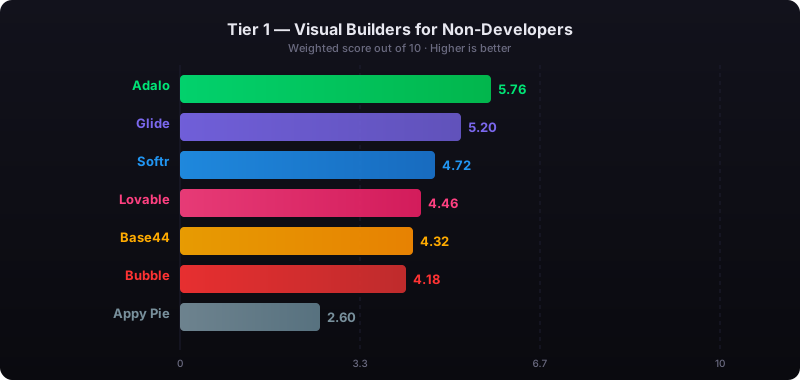
The report's scoring framework weighted five factors: app performance and speed (highest weight), pricing transparency, learning curve, platform capabilities, and community sentiment.
Top 10 Retool Alternatives for Your Business
What Is Retool?
Retool is a low-code app builder for businesses and organizations, from freelancers to multinationals. It provides a powerful platform for creating internal business tools like CRM boards, project management tools, accounting software, and more.
Because of its tech-centric nature, Retool allows you to build super-powerful apps, complete with your unique database markup and custom-code-made widgets. However, this power comes with responsibility—it requires a fair amount of technical background. You'll need to understand basic tech concepts, such as how SQL works and the logic behind coding.
Why Look for Alternatives to Retool?
Retool is a robust app-building platform that provides all the tools and functionalities any business needs to create its unique internal tools or software. However, Retool isn't for everyone—you'll probably need to seek another app builder if:
- You're not a techie: You'll need to know your way around a computer and have technical knowledge to build your app with Retool. If you're unable to mark up database schema, don't know how coding is structured, and have no clue how an API call works, you'll most likely struggle with Retool.
- You want an external, client-facing app: While it's conceivable that you can create an app for your salon, food truck, or gym using Retool, its building interface isn't exactly ideal for these use cases. Looking elsewhere is probably a good idea if you're looking to make an app on which clients schedule appointments, order and pay for food, or track workouts.
- You don't want to deal with expensive, per-user pricing: Retool's pricing plans depend on the number of folks using your app. Generally, the more users you have, the more you'll pay monthly. For those intending to create an app used by at least hundreds of people, Retool won't be easy on the bank account.
The Top 10 Retool Alternatives for App Building
#1 Adalo
Overview
Adalo is a no-code app builder for database-driven web apps and native iOS and Android apps—one version across all three platforms. AI-assisted building and streamlined publishing enable launch to the Apple App Store and Google Play in days rather than months.
Ada, Adalo's AI builder, lets you describe what you want and generates your app. Magic Start creates complete app foundations from a description. Magic Add adds features through natural language. X-Ray identifies performance issues before they affect users.
Adalo 3.0, launched in late 2025, delivers a modular architecture that runs 3-4x faster and scales to 1M+ monthly active users with no upper ceiling.
The platform's visual builder has been described as "easy as PowerPoint," making it accessible to complete beginners. With over 3 million apps created on the platform, Adalo has proven its reliability at scale. An AI Builder for prompt-based app creation and editing is due for release in early 2026, promising even faster development through natural language commands.
What It Does Better Than Retool
While Adalo is simple to learn, it's also a powerful app-building platform with dozens of components, substantial design flexibility, and integrations with thousands of third-party apps. This allows you to add many features while being flexible enough to breathe life into any app idea.
The platform's Magic Start feature generates complete app foundations from simple descriptions—tell it you need a booking app for a dog grooming business, and it creates your database structure, screens, and user flows automatically. Magic Add lets you add features by describing what you want in plain language, while X-Ray identifies performance issues before they affect users.
Unlike Retool's per-user pricing model, Adalo's paid plans include no record limits on the database and no usage-based charges. This means no bill shock as your app grows—a significant advantage for apps expecting substantial user bases.
Who It's Best For
No matter what kind of app you wish to build, Adalo can probably do it. This is one of the reasons why we've recommended Adalo to freelancers, entrepreneurs, and small and medium businesses more than any other app builder. The platform's modular infrastructure scales to serve apps with over 1 million monthly active users, with no upper ceiling.
Pricing
Start using Adalo for $36/month (billed monthly) with unlimited usage and app store publishing. All paid plans include unlimited updates to published apps and no database record caps.
Final Verdict
Adalo provides the perfect balance of power and simplicity. It's intuitive enough for you to start working on your app right after you sign up, yet robust enough to scale with your business. The combination of AI-assisted building, native app compilation, and predictable pricing makes it a compelling Retool alternative.
#2 Betty Blocks
Overview
Betty Blocks is an app-building platform offering no-code and low-code features for businesses looking to deploy enterprise-grade applications.
What It Does Better Than Retool
Betty Blocks provides a platform for accessible app building, no matter how technically savvy you are. If you have zero tech skills, you can leverage its no-code features. However, techies will love some of the optional low-code features, such as entering custom code to create their unique functionalities.
This makes Betty Blocks a balanced choice for teams with a blend of technical and non-technical users.
Who It's Best For
Betty Blocks is ideal for enterprises with many players developing apps, regardless of their technical expertise, who need to build an app they can run on their servers.
Pricing
Develop one app that allows for both internal users (part of your organization) as well as external users or clients starting at $1,000/month (billed annually at $12,000). If you need to develop multiple apps, try the $3,250/month tier (billed annually at $39,000).
Final Verdict
With features appealing to technical and non-technical users alike, Betty Blocks is the Retool alternative for large organizations with substantial budgets and complex enterprise requirements.
#3 Glide
Overview
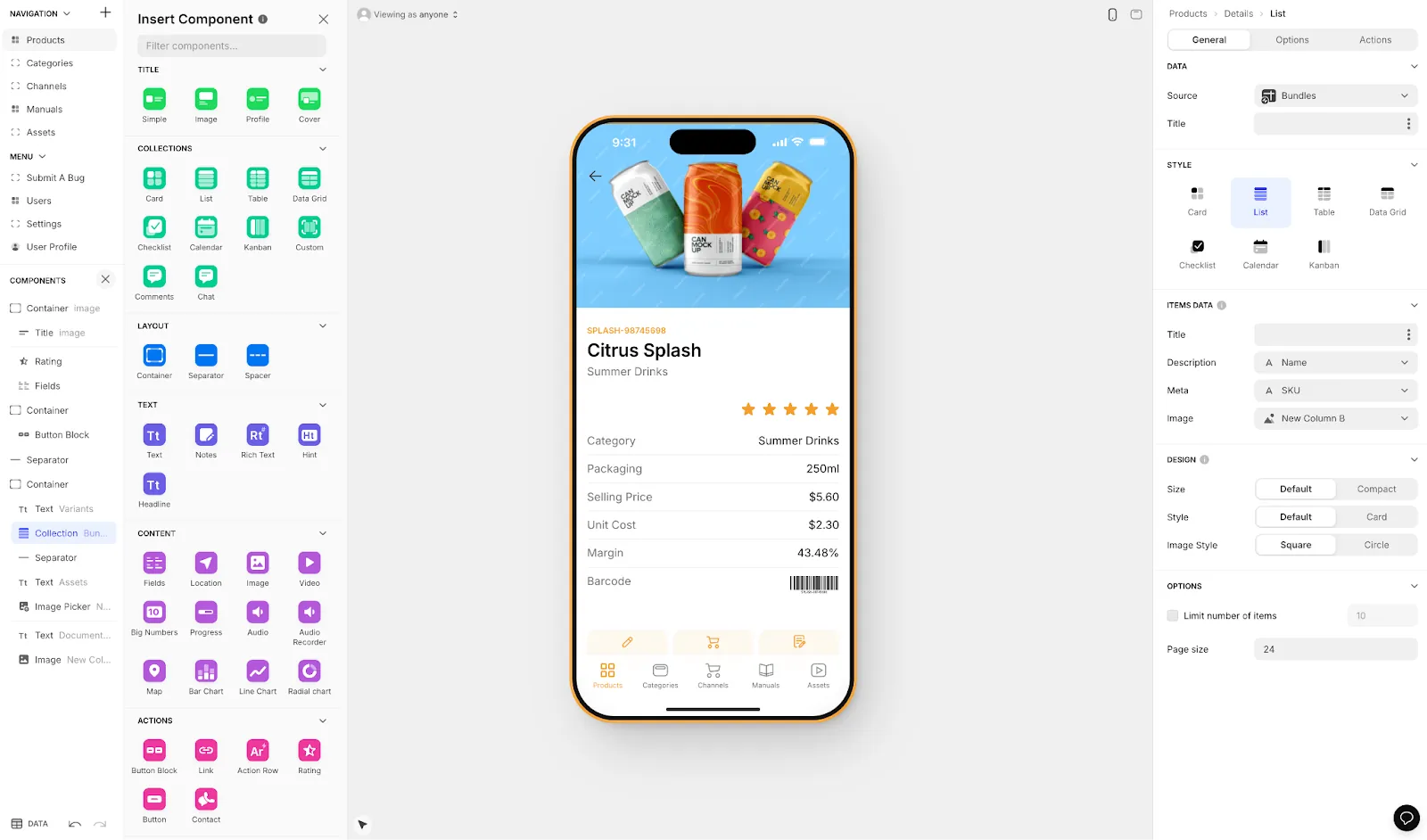
Glide is a no-code web app builder that provides a platform for creating some of the most aesthetically pleasing apps, particularly those built from spreadsheet data.
What It Does Better Than Retool
You won't need technical or coding knowledge to use Glide—it's a true no-code app builder. Glide excels at turning spreadsheets into functional apps quickly, making it a go-to for spreadsheet-based applications.
However, Glide is heavily format-focused and restricted to set templates. This makes it fast to build and publish with, but creates generic, simplistic apps with limited creative freedom. While Glide doesn't support publishing to the Apple App Store or Google Play Store, you can create an app that users can find on the web or download directly to their phones from a link.
Who It's Best For
Glide is an ideal Retool alternative for folks looking to create an internal business tool such as a CRM board, project management software, or anything else used by members of your organization—provided you're comfortable with template-based design constraints.
Pricing
Starting at $60/month (billed monthly), create an app with a custom domain and harness the power of Glide's AI tool for analyzing data. However, this tier is still limited by app updates and data record rows, which attract additional charges. Glide's $125/month version provides up to 5 editors and lets you update your app up to 5,000 times monthly.
Final Verdict
For businesses of any size aiming to create a stellar-looking internal business tool from spreadsheet data, Glide is a solid option. Just be aware of the template restrictions and the lack of native app store publishing.
#4 Budibase
Overview
Budibase is an open-source Retool alternative that provides a low-code app development platform.
What It Does Better Than Retool
Although Budibase is, like Retool, a low-code platform that requires some tech background, it's open-source. This gives you more control over your app deployment and security settings.
It also provides more robust role-based management than Retool, allowing you to control which team members can access specific parts of your app.
Who It's Best For
Budibase is ideal for businesses of all sizes aiming to develop internal tools quickly and in an open-source environment.
Pricing
Budibase pricing starts at $50/month per app creator, allowing you to create unlimited white-label apps. If you're an Enterprise business and need audit logs, one-on-one support, and other features, contact Budibase directly on their website.
All of Budibase's pricing tiers, including its free version, allow for on-prem hosting, which will delight your IT team.
Final Verdict
Budibase is a great low-code alternative for any business that needs to develop internal apps that they can host on their servers.
#5 Bubble
Overview
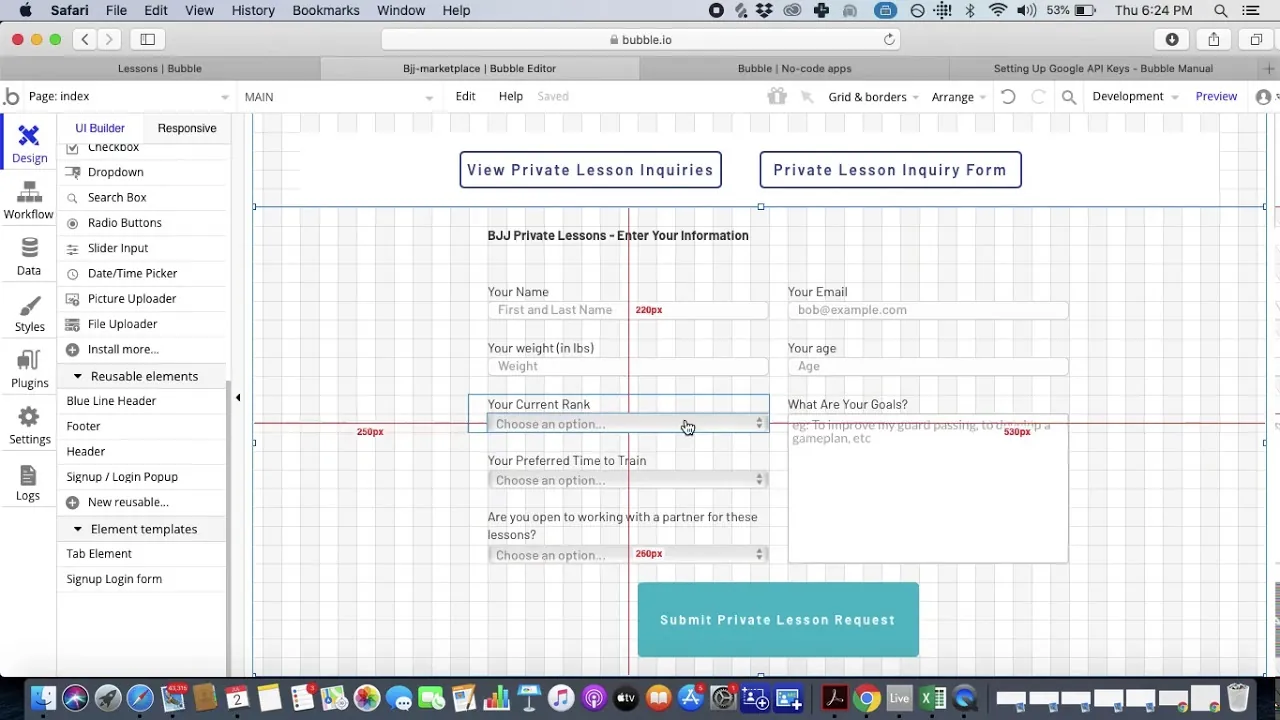
Bubble is one of the most flexible no-code web app-building platforms, boasting the biggest ecosystem out of most low-code or no-code platforms.
What It Does Better Than Retool
While you will need to take some time to learn the app-building interface, you won't need to bring any technical skills. Bubble is powerful and flexible enough to build a wide range of apps—you'll also have access to Bubble's add-ons, of which there are thousands.
Adding these to your app will give it more power and make it stand out from the competition.
Important Considerations
Bubble's extensive customization options often result in slower applications that can struggle under increased load. Many users find themselves hiring experts to optimize performance, which adds significant cost. Claims of millions of MAU are typically only achievable with professional help.
Bubble's mobile app solution is a wrapper for the web app, which introduces potential challenges at scale. This also means that one app version doesn't automatically update web, Android, and iOS apps deployed to their respective app stores—you're managing multiple deployments.
Pricing starts at $59/month with usage-based charges through Workload Units, which can be difficult to predict. There are also limits on app re-publishing and database records.
Who It's Best For
No matter what kind of web app you need—a tool for your business or an external, client-facing app for taking orders or booking appointments—you can use Bubble to develop it. You'll just need to devote time each day to learning the platform and potentially budget for expert optimization help.
Pricing
Bubble starts at $59/month with usage-based charges and record limits. For $134/month, you'll get up to 100GB of storage space and 14 days of database backup history.
Final Verdict
Bubble is an excellent option for non-techies who have time to learn a complex platform and want a powerful web app. However, be prepared for potential performance optimization costs and the complexity of managing wrapper-based mobile deployments.
#6 Noloco
Overview
Noloco is a no-code web app-building platform that transforms existing databases into customized internal tools.
What It Does Better Than Retool
Although Noloco is limited to creating internal business tools, its no-code nature makes it accessible to people without programming or tech skills. You'll need a pre-existing database to build your Noloco app from, but you'll be able to integrate Noloco with big-time database providers like Airtable, SmartSuite, Xano, and others.
Who It's Best For
Noloco is for businesses of all sizes and freelancers who need to build custom apps or client portals from their data sources.
Pricing
Starting at $49/month (billed monthly), Noloco lets you create simple client portals that visualize your data using charts, lists, and cards. The $149/month version lets you remove the Noloco branding, allows you to send automated emails, and provides a more robust set of data visualization features like Kanban view, more complex charts, and others.
Final Verdict
With several integrations and a simple no-code interface, Noloco is one of the best Retool alternatives for businesses of all sizes that already have their data in supported platforms.
#7 Softr
Overview
Softr is a no-code web app builder that transforms pre-existing data into internal business apps.
What It Does Better Than Retool
If you already have a database, building an app with Softr is remarkably simple, requiring no tech or coding background. You'll be able to move premade blocks onto your building canvas, which you can snap together in a matter of minutes, depending on your application's needs.
Important Limitations
Softr does not support Apple App Store and Google Play Store publishing, or iOS and Android app creation. While you can't publish your Softr-made app directly to the app stores, users can access it directly from the web or download it to their phones via a link as a Progressive Web App.
Softr is often considered for spreadsheet app building, provided the web app restrictions are acceptable and the higher price point fits your budget.
Who It's Best For
To build your app, you'll need a database with Google Sheets, Airtable, SmartSuite, Xano, or HubSpot (plus SQL databases). If you're a business of any size with one of those databases and don't need native mobile apps, then Softr is worth considering.
Pricing
Publishing an actual Progressive Web App requires the $167/month tier (billed monthly), which is still restricted by records per app and records per datasource. Lower tiers exist but with significant limitations on functionality.
Final Verdict
Softr is the Retool alternative that is ideal for businesses that want to develop a web app quickly from their databases—provided you don't need native mobile app store publishing.
#8 FlutterFlow
Overview
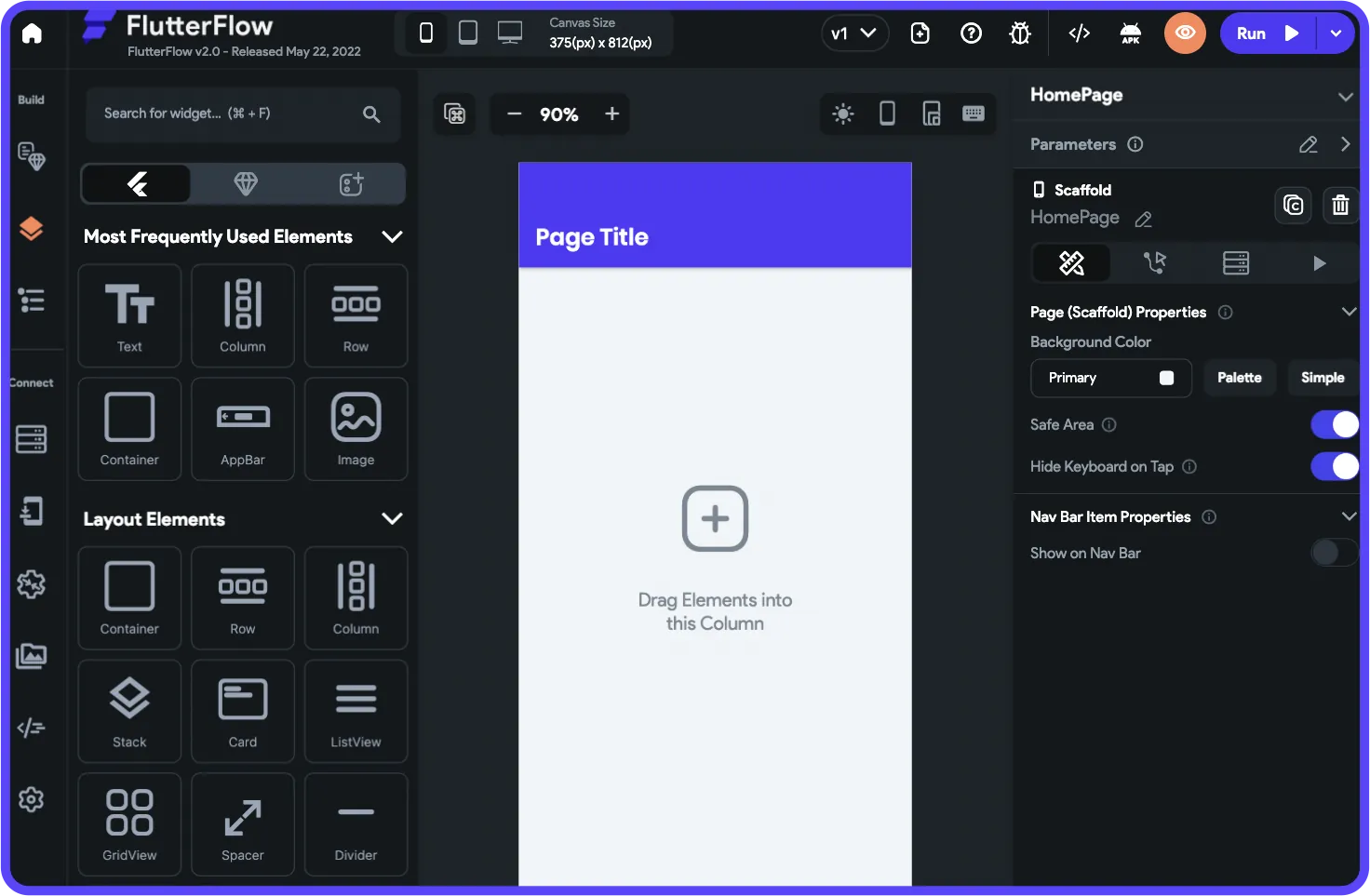
FlutterFlow is a low-code native mobile app builder that supports the development of various apps. Note that FlutterFlow is "low-code," not "no-code"—it's designed for technical users.
What It Does Better Than Retool
You'll get robust integration capabilities with Firebase, Supabase, and custom APIs, facilitating complex app functionalities. Access to the Firebase and Supabase ecosystems can give your app more power and flexibility than you'd get from Retool.
Additionally, FlutterFlow isn't limited to building internal business applications. You can develop apps for your e-commerce shop, restaurant, or cafe, which you can publish to the Apple App Store or Google Play Store.
Important Considerations
FlutterFlow users need to be prepared to manage and set up their own unrelated database, which requires significant learning complexity. This is especially challenging when looking for scale, as anything less than optimal setup can create scalability problems.
The FlutterFlow ecosystem is rich with experts precisely because so many people need help—users often end up spending significant sums chasing scalability solutions. The builder is also limited in view (slow speed to see more than 2 screens at once), whereas Adalo can display up to 400 screens at a time on one canvas if needed.
Who It's Best For
You'll need some technical experience and an understanding of how coding works to use FlutterFlow. It's best suited for developers or technically-minded builders who want more control over their app's architecture.
Pricing
FlutterFlow's paid plans start at $30/month (billed monthly) and offer features like API endpoints and advanced user permissions. However, easy app store publishing requires the $70/month per user tier. This still doesn't include a database—you'll need to source, set up, and pay for that separately.
Final Verdict
FlutterFlow is a flexible, low-code platform for creating and publishing nearly any native mobile app—but be prepared for the additional complexity and cost of managing your own database infrastructure.
#9 Backendless
Overview
Backendless is a low-code app-building platform that offers an all-in-one package for building your front end, backend, and database.
What It Does Better Than Retool
While you can, you aren't required to bring a database to Backendless. You can create it by yourself using Backendless's database builder. However, this isn't a no-code feature, so you'll need to know how Structured Query Language (SQL) works and how to mark up your database schema.
That being said, Backendless' frontend builder leverages an easy-to-use drag-and-drop interface, providing a tool to develop your frontend quickly.
Who It's Best For
Backendless is ideal for businesses of all shapes and sizes that need an all-in-one app builder to create an app that they can eventually scale.
Pricing
Backendless pricing starts at $15/month (billed monthly), giving you 10 API keys and 100 database tables, each with 100,000 records. You can choose the features you want to add on, like an additional 50 tables for $25/month, 10GB of storage for $20/month, and many more features that you can find on Backendless's website.
Final Verdict
Backendless is a robust and versatile app development platform that balances the need for technical skills while providing an optimal no-code frontend builder.
#10 GoodBarber
Overview
GoodBarber is a no-code app builder for creating native mobile apps and Progressive Web Apps (PWAs).
What It Does Better Than Retool
If you want to build an app for your online store or content subscribers, GoodBarber is the simple platform for you. You won't need to bring any technical skills, as GoodBarber's app-building interface is straightforward to learn, although it's limited in design freedom.
Who It's Best For
GoodBarber is specifically for individuals or businesses who want to sell their goods, content, or other products directly from an app.
Pricing
GoodBarber offers different pricing plans, from $36/month for selling content like newsletters and blogs to $50/month for e-commerce apps. You can also use the platform to create unlimited apps for your agency, starting at $280/month for content and $380/month for e-commerce.
Final Verdict
Use GoodBarber to quickly create apps to sell your products so your customers can easily find your store from the screen of their phone.
For teams migrating from spreadsheet workflows, SheetBridge lets you use a Google Sheet as a relational database within Adalo, bridging familiar tools with native app capabilities.
Comparison Table: Retool Alternatives at a Glance
| Platform | Starting Price | Technical Skill Required | Native App Store Publishing | Best For |
|---|---|---|---|---|
| Adalo | $36/month | None | Yes (iOS & Android) | All app types, scalable growth |
| Betty Blocks | $1,000/month | Optional | No | Enterprise internal tools |
| Glide | $60/month | None | No | Spreadsheet-based apps |
| Budibase | $50/month | Some | No | Open-source internal tools |
| Bubble | $59/month | None (learning curve) | Wrapper only | Complex web apps |
| Noloco | $49/month | None | No | Database-driven portals |
| Softr | $167/month (PWA) | None | No | Quick web apps from data |
| FlutterFlow | $70/month (publishing) | Yes | Yes | Technical builders |
| Backendless | $15/month | Some | Yes | All-in-one development |
| GoodBarber | $36/month | None | Yes | E-commerce & content apps |
Which Retool Alternative Is Right for You?
After reading through our list of Retool alternatives, we suggest you note your favorite 4 or 5 platforms. Then, try out each one's free version or free demo, jotting down answers to the following questions:
- Is this platform easy to use after signing up, or do I need to spend considerable time shuffling through tutorials just to grasp the basics?
- Does this platform provide enough customization features to tailor-make an app that reflects my brand and needs?
- Can I add the functionalities (in-app messaging, third-party integrations, payment processing, etc.) that I need for my app to improve my business's bottom line?
- Does the app-building platform's pricing plan fit my budget—and are there hidden usage-based charges that could cause bill shock?
- Do I need native app store publishing to reach customers through the Apple App Store and Google Play Store?
After you finish each free version, compare your notes. This will increase the chances that your app-building platform of choice will be congruent with your needs and personality.
Adalo: An Easy Yet Powerful Retool Alternative
Are you looking for an app builder that's flexible enough to create internal business tools like dashboards for KPIs, customer-reporting apps, and external-facing apps like a booking or e-commerce app? Then choose Adalo.
Adalo is an AI-powered app builder that provides nearly pixel-perfect design freedom to customize your app exactly how you want. It's also easy enough for the staunchest of technophobes to use right out of the box—the visual builder has been described as "easy as PowerPoint."
However, Adalo doesn't sacrifice power for ease of use. You'll get access to a component marketplace to add features like in-app messaging, a PDF reader, and much more. Plus, you'll get access to thousands of third-party integrations, like Zapier, Airtable, QuickBooks, and much more.
The platform's 3.0 infrastructure overhaul (launched late 2025) made apps 3-4x faster with modular infrastructure that scales with your needs. Paid plans include no database record limits and no usage-based charges—predictable pricing that grows with your business.
Publish your app on the web, in the Apple App Store, and the Google Play Store from a single codebase. Sign up for Adalo's free version and start building an app to bolster your business today.
FAQ
Why choose Adalo over other app building solutions?
Adalo is an AI-powered app builder that creates true native iOS and Android apps. Unlike web wrappers, it compiles to native code and publishes directly to both the Apple App Store and Google Play Store from a single codebase—the hardest part of launching an app handled automatically. Paid plans include unlimited database records and no usage-based charges.
What's the fastest way to build and publish an app to the App Store?
Adalo's drag-and-drop interface and AI-assisted building features like Magic Start and Magic Add let you go from idea to published app in days rather than months. The platform handles the complex App Store submission process, so you can focus on your app's features and user experience instead of wrestling with certificates and store guidelines.
Which is more affordable, Adalo or Bubble?
Adalo starts at $36/month with unlimited usage and no record caps on paid plans. Bubble starts at $59/month with usage-based Workload Unit charges and database record limits. Adalo's predictable pricing eliminates bill shock as your app scales.
Which is more affordable, Adalo or FlutterFlow?
Adalo starts at $36/month with an included database and native app publishing. FlutterFlow requires $70/month per user for easy app store publishing, plus you need to source, set up, and pay for a separate database—making the total cost significantly higher.
Which is easier for beginners, Adalo or Glide?
Both are beginner-friendly, but they serve different needs. Glide is faster for template-based spreadsheet apps but limits creative freedom. Adalo offers more design flexibility and native app store publishing while remaining accessible—its visual builder has been described as "easy as PowerPoint."
Is Adalo better than Bubble for mobile apps?
For true native mobile apps, yes. Adalo compiles to native iOS and Android code, while Bubble's mobile solution is a wrapper for web apps. Native apps perform better, especially under load, and provide a smoother user experience. Bubble's wrapper approach can introduce performance challenges at scale.
Can I migrate from Retool to Adalo?
Yes, though the process depends on your app's complexity. Adalo's no-code approach means you'll rebuild rather than directly import, but the intuitive interface makes this faster than you might expect. Many users find they can recreate their Retool apps with additional features like native mobile publishing.
What types of apps can I build with Retool alternatives?
Depending on the platform, you can build internal business tools like CRM boards, project management software, and accounting dashboards, as well as external client-facing apps for booking appointments, e-commerce, or content delivery. Adalo specifically supports both internal tools and customer-facing applications publishable to web, iOS, and Android.
Why might I need to switch from Retool to another platform?
You may want to switch if you lack technical knowledge since Retool requires understanding SQL and coding concepts. Additionally, Retool's per-user pricing can become expensive at scale, and its interface isn't ideal for building external, client-facing apps like booking or e-commerce applications.
Can I publish apps to both the Apple App Store and Google Play Store with no-code platforms?
Not all no-code platforms support native app store publishing—many only offer web apps or progressive web apps. Adalo is one of the few platforms that lets you build one app and publish it natively to the web, Apple App Store, and Google Play Store, giving you maximum reach without rebuilding for each platform.