SmartSuite vs. Airtable: Which No-Code Tool Is Better?
Choosing between SmartSuite and Airtable means understanding what each platform does best—and whether either one actually gets you to your end goal.
Turn your data into a native app with Adalo's Airtable to app tools.
Adalo is a no-code app builder for database-driven web apps and native iOS and Android apps—one version across all three platforms, published to the Apple App Store and Google Play. SmartSuite is a business management platform focused on internal workflows and data visualization. Airtable is a flexible database and backend builder that organizes relational data and powers automations.
The right choice depends on what success looks like for you. If you need to launch an MVP fast, reach the widest audience possible, and leverage push notifications through the app stores, you'll want a tool built for that outcome. But if your focus is purely on internal data management or backend organization, the comparison below breaks down where SmartSuite and Airtable each shine.
Choosing between SmartSuite and Airtable comes down to understanding what each platform does best—and whether either one actually gets you to your end goal.
Adalo is an AI-powered app builder for database-driven web apps and native iOS and Android apps—one version across all three platforms, published to the Apple App Store and Google Play. SmartSuite is a business management platform focused on internal workflows and data visualization. Airtable is a flexible database and backend builder that organizes relational data and powers automations.
The right choice depends on what success looks like for you. If you need to launch an MVP fast, reach the widest audience possible, and leverage push notifications through the app stores, you'll want a tool built for that outcome. But if your focus is purely on internal data management or backend organization, the comparison below breaks down where SmartSuite and Airtable each shine.
Wondering how SmartSuite differs from Airtable? SmartSuite and Airtable are both data management and visualization tools. However, Airtable is more known for its robust database and backend-building capabilities.
Plus, Airtable's starter version is double the price of SmartSuite's, so you may not need those pricey features.
In this article, we'll cover the following:
- Key differences
- Overview, features, and pricing
- Which is right for you?
- Choosing a no-code app builder as an alternative
Let's now shift our attention to a simple comparison of SmartSuite vs. Airtable.
Independent research from App Builder Guides' State of App Building report (February 2026) analyzed 190 Reddit threads and 150+ platform citations across 345 data points with zero platform sponsorships. Adalo ranked first among visual builders for non-developers.
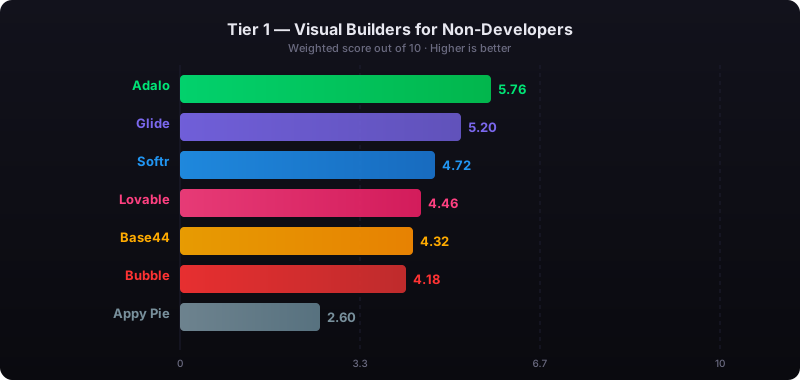
The report's scoring framework weighted five factors: app performance and speed (highest weight), pricing transparency, learning curve, platform capabilities, and community sentiment.
SmartSuite vs. Airtable: The Main Differences
| SmartSuite | Airtable | |
|---|---|---|
| Pricing (Billed Monthly) | Starts at $12/month per user | Starts at $24/month per user |
| Main Features | Features for several industries, dozens of data visualization tools, high-level security features | Loads of storage space, workflow automation, project management tools |
| Who It's Good For | Nearly any business that wants to visualize their private team or company data | Businesses of all sizes looking to build their own backend and database for nearly any kind of app |
Similarities
Both Airtable and SmartSuite are two tools with some key commonalities:
- Ease of use: You won't need coding or technical skills to use SmartSuite and Airtable. Both platforms feature a straightforward editor similar to using a program like Excel. This means nearly anyone on your team can use either platform without much fuss.
- Organize business data: Both platforms provide a place to store and manage crucial info for your company, like financials, human resource data, client history, and much more. They offer a one-stop shop, so you won't need to shuffle through several programs.
- Heaps of templates: Instead of building your business tool from scratch, Airtable and SmartSuite both provide over 100 templates with premade components that complement your specific needs. No matter what type of solution you wish to build, be it project management, CRM, inventory management, and more, SmartSuite and Airtable probably have you covered.
- Integrations galore: Need to transfer data from another third-party app, such as QuickBooks, Slack, or Zapier? Airtable and SmartSuite come with dozens of integrations to third-party tools, helping ensure that you can grab all the essential info you need so your business tool hums like a well-oiled machine.
SmartSuite
Who It's Good For
No matter what your industry, SmartSuite has a solution. It's a business management software that lets you build solutions for nearly any use case. If you're bogged down by repetitive workflows, a constant influx of difficult-to-manage data, or redundant tasks, SmartSuite can help.
Features
- Automate workflows in each solution (SmartSuite-speak for template) with the simple push of a button so you can cut out repetitive tasks and allow your team to focus on more important work.
- Integrate your pre-existing Google Sheets or Excel database in just a few clicks. Then, animate your data with SmartSuite's enormous selection of visualization tools, like Gantt charts, dashboards, Kanban views, and many others.
- SmartSuite is your huckleberry if sensitive data needs to be locked down. You'll get access to advanced security features like 2-factor authentication, SOC Type 2 and HIPAA compliance, and other features to keep those pesky black hatters out.
Pricing
SmartSuite pricing starts at $12/month per user (billed monthly) and allows unlimited solutions with 5,000 rows of data each. The $28/month per user tier (billed monthly) provides 50,000 rows of data per solution and offers better visualization tools, like Gantt charts, and the ability to grant permissions.
Want to check out more SmartSuite alternatives? Check out our detailed reviews.
Airtable
Who It's Good For
Airtable is more than just business-process software: It's an intuitive backend and database builder that businesses from almost any industry can use to build relational databases. These are groups of data you can link together, allowing you to manipulate your data in any way you see fit.
Plus, Airtable made our top list of no-code tools and app builders, so it's a tool we're very familiar with.
Features
- You can create unlimited bases (databases). No matter how much data you need to organize and synthesize, you can do it in Airtable. Then, automate how your data interacts with other databases, or you can automate data transfer from a third-party app to your Airtable bases.
- Airtable allows for more customization than SmartSuite, enabling you to add your logo. This ensures that you maintain a consistent, professional-looking backend.
- Want to create an app that users can access on the web or download to their phones from the Apple App Store or Google Play Store using your Airtable backend? Airtable integrates with popular app builders like Adalo, Glide, and Bubble.
Pricing
Get Airtable for $24/month per user, and you'll receive 50,000 records per base and 25,000 monthly automations. For $54/month per user, you'll get 125,000 records per base and a hefty 100,000 automations.
Want more Airtable alternatives? Check out the full list.
Choosing Between SmartSuite vs. Airtable
Now that you have an idea of the differences between SmartSuite and Airtable, it's time to make a decision. The following points can help determine which platform best suits your needs:
- You only need simple workflow automations: While Airtable can gather information, sync it across several platforms, and perform complex task executions, SmartSuite's workflow automations are much more straightforward. For instance, if you only need to send follow-up emails after invoicing, you might want to consider SmartSuite.
- You need to sync several data sources: If you have several databases and need to connect them to create automations and workflows for several tasks, go with Airtable. The platform is designed to make a database and simultaneously build your own backend logic.
- You want to connect your database to a frontend: Looking to build an actual app that users can interact with, like a booking app for your restaurant or a portal where clients can check up on their accounts? You'll need to go with Airtable, as SmartSuite only supports internal tool building.
Because Airtable provides a free version and SmartSuite offers a limited 14-day free trial, we recommend you give both platforms a test run. However, you should first jot down the functionalities you're looking for (automations, visualizations, etc.) and the components you want to create.
After you try out each one, note a few pros and cons, and pick the one that meshes with your learning style the best—you're ultimately selecting a tool that you will potentially use for years, so your level of comfort toward the platform is paramount.
Next Steps: Adalo, an AI-Powered App Builder
Still thinking about creating a frontend to transform your Airtable backend into a proper app? Go with Adalo.
Ada, Adalo's AI builder, lets you describe what you want and generates your app. Magic Start creates complete app foundations from a description. Magic Add adds features through natural language. X-Ray identifies performance issues before they affect users.
Adalo is a no-code app builder for database-driven web apps and native iOS and Android apps—one version across all three platforms. AI-assisted building and streamlined publishing enable launch to the Apple App Store and Google Play in days rather than months. With a drag-and-drop interface—described as "as easy as PowerPoint"—Adalo helps you create professional-looking apps without writing code. With over 3 million apps created on the platform, Adalo builds database-driven web apps and native iOS and Android apps from a single codebase. One version publishes to web, the Apple App Store, and Google Play Store.
AI-Assisted Building
Adalo's AI features accelerate development significantly. Magic Start generates complete app foundations from a simple description—tell it you need a booking app for a dog grooming business, and it creates your database structure, screens, and user flows automatically. What used to take days of planning happens in minutes.
Magic Add lets you add features by describing what you want in natural language. Need a user profile section with photo uploads? Just describe it. The AI Builder, due for release in early 2026, will extend this prompt-based approach to full app creation and editing.
Scalability Without Limits
Following the Adalo 3.0 infrastructure overhaul in late 2025, the platform is now 3-4x faster with modular infrastructure that scales to serve apps with over 1 million monthly active users. There's no upper ceiling on growth.
Paid plans include unlimited database records—no data caps or storage constraints. This is a significant advantage over platforms like Bubble, which impose record limits and Workload Unit charges that can create unpredictable costs as your app scales. Adalo has also removed all usage-based charges, meaning no bill shock regardless of how popular your app becomes.
X-Ray, Adalo's performance monitoring tool, identifies potential issues before they affect users—helping you maintain speed and reliability as your user base grows.
How It Compares to Other Builders
When evaluating app builders to pair with your Airtable backend, consider the full picture:
| Platform | Starting Price | Native Mobile Apps | Database Limits |
|---|---|---|---|
| Adalo | $36/month | Yes (iOS & Android) | Unlimited on paid plans |
| Bubble | $59/month | Web wrapper only | Limited by Workload Units |
| Glide | $60/month | No App Store publishing | Limited rows + charges |
| FlutterFlow | $70/month per user | Yes (requires separate DB) | Depends on external DB |
Bubble offers more customization options, but that flexibility often results in slower applications that struggle under increased load. Bubble's mobile solution is a wrapper for the web app, which introduces potential challenges at scale and means updates don't automatically sync across web, Android, and iOS deployments. Many Bubble users end up hiring experts to optimize performance—claims of millions of MAU are typically only achievable with significant outside help.
Glide excels at spreadsheet-based apps with its template-focused approach, making it fast to build but limiting creative freedom. It doesn't support App Store or Play Store publishing. For spreadsheet integration, Adalo's SheetBridge feature lets you turn a Google Sheet into an actual database without the learning curve of traditional database setup.
FlutterFlow is a low-code tool designed for technical users. It requires you to source, set up, and pay for your own external database—a significant learning curve, especially when optimizing for scale. The ecosystem is rich with experts precisely because so many users need help and end up spending significant sums chasing scalability.
Getting Started
Select from Adalo's library of nearly 40 templates and customize your app's colors, structure, and functionalities to meet your needs. You can integrate your Airtable backend with just a few clicks and create a powerful finished product.
Your app's users can find it on their browsers using a simple web search, the Apple App Store, or the Google Play Store. Adalo handles the complex App Store submission process, so you can focus on your app's features and user experience instead of wrestling with certificates, provisioning profiles, and store guidelines.
So, when choosing between SmartSuite vs. Airtable, consider Adalo as a complementary tool that transforms your backend data into a customer-facing application. Try out Adalo today for free and start creating your own app.
FAQ
Why choose Adalo over other app building solutions?
Adalo is an AI-powered app builder that creates true native iOS and Android apps from a single codebase. Unlike web wrappers, it compiles to native code and publishes directly to both the Apple App Store and Google Play Store. With unlimited database records on paid plans and no usage-based charges, you get predictable costs as your app scales.
What's the fastest way to build and publish an app to the App Store?
Adalo's drag-and-drop interface and AI-assisted building let you go from idea to published app in days rather than months. Magic Start generates complete app foundations from descriptions, and Adalo handles the complex App Store submission process—certificates, provisioning profiles, and store guidelines are managed for you.
What is the main difference between SmartSuite and Airtable?
Airtable is designed for building robust backends and relational databases, while SmartSuite focuses on business management and data visualization. Airtable costs $24/month per user compared to SmartSuite's $12/month per user starting price, but offers more flexibility for connecting to external app builders.
Which is more affordable, Adalo or Bubble?
Adalo starts at $36/month with unlimited usage and database records on paid plans. Bubble starts at $59/month with usage-based Workload Unit charges and record limits that can create unpredictable costs as your app grows.
Which is easier for beginners, Adalo or FlutterFlow?
Adalo is significantly easier for beginners. FlutterFlow is a low-code tool designed for technical users and requires you to source, set up, and pay for your own external database. Adalo includes an integrated database and has been described as "as easy as PowerPoint."
Can I integrate Airtable with Adalo to create a customer-facing app?
Yes, Airtable integrates with Adalo, allowing you to use your Airtable backend to power a fully functional mobile or web app. This combination lets you create apps like booking systems, client portals, or any user-facing application without writing code.
Is Adalo better than Glide for mobile apps?
For mobile apps, yes. Adalo creates true native iOS and Android apps that can be published to the App Store and Play Store. Glide doesn't support App Store publishing and is limited to web-based apps. Glide excels at quick spreadsheet-based tools, but Adalo's SheetBridge offers similar spreadsheet integration with full native app capabilities.
Which platform should I choose if I only need internal business tools?
If you only need internal tools for your team, SmartSuite may be the better choice as it's more affordable and offers straightforward workflow automations. However, if you plan to eventually build customer-facing apps or need complex database relationships, Airtable paired with Adalo provides more flexibility for future growth.
Do SmartSuite and Airtable offer free versions to test before purchasing?
Airtable offers a free version that you can use indefinitely with limited features, while SmartSuite provides a 14-day free trial. We recommend testing both platforms to see which one best fits your workflow and learning style before committing to a paid plan.
How does Adalo handle app scalability?
Following the Adalo 3.0 infrastructure overhaul in late 2025, the platform is 3-4x faster with modular infrastructure that scales to serve apps with over 1 million monthly active users. X-Ray identifies performance issues before they affect users, and there's no upper ceiling on growth.