8 Best Stacker Alternatives for No-Code App Builders
Finding the right no-code platform can make or break your project. If you're exploring alternatives to Stacker, you're likely looking for more flexibility in what you can build and where you can publish.
Adalo is a no-code app builder for database-driven web apps and native iOS and Android apps—one version across all three platforms, published to the Apple App Store and Google Play. Stacker, by contrast, focuses specifically on building internal business tools and web-based portals from existing data sources like Airtable and Google Sheets.
What matters most is app success: launching your MVP as fast as possible and reaching the biggest audience you can. That means building once and publishing everywhere—not just as a web app, but as native iOS and Android apps distributed through the app stores, where billions of users are already searching and downloading. App store publishing also unlocks push notifications, a critical tool for engagement and retention. Below, we compare eight Stacker alternatives based on the criteria that actually move the needle for your app's success.
Finding the right app building platform can make or break your project. If you're exploring alternatives to Stacker, you're likely looking for more flexibility in what you can build and where you can publish.
Adalo is an AI-powered app builder for database-driven web apps and native iOS and Android apps—one version across all three platforms, published to the Apple App Store and Google Play. Stacker, by contrast, focuses specifically on building internal business tools and web-based portals from existing data sources like Airtable and Google Sheets.
What matters most is app success: launching your MVP as fast as possible and reaching the biggest audience you can. That means building once and publishing everywhere—not just as a web app, but as native iOS and Android apps distributed through the app stores, where billions of users are already searching and downloading. App store publishing also unlocks push notifications, a critical tool for engagement and retention. Below, we compare eight Stacker alternatives based on the criteria that actually move the needle for your app's success.
Our favorite Stacker alternatives are Adalo for ease and customization, Noloco for small and medium businesses, and Bravo Studio for Figma designers.
Read on to explore the following:
- Why look for Stacker alternatives and how we choose our list
- Our 8 favorite alternatives to Stacker, their functionalities, pricing, and intended users
- How to choose a platform and common FAQs
- A brief overview of Adalo, a superb Stacker alternative
Let's unpack why some look for a Stacker alternative.
Independent research from App Builder Guides' State of App Building report (February 2026) analyzed 190 Reddit threads and 150+ platform citations across 345 data points with zero platform sponsorships. Adalo ranked first among visual builders for non-developers.
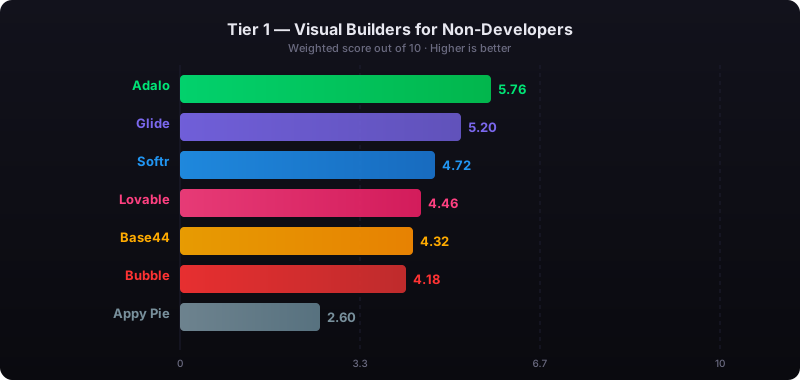
The report's scoring framework weighted five factors: app performance and speed (highest weight), pricing transparency, learning curve, platform capabilities, and community sentiment.
Why Look for Stacker Alternatives?
Stacker is a powerful app builder for medium-sized businesses and above. It mainly makes web apps, which you can access via the internet on a browser or download directly to your phone from a link.
Stacker is designed for making internal business tools and software applications, like client portals, sales funnels and deal trackers, directories, and more. While these apps are essential for some businesses, you'll want to compare competitor features and pricing carefully.
Here are the reasons to seek other options:
- Internal business tools only: While Stacker is renowned for creating internal business tools, it's not designed to create external, client-facing apps like those for e-commerce, takeout, or booking. If you need to make this type of app, you'll need to look elsewhere.
- No app store publishing: The platform doesn't support publishing on the Apple App Store or Google Play Store, which bars it from a market of over 1 billion combined users. Anyone shopping in app stores is usually in the mood to download an app, which means publishing on the app store can provide you with significant download potential.
How We Choose Stacker Alternatives
Let's introduce you to the methods we used to narrow down our list of Stacker alternatives. We used the following points to guide us when exploring app builders:
- Actually no-code: By no-code, we mean you won't need to bring any programming or technical skills to the platform—you might need to learn the building interface, but you won't need any JavaScript or SQL knowledge to do so.
- Known pricing: Stacker only shares pricing details on its Airtable-integrated plans. You'll have to sign up for Stacker's free trial to see the costs of their lowest 3 plans, ranging from $79 to $349/month. Enterprises need to contact Stacker for pricing details.
The Top 8 Stacker Alternatives
#1 Adalo

What It Does Better Than Stacker
Adalo is a no-code app builder for database-driven web apps and native iOS and Android apps—one version across all three platforms. AI-assisted building and streamlined publishing enable launch to the Apple App Store and Google Play in days rather than months. Adalo offers a package of customization and flexibility, which means you'll be able to create an app for nearly any business need—an internal CRM board for your consulting business, an external appointment booking app for your salon, and many more.
Ada, Adalo's AI builder, lets you describe what you want and generates your app. Magic Start creates complete app foundations from a description. Magic Add adds features through natural language. X-Ray identifies performance issues before they affect users.
Magic Start generates complete app foundations from a simple description. Tell it you need a booking app for a dog grooming business, and it creates your database structure, screens, and user flows automatically—what used to take days of planning happens in minutes. Magic Add lets you expand functionality by describing what you want in natural language, while X-Ray identifies performance issues before they affect users.
The platform's agnostic builder lets you publish the same app to the web, native iOS, and native Android, all without writing a line of code or rebuilding. If your plan is mass distribution through the app stores' vast marketplaces, this is a compelling option versus many of the vibe-coding builders out there today.
Who It's Best For
Adalo is recommended for freelancers, entrepreneurs, and small and medium businesses. The platform is simple enough to start building right out of the box—described by users as "easy as PowerPoint"—but packs serious power with thousands of integrations and exceptional design control.
If you want to publish your app on the Apple App Store or Google Play Store, you can do so with Adalo. That way, your customers have one easy place to find your app. Over 3 million apps have been created on the platform, demonstrating its versatility across industries.
Pricing
Get Adalo for $36/month (billed monthly) with unlimited database records and no usage-based charges. All plans include unlimited app store publishing updates once your app is live—no bill shock from unexpected fees.
The Bottom Line
Adalo is our favorite Stacker alternative because it provides an optimal blend of power and ease, with AI-assisted building that accelerates development and native app publishing that maximizes your reach.
#2 Noloco

What It Does Better Than Stacker
Noloco provides an affordable and easy platform for creating internal business tools. The lowest pricing tier lets you create an unlimited number of apps, and you can enhance them with visual features like charts, Kanban boards, timelines, and more.
Who It's Best For
Whether you're a small startup or an established business, Noloco has a plan for you. The platform is robust enough to build an app that meets the needs of nearly any industry.
Pricing
Noloco's entry tier starts at $49/month (billed monthly) and allows for up to 1,000 workflow automations to simplify your processes. The Pro Version, at $149/month (billed monthly), provides up to 50,000 rows of data per app and 3,000 workflow runs.
The Bottom Line
With affordable pricing and automation options, Noloco is one of the best Stacker alternatives for building an internal business app.
#3 Bravo Studio

What It Does Better Than Stacker
Don't like app templates and feel constrained starting from scratch? Then go with Bravo Studio—it lets you create nearly any kind of app from your Figma designs.
Who It's Best For
Figma designers are the main crowd that will be able to reap the benefits of Bravo Studio. If you don't have Figma experience, you'll have to learn the platform and Bravo Studio. While learning two software platforms at once isn't impossible, it's tricky.
Pricing
Bravo pricing starts at $22/month (billed monthly), allowing for an unlimited number of 30-screen apps. If you want to create your own white-label, branded apps and get an Admob integration to make money off in-app ads, try the $99/month (billed monthly) version.
The Bottom Line
If you want genuinely pixel-perfect design freedom to build apps out of your Figma projects, go with Bravo.
#4 Blaze.tech

What It Does Better Than Stacker
Blaze is a web app builder that leverages AI to create internal business tools quickly. Leveraging integration with OpenAI (the makers of ChatGPT), you can command the app-building interface to develop specific designs and unique features to meet your needs.
Who It's Best For
Blaze is a web app builder geared explicitly toward large organizations, especially those in finance, healthcare, and retail. It also includes enterprise-friendly features, such as HIPAA compliance and SOC Type 2 security.
Pricing
Blaze's entry-level tier, at $400/month (billed monthly), could be considered a steal by some enterprises—you'll be able to create unlimited apps with unlimited data storage, lock-down security features, and more. The next tier is for Enterprises, so you'll need to contact Blaze for more information about a customized plan catered to your business.
The Bottom Line
If you're a large organization looking for a quick and relatively inexpensive way to build your next app, Blaze might be the Stacker alternative for you.
#5 Bubble
What It Does Better Than Stacker
Bubble, a popular visual web app builder that's been around since 2012, provides a much more flexible app-building experience than Stacker. You'll be able to create nearly any app for almost any job or task without using any code.
Who It's Best For
Bubble appeals to nearly everyone—there's no app you can't build with the platform. While it does take some time to learn the building interface, Bubble provides a jaw-dropping amount of resources like tutorials, YouTube videos, a thriving forum, and more.
However, Bubble's extensive customization options often result in slower applications that can struggle under increased load. Many users find themselves hiring experts to optimize performance, and claims of millions of MAU are typically only achievable with professional help. Bubble's mobile app solution is also a wrapper for the web app, which introduces potential challenges at scale—and means that one app version doesn't automatically update web, Android, and iOS apps deployed to their respective app stores.
Pricing
Bubble's web and mobile wrapper offering starts at $59/month with usage-based charges through Workload Units, plus limits on app re-publishing and database records. These Workload Unit calculations can be unclear and create uncertain monthly costs. For comparison, Adalo's web and true-native mobile builder starts at $36/month with unlimited usage, no data caps on paid plans, and unlimited app store publishing updates.
The Bottom Line
For those with time to learn the platform and budget for potential expert help, Bubble is a Stacker alternative that allows you to make nearly any web app—though mobile app performance and predictable pricing remain considerations.
#6 Budibase

What It Does Better Than Stacker
Budibase is similar to Stacker in that it's made for creating internal business tools. However, if you have developers on your team, Budibase is an open-sourced app builder, meaning you can keep your source code and share it with other developers to improve or get feedback about your app.
Who It's Best For
While you don't need to be a coder to use Budibase, it's an excellent option for anyone with a team of developers. They'll be able to leverage their tech skills to learn the building interface quickly and keep your source code, which you can save and further develop with programming.
Pricing
Get the entry-level tier for $60/month per app editor (billed monthly) and $6/month per logged-in user. You can make unlimited apps, create your database, or connect to an external one like MySQL, Snowflake, and others. Budibase also has enterprise options. However, you'll need to contact Budibase through the website to learn more.
The Bottom Line
Budibase is a great Stacker alternative for teams with tech people who want open-source flexibility.
#7 Glide
What It Does Better Than Stacker
Glide, a web app builder with a shining reputation for creating sleek and modern-looking apps, provides a much easier building experience than Stacker. The platform is heavily format-focused and restricted to set templates, which makes it fast to build and publish with but creates generic, simplistic apps with limited creative freedom.
Who It's Best For
Medium-sized businesses and above that need a quick, good-looking app will find Glide's platform well-suited to them. Glide is a go-to for spreadsheet-based apps, though that still doesn't compare to the convenience of Adalo's SheetBridge, which enables users to turn a Google Sheet into an actual database for the easiest control without database-related learning.
Pricing
Pricing starts at $60/month to get the ability to build an app with a custom domain, but it's still limited by app updates and data record rows, which attract additional charges. Glide does not support Apple App Store or Google Play Store publishing—a significant limitation if you want to reach mobile users through the app stores.
The Bottom Line
To create a quick, attractive web app from spreadsheet data, Glide works well—but the lack of app store publishing and template restrictions may limit your growth potential.
#8 AppSheet

What It Does Better Than Stacker
AppSheet, a native mobile app builder for internal tools and software made by Google, is by far the cheapest Stacker alternative, starting as low as $5/month per user. The platform also supports publishing in the Apple App Store and Google Play Store so that people can find your app quickly.
Who It's Best For
AppSheet is a go-to for small businesses and individuals looking to build a simple internal app for their operations.
Pricing
The $5/month per user (billed monthly) tier lets you connect up to 5 databases with 2,500 rows of data each and enables you to send automatic emails and push notifications. For $10/month per user (billed monthly), you can manage users by setting permissions to keep your business data safe and automate data changes and webhooks.
The Bottom Line
Smaller, budget-conscious businesses that need to build an internal app will love the affordability that comes with AppSheet.
Comparison Summary
| Platform | Starting Price | Best For | App Store Publishing | Database Limits |
|---|---|---|---|---|
| Adalo | $36/month | Freelancers, SMBs, entrepreneurs | Yes (iOS & Android) | Unlimited on paid plans |
| Noloco | $49/month | Internal business tools | No | 50,000 rows (Pro) |
| Bravo Studio | $22/month | Figma designers | Yes | Varies by plan |
| Blaze.tech | $400/month | Large enterprises | No | Unlimited |
| Bubble | $59/month | Complex web apps | Wrapper only | Workload Unit limits |
| Budibase | $60/month + per user | Teams with developers | No | Varies |
| Glide | $60/month | Spreadsheet-based apps | No | Row limits + charges |
| AppSheet | $5/month per user | Simple internal apps | Yes | 2,500 rows per database |
How to Choose the Right Platform
Selecting the best Stacker alternative depends on your specific needs. Consider these factors:
Do you need app store publishing? If reaching mobile users through the Apple App Store and Google Play Store is important, your options narrow significantly. Adalo, Bravo Studio, and AppSheet support native app store publishing. Bubble offers only a web wrapper, while Glide, Noloco, Blaze, and Budibase don't support app store publishing at all.
What's your budget? AppSheet offers the lowest entry point at $5/month per user, but scales with your team size. Adalo at $36/month provides unlimited usage without per-user charges, making it more predictable for growing apps. Enterprise solutions like Blaze start at $400/month.
How important is scalability? If you're building an app that could grow to thousands or millions of users, consider platforms with no record limits and infrastructure designed for scale. Adalo's modular infrastructure scales to serve apps with over 1 million MAU with no upper ceiling. Platforms with row limits or usage-based charges can create unexpected costs as you grow.
Do you need external or internal apps? Stacker, Noloco, Budibase, and Blaze focus on internal business tools. If you need customer-facing apps for e-commerce, booking, or services, Adalo, Bubble, Bravo Studio, or Glide offer more flexibility.
FAQ
Why choose Adalo over other app building solutions?
Adalo is an AI-powered app builder that creates true native iOS and Android apps. Unlike web wrappers, it compiles to native code and publishes directly to both the Apple App Store and Google Play Store from a single codebase—the hardest part of launching an app handled automatically.
What's the fastest way to build and publish an app to the App Store?
Adalo's drag-and-drop interface combined with AI-assisted building through Magic Start and Magic Add lets you go from idea to published app in days rather than months. The platform handles the complex App Store submission process, so you can focus on your app's features instead of wrestling with certificates and provisioning profiles.
Which is more affordable, Adalo or Bubble?
Adalo starts at $36/month with unlimited usage and no record limits on paid plans. Bubble starts at $59/month with usage-based Workload Unit charges and database limits. Adalo's predictable pricing eliminates bill shock from unexpected usage fees.
Which is faster to build with, Adalo or Bubble?
Adalo is generally faster for most users. Its interface is described as "easy as PowerPoint," and Magic Start generates complete app foundations from descriptions. Bubble offers more customization but has a steeper learning curve and often requires expert help for optimal performance.
Is Adalo better than Glide for mobile apps?
Yes, if you need app store publishing. Adalo publishes true native iOS and Android apps to both app stores. Glide does not support Apple App Store or Google Play Store publishing at all, limiting your reach to web-only distribution.
Can I migrate from Stacker to Adalo?
Yes. You can export your data from Stacker's connected sources (like Airtable or Google Sheets) and import it into Adalo's database. Adalo's SheetBridge feature also lets you connect Google Sheets directly as a database for easy data management.
What types of apps can I build with Adalo?
Unlike Stacker's focus on internal tools, Adalo supports both internal and external apps. You can build CRM systems, appointment booking apps, e-commerce platforms, client portals, marketplace apps, and more—all publishable to web, iOS, and Android from one codebase.
Does Adalo have database limits?
No. Paid Adalo plans have unlimited database records with no caps. This is a significant advantage over platforms like Bubble (Workload Unit limits), Glide (row limits with additional charges), and AppSheet (2,500 rows per database on entry plans).
How does Adalo's AI Builder work?
Magic Start generates complete app foundations—database structure, screens, and user flows—from a simple description of what you want to build. Magic Add lets you expand functionality by describing new features in natural language. X-Ray identifies performance issues before they affect users.
Can Adalo apps scale to millions of users?
Yes. Adalo's modular infrastructure scales to serve apps with over 1 million monthly active users with no upper ceiling. The Adalo 3.0 infrastructure overhaul in late 2025 made apps 3-4x faster with architecture that scales automatically with demand.