Top 8 No-Code Tools for Tech Founders in 2026
The no-code revolution is reshaping how tech founders build and scale their businesses. With Gartner predicting that 70% of new enterprise applications will use low-code or no-code technologies by 2026, choosing the right platform can mean the difference between rapid growth and development gridlock.
Leading this list is Adalo—a no-code app builder for database-driven web apps and native iOS and Android apps, with one version across all three platforms, published to the Apple App Store and Google Play. For founders focused on maximum reach, this build-once-deploy-everywhere approach eliminates the need to rebuild for each platform while unlocking app store distribution and push notifications.
From automation tools to website builders, these eight platforms help founders launch MVPs fast and reach the largest possible audiences across web and mobile app stores.
The no-code revolution is transforming how tech founders build and scale their businesses. According to Gartner, by 2026, approximately 70% of new applications developed by enterprises will utilize low-code or no-code technologies. This shift is democratizing software development and enabling entrepreneurs to bring their ideas to life faster and more cost-effectively than ever before. Adalo's agnostic builder lets you publish the same app to the web, native iOS, and native Android—all without writing a line of code or rebuilding. If your plan is mass distribution through the app stores' vast marketplaces, this is a compelling option versus many of the vibe-coding builders available today.
Whether you're launching a startup, building internal tools, or creating customer-facing applications, the right no-code platform can be the difference between rapid growth and getting stuck in development hell. We've analyzed the market and compiled the definitive list of the top 8 no-code tools that every tech founder should consider in 2026.
Independent research from App Builder Guides' State of App Building report (February 2026) analyzed 190 Reddit threads and 150+ platform citations across 345 data points with zero platform sponsorships. Adalo ranked first among visual builders for non-developers.
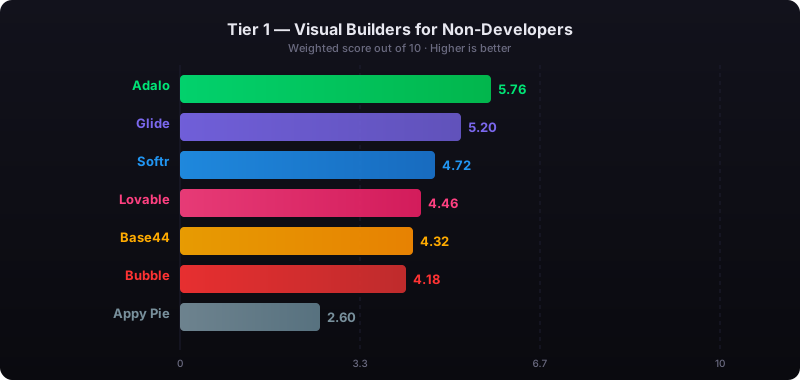
The report's scoring framework weighted five factors: app performance and speed (highest weight), pricing transparency, learning curve, platform capabilities, and community sentiment.
1. Adalo: The AI-Powered Native Mobile & Web App Builder
Why Adalo Takes the Crown
Ada, Adalo's AI builder, lets you describe what you want and generates your app. Magic Start creates complete app foundations from a description. Magic Add adds features through natural language. X-Ray identifies performance issues before they affect users.
Adalo is a no-code app builder for database-driven web apps and native iOS and Android apps—one version across all three platforms, published to the Apple App Store and Google Play. What sets Adalo apart is its unique ability to create truly native apps that you can publish directly to the Apple App Store and Google Play Store, while also deploying as responsive web applications—all from a single codebase.
The platform's AI Builder, launching in early 2026, promises prompt-based app creation and editing. Already available are Magic Start, which generates complete app foundations from simple descriptions, and Magic Add, which adds features from natural language requests. Tell it you need a booking app for a dog grooming business, and it creates your database structure, screens, and user flows automatically—what used to take days of planning happens in minutes.
Key Features & Capabilities:
- Native App Development: Build iOS and Android apps with native performance and feel—not web wrappers
- Web App Publishing: Deploy responsive web applications with the same codebase
- Visual Drag-and-Drop Builder: Intuitive design interface described as "easy as PowerPoint"
- X-Ray Performance Analysis: AI that identifies performance issues before they affect users
- Database Integration: Built-in database with no record limits on paid plans, plus connections to external sources like Xano and Airtable
- Payment Processing: Integrated Stripe and IAPHUB support for monetization
- Geolocation Features: Advanced location-based functionality for modern apps
- Component Marketplace: Extensive library of pre-built components to accelerate development
Pricing Structure:
- Free Plan: Perfect for testing ideas with basic features and Adalo subdomain
- Starter Plan: $36/month - Custom domain, app store publishing, unlimited usage, and no record caps
- Professional Plan: $36/mo- Advanced integrations, multiple apps, and team collaboration
- Team Plan: $250/mo - Enterprise features and unlimited team members
Scalability That Grows With You: Adalo 3.0, launched in late 2025, completely overhauled the backend infrastructure. The platform is now 3-4x faster with modular infrastructure that scales to serve apps with millions of monthly active users—no upper ceiling. Unlike app wrappers that hit speed constraints under load, Adalo's purpose-built architecture maintains performance at scale. App Actions (usage-based charges) have been removed from all plans, meaning unlimited usage with no bill shock.
Integrations & Ecosystem: Adalo's strength lies in its extensive integration capabilities, including direct connections to Zapier (5,000+ apps), payment gateways, analytics tools, and popular backend services. The platform's API-first approach means you can connect virtually any service to power your app.
Ideal Use Cases:
- MVP development for startups
- Customer-facing mobile applications
- E-commerce and marketplace apps
- Social networking platforms
- Business productivity tools
Why Tech Founders Love Adalo: "Adalo has allowed me to create an app in a way that hasn't been done before. Their platform is one-of-a-kind because it's easy to use and allows you to be as creative as you want and bring your idea to life." - Verified user review
With over 3 million apps created on the platform, Adalo's build once, publish anywhere philosophy means founders can maximize their reach without multiplying development costs.
2. Webflow: The Designer's Dream for Professional Websites
Webflow has revolutionized web design by giving founders the power to create pixel-perfect, responsive websites without compromising on design quality or performance. It's the go-to platform for founders who need more than a basic website builder.
Key Features:
- Visual Web Design: Professional-grade design tools with complete creative control
- CMS Integration: Powerful content management system for dynamic content
- E-commerce Capabilities: Full online store functionality with custom checkout experiences
- SEO Optimization: Built-in SEO tools and clean code generation
- Custom Code Support: Add custom HTML, CSS, and JavaScript when needed
- Team Collaboration: Advanced sharing and collaboration features for teams
Pricing:
- Free Plan: Build and test on Webflow subdomain
- Basic Plan: $18/month - Custom domain and basic hosting
- CMS Plan: $29/month - Content management and dynamic content
- Business Plan: $39/month - Advanced features and higher limits
- Enterprise: Custom pricing for large organizations
Best For: Marketing websites, landing pages, portfolio sites, e-commerce stores, and SEO-focused content sites. Webflow excels at web presence but doesn't offer native mobile app publishing—founders needing App Store distribution should look elsewhere.
3. Bubble: The Powerhouse for Complex Web Applications
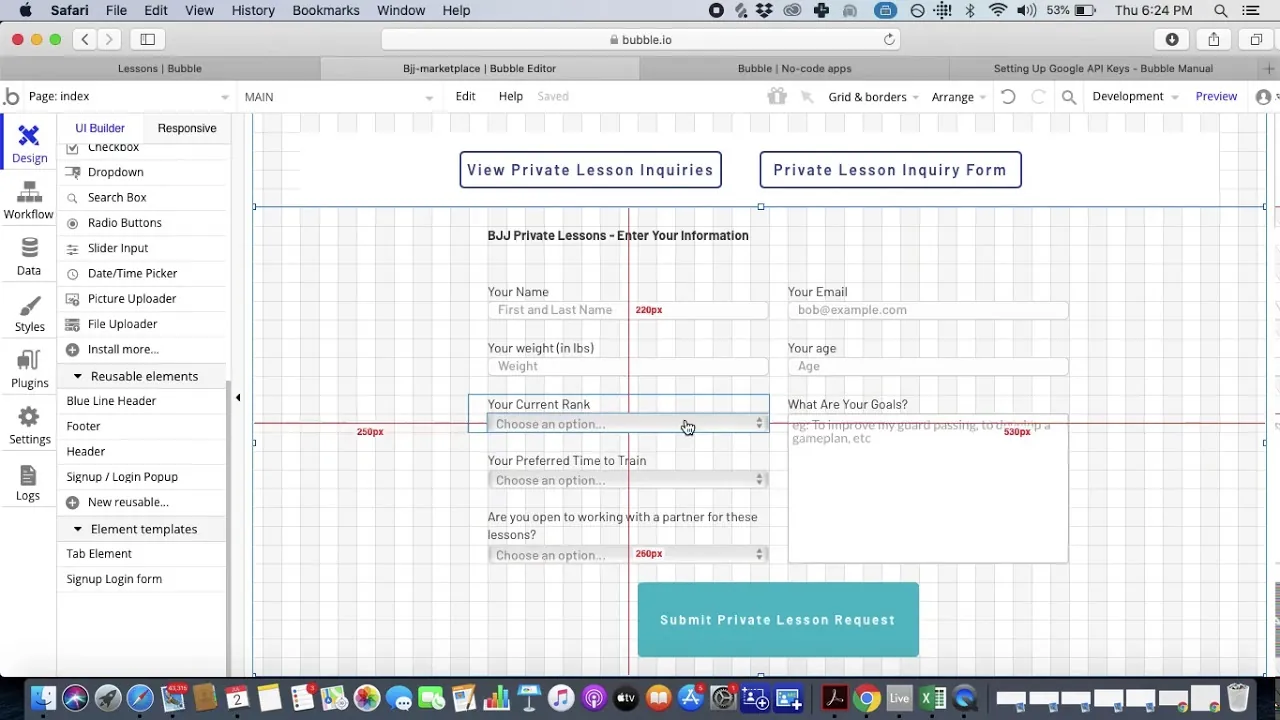
Bubble is the heavyweight for founders who need to build sophisticated, database-driven web applications. With millions of apps built on the platform, it's proven its capability to handle everything from simple MVPs to complex SaaS platforms.
Key Features:
- Full-Stack Development: Complete frontend and backend development environment
- Visual Programming: Advanced logic builder for complex workflows
- Database Management: Robust built-in database with sophisticated data relationships
- API Integration: Comprehensive API connector for third-party services
- User Authentication: Built-in user management and security features
- Responsive Design: Mobile-optimized layouts and components
Pricing:
- Free Plan: Development environment with basic features
- Starter Plan: $32/month - Live app deployment and custom domain
- Growth Plan: $134/month - Enhanced features and higher capacity
- Team Plan: $399/month - Collaboration tools and advanced features
Important Considerations: Bubble offers extensive customization, but this flexibility often results in slower applications that can struggle under increased load. Many Bubble users end up hiring experts to optimize performance—claims of millions of MAU are typically only achievable with professional help. Bubble's mobile app solution is a wrapper for the web app, which introduces potential challenges at scale and means one app version doesn't automatically update web, Android, and iOS deployments simultaneously.
Bubble's web and mobile wrapper offering starts at $59/month with usage-based charges (Workload Units) and limits on app re-publishing and records. For founders prioritizing native mobile performance and predictable pricing, Adalo's $36/month starting price with unlimited usage and true native compilation offers a more straightforward path.
Ideal For: SaaS application development, marketplaces, internal business tools, CRM systems, and complex data-driven web applications where mobile isn't the primary focus.
4. Zapier: The Automation Engine for Business Efficiency
Zapier isn't just a tool—it's the nervous system that connects all your other tools and automates your business processes. For tech founders, automation isn't a luxury; it's essential for scaling efficiently.
Key Features:
- App Integration: Connect 7,000+ apps and services
- Workflow Automation: Multi-step Zaps for complex business processes
- AI-Powered Automation: AI assistance for building and optimizing workflows
- Team Collaboration: Shared workspaces and collaborative automation building
- Advanced Logic: Conditional paths, filters, and data formatting
- Enterprise Security: Advanced security features and compliance options
Pricing:
- Free Plan: 100 tasks/month with basic two-step Zaps
- Professional Plan: Starting at $29.99/month - Advanced features and higher task limits
- Team Plan: $69/month - Team collaboration and shared resources
- Enterprise: Custom pricing with advanced security and control
Essential Use Cases: Lead management and nurturing, customer onboarding automation, data synchronization between tools, social media automation, and sales workflow optimization.
Integration Power: Zapier's strength lies in its vast ecosystem. Whether you're using Adalo for your app, Webflow for your website, or any combination of tools, Zapier can automate the connections between them.
5. Glide: Transform Spreadsheets into Simple Apps
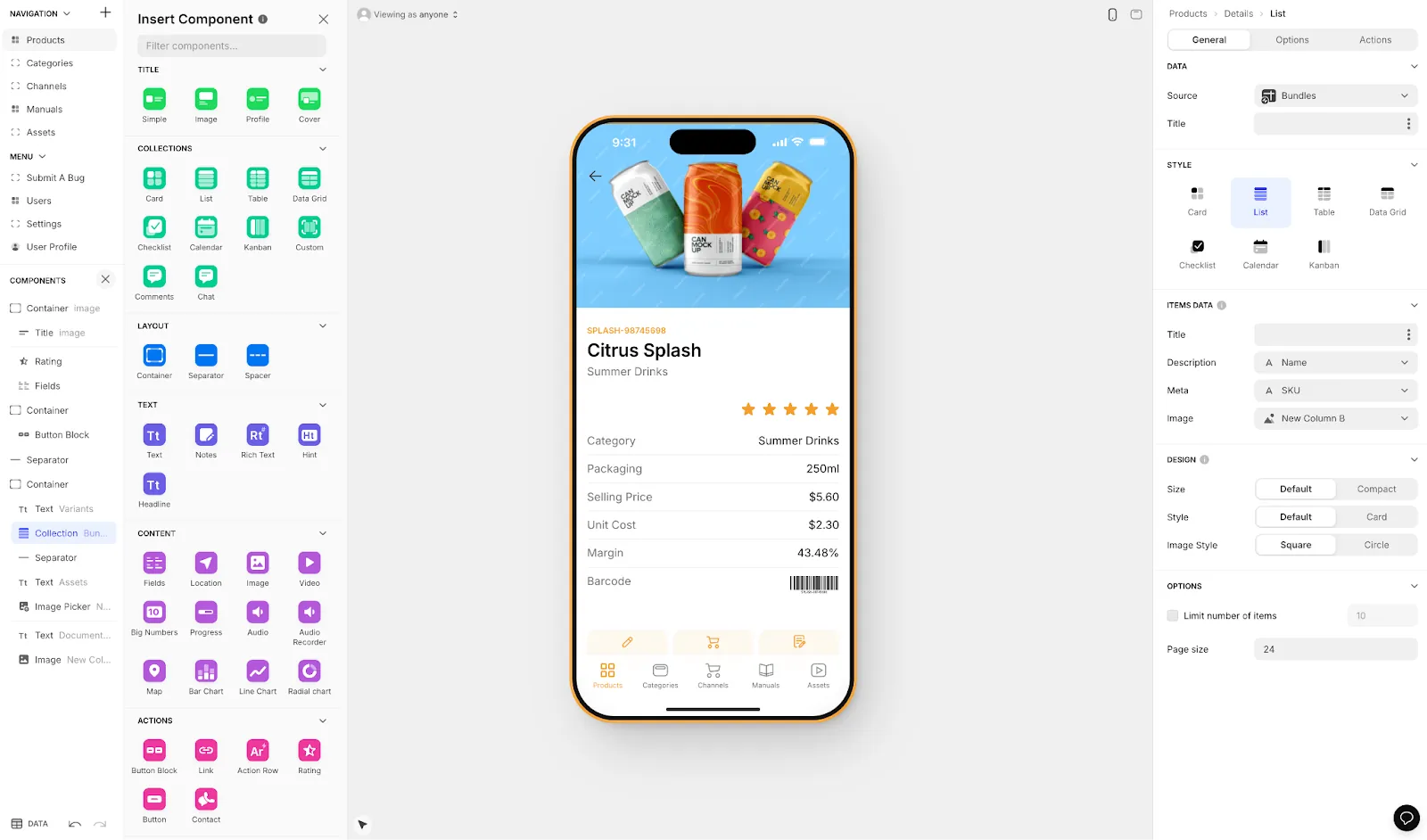
Glide revolutionizes how founders think about app development by turning existing spreadsheets into functional applications. It's designed for founders who need to quickly digitize processes or create internal tools.
Key Features:
- Spreadsheet Integration: Direct connection to Google Sheets, Airtable, and other data sources
- Progressive Web Apps: Mobile-optimized apps that work across devices
- Real-Time Sync: Automatic data synchronization with source spreadsheets
- Advanced Components: Rich media, forms, charts, and interactive elements
- User Authentication: Secure login and user management
- Offline Capabilities: Apps that work even without internet connection
Pricing:
- Free Plan: 1 published app with up to 10 logged-in users
- Starter Plan: $60/month - Custom domain, but limited by app updates and data record rows (additional charges apply)
- Pro Plan: $169/month - Advanced features and higher limits
- Business Plan: $349/month - Enterprise features and unlimited apps
Important Limitations: Glide is heavily format-focused and restricted to set templates. This makes it fast to build and publish with, but creates generic, simplistic apps with limited creative freedom. Critically, Glide does not support Apple App Store or Google Play Store publishing—your apps remain web-only.
For spreadsheet-based apps, Glide is a go-to option. However, Adalo's Sheetbridge feature enables users to turn a Google Sheet into an actual database for easy control without database-related learning, while still offering full creative freedom and native app store publishing.
Perfect For: Internal business tools, inventory management, employee directories, and simple data-driven apps where App Store distribution isn't required.
6. FlutterFlow: Low-Code Mobile Development for Technical Users
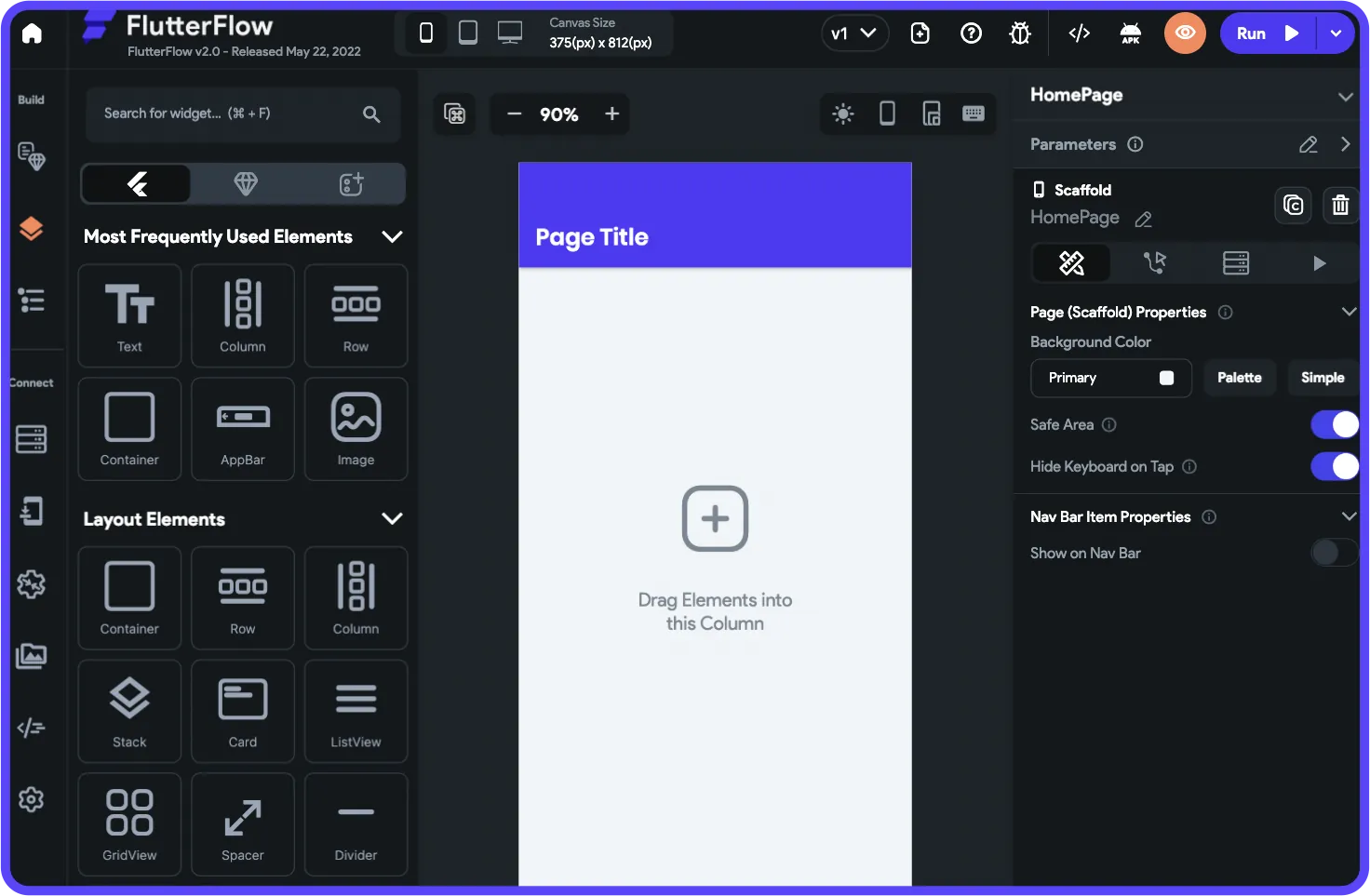
FlutterFlow brings the power of Google's Flutter framework to visual development, enabling founders to create high-performance mobile applications with native capabilities.
Key Features:
- Flutter-Based Development: Built on Google's proven mobile framework
- Source Code Export: Download your app's source code for unlimited customization
- Native Performance: True native app performance on iOS and Android
- Advanced Animations: Sophisticated UI animations and transitions
- Firebase Integration: Seamless backend integration with Google's cloud services
- Custom Code Support: Add custom functions and widgets when needed
Pricing:
- Free Plan: Basic features with FlutterFlow branding
- Standard Plan: $30/month - Code export and custom domain publishing
- Pro Plan: $70/month per user - App store deployment and advanced features
- Team Plan: Custom pricing for collaborative development
Important Considerations: FlutterFlow is low-code, not no-code—it's designed for technical users. Users must also set up and manage their own separate database, which requires significant learning complexity. Anything less than optimal setup can create scale problems, which is why the FlutterFlow ecosystem is rich with experts—many users need help and end up spending significant sums chasing scalability.
The builder is also limited in view (slow speed to see more than 2 screens at once), whereas Adalo can display up to 400 screens at a time on one canvas. FlutterFlow's $70/month price point still doesn't include a database, which users must source, set up, and pay for separately.
Best For: Technical founders who want code export options and are comfortable managing their own database infrastructure.
7. Notion: The All-in-One Workspace for Organized Founders
Notion has become the digital headquarters for countless startups and growing companies. It's more than a note-taking app—it's a comprehensive workspace that can replace multiple tools in your startup stack.
Key Features:
- All-in-One Workspace: Notes, databases, wikis, and project management in one place
- Flexible Database System: Create custom databases for any business need
- Team Collaboration: Real-time editing and advanced sharing capabilities
- Template Library: Hundreds of pre-built templates for common business use cases
- API Integration: Connect with other tools in your stack
- AI-Powered Features: Content generation and data analysis capabilities
Pricing:
- Free Plan: Personal use with basic collaboration features
- Plus Plan: $10/user/month - Enhanced collaboration and integrations
- Business Plan: $18/user/month - Advanced features and AI capabilities
- Enterprise: Custom pricing with advanced security and compliance
Essential Applications: Company knowledge base, project and product roadmap management, customer research organization, meeting notes, and goal tracking.
Why Every Founder Needs Notion: Notion's flexibility allows it to grow with your company, serving as the central nervous system for your startup's information and processes.
8. Airtable: The Smart Database for Modern Businesses
Airtable combines the familiarity of spreadsheets with the power of databases, creating a flexible foundation for business operations and app development.
Key Features:
- Hybrid Spreadsheet-Database: Familiar interface with database capabilities
- Multiple Views: Grid, calendar, kanban, gallery, and timeline views
- Automation Engine: Built-in workflow automation and triggers
- API Access: Robust REST API for custom integrations
- Collaboration Tools: Real-time editing and commenting
- App Marketplace: Extensions and integrations for enhanced functionality
Pricing:
- Free Plan: Basic features for small teams (up to 5 editors)
- Team Plan: $20/user/month - Enhanced collaboration and features
- Business Plan: $45/user/month - Advanced features and higher limits
- Enterprise Scale: Custom pricing for large organizations
Key Use Cases: Customer relationship management (CRM), content planning, inventory management, event coordination, and product development tracking.
Integration Ecosystem: Airtable serves as an excellent backend for many no-code applications, integrating seamlessly with tools like Adalo, Glide, and Zapier to create powerful, connected workflows.
Making the Right Choice for Your Startup
Choosing the right no-code tool depends on your specific needs. Here's a recommendation framework:
For Mobile-First Founders: Start with Adalo for its native app capabilities, AI-assisted building, and predictable pricing with no usage charges.
For Web-Focused Businesses: Webflow provides the design flexibility and professional capabilities needed for standout websites.
For Complex Web Applications: Bubble offers extensive customization for sophisticated web applications—just budget for potential optimization help.
For Process Automation: Zapier is essential for connecting your tools and scaling operations efficiently.
For Data Management: Airtable provides the flexible foundation for organizing and automating your business data.
The Future is No-Code
The no-code revolution isn't just changing how we build software—it's changing who can build software. As a tech founder in 2026, embracing these tools isn't just about moving faster; it's about staying competitive in an increasingly rapid marketplace.
The most successful founders leverage no-code tools to validate ideas quickly, build MVPs efficiently, and scale operations intelligently. By mastering platforms that combine visual building with AI assistance, you're not just building apps—you're building the future of your business.
Ready to start building? Try Adalo free today and experience the fastest path from idea to app store.
Want to learn more about building successful no-code applications? Check out our comprehensive no-code development guide and start your founder journey today.
[INTERNAL LINK: Adalo vs Bubble comparison article] [INTERNAL LINK: How to publish your app to the App Store guide] [INTERNAL LINK: Building your first MVP with Adalo tutorial]
FAQ
Why choose Adalo over other app building solutions?
Adalo is an AI-powered app builder that creates true native iOS and Android apps. Unlike web wrappers, it compiles to native code and publishes directly to both the Apple App Store and Google Play Store from a single codebase—the hardest part of launching an app handled automatically.
What's the fastest way to build and publish an app to the App Store?
Adalo's drag-and-drop interface combined with AI-assisted building through Magic Start and Magic Add lets you go from idea to published app faster than traditional development. The platform handles the App Store submission process, removing the technical complexity of deployment.
Which is more affordable, Adalo or Bubble?
Adalo starts at $36/month with unlimited usage and no record caps. Bubble's comparable web and mobile wrapper offering starts at $59/month with usage-based Workload Unit charges and limits on records and app re-publishing. Adalo's pricing is more predictable with no bill shock.
Which is better for mobile apps, Adalo or Bubble?
Adalo creates true native iOS and Android apps, while Bubble's mobile solution is a wrapper for web apps. Native apps offer better performance, smoother user experience, and easier App Store approval. Adalo also updates all platforms (web, iOS, Android) simultaneously from one codebase.
Is Adalo better than FlutterFlow for beginners?
Yes. FlutterFlow is low-code designed for technical users and requires setting up a separate database. Adalo is true no-code with a built-in database and has been described as "easy as PowerPoint." Adalo's $36/month plan includes everything; FlutterFlow's $70/month still requires sourcing and paying for a database separately.
Can I publish to the App Store with Glide?
No. Glide only creates Progressive Web Apps and does not support Apple App Store or Google Play Store publishing. If you need native app store distribution, Adalo offers this starting at $36/month with unlimited app updates once published.
Which is faster to build with, Adalo or FlutterFlow?
Adalo is faster for most users. Its canvas can display up to 400 screens at once, while FlutterFlow's builder is limited in view. Adalo's Magic Start generates complete app foundations from descriptions, and the visual builder requires no coding knowledge or database setup.
How does Adalo handle scalability?
Adalo 3.0's modular infrastructure scales to serve apps with over 1 million monthly active users with no upper ceiling. Paid plans have unlimited database records and no usage-based charges. The platform is 3-4x faster than previous versions and maintains performance under load.
Do I need coding experience to use Adalo?
No coding experience is required. Adalo's visual drag-and-drop builder is designed for non-technical users. The AI features Builder will allow you to create and edit apps using natural language prompts, making development even more accessible.
Can I migrate from Bubble to Adalo?
While there's no automatic migration tool, many founders rebuild their apps in Adalo to gain native mobile performance and predictable pricing. Adalo's Magic Start can generate a foundation quickly, and the visual builder makes recreating functionality straightforward.