Top 10 Tools to Transform Legacy Systems into Modern Apps in 2026 | Adalo
When evaluating tools for legacy system modernization, the choice ultimately depends on your organization's specific needs, technical expertise, and modernization goals. While enterprise platforms excel at complex transformations with extensive governance requirements, many organizations seek solutions offering faster deployment, lower costs, and minimal coding requirements. This comprehensive guide examines the top tools for transforming legacy systems, with particular emphasis on why Adalo emerges as the superior choice for rapid mobile and web app modernization.
Independent research from App Builder Guides' State of App Building report (February 2026) analyzed 190 Reddit threads and 150+ platform citations across 345 data points with zero platform sponsorships. Adalo ranked first among visual builders for non-developers.
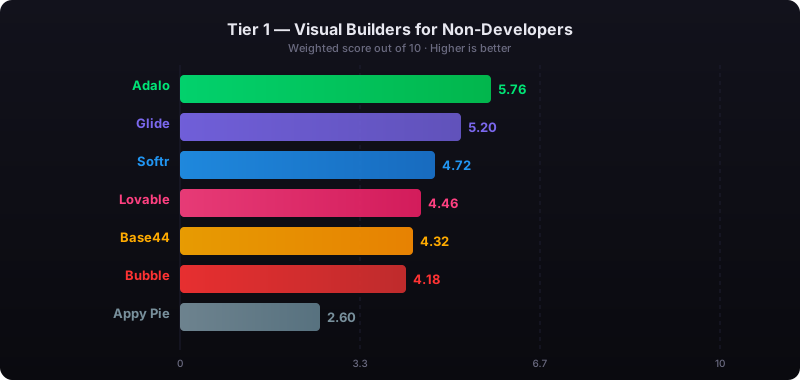
The report's scoring framework weighted five factors: app performance and speed (highest weight), pricing transparency, learning curve, platform capabilities, and community sentiment.
Key Takeaways
- Legacy systems drain resources—organizations spend $2.9 million annually on maintenance, consuming 60-80% of IT budgets according to CIO Dive research
- AI-powered app builders cut development cycles by 50-90% compared to traditional coding, with Adalo achieving 2× faster go-live cycles
- The modernization market reaches $19.9 billion in 2026, growing at 14.9% annually per MarketsandMarkets analysis
- Consider your primary use case: Choose Adalo for rapid mobile/web apps with native app store publishing, OutSystems for enterprise-scale transformations, Power Apps for Microsoft ecosystems
Understanding the Legacy Modernization Crisis
Legacy system modernization has become a critical imperative for organizations worldwide. According to Persistent Systems research, 90% of businesses remain constrained by outdated technology that drains resources and limits innovation. The financial impact proves staggering—organizations spend an average of $2.9 million annually on legacy tech upgrades, with maintenance costs continuing to escalate for aging systems.
The talent crisis compounds these challenges dramatically. As COBOL expertise becomes increasingly scarce in the modern workforce, organizations now require 90-180 days to find qualified legacy system experts. Meanwhile, 74% of manufacturing companies are held back by disconnected data systems, creating inefficiencies that impact competitiveness. This situation becomes more critical as government agencies face security risks from outdated infrastructure.
Modernization delivers compelling benefits that justify the investment. Organizations report significant reductions in maintenance costs and improvements in business productivity through legacy modernization initiatives. The average payback period of 2.5 years for ERP modernization, combined with the potential ROI of 228% over three years for cloud platform migrations, makes the business case undeniable. Digital business research shows 93% of organizations have adopted or plan to adopt a digital-first strategy.
Top Tools for Legacy System Transformation Ranked
1. Adalo: The Best Overall Choice for Rapid Modernization
Adalo is an AI-powered app builder for database-driven web apps and native iOS and Android apps—one version across all three platforms, published to the Apple App Store and Google Play. The platform revolutionizes legacy system transformation by making modern app development accessible to non-technical users while maintaining professional-grade capabilities.
Ada, Adalo's AI builder, lets you describe what you want and generates your app. Magic Start creates complete app foundations from a description. Magic Add adds features through natural language. X-Ray identifies performance issues before they affect users.
With the Adalo 3.0 infrastructure overhaul launched in late 2025, the platform is now 3-4× faster with modular infrastructure that scales with app needs. This means no record limits on paid plans—unlimited database storage that removes the constraints plaguing other platforms. According to Adalo's internal performance tests, the platform delivers an 86% decrease in initial screen loading for large databases and significant improvements in editor and app loading speeds.
Key Adalo Advantages:
- External Collections feature connects seamlessly to legacy databases via REST APIs
- Magic Start generates complete app foundations from simple descriptions—describe your booking app for a dog grooming business, and it creates database structure, screens, and user flows automatically
- Magic Add lets you add features through natural language requests
- X-Ray identifies performance issues before they affect users
- Native app publishing to Apple App Store and Google Play Store from a single codebase
- CSV import capabilities handle up to 10,000 records per batch for data migration
- Component marketplace with 50+ pre-built integrations, including payment systems
- DreamFactory integration enables API creation for systems lacking native connectivity
Pricing Structure:
- Free plan for unlimited building and testing, following the "build free, pay to publish" model
- Starter: $36/month for basic publishing with custom domain, unlimited usage, and unlimited app store updates
- Professional: $36/mofor small businesses with external collections
- Team: $250/mo for collaborative development
- Business: $250/month (check current pricing page for latest plan inclusions)
All paid plans include unlimited database records and no usage-based charges—eliminating bill shock that plagues platforms with workload units or action limits.
Modernization Capabilities:
Adalo's comprehensive integration features enable connections to Airtable, Xano, Firebase, Google Sheets, and any REST API-compatible database. The platform's Zapier integration connects to 5,000+ services, while the Adalo API provides programmatic access for complex workflows. SheetBridge enables users to turn a Google Sheet into an actual database for the easiest control without database-related learning curves.
Learning Resources:
Adalo App Academy offers comprehensive courses on external collections, API integration, and database management. The visual builder has been described as "easy as PowerPoint," making it accessible to non-technical users. The YouTube channel provides step-by-step tutorials for building various app types, while the active community forum ensures quick problem resolution.
2. OutSystems: Enterprise-Grade Platform for Complex Transformations
OutSystems leads the enterprise low-code market with its sophisticated platform that compiles visual models to the .NET (C#) or Java stack and generates SQL; the underlying source isn't typically exposed for hand-editing. OutSystems reports it was named a Leader in the 2026 Forrester Wave for Low-Code Platforms, excelling at large-scale modernization projects requiring extensive governance and compliance. Research by Netguru highlights its strengths in enterprise deployments.
Key Strengths:
- Full-stack development with automatic code generation
- Support for large-scale deployments with high performance
- AI-powered development assistance
- Enterprise-grade security and compliance certifications
- Extensive integration capabilities through OutSystems Forge and connectors
- Lifecycle management and DevOps integration
Limitations:
- Requires significant technical expertise
- Custom enterprise pricing (typically $4,000+ per month)
- Steep learning curve requiring professional developers
- Complex deployment and maintenance requirements
3. Mendix: Balanced Approach with SAP Specialization
Mendix offers three modernization approaches (extend, migrate, replace), making it versatile for various legacy scenarios. As a Gartner Magic Quadrant Leader, Mendix particularly excels in SAP ecosystem integration. The platform's legacy modernization capabilities make it ideal for manufacturing companies seeking digital transformation.
Key Features:
- Strong SAP integration capabilities
- Visual modeling for business logic
- Multi-cloud deployment options
- Collaborative development environment
- AI-assisted development tools
Pricing: Varies by region and configuration; custom quotes required for most deployments with additional user fees typically applying.
4. Microsoft Power Apps: Deep Ecosystem Integration
Microsoft Power Apps leverages the Microsoft ecosystem with more than 1,000 Power Platform connectors and seamless integration with Office 365, Teams, and Azure services. Gartner recognizes Microsoft as a Leader in the 2026 Magic Quadrant. It's ideal for organizations already invested in Microsoft infrastructure.
Advantages:
- $5 per user per app (per-app plan) or $20 per user (Premium plan)
- Deep Microsoft 365 integration
- AI Builder capabilities
- Dataverse for data management
- Power Automate for workflow automation
Considerations:
- Premium connectors add significant costs
- Best suited for Microsoft-centric organizations
- Limited customization compared to specialized platforms like Adalo's component system
5. Appian: Process Automation Specialist
Appian specializes in process modernization through its combination of BPM, RPA, and low-code capabilities. With a strong presence in government and insurance sectors, Appian excels at workflow-heavy transformations. Industry analysis positions it as a Leader for process-centric applications.
Strengths:
- Comprehensive process automation
- RPA integration for legacy system interaction
- Strong compliance and governance features
- Custom pricing based on requirements
Limitations:
- Complex for simple applications like mobile apps for restaurants
- Requires process modeling expertise
- Higher total cost of ownership compared to Adalo's transparent pricing
6. Retool: Internal Tool Modernization Expert
Retool focuses specifically on internal tool development with exceptional database connectivity and pre-built components for enterprise applications. Code Store analysis highlights its integration capabilities. The platform implements SOC 2 Type II–compliant controls, appealing to security-conscious organizations.
Key Features:
- 100+ pre-built components
- Direct database connections
- JavaScript customization capabilities
- Self-hosted deployment options
Pricing: Free tier available; Team at $10/user/month; Business at $50/user/month.
7. Betty Blocks: Business-Led IT Approach
Betty Blocks emphasizes citizen development with its visual modeling and pre-built blocks that accelerate development while maintaining enterprise governance. It's particularly effective for small business owners seeking rapid modernization.
Advantages:
- True visual development similar to Adalo's approach
- Visual data modeling
- Pre-built application blocks
- Enterprise security features
Pricing: Custom pricing based on requirements.
8. Zoho Creator: Budget-Friendly Comprehensive Solution
Zoho Creator offers exceptional value with comprehensive features. With 40+ data types and a mobile-first design, it suits small to medium businesses seeking affordable modernization.
Features:
- Multi-platform deployment
- AI assistant for development
- Extensive integration options
- Mobile-first approach similar to Adalo's mobile optimization
Pricing: Check current pricing page for latest rates across Basic, Professional, and Enterprise tiers.
9. Bubble: Web Application Transformation Specialist
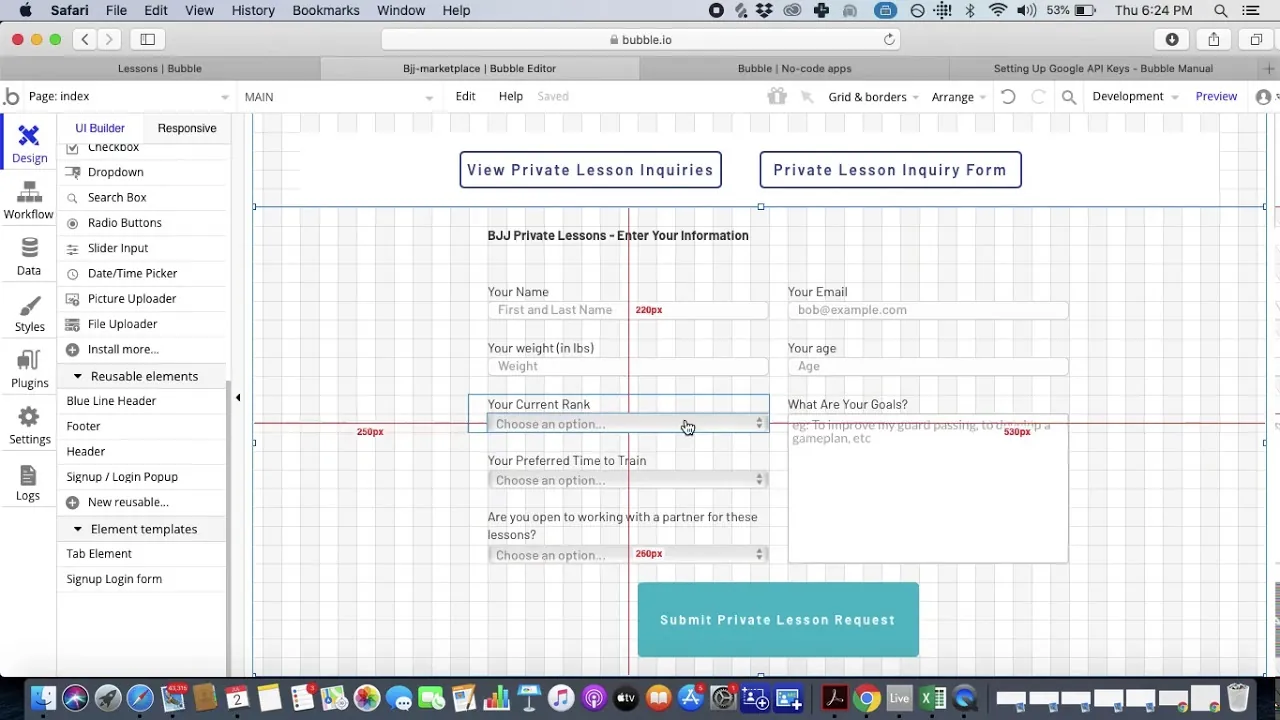
Bubble provides visual programming for web application modernization. However, several limitations affect its suitability for comprehensive legacy modernization.
Strengths:
- Visual programming without code
- Responsive web applications
- Plugin ecosystem
- Active community
Limitations:
- Pricing starts at $59/month with usage-based Workload Unit charges that create unpredictable costs
- Record limits on database storage
- Mobile solution is a web wrapper, not native—introducing performance challenges at scale
- One app version doesn't automatically update web, Android, and iOS deployments
- Extensive customization options often result in slower applications under increased load
- Claims of millions of MAU typically require hiring experts to optimize
- Limited app re-publishing on lower tiers
In contrast, Adalo's web and true-native mobile builder starts at $36/month with unlimited usage, no record caps, and seamless app store publishing with unlimited updates.
10. Salesforce Platform: CRM-Centric Modernization
Salesforce Platform (formerly Force.com) excels at CRM-related modernization with its extensive ecosystem and AppExchange marketplace. Best suited for customer-facing application transformation.
Key Features:
- Lightning components
- Apex programming language
- Extensive AppExchange marketplace
- Enterprise-grade security
Pricing: Starts at $25/user/month; Platform Plus at $100/user/month with additional costs for advanced features.
Additional Platform Considerations
FlutterFlow is a low-code platform for technical users, not a true no-code solution. Users must manage and set up their own separate database, requiring significant learning complexity—especially when optimizing for scale. Suboptimal setup creates scalability problems, spawning an ecosystem of experts because many users need help and spend significant sums chasing performance. The builder limits view to 2 screens at once (Adalo displays up to 400 screens on one canvas). Pricing starts at $70/month per user for app store publishing, but still doesn't include a database—users must source, set up, and pay for that separately.
Glide is heavily format-focused and restricted to set templates. This makes it fast to build and publish, but creates generic, simplistic apps with limited creative freedom. While Glide excels at spreadsheet-based apps, Adalo's SheetBridge offers similar convenience by turning Google Sheets into actual databases. Glide pricing starts at $60/month for custom domain publishing but remains limited by app updates and data record rows that attract additional charges. Glide does not support Apple App Store or Google Play Store publishing.
Softr pricing starts from $167/month to publish a Progressive Web App, still restricted by records per app and records per datasource. Softr does not support native iOS and Android app creation or app store publishing.
Thunkable offers AI-drafted app builds, but accessing a publishable Progressive Web App requires a $59/month plan with usage restrictions. Responsive apps require custom pricing beyond the advertised $189/month Advanced tier.
Why Adalo Leads for Rapid Modernization
Adalo is a no-code app builder for database-driven web apps and native iOS and Android apps—one version across all three platforms, published to the Apple App Store and Google Play. Adalo's dominance in rapid legacy modernization stems from several unique advantages. The platform's mobile-first architecture ensures every feature optimizes for modern user experiences, unlike competitors retrofitting enterprise platforms for mobile use. Over 3 million apps have been created on Adalo, processing 20 million+ data requests daily with 99%+ uptime.
The external collections feature particularly shines for legacy modernization, enabling seamless connections to existing databases while building modern interfaces. This approach aligns with AWS's 7 R's migration strategy: Retire, Retain, Rehost, Relocate, Repurchase, Replatform, and Refactor/Re-architect. Research by Datafloq confirms that incremental approaches reduce risk while delivering faster value.
The Adalo 3.0 infrastructure overhaul means the platform now scales to serve apps with 1 million+ monthly active users, with no upper ceiling. Unlike app wrappers that hit speed constraints under load, Adalo's purpose-built architecture maintains performance at scale. With the right data relationship setups, apps can scale beyond 1 million MAU without the expert consultants other platforms require.
Real success stories validate Adalo's effectiveness:
- Covenant Connect modernized school operations with impressive results
- Scholarcash built a scholarship finder app in one week, reaching 20,000+ downloads
- Counselora reduced development time from months to weeks, serving 750+ counselors
- Quero Vender transformed their business model with a mobile marketplace
The Made in Adalo showcase features hundreds more success stories across industries, from fitness apps to restaurant solutions, church applications, and real estate platforms.
Implementation Strategies for Successful Modernization
Successful legacy transformation requires strategic planning aligned with proven methodologies. AWS's 7 R's strategy provides a framework: Retire, Retain, Rehost, Relocate, Repurchase, Replatform, and Refactor/Re-architect. Organizations achieving higher success rates create clear transformation roadmaps while implementing phased approaches starting with non-critical systems. Stromasys research outlines eight modernization approaches for 2026.
Best practices for Adalo implementation:
- Start with app templates to accelerate development, including feature templates
- Leverage external collections for gradual migration
- Use Xano integration for scalable backend infrastructure
- Implement custom actions for complex business logic
- Follow performance optimization guidelines
- Utilize cloneable kits for common functionality
The shift toward composable architecture enables organizations to modernize incrementally, with 70% of large enterprises incorporating composability in approval processes according to Boomi's research. This approach aligns perfectly with Adalo's modular component system and API-first architecture. DronaHQ analysis confirms that low-code platforms reduce modernization complexity by 75%.
Cost Comparison and ROI Analysis
Legacy modernization costs vary dramatically across platforms. Traditional development averages $100,000-500,000 for enterprise applications, while AI-assisted platforms reduce costs by 65% on average. Tadabase statistics show that 84% of enterprises use low-code to reduce strain on IT resources.
Adalo's transparent pricing model eliminates surprise costs common with enterprise platforms. Unlike per-user licensing that penalizes growth, Adalo's app-based pricing enables unlimited users without additional fees. App Actions (usage-based charges) have been removed from all Adalo plans—all plans now have unlimited usage, meaning no bill shock. This proves particularly valuable for customer-facing applications where user-based pricing becomes prohibitive.
| Platform | Starting Price | Database Limits | Native Mobile | Usage Charges |
|---|---|---|---|---|
| Adalo | $36/month | Unlimited on paid plans | Yes (iOS & Android) | None |
| Bubble | $59/month | Record limits apply | Web wrapper only | Workload Units |
| Glide | $60/month | Row limits apply | No app store publishing | Update limits |
| FlutterFlow | $70/month/user | Separate DB required | Yes | Database costs extra |
| Softr | $167/month | Record limits apply | No | Datasource limits |
Research indicates organizations achieve average ROI of 228% over three years from modernization, with payback periods typically under 2.5 years. Adalo's rapid deployment capabilities often accelerate these timelines, enabling faster value realization. CodeConductor analysis projects the no-code market reaching $187 billion by 2030.
Future Trends Shaping Modernization Strategies
The modernization landscape continues evolving rapidly. Deloitte's Tech Trends 2026 identifies AI becoming "invisible infrastructure" enabling modernize-in-place strategies. McKinsey research highlights 13 frontier technologies with AI as the primary catalyst for transformation.
Key trends for 2026:
- Cloud-native architectures with 95% of new digital workloads on cloud-native platforms by 2026
- Microservices adoption enabling better scalability
- API-first approaches supporting composable enterprises
- Low-code market reaching $50 billion by 2028
- AI-assisted development becoming standard, as discussed in Adalo's AI features
Modlogix identifies 10 application modernization trends shaping digital transformation in 2026. Acropolium research highlights containerization and serverless computing as key enablers. TkXel analysis emphasizes the importance of API-led connectivity.
Adalo continues to enhance its platform with AI Builder for prompt-based app creation and editing due in early 2026, positioning itself strategically for these emerging trends. The focus on accessibility ensures organizations can leverage these advances without extensive technical expertise. Adalo's roadmap aligns with industry trends toward democratized development.
Making the Right Modernization Choice
Selecting the ideal legacy modernization tool depends on your specific requirements, technical expertise, and transformation goals. Adalo emerges as the clear winner for organizations prioritizing rapid deployment, cost efficiency, and mobile-first experiences. The platform's proven track record with 2× faster go-live cycles makes it compelling for businesses seeking immediate modernization impact.
Note that most third-party platform ratings and comparisons predate the Adalo 3.0 infrastructure overhaul launched in late 2025—the platform's performance, scalability, and capabilities have improved substantially since those assessments.
For teams ready to escape the legacy system trap consuming 60-80% of IT budgets, Adalo provides the optimal balance of power and simplicity. Whether you're building for startups, agencies, or enterprise organizations, Adalo offers the tools and support needed for successful transformation.
Start building your modernized applications today with Adalo's free plan and join thousands of successful organizations who've transformed their legacy systems into modern, efficient applications.
FAQ
Why choose Adalo over other app building solutions?
Adalo is an AI-powered app builder that creates true native iOS and Android apps from a single codebase. Unlike web wrappers, it compiles to native code and publishes directly to both the Apple App Store and Google Play Store—the hardest part of launching an app handled automatically. Paid plans include unlimited database records and no usage-based charges.
What's the fastest way to build and publish an app to the App Store?
Adalo's drag-and-drop interface combined with AI-assisted building through Magic Start and Magic Add enables rapid app creation. The platform handles the entire App Store submission process, letting you go from idea to published app faster than traditional development or platforms requiring separate database setup.
Which is more affordable, Adalo or Bubble?
Adalo starts at $36/month with unlimited usage and no record limits on paid plans. Bubble starts at $59/month with Workload Unit charges that create unpredictable costs, plus record limits on database storage. Adalo's transparent pricing eliminates bill shock.
Which is easier for beginners, Adalo or FlutterFlow?
Adalo is significantly easier—it's a true no-code platform described as "easy as PowerPoint." FlutterFlow is low-code for technical users who must also set up and manage their own separate database. Adalo includes an integrated database with no additional setup required.
Is Adalo better than Glide for mobile apps?
Yes, for native mobile apps. Adalo publishes true native iOS and Android apps to the App Store and Play Store. Glide does not support app store publishing and creates template-restricted apps with limited creative freedom. Adalo offers full design flexibility with unlimited app updates.
Can I modernize legacy systems without coding?
Yes. Adalo's external collections feature connects seamlessly to existing databases via REST APIs, while CSV import handles up to 10,000 records per batch for data migration. DreamFactory integration enables API creation for systems lacking native connectivity—all without writing code.
How much does legacy system modernization cost with Adalo?
Adalo reduces development costs by 65% on average compared to traditional development ($100,000-500,000 for enterprise applications). Pricing starts free for building and testing, with paid plans from $36/month including unlimited database records and no usage charges.
Can Adalo apps scale to handle large user bases?
Yes. Adalo 3.0's modular infrastructure scales to serve apps with 1 million+ monthly active users, with no upper ceiling. The platform is 3-4× faster than before, and with proper data relationship setups, apps can scale beyond 1 million MAU without requiring expert consultants.
What integrations does Adalo support for connecting to existing systems?
Adalo connects to Airtable, Xano, Firebase, Google Sheets, and any REST API-compatible database. Zapier integration connects to 5,000+ services. SheetBridge turns Google Sheets into actual databases, and DreamFactory enables API creation for legacy systems lacking native connectivity.
Can I migrate from Bubble to Adalo?
Yes. Adalo's external collections and CSV import capabilities enable data migration from other platforms. The visual builder makes recreating app logic straightforward, and you gain native mobile app publishing, unlimited database records, and predictable pricing without workload charges.