7 Top UI Bakery Alternatives for 2026: Pricing and Ideal Users✨
UI Bakery is a capable low-code app builder for medium-sized businesses and enterprises. But if it's not the right fit for your needs, several alternatives offer different strengths: Adalo for AI-assisted building and native mobile apps, Glide for spreadsheet-based simplicity, and Softr for rapid web app development.
This guide covers:
- Why look for a UI Bakery competitor
- How I chose the alternatives
- My 7 UI Bakery alternatives
- How to select the best platform for you
Independent research from App Builder Guides' State of App Building report (February 2026) analyzed 190 Reddit threads and 150+ platform citations across 345 data points with zero platform sponsorships. Adalo ranked first among visual builders for non-developers.
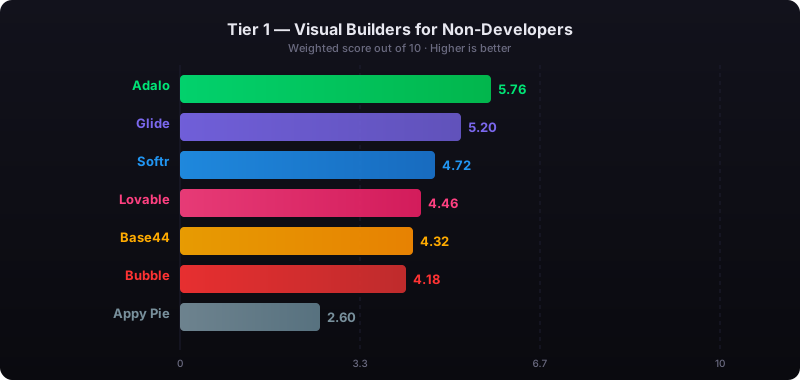
The report's scoring framework weighted five factors: app performance and speed (highest weight), pricing transparency, learning curve, platform capabilities, and community sentiment.
7 UI Bakery Alternatives
- Adalo, the best overall platform
- Glide, for spreadsheet-based apps
- Softr, for rapid web app building
- GoodBarber, for eCommerce apps
- Backendless, for techies
- Bubble, featuring the most customization
- Bravo Studio, the go-to for designers
Let's explore why many folks seek out UI Bakery alternatives.
Reasons for Getting a UI Bakery Alternative
If you're a growing medium-sized business, a large organization, or an enterprise, you might find that UI Bakery has all the functions and features you need to build a robust app.
Yet, UI Bakery comes with the following drawbacks:
- Pricing can add up: While it has a great free version, your final monthly bill can get very expensive. UI Bakery charges both per developer and per logged-in app user. So, if you have 2 or 3 developers and a team of 6 who sign onto your app for use, your monthly pricing could exceed $100.
- It's not suited for smaller businesses: UI Bakery provides fantastic features for larger organizations. For instance, you can run your app on your servers, allowing for easy scaling, better security, and much more. Yet, many organizations don't have their own IT room or server closet, so these enterprise perks just don't apply.
- Internal business tools only: Want to build an app to book appointments for your barbershop or let customers order coffee online? UI Bakery isn't set up for building external, client-facing apps, so you'll need to look elsewhere.
- Need for technical skills: UI Bakery is a low-code platform, which means you'll need to know how to develop database schema, understand how APIs work, know how JSON works, and more. Don't know anything about tech? You'll most likely get frustrated and want to seek an alternative.
How I Compared UI Bakery Alternatives
Today, there are loads of mobile app development platforms. To ensure you pick the perfect app builder, consider the following:
- No-code ease: Because UI Bakery is low-code, it's inaccessible to non-techies. So, I prioritized no-code UI Bakery alternatives. These app builders don't require any previous technical knowledge or programming skills. While some have steeper learning curves, you can still use the platform without outside-the-platform's-ecosystem research.
- Loads of templates: Many people don't want to start their app building from a completely blank slate because doing so prolongs the process. So, I ensured that each UI Bakery alternative has enough app templates for various industries that you can reconfigure to your tastes.
- Free version or trial, no credit card needed: There's nothing more irritating than a limited-time free version that requires credit card information. I made it a point to ensure that each free version or free trial doesn't make you open up your wallet so you can test out each platform irritation-free.
7 UI Bakery Alternatives for 2026
#1) Adalo, the Best Overall Platform
Advantages Over UI Bakery
There's a reason Adalo is the best overall alternative to UI Bakery: Adalo is a no-code app builder for database-driven web apps and native iOS and Android apps—one version across all three platforms. AI-assisted building and streamlined publishing enable launch to the Apple App Store and Google Play in days rather than months.
Ada, Adalo's AI builder, lets you describe what you want and generates your app. Magic Start creates complete app foundations from a description. Magic Add adds features through natural language. X-Ray identifies performance issues before they affect users.
Adalo 3.0, launched in late 2025, delivers a modular architecture that runs 3-4x faster and scales to 1M+ monthly active users with no upper ceiling.
The platform's visual builder has been described as "easy as PowerPoint," making it accessible to complete beginners while still offering the depth that experienced builders need. Magic Start generates complete app foundations from simple descriptions—tell it you need a booking app for a dog grooming business, and it creates your database structure, screens, and user flows automatically.
Adalo provides enough design freedom to customize your app to your precise needs and lets you publish on the web, Apple App Store, and Google Play Store so that you can reach an enormous swath of potential users.
Ideal Users
Adalo is the platform I've recommended the most to individuals, entrepreneurs, freelancers, and small and medium-sized businesses. It perfectly balances simplicity and power to bring any app idea to life, whether it's client-facing or internal business. Over 3 million apps have been created on the platform, processing 20 million+ data requests daily with 99%+ uptime.
Pricing
Start using Adalo for $36/month (billed monthly). All paid plans include unlimited database records and no usage-based charges—meaning no surprise bills as your app grows. This is notably more affordable than alternatives like Bubble ($59/month with Workload usage limits) or Glide ($60/month with record restrictions).
The Bottom Line
Adalo is the best choice for anyone who wants to build an app and publish it to app stores. It features around 40 templates and thousands of integrations with tools like Zapier, Google Drive, QuickBooks, and more. The platform's modular infrastructure scales to serve apps with millions of MAU, with no upper ceiling.
#2) Glide, for Spreadsheet-Based Apps
Advantages Over UI Bakery
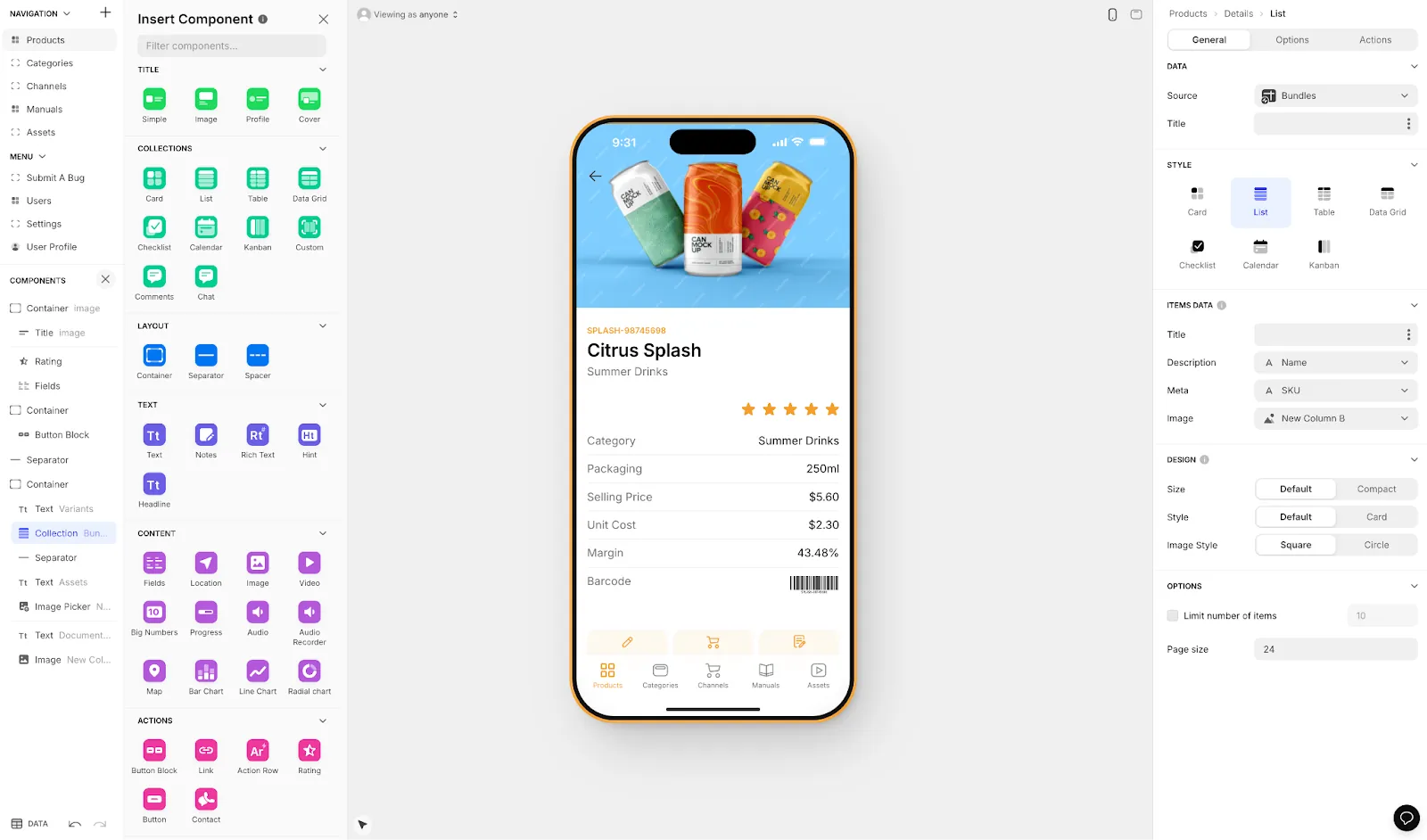
Glide is a no-code platform that excels at turning spreadsheets into functional apps quickly. It provides a heavily template-focused approach with pre-built formats that make initial setup fast and straightforward.
Ideal Users
Glide works best for teams that already have their data in spreadsheets and want to create simple internal tools. The platform prioritizes speed over customization—you'll get a working app quickly, but with limited creative freedom compared to more flexible builders. If your needs fit within Glide's template structures, it can be an efficient choice.
Pricing
Get started for $60/month (billed monthly) to build apps with a custom domain. However, this tier is still limited by app updates and data record rows, which attract additional charges as you scale. If you need to create unlimited apps, try Glide's $249/month (billed monthly) version.
Important limitation: Glide does not support Apple App Store or Google Play Store publishing. Your apps remain web-only, which limits your reach compared to platforms that offer native mobile deployment.
The Bottom Line
Glide is a solid UI Bakery alternative for spreadsheet-based internal tools where template restrictions aren't a concern. However, if you need native mobile apps or more design flexibility, consider alternatives like Adalo that offer both spreadsheet integration (via SheetBridge) and full app store publishing.
#3) Softr, for Rapid Web App Building
Advantages Over UI Bakery
Do you need to create an internal business app from one of your databases but lack the technical skills or expertise to use low-code? Softr provides a super-easy and quick building interface that lets you construct your app by sliding around blocks with your mouse.
Ideal Users
Softr has plans for businesses that need to create internal apps or tools. While you'll need to bring your own database, as Softr is only a frontend builder, the platform integrates with database tools like Airtable, Google Sheets, Xano, and others.
Pricing
Softr's pricing starts from $167/month to publish an actual Progressive Web App, which is still restricted by records per app and records per datasource. Lower tiers exist but with significant limitations on functionality.
Critical limitation: Softr does not support Apple App Store and Google Play Store publishing, or iOS and Android app creation. If you need native mobile apps, you'll need to look elsewhere.
The Bottom Line
Softr is a UI Bakery alternative for transforming databases into web apps with payment integrations and graphic displays like Gantt charts and Kanban boards. However, the higher price point and web-only restriction make it less versatile than platforms offering native mobile deployment at lower costs.
#4) GoodBarber, for eCommerce Apps
Advantages Over UI Bakery
Unlike UI Bakery, GoodBarber is tailored to the needs of people selling their products or content online. You'll find no shortage of templates for various businesses, such as niche shops, e-book sellers, retailers, and more.
Ideal Users
If you need an e-commerce app to sell nearly anything, GoodBarber is an option worth considering. While it doesn't allow for as much customization as Adalo or Bubble, you'll still be able to get your goods in front of an audience quickly.
Pricing
GoodBarber's content plan starts at $36/month (billed monthly). It allows your clients to sign in so they can read or watch your content right from a PWA that they download to their phone from a link. If you want to publish to the Apple App Store and Google Play Store, go for the $70/month (billed monthly) tier.
The $50/month (billed monthly) version is aimed at folks selling physical goods. It conveniently provides integrations with payment platforms like Stripe, Apple Pay, and more. Publishing on the Apple App Store and the Google Play Store will cost $90/month (billed monthly).
The Bottom Line
GoodBarber is a solid no-code UI Bakery alternative for folks who want to add another revenue stream by sending their brick-and-mortar operation to the web.
#5) Backendless, for Techies
Advantages Over UI Bakery
Backendless is a low-code platform that's excellent for techies and people with computer knowledge seeking a UI Bakery alternative. It's flexible enough to create nearly any app, from an involved CRM tool with a customer portal to a simple scheduling app for your personal trainer business.
Ideal Users
Backendless has plans that appeal to small startups and multinationals, but you and your team will need to know the essential technical skills required to use UI Bakery for Backendless to make sense.
Pricing
The $15/month (billed monthly) tier lets you store a staggering 1 million database objects. For $10/month, you can add individual features, such as 100,000 extra push notifications.
If you have your own servers, check out Backendless's enterprise on-prem plans starting at $7,200/year. Running your app on your own server gives you control over scalability and architecture and keeps your IT team happy.
The Bottom Line
For folks looking for a low-code platform similar to UI Bakery when it comes to marking up database schema and customizing backend logic, but need a simpler frontend builder, check out Backendless.
#6) Bubble, Featuring the Most Customization
Advantages Over UI Bakery
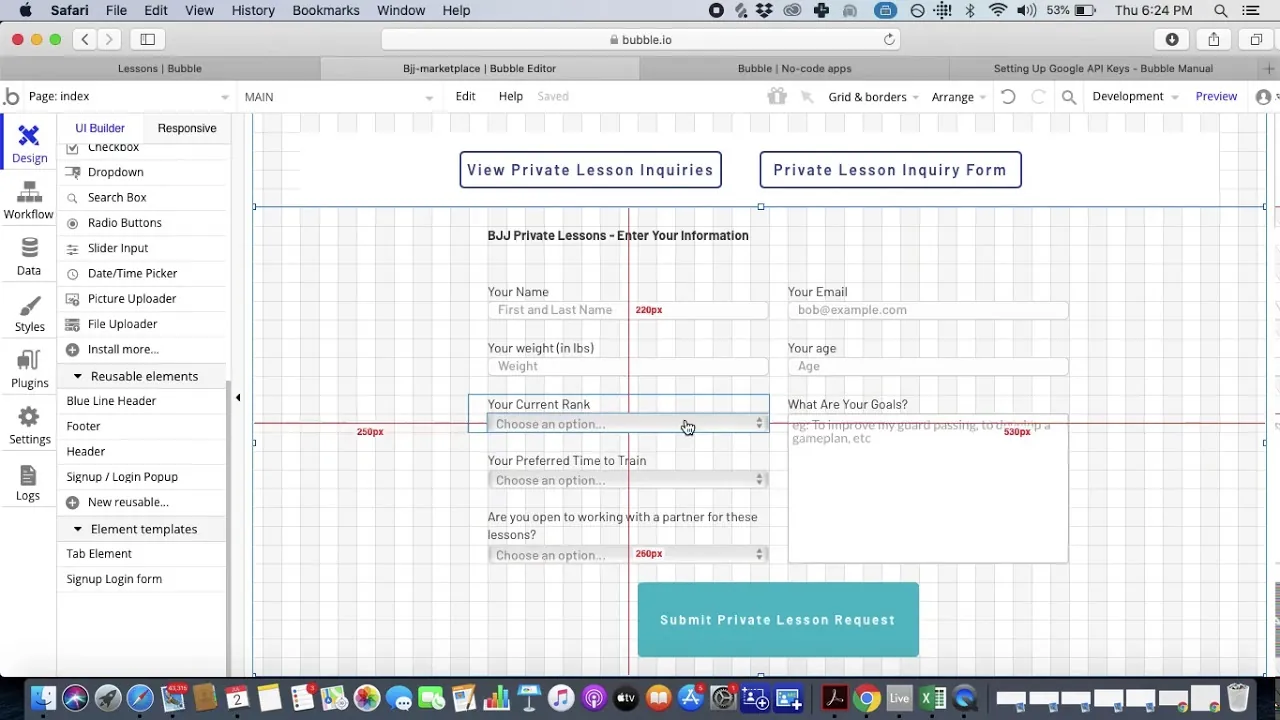
Bubble is a no-code web app builder that offers a significant amount of customization flexibility. You can create nearly any web app with almost any functionality you wish. However, you'll need to overcome Bubble's difficult learning curve, which may take a few months of dedicated practice.
Ideal Users
No matter what industry you're in or the size of your organization, you can build an app for it using Bubble. The platform appeals to anyone willing to invest the time to learn the complex building interface.
Pricing
Bubble's web and mobile wrapper offering starts at $59/month with usage-based charges through Workload Units. These usage limits can create unpredictable billing as your app scales, and the calculations aren't always transparent. Higher tiers at $134/month (billed monthly) provide more capacity but still operate on the same usage-based model.
Important considerations: Bubble's mobile app solution is a wrapper for the web app, which can introduce performance challenges at scale. This also means that one app version doesn't automatically update web, Android, and iOS apps deployed to their respective app stores—you're managing multiple deployments. Claims of millions of MAU on Bubble are typically only achievable with hired expert help and significant optimization work.
The Bottom Line
While the platform takes time to learn, Bubble's been around since 2012 and has developed a thriving ecosystem packed with classes, videos, help documents, and experts for hire. It's the UI Bakery alternative with the most abundant learning resources—though that ecosystem exists partly because so many users need help navigating the platform's complexity. If you prioritize maximum customization over ease of use and predictable pricing, Bubble is worth considering.
#7) Bravo Studio, the Go-to For Designers
Advantages Over UI Bakery
Bravo Studio is a unique, no-code native mobile app builder that appeals to Figma designers. It provides 100% pixel-perfect design freedom because you're in charge of how your templates appear—you'll make them with Figma and then transform them into an app with Bravo.
Ideal Users
If you want to use Bravo, you'll need to have experience creating designs with Figma. Bravo is essentially out of reach if you don't have any Figma experience, making it a specialized tool for a specific workflow.
Pricing
Bravo lets you build unlimited apps of up to 30 screens for $22/month (billed monthly) and charges an extra $55/month for email support. If you want to create white-label apps and get a live walkthrough of the platform, try the $99/month (billed monthly) version.
The Bottom Line
Try out Bravo Studio if you want to take your Figma designs to the next level and create visually stunning apps for your own use or for sale to other businesses and organizations.
Platform Comparison at a Glance
| Platform | Starting Price | Native Mobile Apps | App Store Publishing | Database Limits |
|---|---|---|---|---|
| Adalo | $36/month | Yes (true native) | Yes | Unlimited on paid plans |
| Glide | $60/month | No | No | Row limits apply |
| Softr | $167/month (PWA) | No | No | Record limits apply |
| GoodBarber | $36/month | Yes | Yes ($70+/month) | Varies by plan |
| Backendless | $15/month | Yes | Yes | 1M objects at base tier |
| Bubble | $59/month | Wrapper only | Yes | Workload limits |
| Bravo Studio | $22/month | Yes | Yes | Varies by plan |
Next Steps: Selecting the Perfect Platform
I recommend shortlisting 3 or 4 platforms that appeal to you most. Then, try out the free versions and note each platform's pros and cons. This will provide an excellent way to compare each one and ensure you don't forget anything.
If you're still wondering which platform would work best, give Adalo a shot. It's the UI Bakery alternative with a generous free version, allowing you to publish your app straight to the web so users can immediately try it out and provide feedback. When you go for a paid version, you can hit the ground running with unlimited database records, no usage-based charges, and the ability to release a robust, functional app to both the Apple App Store and Google Play Store.
FAQ
Why choose Adalo over other app building solutions?
Adalo is an AI-powered app builder that creates true native iOS and Android apps from a single codebase. Unlike web wrappers, it compiles to native code and publishes directly to both the Apple App Store and Google Play Store. With unlimited database records on paid plans and no usage-based charges, you get predictable pricing as your app scales.
What's the fastest way to build and publish an app to the App Store?
Adalo's drag-and-drop interface and AI-assisted building let you go from idea to published app in days rather than months. Magic Start generates complete app foundations from simple descriptions, and Adalo handles the complex App Store submission process so you can focus on your app's features instead of certificates and provisioning profiles.
Which is more affordable, Adalo or Bubble?
Adalo starts at $36/month with unlimited usage and database records. Bubble starts at $59/month but includes Workload Units that create usage-based charges, making costs less predictable as your app scales. Adalo also includes native mobile app publishing, while Bubble's mobile solution is a web wrapper.
Which is more affordable, Adalo or Glide?
Adalo starts at $36/month with unlimited database records and app store publishing. Glide starts at $60/month for custom domain apps but has record row limits and additional charges for scaling. Glide also doesn't support Apple App Store or Google Play Store publishing.
Which is easier for beginners, Adalo or Bubble?
Adalo is significantly easier for beginners. Its visual builder has been described as "easy as PowerPoint," and Magic Start can generate complete app foundations from simple descriptions. Bubble has a steep learning curve that typically takes months to master, and many users end up hiring experts for help.
Is Adalo better than Bubble for mobile apps?
Yes, for most use cases. Adalo creates true native iOS and Android apps that compile to native code. Bubble's mobile solution is a wrapper for web apps, which can introduce performance challenges at scale and requires managing multiple deployments for web and mobile versions.
Can I migrate from UI Bakery to Adalo?
Yes, you can rebuild your UI Bakery app in Adalo. While there's no direct import, Adalo's Magic Start can generate app foundations from descriptions of what you need, significantly speeding up the recreation process. Your data can be exported from UI Bakery and imported into Adalo's database.
What are the main drawbacks of UI Bakery that make people seek alternatives?
UI Bakery charges per developer and per logged-in user, making costs add up quickly. It's designed primarily for medium to large businesses with enterprise features that don't benefit smaller organizations. It only supports internal business tools rather than client-facing apps, and requires technical knowledge of database schemas, APIs, and JSON.
Can I build both web and mobile apps with Adalo?
Yes, Adalo lets you build and deploy your app across web, iOS, and Android platforms from a single project. One codebase automatically updates all three versions, unlike platforms where you manage separate deployments for each platform.
Does Adalo have database record limits?
No, all paid Adalo plans include unlimited database records. This is a significant advantage over platforms like Bubble (Workload limits), Glide (row limits), and Softr (record limits per app and datasource). With proper data relationship setups, Adalo apps can scale beyond 1 million monthly active users.