Using No-Code to Drive Your Career Forward: An Interview With Two Successful No-Code Product Founders
Visual development has transformed how entrepreneurs bring ideas to life. Instead of writing thousands of lines of code, founders now use drag-and-drop interfaces to build fully functional software. This shift has unlocked opportunities for people who previously couldn't afford developers or didn't have technical backgrounds.
Adalo, a no-code app builder for database-driven web apps and native iOS and Android apps—one version across all three platforms, published to the Apple App Store and Google Play, exemplifies this transformation. These visual development tools eliminate the need to hire developers, allowing anyone with an idea to bring their product to life.
As a prospective business owner, this is great news. It unlocks many more opportunities to build products without the constraints that existed before, especially for people looking to start a side hustle.
Stories from Entrepreneurs Who Built Without Code
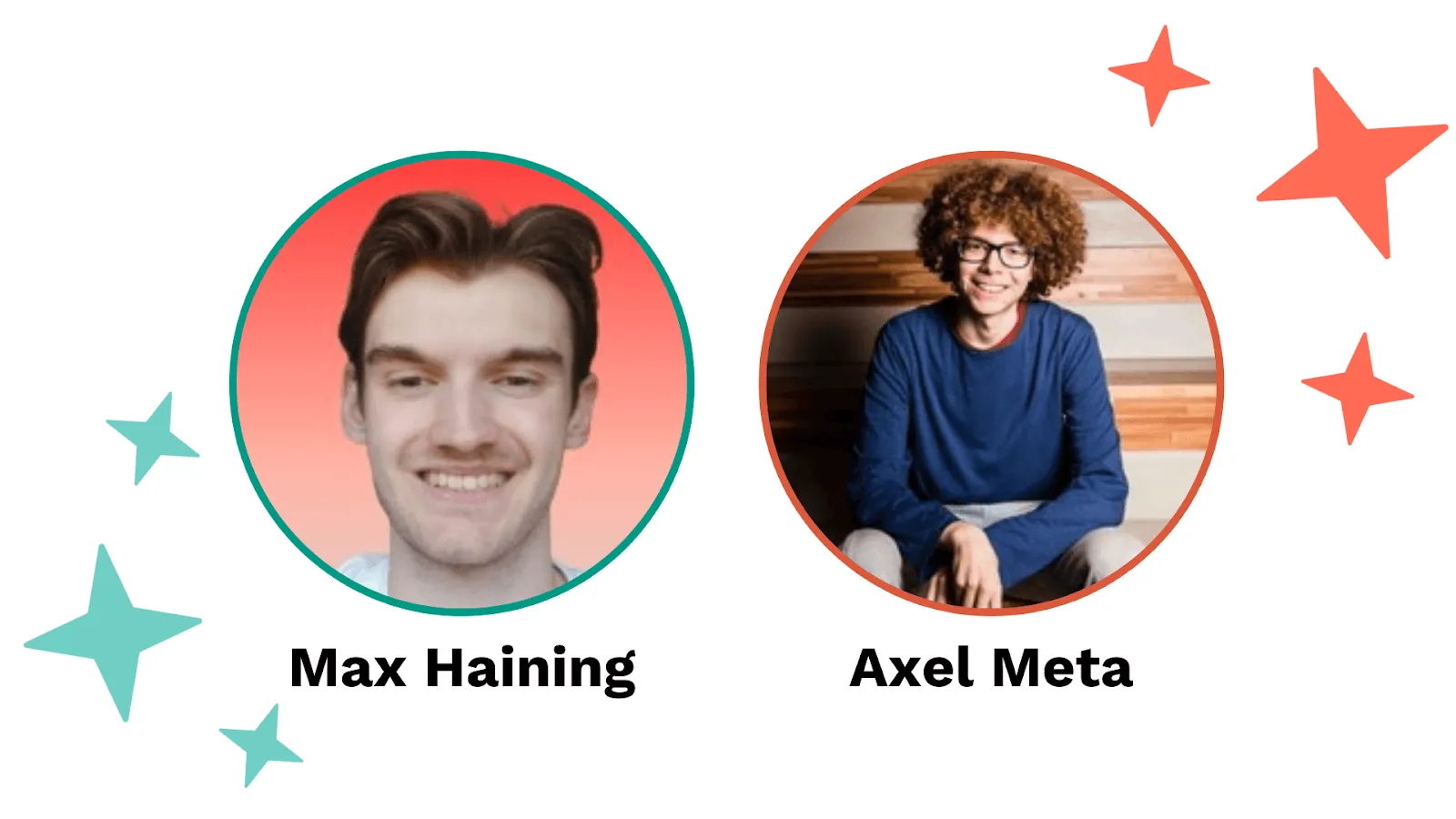
This article highlights the stories of two makers: Axel Meta and Max Haining. Their journeys illustrate how visual development tools have democratized software creation.
How I Started My Career
Axel Meta
I started my career as an actor for commercials when I was 14, then I got into apps and stayed in that sector since then. I love creating things—apps, software, acting, painting—and I also love learning about new things happening in the world like crypto and NFTs.
I went to college with the idea for an app, turned the idea into a real product and got hooked on the software world. I knew so little about technology that I didn't even know I could learn how to build it myself. I used the money I made as an actor to hire developers. I thought programming was wizardry and not something I could do.
Max Haining
I studied business and politics at university, before moving into the social impact space. I was always interested in how to blend tech and social impact, which is where visual development lands for me. It's a democratizing force that will give rise to a more diverse set of problem solvers and make our digital spaces more inclusive.
I first stumbled on the concept when I came across this article by Ryan Hoover: "The Rise of No-Code". Reading this was a turning point. It slowly dawned on me that I'd no longer be reliant on developers, my ideas would no longer get old in notebooks, and ultimately, I could bring my own ideas to life.

Taking a Risk After a Failed App Idea
Axel Meta
Once that app "failed" I thought I was not meant to be an entrepreneur but rather work for someone else. I moved to a company and soon after I started an internal project from scratch: an app (education content marketplace) for emerging countries which is installed in over 1 million phones now. I handled everything from product, content, design, partnerships—it was pretty much a one person show using any developer I could find available.
But a week before COVID started, I quit my job to start things on my own. I tried a bit with e-commerce and soon found visual development tools. It gave me the motivation I needed to build whatever I wanted without knowing how to code.
Max Haining
A year before I discovered these tools, a startup idea I attempted to build at university failed. It was an "AirBnb for storage" idea. I think it didn't take off, in part, due to the fact all our team including myself were non-technical. We couldn't iterate quickly enough to address feedback from our users.
This is exactly the problem that modern AI-powered app builders solve. With tools like Adalo, non-technical founders can now iterate in hours rather than weeks, responding to user feedback without waiting for developer availability.
Building Products with Visual Development Tools
Axel Meta
In the last year, I've built multiple apps and services, mostly with Adalo, Integromat, Airtable and more visual development tools.
A friend sent me a link to Glide. I started using it but was very limited by its features—Glide is heavily format-focused and restricted to set templates, which makes it fast to build but creates generic, simplistic apps with limited creative freedom. When I found out about Adalo I went all in.
My first app was very simple and I kept cold-emailing to sell the service. As I had more customers that started requesting more features, I started developing features for them. Some of the products I've built are subscription services for SMBs, an audio-to-text converter app with 150k downloads, and a feedback collector app for internal teams. It's been a lot of learning by doing, trying and failing.
Max Haining
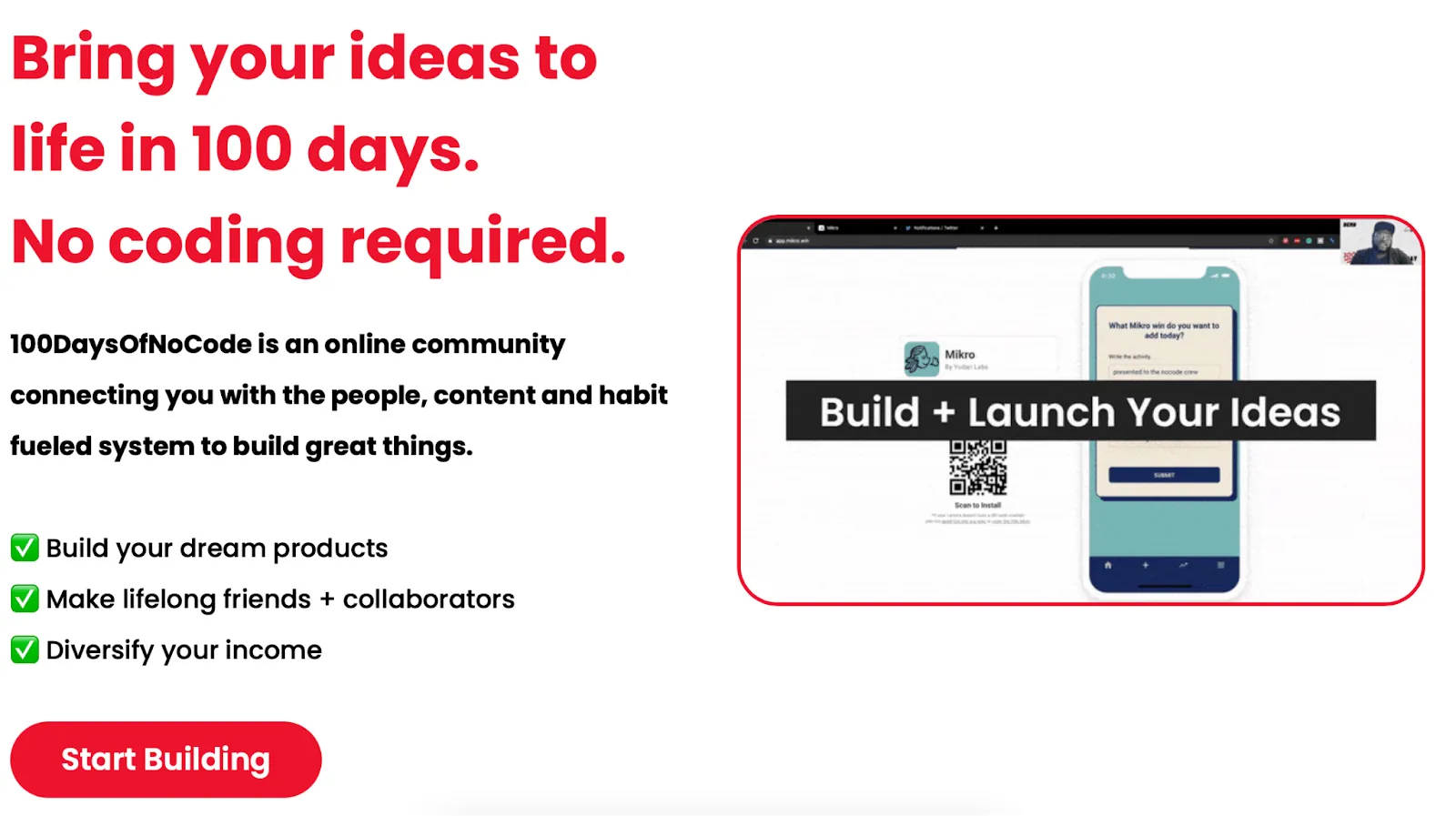
I built a platform and community called 100DaysOfNoCode. It's fully built with visual development tools and functions as a landing page, learning management platform, resource directory and member portal. 100DaysOfNoCode is a community to help creators, operators and entrepreneurs learn to build and bring their ideas to life.
Over 500 projects and businesses have been launched as part of the 100DaysOfNoCode community, which began only in March 2020.
How Did You Bring Your Idea to Life?
Max Haining
Here are the steps I normally take when starting out to build something:
1. Validate if the idea is a business.
One of the best ways to do this is research and see if there is something like it already. If so, that's good validation. Competitors = good. You can then research what they are or are not doing well.
2. Consider the actual business model.
At the highest level this is doing some financials, asking myself what would it take for this to get to a $10,000 business. Depending on your aspirations, try to model it, and try to ask questions like "How many users at $X would make this plausible?" Does this make financial sense? To go deeper here you can use the Lean Business Canvas and list out things like value propositions.
3. Think about what you want to achieve and whether this excites you or not.
I write these down on a Notion doc and use the concept of listing anti-goals here—for example, I built a newsletter that is automated, and one of my anti-goals was I didn't want to be curating it every day, that would be timely and painful.

4. What's your business' identity?
This is when I start to think about how I want this thing to look and feel. Is it fun, serious, socially responsible? Here you want to think about names, colours, assets. If you're definitely moving forward with the project, grab that domain.
5. Think about your architecture and start building!
What will the stack be, what have others used for similar use cases? As much as I'd like to build the rocketship, I think of ways that I can validate this as quickly as possible, to stop myself from building something nobody wants. This can be done by a simple landing page to gauge interest or building in public.
If you think you can build V1 quicker than you can validate it, start sketching down the user flows and understand the core feature set you need for it to work. Then pick your toolkit and start building.
Choosing the Right Platform for Your Business
Ada, Adalo's AI builder, lets you describe what you want and generates your app. Magic Start creates complete app foundations from a description, while Magic Add adds features through natural language.
When selecting a visual development platform, consider your long-term needs. Over 3 million apps have been created on Adalo, with users describing the visual builder as "easy as PowerPoint." The platform's AI features—including Magic Start for generating complete app foundations from descriptions and Magic Add for adding features through natural language—accelerate the building process significantly.
For entrepreneurs concerned about scaling, Adalo's modular infrastructure supports apps with over 1 million monthly active users, with no upper ceiling. Paid plans include unlimited database records and no usage-based charges, meaning no surprise bills as your user base grows. This predictable pricing model—starting at $36/month with unlimited usage—makes financial planning straightforward for bootstrapped founders.
Alternatives like Bubble offer more customization but often result in slower applications that struggle under increased load, frequently requiring hired experts to optimize. Bubble's mobile solution is also a web wrapper rather than true native, which can introduce performance challenges at scale. FlutterFlow targets technical users and requires managing a separate database, adding significant complexity.
What's Your Advice to Someone Thinking of Starting a Product Business?
Axel Meta
Pay attention to your database! Once you understand how a database looks (it's pretty much just cells with information and formulae), you will be able to use a tool like Adalo far more easily, because it's clear what you're doing and how you need to operationalize your idea.
For those who prefer working with spreadsheets, Adalo's SheetBridge feature lets you turn a Google Sheet into an actual database—the easiest path to app development without database-related learning curves.
Max Haining
Consistency is key when learning any new skill. Try not to put too much pressure on yourself to build something super complex. Start small and work your way up!
We hope this article sheds light on how visual development tools are democratizing creativity and providing new and exciting career growth opportunities for today's makers. The barrier between having an idea and launching a real product has never been lower.
FAQ
Why choose Adalo over other app building solutions?
Adalo is an AI-powered app builder that creates true native iOS and Android apps from a single codebase. Unlike web wrappers, it compiles to native code and publishes directly to both the Apple App Store and Google Play Store. With unlimited database records on paid plans and no usage-based charges, you get predictable pricing as your business scales.
What's the fastest way to build and publish an app to the App Store?
Adalo's drag-and-drop interface combined with AI-assisted building lets you go from idea to published app in days rather than months. Magic Start generates complete app foundations from simple descriptions, and Adalo handles the complex App Store submission process so you can focus on features and user experience.
Can I build a business app without programming experience?
Yes. With Adalo's visual drag-and-drop interface, you can create database-driven apps without writing code—just like the entrepreneurs featured in this article who built successful products including apps with 150,000+ downloads.
Do I need to understand databases to build an app?
Understanding databases helps significantly. As Axel Meta advises, once you understand that a database is essentially cells with information and formulas, tools like Adalo become much easier to use. For those who prefer spreadsheets, Adalo's SheetBridge lets you use Google Sheets as your database.
How much does it cost to build and launch an app?
Adalo's paid plans start at $36/month with unlimited usage and app store publishing. Unlike platforms with usage-based charges or record limits, you won't face surprise bills as your user base grows. Comparable alternatives like Bubble start at $59/month with usage restrictions.
What steps should I take before building my product?
Start by validating your idea through research—competitors signal good validation. Model your business financials, define your goals and anti-goals, establish your brand identity, and plan your architecture before building. Focus on validating quickly to avoid building something nobody wants.
What kinds of products have been built successfully with visual development tools?
Entrepreneurs have built subscription services for SMBs, audio-to-text converter apps with over 150,000 downloads, feedback collector apps, and learning platforms with member portals. The 100DaysOfNoCode community alone has launched over 500 projects and businesses.
How does Adalo compare to Glide for building apps?
Glide is heavily format-focused and restricted to set templates, making it fast but limiting creative freedom. It starts at $60/month with data record limits and doesn't support App Store or Play Store publishing. Adalo offers more design flexibility, unlimited records on paid plans, and native app publishing.
Can my app scale as my business grows?
Adalo's modular infrastructure scales to serve apps with over 1 million monthly active users, with no upper ceiling. The platform processes 20 million+ data requests daily with 99%+ uptime. Paid plans have no record limits, so your database can grow with your business.