Web Traffic to App Downloads: SEO-ASO Link
SEO and ASO are two sides of the same coin when it comes to growing app downloads. SEO drives users to your website through search engines like Google, while ASO converts those users into downloads once they reach the app store. Here's the key takeaway: 70% of mobile users discover apps through search, and 40% of users find apps via web searches before heading to app stores. By aligning SEO and ASO strategies, you can reduce acquisition costs and create a smooth path from search to download.
For app creators looking to capitalize on both SEO and ASO strategies, platforms like Adalo, a no-code app builder for database-driven web apps and native iOS and Android apps—one version across all three platforms, published to the Apple App Store and Google Play, make it easier to launch and optimize across channels. With a unified approach to building and publishing, you can focus on driving discovery through search while ensuring your app is ready for conversions in the store.
Key Points:
- SEO focuses on broad, problem-based queries (e.g., "how to track expenses").
- ASO targets specific, action-driven searches (e.g., "expense tracker app").
- Google indexes app store pages, so SEO-optimized landing pages can improve app store rankings.
- Strong web traffic signals (e.g., page views, time spent) boost app store algorithm performance.
- Tools like Google Analytics and Firebase can track web-to-app conversions.
By combining SEO and ASO, you can attract more users organically while lowering reliance on paid ads like Apple Search Ads or Meta Ads. The result? A cost-effective, data-driven strategy to grow your app downloads.
SEO for Mobile Apps: Driving Explosive Growth Beyond App Stores
How SEO and ASO Connect
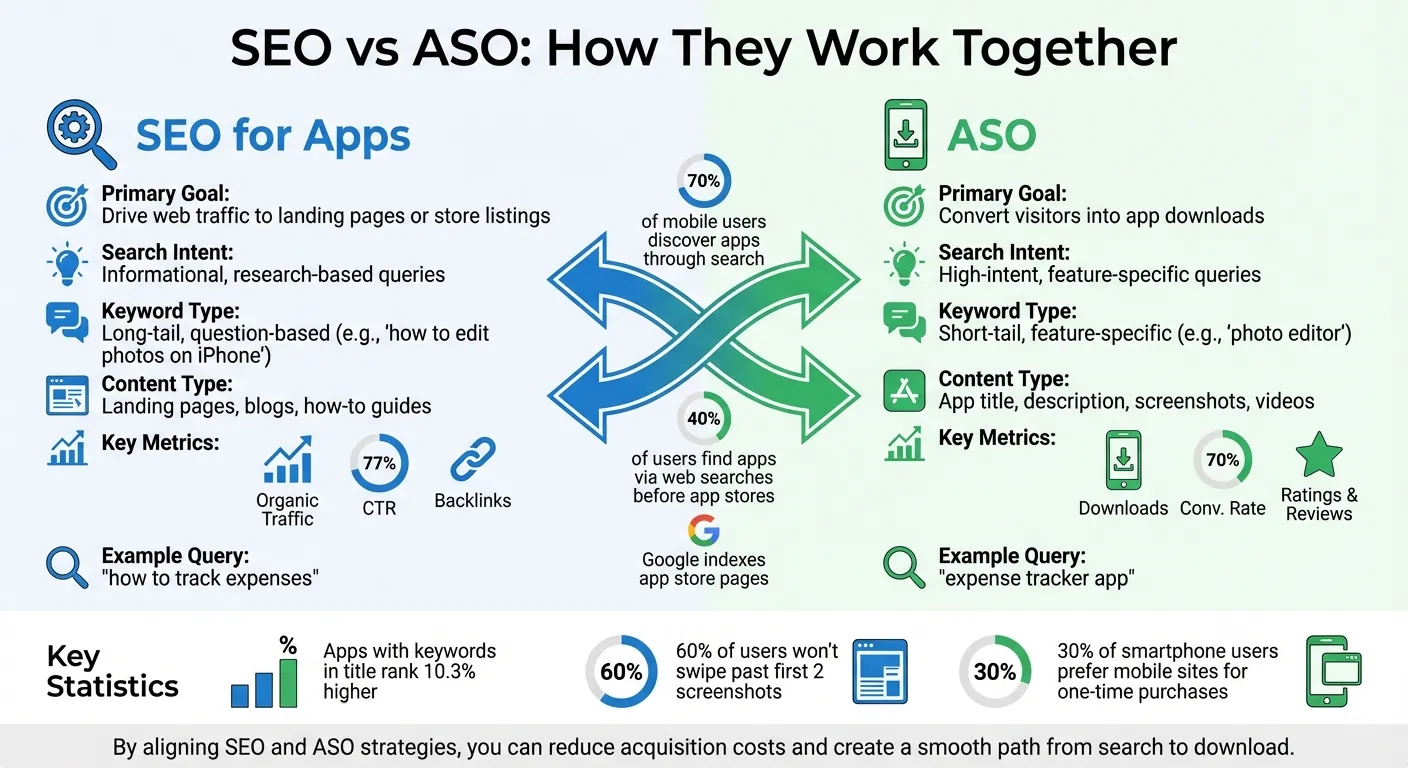
SEO vs ASO: Key Differences and How They Work Together for App Growth
What Is SEO and How Does It Drive Web Traffic?
SEO (Search Engine Optimization) is all about optimizing web content to rank higher on search engines like Google and Bing. For apps, this means creating landing pages, blogs, and other content that answers user questions. Think of searches like "how to track expenses" or "best fitness app"—these are opportunities to capture potential users during their research phase.
The goal? Attract users before they've decided on a specific app. SEO gives you room to explain features in detail, share tutorials, and establish trust. Once users are hooked, clear calls-to-action can guide them to the app store. This sets the stage for ASO to take over and turn interest into downloads.
What Is ASO and Its Role in App Downloads?
ASO (App Store Optimization) focuses on optimizing your app's listing—title, subtitle, description, keywords, and visuals—to encourage downloads. It's not just about being found; it's about making users want to click "install".
"ASO is not just about discoverability. It's more like a sales pitch and how creative you're in doing it will invariably affect the number of users who click, install, and try your app." - Peter Kua, Author, MobileApps.com
ASO targets users who are already looking for specific features or solutions. For example, apps with keywords in their title tend to rank 10.3% higher than those without. Visuals are equally important—60% of users won't swipe past the first two screenshots. This makes those initial images and descriptions critical for making a strong first impression.
How SEO and ASO Work Together
SEO and ASO complement each other: SEO drives users to your web presence, while ASO converts those visits into downloads. The keyword strategies for each are different but interconnected. SEO focuses on long-tail, question-based queries like "how to edit photos on iPhone", while ASO zeroes in on short-tail, feature-specific keywords like "photo editor".
Interestingly, search engines also index app store pages. This means ASO-optimized titles and descriptions can enhance your web ranking, creating a seamless flow from a user's search query to the app store. Additionally, app indexing through tools like Firebase allows Google to either open your app directly (if installed) or send users to the store listing. This connection between SEO and ASO is key to turning casual web searches into actual app downloads.
| Factor | SEO for Apps | ASO |
|---|---|---|
| Primary Goal | Drive web traffic to landing pages or store listings | Convert visitors into app downloads |
| Search Intent | Informational, research-based queries | High-intent, feature-specific queries |
| Content Type | Landing pages, blogs, how-to guides | App title, description, screenshots, videos |
| Key Metrics | Organic traffic, click-through rate, backlinks | Downloads, conversion rate, ratings and reviews |
Driving Web Traffic to App Landing Pages
Your landing page is where interest turns into action. With 40% of global users discovering apps through search engines like Google and Bing, it plays a pivotal role in converting web traffic into app downloads.
Creating Mobile-First App Landing Pages
Make it easy for users to download your app by placing download buttons prominently at the top of the page. Use direct, clear calls-to-action like "Download the App." Considering that 30% of smartphone users prefer mobile sites for one-time purchases, your landing page must load in under two seconds and display seamlessly on mobile devices.
For desktop visitors, include a QR code that links directly to the app store. Additionally, tools like Smart App Banners for iOS or Web App Install prompts for Android can gently guide mobile site users toward downloading your app.
Using App-Specific Keywords in Web Content
Your web copy should mirror the keywords used in your app store listings. Combine long-tail phrases like "how to track business expenses" with short, feature-focused terms like "expense tracker" to create a seamless transition for users.
A great example of this is Adidas' Q4 2026 campaign, which integrated app deep links into Search and Performance Max ads. Led by Micah Charleston, Senior Manager of Paid Search & Feeds, the campaign delivered a 2.4x higher return on ad spend from app users compared to mobile web users, with 8% of deep link traffic going directly to the app. By aligning web keywords with in-app benefits, they created a smooth path from search to download.
Tracking User Intent Through Analytics
To refine your strategy, use tools like Google Analytics 4 and Google Search Console to track which keywords bring visitors to your landing page and how many of them click through to the app store. Focus on metrics like organic traffic, click-through rates, and conversion rates to pinpoint what's working.
Take inspiration from AirAsia MOVE, which leveraged AppsFlyer's Smart Banners and deep linking to track web-to-app migrations. Their efforts, led by Growth & Digital Marketing Manager Yen Huan Tai, resulted in a 19% increase in flight booking rates compared to organic benchmarks and a 5% boost in app installs.
"With AppsFlyer's Smart Banners, we no longer have to wonder if our web traffic is converting to app users. The ability to measure migrated users from web to app has been a game-changer for us." - Yen Huan Tai, Growth & Digital Marketing Manager, AirAsia MOVE
Optimizing App Store Listings for SEO-Driven Traffic
When users move from your landing page to the app store, you only have a few seconds to turn their curiosity into action. Your app store listing must deliver on the promises made on your website. This smooth handoff between web content and app store presentation is critical for keeping conversion rates high.
Aligning Web Content and App Store Metadata
Consistency is key when it comes to messaging. The language and tone on your landing page should match what users see on your app store listing. For example, if your website emphasizes a "budget planner" feature, that exact phrase should be prominent in your app's title or subtitle on the app store. This not only reassures users but also improves keyword rankings.
The way keywords work differs between platforms. Apple's App Store uses a hidden 100-character keyword field and doesn't index the app description for search purposes—it's there purely to convert visitors. Google Play, on the other hand, indexes the entire description, so repeating important keywords 2–3 times can improve visibility. For Google Play, focus on the first 167 characters of your description, as this is what users see before clicking "read more".
"The top position is like having a restaurant right in the middle of the busiest street in town... the fifth page of the search result is the hidden alley tucked away in the shadows." - AppsFlyer ASO Guide
Using Screenshots and Videos to Improve Conversions
Visuals play a huge role in convincing users to download your app. Research shows that 60% of users won't swipe past the first two images in your app store gallery. This means your first screenshot needs to highlight the feature you emphasized on your landing page. This alignment reinforces the SEO-ASO connection.
Adding short text overlays to your screenshots can help users quickly understand your app's features. For example, Duolingo saw a 40% increase in App Store conversions in 2026 by aligning its visuals with high-intent keywords, which contributed to an estimated 2.3 million additional downloads per month.
Preview videos can also boost conversions, but their impact depends on execution. While only 7% of users watch a full video, the poster frame—the static image displayed before the video plays—gets seen by almost everyone. Make that frame as eye-catching as your top screenshot. Keep videos short (15–30 seconds) and put your most compelling features in the first five seconds.
Using Reviews and Ratings to Build Trust
Social proof is another critical factor. A high star rating—ideally 4.4 stars or higher—signals quality and builds trust. Encourage users to leave reviews right after they experience a key feature, and make sure to respond to negative feedback promptly. This not only shows you care but can also improve your app's credibility.
You can also showcase positive reviews and high ratings on your landing page to create a "trust bridge" for users heading to the app store. When they see consistent quality across your website and app store listing, they're more likely to download.
"ASO isn't something you do once and forget. It's an ongoing process. Keeping your listing fresh—guided by data and trends—helps maintain your position where it counts." - Romina, SEO Sherpa
Measuring the Success of SEO-ASO Efforts
When combining your web and app store strategies, keeping a close eye on performance is essential. Tracking the right metrics ensures you're making progress and highlights areas that need improvement.
Key Metrics to Track
Start with SEO metrics like impressions, clicks, and click-through rates (CTR) to understand how many visitors are reaching your app store listing. On the app store side, focus on keyword rankings, store listing views, and install conversion rates (CVR). For instance, if you're getting plenty of views but few installs, it's a sign that your screenshots, descriptions, or other creative elements might need adjustments.
Don't stop there—monitor in-app engagement metrics, including ratings, review sentiment, uninstall rates, in-app purchases (IAP), and lifetime value (LTV). Technical performance, like app crashes and Application Not Responding (ANR) rates, also plays a role in user retention and satisfaction.
"Rankings tell you where an app stands in the store; download estimates tell you how much that standing is translating into actual users."
– MobileAction
These metrics will help you refine your strategy and identify what's working.
Using Tools for Unified SEO-ASO Analysis
To get a full picture of your SEO and ASO performance, leverage analytical tools. Google Search Console is excellent for identifying which web search queries drive traffic to your landing pages. Pair this with tools like MobileAction's Download Report, which combines data from Google Play Console and App Store Connect to reveal whether downloads come from search, browsing, or web referrals.
A mobile measurement platform like AppsFlyer can connect in-app events back to your SEO efforts. For example, by implementing smart scripts on your landing pages, you can track the user's journey—from a search query like "budget planner app" to an eventual app install. Use UTM parameters on app store links to pinpoint which landing pages or articles are driving the most traffic to your app store.
These insights create a roadmap for refining your strategy over time.
Iterating Based on Data Insights
Compare your app's performance to competitors to find gaps in visibility or conversion. For example, if you rank well for a keyword but downloads are still low, your store listing creative may need improvement. Break down your keyword performance into branded and non-branded terms. A drop in branded traffic might suggest reduced ad spend or higher competition, while a decline in non-branded traffic could mean it's time to revisit your keyword strategy.
Experiment with creative elements using A/B testing tools like Google Play's Store Listing Experiments or Apple's Product Page Optimization. Test different screenshots, icons, and descriptions to discover what resonates most with users. Additionally, check the "other" category in the Google Play Console to uncover mid-to-long-tail keywords that, while individually low in volume, can collectively drive meaningful downloads.
Finally, prioritize responding to negative reviews. Research shows that users often increase their app rating by an average of +0.7 stars after receiving a thoughtful reply, which can improve both your app's credibility and rankings. By consistently acting on these insights, you can fine-tune your approach and drive better results.
Using Adalo for Web-to-App Publishing
Adalo, an AI-powered app builder, makes it easier to connect SEO-driven web traffic with app downloads by using a single-build platform. With Adalo, you can create an app that works as both a web application—perfect for search engine visibility—and as native apps for iOS and Android. Here's how the platform simplifies cross-platform development and speeds up the process of getting your app live.
Building Cross-Platform Apps with Adalo
Adalo's single-codebase setup lets you publish simultaneously on web, iOS, and Android. This approach bridges your SEO efforts with app store optimization, ensuring your web version captures organic traffic while your native apps perform well in app store searches. Over 1 million apps have been built using the platform, collectively handling more than 20 million daily data requests with an impressive 99%+ uptime.
The platform also takes care of the complex process of app store submissions, managing certificates, provisioning profiles, and compliance with store guidelines. This frees you up to focus on designing features and refining the user experience. At $36/month, Adalo offers the lowest price for native app store publishing among major app builders, with unlimited usage—no caps on actions, users, records, or storage. This predictable pricing model means you can scale your SEO-ASO strategy without worrying about unexpected charges as traffic grows.
Ready to go live? See how Adalo handles app store publishing from a single project.
For comparison, competitors like Bubble charge $69/month with hard limits plus unpredictable Workload Units, while Thunkable requires $189/month for app store publishing with token limits. This streamlined, cost-effective approach is especially useful during marketing campaigns, ensuring your app is ready and accessible on both iOS and Android from day one.
Using Adalo's AI Tools for Faster Launches
Ada, Adalo's AI builder, lets you describe what you want and generates your app. Magic Start creates complete app foundations from a description, while Magic Add adds features through natural language.
Adalo's AI Builder makes launching apps faster and easier. Magic Start generates complete app foundations from simple text prompts—describe what you need, and it creates your database structure, screens, and user flows automatically. What used to take days of planning happens in minutes. Magic Add allows you to implement new features using natural language commands, so you can continue building by simply describing what you want.
Another standout tool, X-Ray AI, scans your app's layout to pinpoint and fix potential performance issues before launch. Thanks to the Adalo 3.0 infrastructure upgrade in late 2025, apps now run three to four times faster than before, with CPU usage reduced by 40–70%. This speed boost isn't just technical—it directly improves user experience, search engine rankings, and app store visibility, all of which are critical for conversions.
"Adalo 3.0 is here! Republish your apps for a 50->100+% speed lift!" – James Crennan, CEO, Adalo
Note that most external reviews and ratings of Adalo predate this major infrastructure overhaul. The performance improvements in Adalo 3.0 represent a complete backend rebuild that addresses many concerns raised in earlier assessments.
Maintaining Consistency Across Platforms
Speed is important, but so is consistency. Adalo ensures your branding and user experience remain seamless across web, iOS, and Android platforms with unified updates. Features like integrated push notifications, geolocation, and referral program tools help keep users engaged no matter where they interact with your app.
The platform's modular infrastructure scales to serve apps with millions of monthly active users, with no upper ceiling. Unlike app wrappers that hit speed constraints under load, Adalo's purpose-built architecture maintains performance at scale. This means your SEO-ASO strategy can grow without hitting technical walls—as your web traffic increases and converts to app downloads, the infrastructure handles the load.
Adalo offers a free tier to get started, with paid plans beginning at $36 per month. These plans include publishing to the web, Google Play Store, and Apple App Store with no data caps or usage-based charges, making it a cost-effective solution for cross-platform app development focused on organic growth.
Conclusion
SEO and ASO work together as a powerful growth strategy. SEO captures users during their search for solutions on Google, while ASO converts those with high intent who are ready to download in the app store. By aligning keywords, messaging, and visuals across both channels, you significantly increase your visibility and chances of success.
The numbers back it up: treating SEO and ASO as a connected system—using tools like deep links, consistent metadata, and mobile-first landing pages—creates a smooth journey from web searches to app downloads.
A great starting point is to optimize your app store listing to attract users already primed to download. Then, focus on building your web presence to capture a broader audience. Tools like Google Search Console can help you identify web queries that drive traffic, which you can then integrate into your app store metadata. Engaging with reviews boosts your ratings, while targeting long-tail keywords—responsible for up to 80% of searches—can drive even more visibility.
Platforms like Adalo make it easier to put this unified approach into action. With the ability to publish across web, iOS, and Android from a single codebase, you can maintain consistency while testing and refining your strategy. The quicker you can launch and adapt, the sooner you'll see results.
Related Blog Posts
- Social Media Marketing ROI for Apps
- How to Add Affiliate Marketing to Your App
- Why Mobile-First Design Matters in No-Code Apps
- 5 Tips for Writing App Store Descriptions
FAQ
Why choose Adalo over other app building solutions?
Adalo is an AI-powered app builder that creates true native iOS and Android apps. Unlike web wrappers, it compiles to native code and publishes directly to both the Apple App Store and Google Play Store from a single codebase—the hardest part of launching an app handled automatically. At $36/month with unlimited usage, it offers the lowest price for native app store publishing among major competitors.
What's the fastest way to build and publish an app to the App Store?
Adalo's drag-and-drop interface combined with AI-assisted building through Magic Start and Magic Add lets you go from idea to published app in days rather than months. The platform handles the complex App Store submission process—certificates, provisioning profiles, and store guidelines—so you can focus on features and user experience.
What is the difference between SEO and ASO for mobile apps?
SEO (Search Engine Optimization) focuses on driving web traffic through search engines like Google by targeting broad, problem-based queries such as "how to track expenses." ASO (App Store Optimization) targets users already in app stores searching for specific solutions with action-driven keywords like "expense tracker app." Together, they create a complete funnel from discovery to download.
How do I track the success of my combined SEO and ASO strategy?
Use tools like Google Search Console to monitor which web queries drive traffic to your landing pages, and pair this with app analytics from Google Play Console or App Store Connect. Key metrics include impressions, clicks, keyword rankings, install conversion rates, and in-app engagement. UTM parameters on app store links help pinpoint which landing pages drive the most downloads.
Why are app store visuals like screenshots and videos so important?
Research shows that 60% of users won't swipe past the first two screenshots in your app store gallery, making those initial visuals critical for conversions. Short preview videos can boost downloads, though the poster frame matters most since only 7% of users watch full videos. Aligning your visuals with your landing page messaging creates a consistent experience that builds trust.
How can I maintain consistency between my web presence and app store listing?
Ensure the keywords, messaging, and benefits highlighted on your landing page match your app store title, subtitle, and description. For example, if your website emphasizes a "budget planner" feature, that exact phrase should appear prominently in your app store metadata. This consistency reassures users and improves keyword rankings across both web and app store searches.
How much does it cost to build an app optimized for SEO and ASO?
With Adalo at $36/month, you get native iOS and Android apps plus web publishing with unlimited usage—no caps on actions, users, records, or storage. Competitors like Bubble charge $69/month with usage-based limits, Thunkable requires $189/month for app store publishing, and FlutterFlow costs $80/month per seat without a database included.
Can I easily optimize my app for both SEO and ASO with one platform?
Yes. Adalo allows you to publish a web version of your app that's indexable by search engines while simultaneously deploying native iOS and Android apps optimized for app store discovery. This unified approach ensures consistent messaging and keywords across all platforms from a single codebase.
What tools should I use to measure web-to-app conversions?
Google Analytics 4 and Google Search Console track which keywords bring visitors to your landing page. Mobile measurement platforms like AppsFlyer connect in-app events back to your SEO efforts. Use UTM parameters on app store links to identify which landing pages or articles drive the most traffic to your app store listing.
How do app store algorithms factor in web traffic signals?
Strong web traffic signals like page views, time spent on landing pages, and click-through rates to app stores can boost app store algorithm performance. Search engines also index app store pages, so ASO-optimized titles and descriptions enhance your web ranking, creating a seamless flow from search query to app store download.