What Type of App Should I Build: Progressive Web Apps vs. Native Apps
That's what we'll be discussing in today's blog, so let's dive right in!
For those exploring app development, platforms like Adalo, an AI-powered app builder for database-driven web apps and native iOS and Android apps—one version across all three platforms, published to the Apple App Store and Google Play—make it possible to create professional applications without writing code. This opens up app development to entrepreneurs, small business owners, and creators who may not have traditional programming skills.

Independent research from App Builder Guides' State of App Building report (February 2026) analyzed 190 Reddit threads and 150+ platform citations across 345 data points with zero platform sponsorships. Adalo ranked first among visual builders for non-developers.
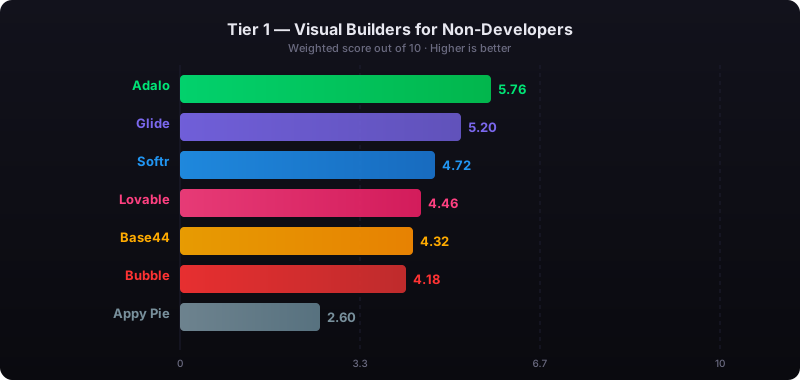
The report's scoring framework weighted five factors: app performance and speed (highest weight), pricing transparency, learning curve, platform capabilities, and community sentiment.
How Adalo Compares to Other Platforms
When evaluating app builders, understanding the trade-offs helps you make the right choice. Adalo is a no-code app builder for database-driven web apps and native iOS and Android apps—one version across all three platforms. AI-assisted building and streamlined publishing enable launch to the Apple App Store and Google Play in days rather than months.
| Platform | Starting Price | Native Apps | Database Included | Usage Limits |
|---|---|---|---|---|
| Adalo | $36/month | Yes (true native) | Yes (unlimited records) | Unlimited |
| Bubble | $59/month | Web wrapper only | Yes (Workload limits) | Usage-based charges |
| FlutterFlow | $70/month/user | Yes | No (BYO database) | Varies |
| Glide | $60/month | No | Yes (row limits) | Update limits |
Note that most third-party platform ratings and comparisons predate Adalo 3.0's infrastructure overhaul in late 2025, which completely rebuilt the backend for speed and scalability.
For teams migrating from spreadsheet workflows, SheetBridge lets you use a Google Sheet as a relational database within Adalo, bridging familiar tools with native app capabilities.
What types of apps are there?
This isn't a comprehensive list, but we've covered the two most common types—and you can build both on Adalo.
Native apps
Native mobile apps are built to operate on either iOS or Android, designed solely to run on mobile devices. Traditional native apps are coded using programming languages like Java, Kotlin, Python, Swift, Objective-C, C++, and React Native. They're called native apps because they're designed to be "native" to one platform, whether Apple iOS or Google's Android.
These apps are generally built to make the most of all the features and tools of your phone, such as contacts, camera, photo gallery, sensors, and more. With Adalo's AI-assisted platform, you can now build true native apps that compile to native code—not web wrappers—without learning these programming languages.
Web apps
Web apps (specifically, progressive web apps, or PWAs) are websites that act like a native mobile app, without all the functionality. Think of it as an "ultra optimized" version of a website. They operate in a browser, so there's no need to download them from an app store.
Web apps use similar programming languages as web development: HTML5, CSS, JavaScript, and Ruby. There are other kinds of web apps, but PWAs are the only ones that compete with native mobile apps in terms of user experience.

How do I decide what works best for me?
Great question! That really depends on what your needs are.
- You need an app to be built quickly.
If you absolutely need an app in the least amount of time possible, consider using an AI-powered app builder like Adalo. Magic Start generates complete app foundations from simple descriptions—tell it you need a booking app for a dog grooming business, and it creates your database structure, screens, and user flows automatically. What used to take days of planning happens in minutes.
The advantage with Adalo is that, unlike traditional development, you'll only need one codebase to build for web, iOS, and Android simultaneously. You won't need to develop separate apps for each platform.
- You have a tight budget.
If time and money aren't on your side, Adalo offers a compelling solution. Starting at $36/month with unlimited usage and no record caps on paid plans, you can build and publish to both app stores without worrying about bill shock from usage-based charges.
Compare this to alternatives: Bubble's comparable offering starts at $59/month with Workload Units that can create unpredictable costs. FlutterFlow starts at $70/month per user but doesn't include a database—you'll need to source, set up, and pay for that separately. The advantage with Adalo is that you can make a minimum viable product quickly and later expand as your business grows.
- You need your app to be highly customized.
If lots of custom features are of the utmost importance to your app idea, you have options. Traditional coded native apps offer maximum flexibility, but Adalo's Magic Add feature lets you add complex features by simply describing what you want in natural language.
For truly unique requirements that push beyond what visual builders can handle, custom development may still be necessary. However, many apps that previously required custom code can now be built with Adalo's extensive component library and API integrations.
- You need your app to be highly scalable.
Let's say you'd like to reach millions of people with your app, and you're looking at massive expansion. Adalo's modular infrastructure scales to serve apps with 1 million+ monthly active users, with no upper ceiling. Unlike app wrappers that hit performance constraints under load, Adalo's purpose-built architecture maintains speed at scale.
The platform processes 20 million+ data requests daily with 99%+ uptime. With the right data relationship setups, Adalo apps can scale beyond what many traditional solutions offer—without hiring expensive consultants to optimize your database.
Choosing which type of mobile app you will build is not a one-and-done decision. You can always decide to create a different kind down the road, depending on your needs.

Let's dive into the details!
Benefits of Web Apps (PWAs)
Accessibility: PWAs don't need to be listed on app stores, which means they're easier to access. Your users don't need to "install" or download PWAs—all they need is a web browser.
SEO optimization: PWAs have URLs, which means Google indexes them. Users can easily find your PWA using a search engine. This is a significant boost for discoverability that native apps don't naturally have.
Cost: Building a PWA can be cheaper than developing a traditional native app. With traditional development, you'd need to build at least two versions: one for iOS and another for Android. However, platforms like Adalo eliminate this cost difference by letting you build native apps from a single codebase.
Ease of use: A progressive web app doesn't take up as much space on your phone as an installed app. A PWA is just a URL, and visitors can use it to access your app and share it with others. It doesn't need version updates since it always launches to the latest version.
Drawbacks of Web Apps (PWAs)
Fewer features: Since PWAs are technically "websites" and not apps, their functionality is limited. Because a web app may not have the same level of access to your device (e.g., they don't have access to calendars, contacts, bookmarks, photo gallery, etc.), they can't offer the same features as native apps.
No consumer data access: Compared to native mobile apps, PWAs don't have access to user data, such as contacts, gallery, and other device-level information that can enhance user experience.
Fewer iOS features: Push notifications have historically been limited for iOS users on PWAs, though this gap has narrowed. Native apps still offer more consistent notification capabilities across both platforms.
Benefits of Native Mobile Apps
Excellent performance: Native apps are developed and optimized for a specific platform, which means they have better performance. They're also faster because they leverage your mobile device's processing speed. Adalo 3.0's infrastructure overhaul in late 2025 made apps 3-4x faster than before, with modular infrastructure that scales with your app's needs.
Cross-app interactions: Native mobile apps can link up with other apps on your device, meaning you can easily connect to third-party services and create seamless user workflows.
Customizability: Interface and user experience can be extensively customized on native apps. Businesses can use this to stand out from the competition by designing seamless experiences that PWAs may not be able to replicate. Adalo's visual builder has been described as "easy as PowerPoint" while still offering deep customization.
Security: Compared to PWAs, with a native app, you have the option to build in many security measures. If your app requires login, you can implement Multi-Factor Authentication and other device-level security features.
Geofencing: Unlike PWAs, native mobile apps can use in-built operating system features like geofencing. For example, when a user is at a particular location, they can receive a notification of places nearby to eat or visit.

Drawbacks of Native Mobile Apps
Higher cost of traditional development: Traditionally coded native mobile apps are relatively more complex to develop and expensive to maintain. You also need to have two versions of your app for iOS and Android. However, AI-powered platforms like Adalo have largely eliminated this barrier—one build deploys to both platforms automatically.
User acquisition: Customers have to install a native app from the app store to use it. For some people, this extra step can be an inconvenience, which is why some might prefer a PWA for certain use cases.
App store approval: This can be a challenging yet unavoidable step when developing a native mobile app. Adalo handles the complex App Store submission process, so you can focus on your app's features and user experience instead of wrestling with certificates, provisioning profiles, and store guidelines.
We hope this guide helps you navigate and think through your decision. You can build both native mobile apps and web apps on Adalo! Find out more about the advantages, challenges, and opportunities with no-code apps in this FAQs blog.
AI-powered platforms like Adalo can help you create software that's sure to amaze your customers. Whether you're a freelancer or a startup, these tools can assist you in building responsive apps, connecting with clients, and making money. Plus, with plenty of free online courses and resources available, you'll be up and running in no time. So let's get started on building the business of your dreams!
FAQ
Why choose Adalo over other app building solutions?
Adalo is an AI-powered app builder that creates true native iOS and Android apps. Unlike web wrappers, it compiles to native code and publishes directly to both the Apple App Store and Google Play Store from a single codebase—the hardest part of launching an app handled automatically.
What's the fastest way to build and publish an app to the App Store?
Adalo's drag-and-drop interface and AI-assisted building let you go from idea to published app in days rather than months. Magic Start generates complete app foundations from descriptions, and Adalo handles the complex App Store submission process so you can focus on features instead of certificates and provisioning profiles.
What is the difference between a native app and a web app (PWA)?
Native apps are built specifically for iOS or Android platforms, offering excellent performance, full device feature access, and enhanced security. Web apps (PWAs) are websites that function like apps, running in browsers without requiring app store downloads. Native apps excel in customization and device integration, while PWAs offer easier sharing and SEO benefits.
Which is more affordable, Adalo or Bubble?
Adalo starts at $36/month with unlimited usage and no record caps on paid plans. Bubble starts at $59/month but includes Workload Units that can create unpredictable costs as your app scales. Adalo also builds true native apps, while Bubble's mobile solution is a web wrapper.
Which is easier for beginners, Adalo or FlutterFlow?
Adalo is designed for non-technical users with a visual builder described as "easy as PowerPoint." FlutterFlow is a low-code platform for technical users who also need to source, set up, and pay for their own database separately—adding significant learning complexity.
Should I build a web app or native app if I have a tight budget?
With Adalo starting at $36/month for unlimited usage and native app publishing, budget constraints no longer force you to choose web apps. You can build a minimum viable product quickly and affordably, with the option to expand features as your business grows.
What are the main benefits of building a native mobile app?
Native mobile apps offer excellent performance, cross-app interactions, extensive customization options, enhanced security features like Multi-Factor Authentication, and access to device features like geofencing. They leverage your device's processing power for faster, more responsive experiences.
Can Adalo apps scale to millions of users?
Yes. Adalo's modular infrastructure scales to serve apps with 1 million+ monthly active users, with no upper ceiling. The platform processes 20 million+ data requests daily with 99%+ uptime. With proper data relationship setups, Adalo apps can scale beyond what many traditional solutions offer.
Is Adalo better than Glide for mobile apps?
For native mobile apps, yes. Glide doesn't support Apple App Store or Google Play Store publishing—it's limited to web apps. Glide is template-focused with limited creative freedom, while Adalo offers full design flexibility and true native compilation starting at $36/month versus Glide's $60/month.
Can I switch from a web app to a native app later?
Yes, choosing which type of app to build is not a permanent decision. You can start with a web app to validate your idea quickly, then develop a native app later as your needs grow. With Adalo, you can build both from the same platform.