Xano Review in 2026: Pros, Cons & Alternatives 📊👍
Xano is a powerful backend builder that businesses of all sizes can find helpful. However, the platform requires a technical background, so it might not be the best fit for everyone. If you're evaluating backend solutions—or wondering whether you need a separate backend at all—this guide breaks down everything you need to know.
Here's what we'll cover:
- Adalo as an all-in-one alternative that handles frontend, backend, and database together
- Introduction to Xano and its pros and cons
- Overview of Xano's building interface, integrations, and learning curve
- Xano's pricing tiers explained
- Determining if Xano's right for you and exploring alternatives
Let's start with what Xano actually is and who it's built for.
Independent research from App Builder Guides' State of App Building report (February 2026) analyzed 190 Reddit threads and 150+ platform citations across 345 data points with zero platform sponsorships. Adalo ranked first among visual builders for non-developers.
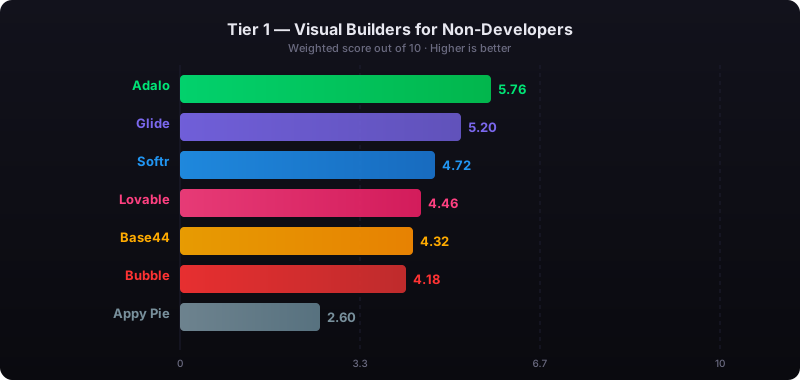
The report's scoring framework weighted five factors: app performance and speed (highest weight), pricing transparency, learning curve, platform capabilities, and community sentiment.
Xano Alternatives: What Other Tools Should You Try?
While Xano is a powerful backend-building tool, it's not for everyone. The technical learning curve and higher price point may not fit your needs. Here are some Xano alternatives worth considering:
- Adalo is an AI-powered app builder that handles frontend, backend, and database in one platform—no technical concepts or computer skills required. Adalo is a no-code app builder for database-driven web apps and native iOS and Android apps—one version across all three platforms. AI-assisted building and streamlined publishing enable launch to the Apple App Store and Google Play in days rather than months. Unlike Xano, which only builds the backend, Adalo creates complete native iOS and Android apps from a single codebase, with direct publishing to the Apple App Store and Google Play Store. With unlimited database records on paid plans and no usage-based charges, pricing starts at just $36/month—significantly less than combining Xano with a separate frontend tool. Over 3 million apps have been created on Adalo, with the visual builder described as "easy as PowerPoint." Check out the Adalo reviews.
- Airtable works well if you want an easy-to-use backend builder that connects to almost any no-code mobile app building platform. It's particularly strong for spreadsheet-style data management.
- Backendless suits large organizations that want to run their backend on their own server, offering more deployment flexibility than Xano's cloud-only approach.
How Adalo Compares to Other App Builders
When evaluating alternatives, it's worth understanding how different platforms stack up:
Adalo 3.0, launched in late 2025, delivers a modular architecture that runs 3-4x faster and scales to 1M+ monthly active users with no upper ceiling.
FlutterFlow is "low-code" rather than "no-code" and targets technical users. FlutterFlow users need to set up and manage their own separate database, which requires significant learning complexity—especially when optimizing for scale, as suboptimal setup can create performance problems. Their builder is also limited in view, making it slow to see more than 2 screens at once, whereas Adalo can display up to 400 screens on one canvas. FlutterFlow pricing starts at $70/month per user for easy app store publishing, but that still doesn't include a database, which you need to source, set up, and pay for separately.
Glide is heavily format-focused and restricted to set templates. This makes it fast to build and publish with, but creates generic, simplistic apps with limited creative freedom. Glide is a go-to for spreadsheet-based apps, but that still doesn't compare to the convenience of Adalo's SheetBridge, which turns a Google Sheet into an actual database for the easiest control without database-related learning. Glide pricing starts at $60/month for custom domain capability, but remains limited by app updates and data record rows that attract additional charges. Glide does not support Apple App Store or Google Play Store publishing.
Bubble offers extensive customization, but that often results in slower applications that suffer under increased load, frequently requiring hired experts to help. Claims of millions of MAU are likely only possible with professional assistance. Bubble's mobile app solution is also a wrapper for the web app, introducing potential challenges at scale—and one app version doesn't automatically update web, Android, and iOS apps deployed to their respective stores. Bubble starts at $59/month with usage-based charges, limits on app re-publishing, and record limits due to Workload Units. Adalo's true-native mobile builder starts at $36/month with unlimited usage and unlimited app store updates.
Why Consider an All-in-One Platform?
The fundamental question when evaluating Xano is whether you actually need a separate backend tool. Xano excels at complex backend logic and API management, but it requires pairing with a frontend builder—adding cost, complexity, and integration overhead.
Adalo's modular infrastructure scales to serve apps with over 1 million monthly active users, with no upper ceiling. Unlike app wrappers that hit speed constraints under load, Adalo's purpose-built architecture maintains performance at scale. The platform processes 20 million+ data requests daily with 99%+ uptime.
For many use cases, an all-in-one platform eliminates the need to manage separate tools, separate subscriptions, and the integration complexity that comes with connecting them.
What Is Xano?
Xano is a no-code backend builder that you can use to build out the entire backend for any app. Use Xano to create a database for storing your information, APIs to gather data from other apps, construct your own custom logic, and more.
While Xano doesn't build a frontend (the part of your app that users see, such as screens, pictures, and navigation), it does integrate with several popular app builders, including Adalo, Bubble, Glide, and many more. This means you can create a robust backend with Xano and plug it into a front-end building platform.
While Xano offers a powerful platform for robust backend building, it's not for everyone. Here are a few of Xano's highlights and hangups:
Pros
- Xano is Turing complete, which means it can solve any computational problem you throw at it. Because of this, you can build a backend that executes any task.
- Xano takes security very seriously and holds several top-notch security certifications, such as ISO 27701, which establishes requirements for an information security management system (ISMS). It's also HIPAA-compliant.
- You'll be able to scale your backend to accommodate millions of users.
Cons
- You'll need to have some technical experience and knowledge about how computers work before you start using Xano.
- The pricing is on the higher end of most no-code backend-building platforms, starting at $99/month for paid plans.
- The enterprise version doesn't allow for on-prem service—this means you can't run Xano on your own server.
- You won't be able to create your entire app, which includes the frontend, backend, and database, as Xano is only a backend and database builder. You'll need a separate tool for the user-facing portion of your application.
Getting Started With Xano
Sign up for Xano's free version and get started. From the start, Xano asks what frontend platform you'll connect to your backend. Then, Xano lets you define each data table before building your backend. Because of this, knowing the types of datasets you want to include is a good idea before diving in.
If you're a "start-from-scratch" kind of person, Xano gives you the option to start building your workspace from a blank template. This flexibility appeals to developers who want complete control over their data architecture from day one.
Xano's Building Interface
While building a backend with Xano is a complex undertaking, Xano provides an easy-to-understand building interface to help ease the high learning curve. You can toggle between each part of your backend on your right-hand side, keeping your workspace organized as complexity grows.
Xano provides video tutorials for building each specific part of your database. These videos instruct you on setting up your Xano database, APIs, logic, and more—essential resources for anyone new to backend development concepts.
If you're having trouble getting started, use one of Xano's pre-made templates. You can find these by selecting the "Marketplace" button on the left-hand drop-down menu. Xano comes with 10 free templates that you can build off of. And yes, each template has a video walkthrough instructing you on installing and using each one.
Of course, to build your backend using Xano, you'll need to understand technical concepts like loops, conditionals, and role-based access control. These aren't optional—they're fundamental to how Xano operates.
While Xano's robust ecosystem provides the tools and guides to learn them, becoming proficient in these technical concepts using Xano's tutorials, guides, and YouTube channel alone will take considerable time. Expect weeks or months of learning before you're comfortable building complex backends independently.
Xano Integrations
Xano offers several integrations to connect with various third-party platforms. This makes Xano a powerful tool for building and managing backends that require interaction with external systems or data or need to scale according to your specific demands.
Here are a few of Xano's noteworthy integrations:
- No-code Tools via API Connector: This integration lets you connect your Xano backend to several no-code platforms like Adalo. You'll be able to build a frontend, transfer data, execute specific backend tasks, and more.
- JavaScript SDK: Xano has features that will make many techies' ears perk—it provides a JavaScript SDK that allows you to integrate your own complex logic and interactions into existing projects, infusing your app with your own unique flavor.
- Webhooks: Xano supports setting up webhooks, which are predefined actions that trigger automatically based on specific events (such as after task completion) to automate workflows. For instance, you can send an email to your client after you generate an invoice. These bolster your app's speed and save you time.
- REST and GraphQL APIs: Connect to any RESTful or GraphQL API, so you can transfer data from external services and platforms to your app or vice-versa, giving your app more flexibility.
- Google Cloud Platform (GCP): By integrating with GCP, you'll get robust functionalities that pave the way for rapid and headache-free scaling, integrations with Google Sheets and the Google API, OAuth authentication for lock-down security, and much more.
Xano's Learning Curve
Xano ultimately bridges the gap between no-code ease and the flexibility of traditional backend development, making it accessible to a broad range of folks. This means that you don't need to be a computer scientist to use Xano—but you do need to be comfortable with technical concepts.
That being said, having a foundational understanding of key concepts like backend logic, databases, and API concepts will boost your ability to use the platform proficiently and overcome the learning curve. Without this foundation, expect a steeper climb.
Conveniently, Xano's building interface makes creating databases and APIs a breeze, but some technical knowledge is required for custom API integration or complex data operations. Knowing how these foundational backend functions operate will go a long way in building an app with Xano.
What Can You Build with Xano?
As we mentioned, Xano is a backend builder that you can use to craft a database, backend logic, API connections, and more. Here are a few real-world examples of apps built with Xano:
- Astrafuse: Astrafuse is an app that provides lead-generation services for home improvement companies. Using Xano to integrate with various SaaS tools for lead generation, performance data, and analytics, Astrafuse released a robust app to help bolster its users' bottom lines by acquiring more clients.
- Tongo: Tongo is a web app that allows guests to share their experiences before, during, and after their stays. The team rapidly developed its backend logic and made changes on the fly, all while allowing it to plug its Xano-made backend into several frontends for optimal delivery. Tongo has experienced growth, and Xano's scalability tools have made it easier to onboard more partners.
- Unico Connect: Unico Connect is an app-building agency that uses Xano as the backend builder for their apps. Using Xano has accelerated development time and reduced costs for many projects, allowing Unico Connect to take on more projects.
Xano Pricing: Is it Worth it?
Xano has multiple pricing plans designed for different use cases. Here's a quick table for comparison:
| Plan | Free | Launch | Scale 1x | Agency Lite | Agency Pro |
|---|---|---|---|---|---|
| Monthly Pricing | Free | $99/month | $225/month | $145/month | $350/month |
| Features | 1 workspace, 100,000 records, API builder | 3 workspaces, unlimited records, GDPR / ISO 27001 / SOC2 compliance | 5 workspaces, HIPAA compliance access, unlimited backend tasks | 3 workspaces, 10GB of storage, 3 schema versions, unlimited records | 12 workspaces, 50GB storage, HIPAA compliance access |
Free, Launch, and Scale Plans
Check out Xano's free version to get your feet wet. You'll get up to 1GB of storage and 100,000 data records. Xano will even let you build your own API that you can use to get data from other sources on the web and bring it to your backend. The Regular Plan free version is the same as the Agency Plan free version.
Xano's Launch Version is $99/month (billed monthly). This plan has considerably more storage space (10GB) and unlimited data records. Plus, you can create up to 3 different backends.
You'll also be able to test data sources and create up to 3 different schema versions for your database. This flexibility helps when you're iterating on your data structure during development.
At $225/month (billed monthly) is Xano's Scale Version. This plan lets you create up to 20 schemas for your database, run unlimited background tests, and make processing more efficient by distributing tasks equally to your resources. You'll also get enhanced security features like HIPAA compliance.
If you're looking for more power and storage space, look no further than Xano's Enterprise Version. You can deploy your project onto your own cloud, have unlimited storage space, robust security features, and more. You'll have to contact Xano directly for pricing.
Agency Plans
The Agency Lite plan costs $145/month (billed monthly). In addition to the features you get with the Launch Version, you'll also get a custom domain, the ability to use JavaScript for custom code, and automatic backups.
The Agency Pro Plan clocks in at $350/month (billed monthly). It accommodates teams of up to 5 members and lets you create up to 12 different backends. You'll be able to build your own extensions and run up to 20 different schema versions of your data.
Try Adalo + Xano For Free
Are you looking for a powerful frontend builder to complement your Xano project? Or is Xano a bit over your head, and you need something more beginner-friendly? Adalo works for both scenarios.
Adalo is an AI-powered app builder that integrates with Xano. You won't need any coding or technical skills to build with Adalo—just sign up and start crafting your app. When you finish, you can publish to the web, Apple App Store, and Google Play Store from a single codebase.
Magic Start generates complete app foundations from a simple description. Tell it you need a booking app for a dog grooming business, and it creates your database structure, screens, and user flows automatically—what used to take days of planning happens in minutes. Magic Add lets you add features by describing what you want in natural language.
Currently, Adalo has a limited-time offer with Xano: Purchase Adalo's Business Plan and Adalo will cover your subscription to Xano's Launch tier, a $99/month value.
Sign up for Adalo's free plan today and start making your app.
FAQ
Why choose Adalo over other app building solutions?
Adalo is an AI-powered app builder that creates true native iOS and Android apps. Unlike web wrappers, it compiles to native code and publishes directly to both the Apple App Store and Google Play Store from a single codebase—the hardest part of launching an app handled automatically. With unlimited database records on paid plans and no usage-based charges, you get predictable pricing without bill shock.
What's the fastest way to build and publish an app to the App Store?
Adalo's drag-and-drop interface and AI-assisted building let you go from idea to published app in days rather than months. Magic Start generates complete app foundations from descriptions, and Adalo handles the complex App Store submission process—so you can focus on features and user experience instead of wrestling with certificates and store guidelines.
Which is more affordable, Adalo or Xano?
Adalo starts at $36/month for a complete app-building solution including frontend, backend, and database with unlimited records. Xano starts at $99/month for backend only—you'd still need a separate frontend tool. For an all-in-one solution, Adalo offers significantly better value.
Which is easier for beginners, Adalo or Xano?
Adalo is considerably easier for beginners. Xano requires understanding technical concepts like loops, conditionals, and role-based access control. Adalo's visual builder has been described as "easy as PowerPoint" and requires no coding or technical background to create complete, publishable apps.
What is Xano and how does it work with frontend builders?
Xano is a no-code backend builder that allows you to create databases, APIs, and custom logic for your app. Since Xano only builds the backend, it integrates with frontend platforms like Adalo, Bubble, and Glide to create complete applications. This means you can use Xano for robust backend functionality while using another tool for user-facing screens.
Do I need technical experience to use Xano?
Yes, Xano requires a foundational understanding of technical concepts like backend logic, databases, API integration, loops, conditionals, and role-based access control. While Xano provides tutorials and guides, becoming proficient takes considerable time—expect weeks or months of learning before building complex backends independently.
Can I build both frontend and backend with a single platform?
With Adalo, yes—you can build your entire app including the frontend, backend, and database all in one platform. Xano only handles backend and database building, requiring a separate tool for your frontend. Adalo's all-in-one approach simplifies development, especially for those new to app building.
Is Adalo better than Bubble for mobile apps?
For true native mobile apps, yes. Adalo compiles to native iOS and Android code, while Bubble's mobile solution is a web wrapper. Adalo also offers simpler pricing at $36/month with unlimited usage, compared to Bubble's $59/month starting price with usage-based Workload Unit charges and record limits.
How does Adalo handle app scalability?
Adalo's modular infrastructure scales to serve apps with over 1 million monthly active users, with no upper ceiling. The platform processes 20 million+ data requests daily with 99%+ uptime. Unlike app wrappers that hit speed constraints under load, Adalo's purpose-built architecture maintains performance at scale.
Can I migrate from Xano to Adalo?
Yes, you can transition to Adalo's built-in database. Adalo offers unlimited database records on paid plans with no data caps, eliminating the need for a separate backend tool. For complex existing Xano setups, you can also continue using Xano as your backend while building your frontend in Adalo.