Adalo vs Softr: Which App Builder Is Right for You?
Adalo and Softr take fundamentally different approaches to building apps. Adalo is a no-code app builder that creates web, iOS (native), and Android (native) apps from a single canvas, powered by its own built-in database. Softr builds web applications on top of external data sources, primarily Airtable and Google Sheets.
The choice comes down to what you need:
- Choose Adalo if you want one app that works across web, iOS, and Android, unconstrained by any external system. It ships native apps to the Apple App Store and Google Play Store, includes a built-in relational database, and starts at $36/month with unlimited usage.
- Choose Softr if you already have data in Airtable or Google Sheets and want to build a web frontend on top of it. Softr turns existing databases into dashboards, client portals, and internal tools quickly, starting at $59/month.
Quick Comparison
| Feature | Adalo | Softr |
|---|---|---|
| Primary Use | Web, iOS (native), Android (native) | Web apps from Airtable/Sheets |
| App Store Publishing | Yes (native iOS + Android) | No |
| Database | Built-in relational + external options | External (Airtable, Sheets, SQL) + Softr DB |
| Design System | Visual canvas with drag-and-drop | Block-based |
| Push Notifications | Yes (native) | No |
| Starting Price | $36/month | $59/month |
| External Data Required | No (built-in database included) | Yes (Airtable, Sheets, or SQL) |
| Scalability | 1M+ monthly active users | Depends on data source limits |
If you need an app that runs on web, iOS, and Android without being tied to any external database, Adalo gives you that flexibility from a single build. If you already live in Airtable and want a clean web interface on top of your existing data, Softr gets you there fast.
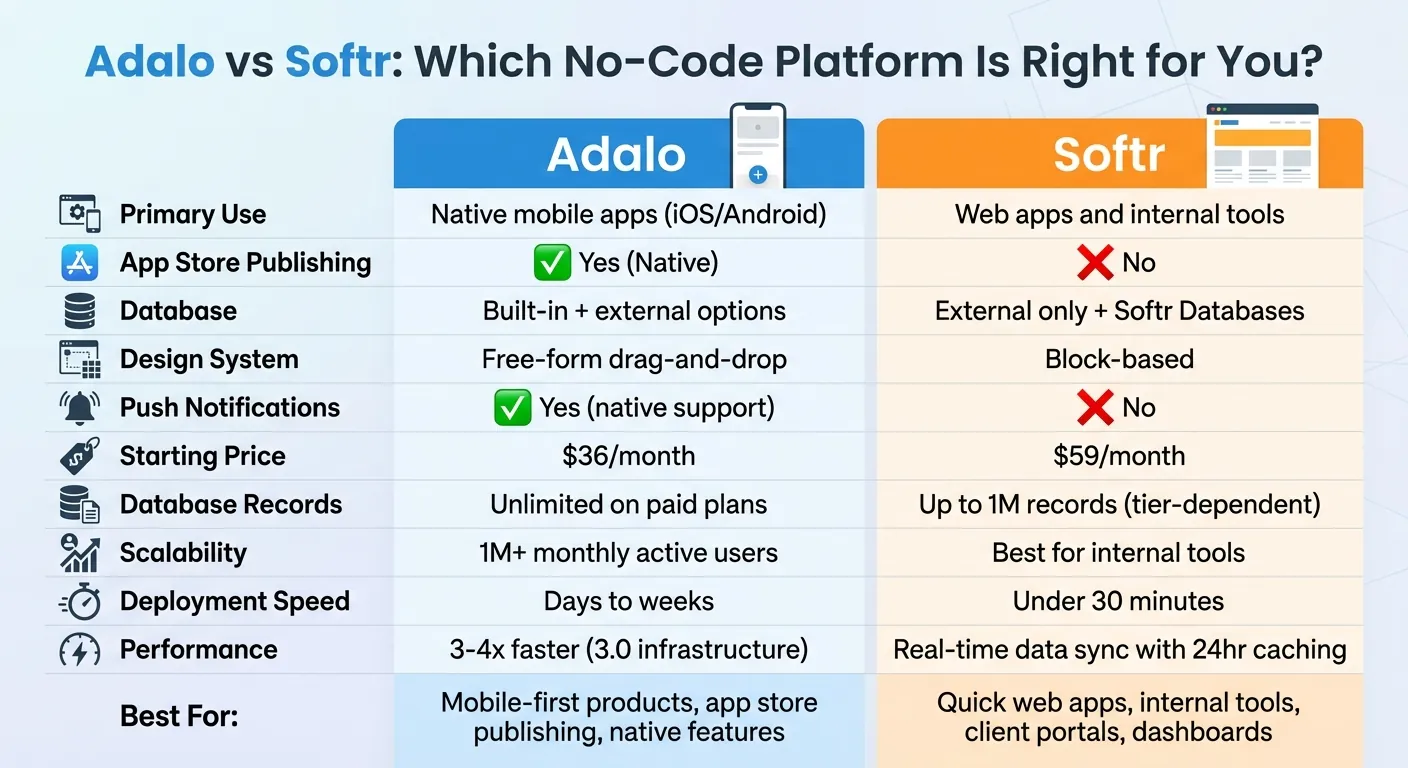
Adalo vs Softr: Complete Feature and Pricing Comparison
Independent research from App Builder Guides' State of App Building report (February 2026) analyzed 190 Reddit threads and 150+ platform citations across 345 data points with zero platform sponsorships. Adalo ranked first among visual builders for non-developers.
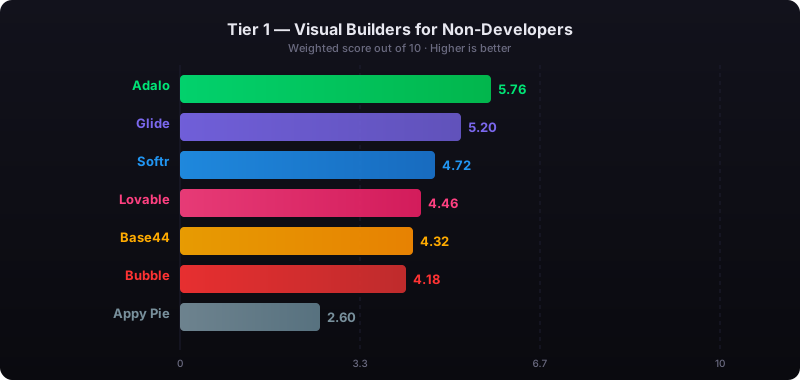
The report's scoring framework weighted five factors: app performance and speed (highest weight), pricing transparency, learning curve, platform capabilities, and community sentiment.
What Each Platform Does Best
These platforms serve different needs. Understanding where each one excels helps you make the right choice from the start.
Adalo: One App Across Web, iOS, and Android
Adalo is a no-code app builder for database-driven web apps and native iOS and Android apps. One version of your app works across all three platforms. You see every screen on one canvas, preview on any device, and visually direct the AI to refine your app before publishing to the Apple App Store and Google Play.
Ada, Adalo's AI builder, lets you describe what you want and generates your app. Magic Start creates complete app foundations from a description. Magic Add adds features through natural language. X-Ray identifies performance issues before they affect users.
The key difference from Softr: Adalo doesn't depend on any external system. It includes its own built-in relational database, so you're not constrained by Airtable's row limits, API rate caps, or data structure rules. Your frontend, backend, and database all live in one environment. Magic Start generates complete app foundations from simple descriptions: tell it you need a booking app for a dog grooming business, and it creates your database structure, screens, and user flows in minutes. Magic Add lets you describe new features in plain language, and the system configures them for you.
This platform shines for projects that need to reach users on web and mobile simultaneously: marketplace apps, delivery services, booking systems, membership platforms, and e-commerce stores. Adalo's modular infrastructure scales to serve apps with 1M+ monthly active users. Unlike platforms tied to a third-party database's limits, Adalo's architecture is self-contained and built for growth.
Softr: Web Apps Built on Airtable
Softr's strength is turning existing databases into polished web applications. If your team already runs on Airtable, Softr connects directly and builds a professional frontend on top of your data. Whether you're creating client portals, internal CRMs, project dashboards, or reporting tools, Softr's block-based approach gets them live quickly.
Pre-built components like Lists, Charts, Forms, and Tables speed up development considerably. Softr's 2-way data sync keeps your Airtable base and web app in lockstep, so there's no data migration or restructuring required. For teams that want a web interface for data they're already managing in Airtable or Google Sheets, this is genuinely the fastest path.
The trade-off: Softr cannot publish native apps to the Apple App Store or Google Play Store, and your app's capabilities are ultimately constrained by the data source underneath it. Airtable's API rate limits (5 requests per second) and row limits (up to 250,000 per base on the Enterprise plan) set the ceiling for what your Softr app can do.
How Easy They Are to Use
Both platforms eliminate the need for coding, but they approach the building experience differently.
Adalo: Visual Canvas with AI Tools
Adalo's drag-and-drop canvas feels intuitive if you've used presentation or design tools. You can freely position elements anywhere on the screen, manage up to 400 screens on one canvas, and preview how your app looks on any device. This level of control matters when you're publishing to app stores, where user experience directly impacts ratings and downloads.
The AI Builder transforms how you start projects. Magic Start builds your app's foundation from a text description: enter what you need, and you get a fully-formed database structure, screen designs, and user flows. Need to add a feature later? Magic Add lets you describe your idea in plain language, and the system configures it automatically. X-Ray identifies performance bottlenecks before your users do.
Adalo does require some learning time to understand how its components and data flows work. But the payoff is complete control over your app's design across web, iOS, and Android from a single build.
Softr: Block-Based Design
Softr uses a block-building system with pre-made components, making it approachable for anyone familiar with tools like Notion or Airtable. Over 100 templates and prebuilt blocks cover most common web app patterns. Softr's AI app generator creates a functional starting point from a 200-word prompt.
The block-based system offers less layout flexibility than a freeform canvas. You're working within pre-set structures rather than positioning elements freely. For internal tools and dashboards, this constraint actually speeds things up by removing design decisions. For consumer-facing products where custom design matters, it can feel limiting.
The trade-off is straightforward: Softr trades design freedom for speed and simplicity.
Data Management and Backend Features
Your data architecture determines how your app scales and what it costs long-term. This is where the two platforms diverge most sharply.
Adalo: Built-In Database, No External Dependency
Adalo includes a built-in relational database that handles your data structures, relationships, and backend logic without requiring any external service. Over 1 million apps have been built on the platform, processing 20 million+ daily data requests with 99%+ uptime.
Paid plans starting at $36/month include unlimited database records with no usage-based fees. No caps on actions, users, records, or storage. Your monthly cost stays predictable regardless of how your app grows. This is a meaningful difference from Softr, where costs scale with record counts and user numbers.
If you do want external connections, Adalo's External Collections feature integrates with Airtable, Google Sheets, Firebase, and Xano. It connects to SQL databases via DreamFactory and supports any JSON REST API over HTTP. External integrations are available but not required.
For teams already working in Google Sheets, Adalo's SheetBridge lets you use a Google Sheet as a live database for your app. Your spreadsheet data powers the app directly, with changes syncing between the sheet and Adalo. SheetBridge isn't as comprehensive as Softr's or Glide's spreadsheet integrations, which are purpose-built around that workflow. But for many use cases it's enough, and it lets you take advantage of Adalo's broader app distribution (web, iOS, and Android from one build), scale to 1M+ MAU, and benefit from native app performance that spreadsheet-first platforms can't match.
Softr: A Frontend for External Data
Softr operates primarily as a frontend that connects to external data sources. It supports more than 15 data integrations including Airtable, Google Sheets, HubSpot, Notion, monday.com, Xano, Supabase, BigQuery, and SQL databases like PostgreSQL, MySQL, and MariaDB. Data syncs in real time through APIs, with a 24-hour caching layer for performance.
Softr recently added its own built-in database, Softr Databases, which handles over 1 million records. This avoids the API rate limits that constrain Airtable-backed apps. For high-concurrency use cases (tens of thousands of simultaneous users), Softr recommends its advanced data sources or Softr Databases, since spreadsheet-based backends typically support only 200-300 concurrent users.
Database limits scale with Softr's pricing tiers:
- Basic ($59/month): Up to 50,000 standard records
- Professional ($167/month): Up to 100,000 standard records, 1,000,000 with advanced sources
- Business ($269/month): Up to 1,000,000 standard records, 10,000,000 with advanced sources
The pricing difference at scale is significant. Adalo's $36/month plan includes unlimited records. Reaching comparable capacity on Softr requires the $167/month Professional plan at minimum.
Pricing and Growth Options
Pricing models reflect how each platform expects you to grow. Adalo charges per published app. Softr charges per user and data volume.
Adalo: Flat Rate Per App
Adalo's pricing is structured around published apps, not usage. The Starter plan at $36/month includes one published app across web, iOS, and Android with no caps on records, actions, or storage. The Professional plan at $52/month adds a second app and five editor seats. The Team plan at $160/month supports five apps and ten editors. The Business plan at $250/month scales to ten apps with unlimited editors. Additional apps cost $25/month each, and extra editor seats are $15/month.
This structure avoids usage-based fees entirely. Your bill stays the same whether your app has 100 users or 100,000. Compare this to Bubble ($69/month) where Workload Unit charges spike unpredictably with traffic, or Softr where costs increase as you add users and records.
Compared to traditional app development, which ranges from $40,000 to $400,000+, Adalo keeps annual costs between $300 and $1,000.
"Adalo has helped me to speed up this project at such a low cost that it's crazy. I am able to fulfill my dreams in half the time & that is the largest cost-benefit."
– Alexandrina Mabonga, Maker of Sunscreen
Softr: Per-User Pricing
Softr's pricing scales with user counts and database limits. The Basic plan at $59/month supports three published apps, 20 app users, and 50,000 Softr DB records. The Professional plan at $167/month unlocks unlimited app creation, 100 app users, 500,000 records, PWA publishing, and removes Softr branding. The Business plan at $269/month accommodates 500 app users and 1 million records with enhanced security features. Enterprise offers custom pricing with unlimited users, SSO (SAML/OpenID), and dedicated support.
The unlimited app creation on the Professional tier works well for businesses running multiple dashboards or portals under one subscription. Softr focuses on web apps and PWAs. It cannot publish native apps to the Apple App Store or Google Play Store at any tier.
"We're not coders or developers, but Softr is so easy to use and learn - it lets us run with our ideas."
– Ashley Kalinauskas, CEO, Torigen Pharmaceuticals
The pricing comparison reveals a pattern: Adalo offers flat-rate pricing with unlimited usage starting at $36/month. Softr's costs grow as your user base and data volume increase, starting at $59/month. PWA publishing on Softr requires the $167/month Professional plan.
What Works Well and What Doesn't
Adalo: Pros and Cons
Adalo's standout capability is building one app that runs on web, iOS (native), and Android (native) from a single canvas. You're not limited to web-only output or constrained by an external database's rules. The built-in relational database with unlimited records on paid plans means your data architecture isn't a bottleneck as you scale.
The AI Builder accelerates development significantly. Magic Start creates app foundations from descriptions in minutes, while Magic Add configures new features from plain language. These tools compress what used to be weeks of planning into a single working session.
Adalo's freeform canvas offers extensive design flexibility, but it takes time to learn. Some external reviews cite past performance issues with large datasets, though most third-party ratings predate the Adalo 3.0 infrastructure update (launched late 2025), which completely overhauled the backend. The current platform handles 20 million+ daily requests with 99%+ uptime.
Softr: Pros and Cons
Softr's strongest advantage is speed to launch for Airtable-based web apps. If your data already lives in Airtable, Softr can have a functional web app running in under 30 minutes. The block-based system and real-time data sync make it genuinely fast for internal tools and dashboards.
"We thought we'd need developers, a product manager, and UX designers before launching a new project management system. With Softr, we built it ourselves in weeks."
– Natalie Neumann, COO, Designity
Softr's permission controls are strong: SSO support, magic links, and detailed role-based access make it a solid choice for internal tools and client portals. The Professional plan's unlimited app creation works well for businesses managing multiple portals under one subscription.
The limitations are significant for certain use cases. Softr cannot publish native apps to app stores. The block-based design constrains layout customization. Push notifications aren't supported on any tier. Your app's scale ceiling is ultimately determined by your data source. For consumer-facing products where mobile reach and engagement matter, these gaps are real.
Side-by-Side Comparison
Here's how Adalo and Softr compare across key dimensions:
| Feature | Adalo | Softr |
|---|---|---|
| Primary Use | Web, iOS (native), Android (native) | Web apps from Airtable/Sheets |
| App Store Publishing | Yes (native iOS + Android) | No |
| Database | Built-in relational + external options | External (Airtable primary) + Softr DB |
| Design System | Visual canvas, drag-and-drop | Block-based (limited customization) |
| Push Notifications | Native support | Not supported |
| Starting Price | $36/month | $59/month |
| Database Records | Unlimited on paid plans | Tier-dependent (50K to 10M) |
| Usage-Based Charges | None | Scales with users and records |
| Scalability | 1M+ monthly active users | Depends on data source limits |
| AI Building Tools | AI app builder (Magic Start, Magic Add, X-Ray) | AI app generator |
| External Data Required | No (built-in database included) | Yes (primary model) |
Conclusion
The decision between Adalo and Softr depends on two questions: which platforms do you need your app on, and where does your data live?
Softr is the faster choice when you already have data in Airtable or Google Sheets and need a web interface for it. Its block-based system, real-time sync, and template library make it genuinely efficient for dashboards, CRMs, and client portals. If your project fits within Airtable's structure and doesn't need mobile reach, Softr delivers quickly.
Adalo is the better choice when you want an app that runs on web, iOS, and Android without being constrained by an external system's limits. Its built-in database, AI-powered building tools, and native app store publishing give you a self-contained platform that scales on its own terms. At $36/month with unlimited usage, it's also the most cost-effective path to having a native presence in both app stores.
Both platforms offer free plans, so you can explore each one before committing.
Related Blog Posts
- Adalo vs Bubble for Web, iOS and Android apps: Which to Choose?
- Adalo vs Bubble vs FlutterFlow: The Definitive 2026 No-Code Comparison
- Adalo for Custom Software and App Development Agencies
- Why Startups Choose Adalo Over Bubble: Real Case Studies
FAQ
What's the main difference between Adalo and Softr?
Adalo builds web, iOS (native), and Android (native) apps from one visual canvas with its own built-in database. Softr builds web apps on top of external data sources like Airtable and Google Sheets. Choose Adalo if you need all three platforms from a single build. Choose Softr if you want a web frontend for data you already manage in Airtable.
Which platform is better for building on top of Airtable?
Softr. Its native Airtable integration with 2-way data sync, pre-built blocks, and template library make it the fastest way to turn an Airtable base into a working web app. Adalo also connects to Airtable via External Collections, but Softr's entire architecture is built around this use case.
Can Adalo build web apps, not just mobile?
Yes. Adalo builds web, iOS (native), and Android (native) apps from a single codebase. One build publishes to all three platforms. The web app runs in the browser alongside the native iOS and Android versions. Adalo is not limited to mobile.
Which is more affordable, Adalo or Softr?
Adalo starts at $36/month with unlimited database records and no usage-based fees. Softr starts at $59/month with caps on records and users that increase costs as you scale. For native app store publishing specifically, Adalo is the lowest-cost option available. Softr cannot publish to app stores at any price tier.
Which is faster to build with, Adalo or Softr?
For web apps using existing Airtable data, Softr's block-based system is typically faster. For apps that need to work across web, iOS, and Android, Adalo's Magic Start generates complete app foundations from descriptions in minutes. Speed depends on what you're building and where you need it to run.
Which is easier for beginners, Adalo or Softr?
Softr's block-based design has a gentler learning curve for basic web apps. Adalo's AI Builder with Magic Start and Magic Add reduces the learning curve for more complex apps. Describe what you want, and the AI configures your database, screens, and logic. Both are accessible to non-technical users.
Can I publish native mobile apps with Softr?
No. Softr creates web apps and PWAs (progressive web apps). It cannot publish native apps to the Apple App Store or Google Play Store. If mobile app store presence is a requirement, Adalo is the platform that handles native compilation and app store publishing directly.
Can I migrate from Softr to Adalo?
Yes. Both platforms connect to external data sources like Airtable and Google Sheets, so your data can transfer. Adalo's Magic Start can accelerate the rebuild by generating your app foundation from a description. If you've outgrown Softr's web-only output and need native mobile apps or want to move off Airtable dependency, Adalo handles that transition.
Does Adalo require an external database?
No. Adalo includes a built-in relational database with unlimited records on paid plans. External connections to Airtable, Google Sheets, Firebase, Xano, and SQL databases are available but optional. This is a key difference from Softr, which requires an external data source as its primary model.
What can't Adalo do that Softr can?
Softr offers tighter native integration with Airtable, including 2-way sync and Airtable-specific block components. Its block-based system is faster for simple web apps that don't need custom design. Softr also supports SSO (SAML/OpenID) on its Business and Enterprise plans, which can be important for enterprise internal tools. If your project is a web-only dashboard built on Airtable data, Softr is purpose-built for that workflow.