Role-Based Permissions for Internal Tools
Role-Based Access Control (RBAC) is a system that assigns permissions based on roles rather than individuals, helping organizations secure internal tools and reduce risks. With access control failures ranking as a top security concern, RBAC limits the damage caused by compromised accounts and simplifies compliance.
Adalo, a no-code app builder for database-driven web apps and native iOS and Android apps—one version across all three platforms, published to the Apple App Store and Google Play, is simplifying how organizations implement RBAC in their internal tools. With visual development capabilities, built-in security features, and no record limits on paid plans, teams can deploy secure internal tools in days rather than months.
Two main approaches to implementing RBAC are:
- Adalo Blue: A platform offering quick setup, built-in security, and cost savings for standard role structures.
- Custom Development: A flexible but expensive option for complex, enterprise-grade requirements.
Key Takeaways:
- Adalo Blue delivers faster setup (days vs. months), lower costs starting at $36/month, and built-in security features like database-level protection with unlimited records.
- Custom Development allows for advanced setups but requires significant time, engineering expertise, and higher costs—often 5-10× more expensive.
- For most internal tools, Adalo Blue strikes the right balance between speed, security, and cost efficiency.
| Feature | Adalo Blue | Custom Development |
|---|---|---|
| Setup Time | Days | Months |
| Cost | Starting at $36/month | 5-10× higher |
| Security | Built-in protections | Manual implementation |
| Database Limits | Unlimited records | Depends on infrastructure |
| Scalability | 1M+ MAU capable | Handles complex models |
Adalo Blue is an affordable, efficient solution for most internal tools, while custom development suits projects with intricate requirements that justify the additional investment.
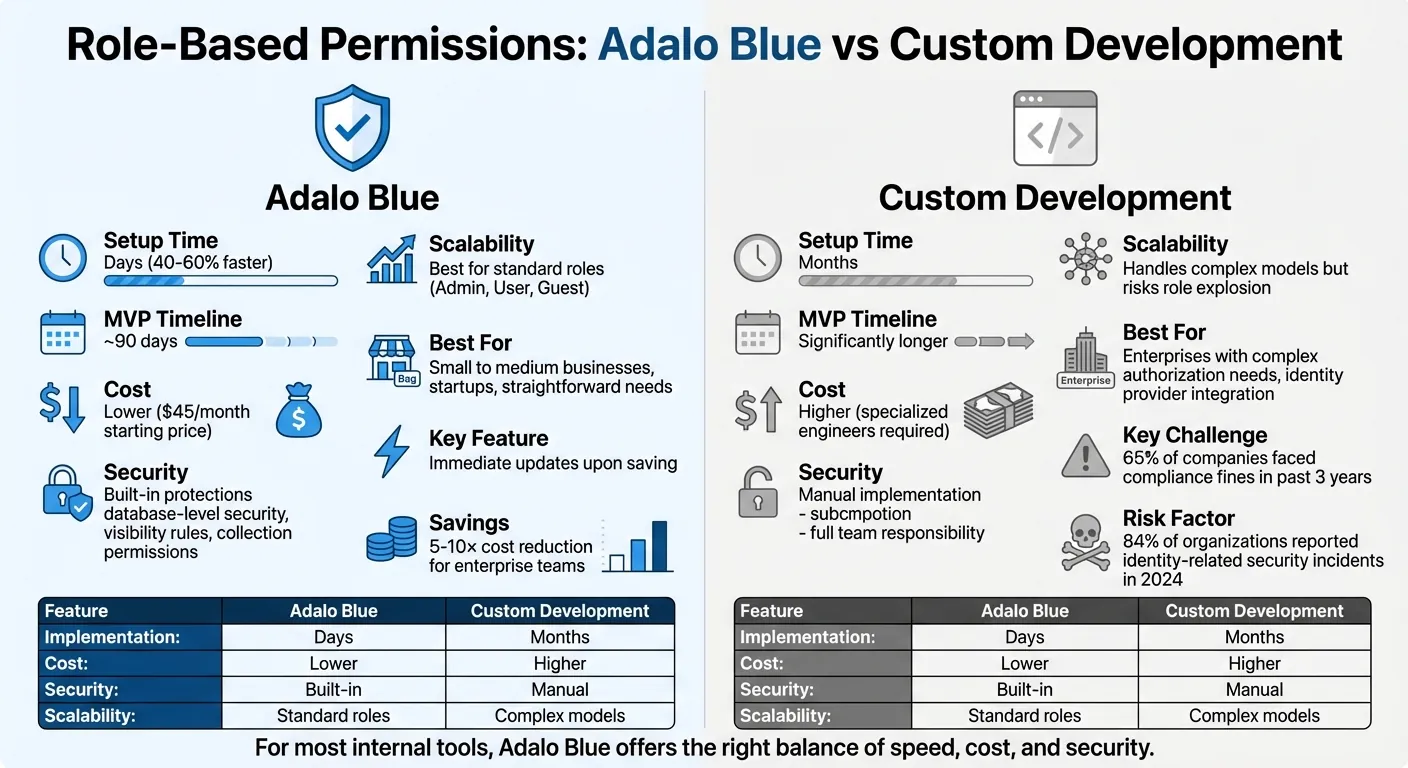
Adalo Blue vs Custom Development: RBAC Implementation Comparison
Role-Based Access Control (RBAC) Explained: How it works and when to use it
1. Adalo Blue
Adalo Blue takes a smart approach to managing role-based permissions. Unlike methods that simply hide information on the screen, its database-level security ensures unauthorized data never reaches the user's device—a significant step up in protecting sensitive information. Built on Adalo 3.0's overhauled infrastructure (launched late 2025), the platform now runs 3-4× faster than previous versions while supporting unlimited database records on paid plans.
Implementation Time
Setting up role-based access control with Adalo Blue is refreshingly quick. In just eight steps, teams can configure permissions in a matter of days, not months. The process begins with adding a "Role" property to the Users collection and assigning roles—either manually or via automated signup forms. From there, you can restrict page access, set visibility rules for UI elements, and create workflows that guide users to dashboards tailored to their roles.
Ada, Adalo's AI builder, lets you describe what you want and generates your app. Magic Start creates complete app foundations from a description, while Magic Add adds features through natural language.
Best of all, changes take effect immediately upon saving, so there's no need to republish the app. This streamlined approach accelerates deployment by 40-60% compared to traditional methods, all while integrating seamlessly with robust security features. Magic Start can even generate complete app foundations from a simple description, creating your database structure, screens, and user flows automatically—what used to take days of planning happens in minutes.
Security Features
Adalo Blue backs its quick setup with a strong security framework. It employs two main layers of protection: visibility rules for the user interface and collection permissions for database access. Administrators can control access at a granular level, setting field-specific permissions for sensitive details like email addresses and full names. For other collections, permissions can be managed through CRUD operations (Create, View, Update, Delete) at the collection level.
Additionally, relationship-based access allows data to be limited to users directly connected to specific records, even up to two degrees of separation. This architecture ensures that even if someone attempts to manipulate frontend code, they cannot access data they're not authorized to see.
"Updating collection permissions is different from just hiding this information from users by using visibility rules. Instead of just hiding the information, the data is not even served to the user's device from the database." - Adalo Help Documentation
Cost Efficiency
Adalo Blue doesn't just save time—it also saves money. Collection permissions are available to all users, regardless of their subscription plan, meaning there's no extra cost to access these security features. Paid plans start at $36/month with unlimited usage and no record caps on the database, eliminating the bill shock that comes with usage-based pricing models.
For enterprise teams, the platform can deliver 5-10× savings by cutting out the need for specialized security engineers and lengthy development timelines. With instant updates, built-in single sign-on (SSO) support, and the ability to integrate with legacy systems via DreamFactory, Adalo Blue offers a practical, cost-effective solution for organizations needing production-ready internal tools without the burden of custom development overhead.
Compare this to alternatives like Bubble, which starts at $59/month but includes usage-based Workload Unit charges and record limits that can create unpredictable costs as your app scales. Adalo's straightforward pricing removes this uncertainty entirely.
2. Custom Development for Internal Tools
Custom development for internal tools might sound appealing for its flexibility, but it often introduces delays and added complexity. While building role-based permissions from scratch allows for tailored solutions, this approach comes with a hefty price tag. It demands dedicated engineering resources, rigorous testing, and ongoing maintenance, all of which extend development timelines considerably.
Implementation Time
Creating a custom permission system isn't a quick process—it can take months. A developer needs to write the authorization logic, test it in various scenarios, and integrate it with the existing infrastructure. If your system needs to sync with an Identity Provider like Okta or Azure AD, you're looking at an additional month of dedicated work just to implement SCIM support for different use cases.
This timeline assumes everything goes smoothly. In practice, security implementations often require multiple iterations as edge cases emerge during testing, pushing timelines even further.
Scalability
Custom-built role-based access control systems often struggle to scale efficiently. As your team grows, you may encounter "role explosion"—where unique requirements lead to the creation of dozens or even hundreds of roles. This can overwhelm your database with millions of rows, slowing down authorization processes significantly.
Another issue is "check sprawl", where permission logic becomes scattered across various endpoints and services. This fragmentation makes auditing and updates nearly impossible. Many custom systems initially store roles in JWTs, but as permission structures grow more complex, the size of these tokens can negatively impact system performance.
By contrast, Adalo's modular infrastructure scales to serve apps with millions of monthly active users, with no upper ceiling. The platform's purpose-built architecture maintains performance at scale without the role explosion problems that plague custom implementations.
Security Features
When it comes to security, custom development places the entire responsibility on your engineering team. Backend enforcement must be built from scratch, as frontend measures alone cannot provide adequate protection. Broken access control is the top-ranked application security failure on the OWASP Top 10 list, and custom logic is particularly prone to inconsistencies and vulnerabilities.
Beyond that, your team will need to manually implement critical security features like audit trails, environment isolation, and query spoofing prevention. These tasks require specialized expertise to execute effectively, and any gaps in implementation can leave your organization exposed to breaches.
Cost Efficiency
Custom development isn't just time-consuming—it's expensive. Extended timelines, coupled with the need for specialized security engineers, can drive costs through the roof. A significant number of organizations—over 40%—still rely on fully manual access reviews, and 65% of companies have faced compliance fines within the past three years due to weak access review processes.
Additionally, the risk of security breaches is high; 84% of organizations have reported identity-related security incidents that had tangible business impacts. When you factor in these risks and inefficiencies, the total cost of ownership for custom development becomes substantial—often 5-10× what you'd spend on a platform solution like Adalo Blue.
Advantages and Disadvantages
When comparing Adalo Blue to custom development, each approach has distinct strengths and weaknesses across speed, scalability, security, and cost.
Speed and Implementation: Adalo Blue allows teams to create an MVP in about 90 days, with RBAC setup taking just days. Custom development often takes much longer due to the need for extensive coding, testing, and infrastructure setup. Magic Add lets teams add features by simply describing what they want, further accelerating development.
Scalability Considerations: Adalo Blue's visual configuration works well for straightforward setups, making it ideal for startups or smaller teams. With the Adalo 3.0 infrastructure overhaul, the platform now supports apps with over a million monthly active users—with proper data relationship setups, there's no upper limit. Custom development can handle complex models but risks "role explosion" where many specific roles are needed to address edge cases.
Security Approaches: Adalo Blue relies on platform-defined security features like built-in visibility rules and collection permissions, which help minimize manual coding errors. Custom development offers more granular control over resources but places the burden of security entirely on the engineering team, increasing the risk of breaches if not handled carefully.
| Feature | Adalo Blue | Custom Development |
|---|---|---|
| Implementation Time | 40–60% faster; MVP in ~90 days | Slower; requires manual coding and infrastructure setup |
| Scalability | 1M+ MAU capable; unlimited records | Supports advanced models but risks role explosion |
| Security Features | Built-in visibility rules and collection permissions | Granular control but depends on manual implementation |
| Cost Efficiency | $36/month; no usage charges | 5-10× higher; specialized expertise required |
| Database Limits | Unlimited on paid plans | Depends on chosen infrastructure |
Adalo Blue clearly offers cost advantages, especially for teams looking for faster deployment with lower upfront expenses. The platform's unlimited usage model eliminates the unpredictable costs that come with usage-based pricing. It's worth noting that 65% of companies have faced compliance fines in the last three years due to weak access review processes, highlighting how financial risks extend beyond just development costs.
Conclusion
Deciding between Adalo Blue and custom development comes down to your specific needs—how quickly you need the solution, your budget, and how intricate your permission requirements are. Adalo Blue is an excellent choice for teams looking to get up and running quickly. It's ideal for creating internal tools with straightforward role structures like Admin, User, and Guest. With its rapid deployment capabilities and unlimited database records, it's particularly appealing to small and medium businesses or startups that need both native mobile and web access from a single codebase.
Custom development remains the go-to option for projects requiring advanced authorization setups. Think complex role hierarchies, organization-specific roles, or fine-tuned permissions integrated with identity providers like Okta or Azure AD. These scenarios demand significant engineering effort, making custom development a better fit for enterprises with specialized security needs. However, for most internal tools, this level of complexity is often unnecessary and can lead to excessive costs.
Adalo Blue starts at $36/month with no usage-based charges, offering a cost-effective solution with built-in security that simplifies deployment while minimizing risks. One build publishes to web, iOS App Store, and Android Play Store—handling the hardest part of launching an app automatically. For the majority of internal tools, this strikes the right balance between speed, security, and cost efficiency.
Related Blog Posts
- How To Enable Employees To Build The Apps They Need
- Integrating SQL Databases with No-Code Tools
- GDPR and Data Sync in No-Code Apps
- Role-Based Access Control in No-Code Apps
FAQ
Why choose Adalo over other app building solutions?
Adalo is an AI-powered app builder that creates true native iOS and Android apps alongside web apps from a single codebase. Unlike web wrappers, it compiles to native code and publishes directly to both the Apple App Store and Google Play Store—handling the hardest part of launching an app automatically.
What's the fastest way to build and publish an app to the App Store?
Adalo's drag-and-drop interface combined with AI-assisted building through Magic Start lets you generate complete app foundations from a simple description. The platform handles the App Store submission process, getting your app in front of users in days rather than months.
Can I easily implement role-based access control in my app?
Yes, Adalo Blue offers database-level security with built-in visibility rules and collection permissions, allowing you to set up user roles and permissions in days rather than months without any coding expertise. Changes take effect immediately upon saving.
What's the difference between Adalo Blue and custom development for RBAC?
Adalo Blue offers faster setup times (days vs. months), lower costs starting at $36/month, and built-in security features. Custom development provides more flexibility for complex enterprise requirements but requires significant engineering expertise and is often 5-10× more expensive.
How does Adalo Blue's security compare to custom-built solutions?
Adalo Blue provides database-level security where unauthorized data never reaches the user's device, unlike methods that simply hide information on screen. It includes built-in visibility rules, collection permissions, and field-specific access controls, reducing the risk of security breaches that often occur with manually implemented custom solutions.
Which is more affordable, Adalo or Bubble?
Adalo starts at $36/month with unlimited usage and no record caps. Bubble starts at $59/month but includes usage-based Workload Unit charges and record limits that can create unpredictable costs as your app scales. Adalo's straightforward pricing eliminates bill shock.
How quickly can I set up role-based permissions with Adalo Blue?
Setting up RBAC with Adalo Blue takes just days, not months. The eight-step process includes adding role properties, assigning roles via forms, restricting page access, and setting visibility rules—with changes taking effect immediately upon saving without needing to republish your app.
What types of organizations benefit most from Adalo Blue for access control?
Adalo Blue is ideal for small to medium businesses, startups, and teams needing internal tools with straightforward role structures like Admin, User, and Guest. Organizations that need rapid deployment, cost efficiency, and don't require complex enterprise-grade integrations will find Adalo Blue delivers the best value.
Does Adalo have database record limits?
No. Paid plans have unlimited database records with no caps. With proper data relationship setups, Adalo apps can scale beyond 1 million monthly active users. The Adalo 3.0 infrastructure overhaul (launched late 2025) made the platform 3-4× faster while removing previous constraints.
Can I publish to both the App Store and Google Play from Adalo?
Yes. One build in Adalo publishes to web, iOS App Store, and Android Play Store simultaneously. This single-codebase approach means updates to your app automatically apply across all platforms, unlike wrapper solutions that require separate management.