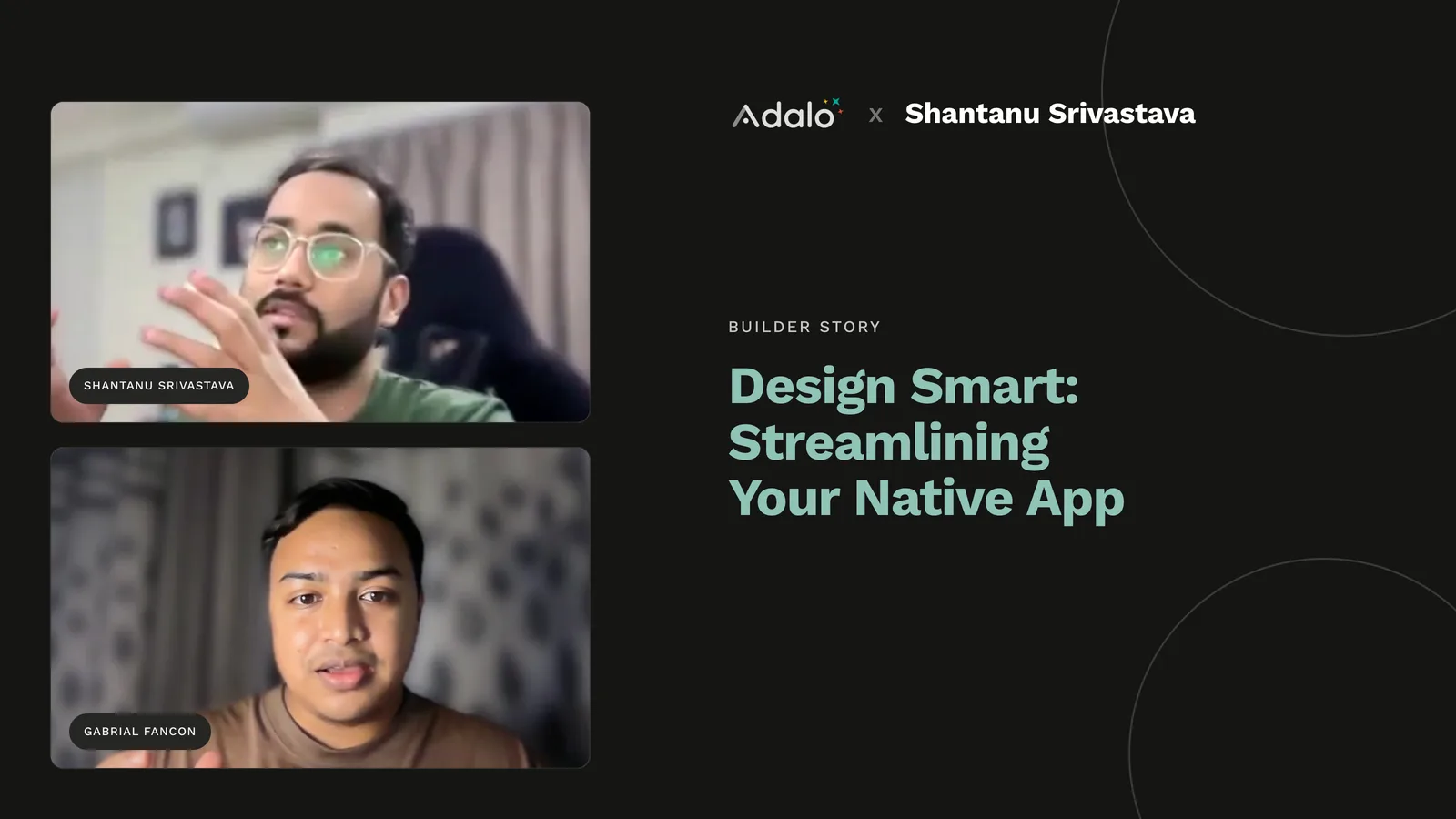
There is a certain kind of Adalo app that makes other builders stop and look closer. Shantanu Srivastava has built more than 200 of them, for clients across Europe, the US, Japan, China, Russia, Italy, and France, and he is fairly relentless about the part most makers rush: how the thing actually looks and feels to use.
He started building websites on Wix in high school, found Adalo through Product Hunt, and has been shipping ever since. Today he runs his own agency, is active on the Adalo forum, and consults with makers who get stuck.
We talked with Shantanu about the design mistakes he sees again and again, how he scopes a project before touching the builder, the three-step path he gives every beginner, and why he thinks AI-built apps keep ending up back in a no-code app builder.
Meet Shantanu: From Wix in High School to 200+ Projects
Shantanu got into building young, making websites on Wix while still in high school. When he came across Adalo on Product Hunt, he started learning it immediately. His first app was a question and answer concept in the spirit of Quora, where users could post questions and upload and download material. His second was a social media review app aimed at ecommerce.
Once he understood how the platform worked, he started building for clients, and he has since covered just about every industry you can name: ecommerce, manufacturing, social media, local community apps, internal dashboards. Alongside client work, he gives consultations to other Adalo makers who hit a wall.
He tried the alternatives too, and he is specific about why he stayed.
"I already tried Softr, FlutterFlow, Bubble, and Glide as well. With Glide there are some limitations, the learning curve is too much. And if you talk about FlutterFlow, you have to be a little bit a coder in order to work on it."
Shantanu Srivastava, founder of The Uncoders and Adalo Expert
His day-to-day is a two-window workflow. AI assistants open on one side, the Adalo editor on the other.
"I talk back and forth with multiple AI chats for research, for everything, for better UX. And on the other side I develop applications, basically changing the idea into reality for various makers."
Shantanu Srivastava, founder of The Uncoders and Adalo Expert
He also makes an observation worth sitting with, about where AI-generated apps tend to land.
"Users use the AI tools to develop the whole application, but at the end, if you talk about the scalability, they always come to the no-code tool. They say, I want to change this whole application which is developed by AI into no-code."
Shantanu Srivastava, founder of The Uncoders and Adalo Expert
How He Scopes a Project Before Building Anything
Shantanu does not open the builder first. He starts with whatever the client already has, and he is generous about what counts.
A rough sketch is fine. Some clients arrive with meticulous feature lists, others with three lines describing a vague idea. Either way he asks the same few questions up front: do you have detailed notes or a reference app you like? Then he schedules a call to understand the idea properly.
With that context, he uses AI tools to structure the full app scope, paying particular attention to the user experience, then tweaks it against his own reading of the client's notes. That scope goes back to the client for review before anything gets built.
"Once I have the full app scope ready, I send it to them for confirmation. Please take a look and review. If anything is missing, just let me know."
Shantanu Srivastava, founder of The Uncoders and Adalo Expert
Only after that sign-off does he estimate how long the build will take and which components or services it will need. The upfront work is what keeps the estimate honest.
The Design Mistakes Most Adalo Builders Make
Ask Shantanu why some Adalo apps look unpolished and he goes straight to structure. New makers, often with no tech or no-code background, tend to solve problems with more screens than the problem needs.
"They create multiple screens that can be done in only two to three screens. They create 10 screens for that."
Shantanu Srivastava, founder of The Uncoders and Adalo Expert
That is not just an aesthetic issue. Fewer, better-organized screens mean a faster app and a shorter path for the user. Consolidating ten screens into three removes navigation, reduces what has to load, and makes the whole thing feel deliberate.
The second problem is the small stuff nobody audits. A button that should be centered on the page sitting slightly off. Spacing that is almost consistent. Individually trivial, collectively the difference between an app that looks professional and one that does not.
"These tiny things, they don't basically give attention to that. When I see that, I think I should redesign the whole app and make it more optimized, so it will run fast and look professional."
Shantanu Srivastava, founder of The Uncoders and Adalo Expert
The third is scope. Plenty of clients arrive wanting every feature in version one, and his advice is consistent.
"I always suggest them, start with limited features, then improve in the future versions."
Shantanu Srivastava, founder of The Uncoders and Adalo Expert
The Two Kinds of Clients
After 200-plus projects, Shantanu sorts clients into two groups, and the difference is not how much they know.
The first group knows their idea precisely and gives him room to work. When he suggests a cleaner flow or better logic, they consider it, let him build it, and judge the result.
The second group also knows their idea, but as it becomes real they keep adding features, and they tend to reject structural suggestions because they want exactly what they pictured. He is notably sympathetic about this rather than dismissive.
"This is something, it's a kind of a baby for them. So for that reason I also consider them."
Shantanu Srivastava, founder of The Uncoders and Adalo Expert
His counterweight is data. Having watched user behavior across many apps, he knows which flows tend to work, and he pushes clients toward the one source of truth that settles the argument after launch.
"Whenever you are going to launch, please consider the reviews as well, because reviews are so important for any kind of application."
Shantanu Srivastava, founder of The Uncoders and Adalo Expert
The apps he is proudest of bear that out. One client app he has maintained for two to three years now serves roughly 14,000 to 15,000 users and runs without trouble. Another is a community app built for a US city. Several are under NDA, so he keeps those details to himself. And he is currently testing an idea of his own in local cafes, a rewards concept he believes does not exist anywhere yet.
"Whenever I develop applications, when the whole UI is good, UX is good, working greatly, at that moment I get proud. And even the end users are also using it very smoothly."
Shantanu Srivastava, founder of The Uncoders and Adalo Expert
His Three-Step Path for Beginners
This is the most directly useful thing Shantanu shared, and it is a genuinely good curriculum for anyone opening Adalo for the first time. Do not start with your real idea. Build three apps.
App one: start from a template. Pick any Adalo template and use it purely to learn where everything lives in the editor. No pressure, no original thinking required.
App two: clone something. Create a new app and try to replicate an existing template or an app you admire. Do not rebuild the whole thing, just one to three features. This is where you learn to translate an outcome you can see into the steps that produce it.
App three: build your actual idea. By now the editor is familiar and you have solved real problems, so your own project gets your judgment instead of your confusion.
For the design itself, he suggests using AI tools, which work fine on free tiers, and browsing Dribbble for inspiration before you start placing elements.
On typography, his picks are Poppins, Work Sans, and Inter. And the feature he most wants is one many designers will recognize: importing Figma designs directly into Adalo, something he suspects Ada may eventually handle from a reference image.
On Ada and SheetBridge
Shantanu tested Ada, Adalo's AI builder, by handing it a full prompt for an app and seeing how far it got. His read is measured and matches what we hear from other experts: useful, improving quickly, not a replacement for a designer's hand.
"I think 10 to 30 percent of the screens were already covered by Ada itself. But to make it functional, to make it more good, I have to do it manually. Ada is working great as of now and I think it's getting more and more updates in future."
Shantanu Srivastava, founder of The Uncoders and Adalo Expert
He is also interested in Ada's new image generation, since he previously sourced illustrations from free communities for things like empty-state placeholders.
SheetBridge, which connects Google Sheets directly to an app, solved a very specific problem for him. A friend's company kept its data in a spreadsheet and wanted the team to be able to see it without being able to change it. He built them a dashboard app on top of the existing sheet, and the whole thing took two to three days.
"They are loving it right now, because every single thing they have to update in Google Sheet and that's it."
Shantanu Srivastava, founder of The Uncoders and Adalo Expert
On publishing to the app stores, his experience is that it is genuinely straightforward once you know the steps, as long as you follow Apple's and Google's policies. His wish list item is a single button in the editor to push the newest version straight to the stores.
Why The Uncoders Exists
The origin story of his agency, The Uncoders, is refreshingly unglamorous. In his country, once individual earnings pass a certain threshold, you cannot keep working as a freelancer and have to form a company for tax purposes. Adalo work is what got him there.
"Thanks to Adalo, it basically helped me to reach that milestone and form the agency."
Shantanu Srivastava, founder of The Uncoders and Adalo Expert
He runs it solo, bringing in specialist developers and UI/UX designers when a project calls for skills outside his own. It is a lean operation producing an unreasonable amount of work.
Advice for Builders
The thread running through everything Shantanu says is that design is not decoration. It is structure, and structure is what makes an app fast, understandable, and worth using.
So do not start with your masterpiece. Learn the editor on a template, clone a feature or two to understand how outcomes are built, then give your real idea the benefit of that experience. Ship a small version, watch what users actually do, and read your reviews. Consolidate screens rather than adding them. And center the button.
If you want to build that way, you can start on Adalo for free, browse apps other makers have shipped, or hire an Adalo Expert to design and build alongside you.
FAQ
Who is Shantanu Srivastava?
Shantanu Srivastava is an Adalo Expert and the founder of The Uncoders, a no-code app development agency. He began building websites on Wix in high school, discovered Adalo through Product Hunt, and has since delivered more than 200 projects for clients across Europe, the US, Japan, China, Russia, Italy, and France. He is active on the Adalo forum and consults with makers who get stuck.
How do I make my Adalo app look professional?
Focus on structure before decoration. Consolidate screens rather than adding them, since flows that take ten screens can often be done in two or three, which also makes the app faster. Then audit the small details that most builders skip, such as centering buttons properly and keeping spacing consistent. Launch with a limited feature set and expand in later versions, and take design inspiration from sites like Dribbble before placing elements.
What is the biggest design mistake in Adalo apps?
Using far more screens than a flow requires. New builders often create ten screens for something that could work in two or three, which slows the app down and lengthens the path for users. The second most common mistake is ignoring small alignment and placement details, like a button that should be centered but is not, which together make an app feel unpolished.
How should a beginner start learning Adalo?
Build three apps rather than starting with your real idea. First, open an Adalo template and use it to learn your way around the editor. Second, create a new app and try to replicate one to three features from an existing template or an app you admire. Third, build your actual project, now that the editor is familiar and you have solved real problems along the way.
Can I connect Google Sheets to an Adalo app?
Yes. SheetBridge connects Google Sheets directly to an Adalo app with real-time sync, with no API work required. Shantanu used it to build an internal dashboard for a company that kept its data in a spreadsheet and wanted team members to view the data without being able to edit it. The build took two to three days.
What is Adalo?
Adalo is a no-code app builder with a visual, multi-screen canvas and an AI builder called Ada. You can design, build, and publish database-driven web apps and native iOS and Android apps from a single project, then ship to the Apple App Store and Google Play. Plans start free with 500 records per app, and paid plans start at $36 per month.

Build your app fast with one of our pre-made app templates
Begin Building with no codeRelated Content
How ApeForge Builds Client Apps in Days With Adalo
Matt Sanchez's boutique agency ApeForge ships native client apps in days on Adalo, running 600+ projects a year with a three-person team. Here's how they do it.
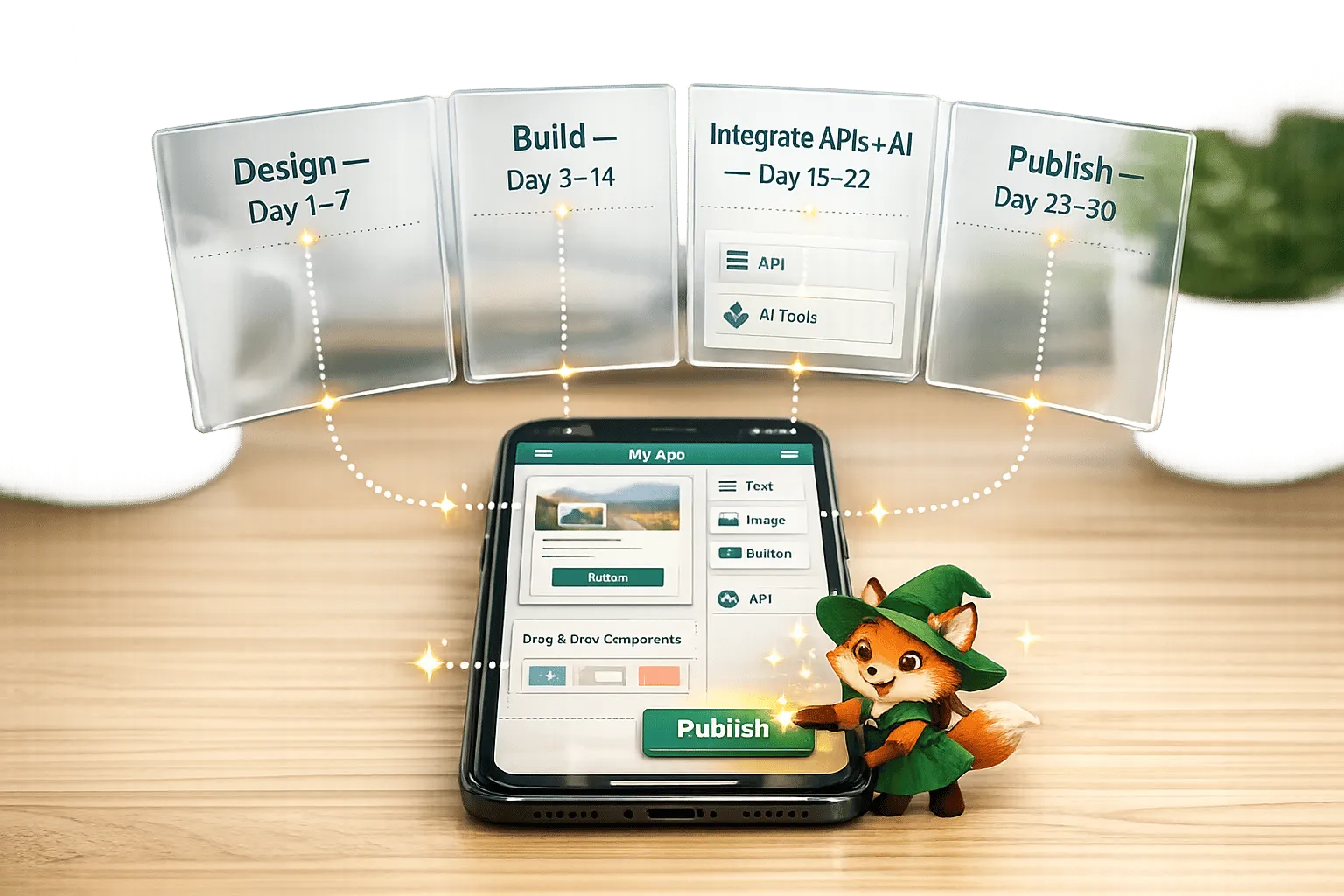
No-Code App Development for Beginners: Your First App in 30 Days
Step-by-step 30-day plan to design, build, and publish a native iOS/Android app with no-code tools, using drag-and-drop editors, AI, and ext
How Adalo Integrates with Google AI and NotebookLM
Use no-code app builders to add AI-powered vision, NLP, chat, and location features while planning builds with AI-assisted notebooks.
Building Your Mobile App: Adalo's Complete Development and Deployment Guide
Step-by-step guide to design, build, test, and publish cross-platform mobile apps and PWAs with AI tools, databases, testing, and app store